
Hard money loans are short-term, asset-based loans secured by real estate and funded by private lenders, prioritizing property value over credit history. Traditional financing relies on bank underwriting, credit scores, and income verification, producing lower rates but slower closings. First-time buyers, investors, and fund managers weigh speed against cost, since hard money carries higher interest and shorter repayment terms.
What Sets Hard Money Loans Apart From Traditional Financing?
Hard Money Loans vs Traditional Financing comes down to one core distinction: who evaluates the deal, and what they evaluate. Hard money loans are short-term, asset-based loans secured by real estate, typically funded by private or nonbank lenders rather than banks. Traditional mortgages, by contrast, rest on personal income, credit history, and debt ratios reviewed by an institutional underwriter.
The gap widens once timing enters the picture. A conventional mortgage often takes weeks to underwrite. Lenders verify pay stubs, tax returns, and employment history line by line. Hard money financing skips much of that review, focusing instead on the value of the property itself, which produces faster funding for time-sensitive purchases or renovation projects.
How Do Hard Money and Conventional Loans Actually Differ Day to Day?
The differences between hard money and conventional loans show up most clearly in speed, collateral, and scrutiny:
First-time home buyers, seasoned investors, and fund managers each weigh this trade-off differently, and matching the loan structure to the strategy matters more than chasing speed alone.
Munshi Capital Inc., based in Walnut Creek, California, works with exactly this range of clients. First-time buyers, investors, and fund managers navigating that decision. Hard money financing explained in plain terms means fast capital tied to collateral, not credentials. Munshi Capital Inc. addresses complex financing needs with an emphasis on transparency. Efficiency, standing in direct contrast to the opaque terms and fee structures that often accompany private hard money arrangements.

How Does a Hard Money Loan Actually Work?
A hard money loan functions as a short-term, asset-based loan, structured primarily to purchase or renovate investment property. The property itself, not the borrower’s full financial history, secures the debt. That structural difference explains nearly every practical distinction in the broader comparison of Hard Money Loans vs Traditional Financing.
Underwriting speed sets this financing apart. Traditional mortgages take weeks to process because lenders verify income, credit history, and debt ratios in detail. Hard money financing skips much of that review, concentrating instead on the property’s value and its income potential. This is the core mechanic behind Hard Money Financing Explained in practical terms: collateral drives the decision, not a borrower’s pay stubs.
What Makes Hard Money Underwriting Different From a Conventional Loan?
Conventional underwriting weighs credit score, income documentation, and debt-to-income ratio over an extended review period. Hard money underwriting narrows that focus almost entirely to the asset securing the loan. Fund managers and seasoned investors often value this trade-off when a closing timeline matters more than securing the lowest possible rate.
The table below summarizes the Differences Between Hard Money and Conventional Loans at the underwriting stage:
Munshi Capital Inc. approaches this landscape differently than a generic lender. Rather than applying one-size-fits-all shortcuts, the firm draws on proprietary insights and strategy to match first-time buyers, investors, and fund managers with financing suited to their goals. From application through closing, clients receive guidance built on clarity and speed, without confusing jargon or hidden surprises at the closing table. Owners weighing a fast sale timeline against financing complexity can request a direct cash offer to compare paths side by side.

What Core Differences Separate Hard Money From Conventional Loans?
Asset value drives one loan type; personal financial history drives the other. Hard money financing explained in its simplest form means underwriting based on the property itself, not the borrower’s income or credit profile. Most hard money loans serve business purposes, financing investment properties such as rental homes or commercial buildings rather than primary residences. Conventional loans take a different path, weighing income verification, credit scores, and debt ratios above collateral value.
This distinction shapes who each product serves. Differences between hard money and conventional loans become clear once the borrower profile enters the picture. Investors chasing a fast commercial acquisition often need speed and collateral-based approval more than favorable long-term rates. First-time buyers and fund managers building a diversified portfolio, however, typically need structured programs suited to varied financial pictures.
Who benefits most from each loan structure?
Business owners and seasoned investors purchasing rental or commercial property often turn to asset-based financing when timing outweighs cost. First-time homebuyers, by contrast, generally fare better under conventional structures built around income and credit qualification. Munshi Capital Inc. addresses both realities directly, offering a comprehensive range of residential and commercial loan programs spanning first-time homebuyers to seasoned investors and business owners across the country.
Hard money loans vs traditional financing decisions often come down to timeline pressure versus long-term cost control:
- Asset-based underwriting favors speed over documentation depth.
- Business-purpose loans concentrate on investment and commercial property.
- Conventional programs suit buyers prioritizing structured, long-term terms.
For sellers facing repair costs or drawn-out timelines that hard money structures rarely accommodate, Munshi Capital Inc. provides fast and fair cash offers for commercial properties, helping owners maximize proceeds while sidestepping delays. Clients weighing a sale versus a loan-based path can request a direct cash offer to compare outcomes directly. The approach reflects a customer-centric standard, valuing a client’s time while delivering clear, practical financial solutions for real estate transactions of every kind.
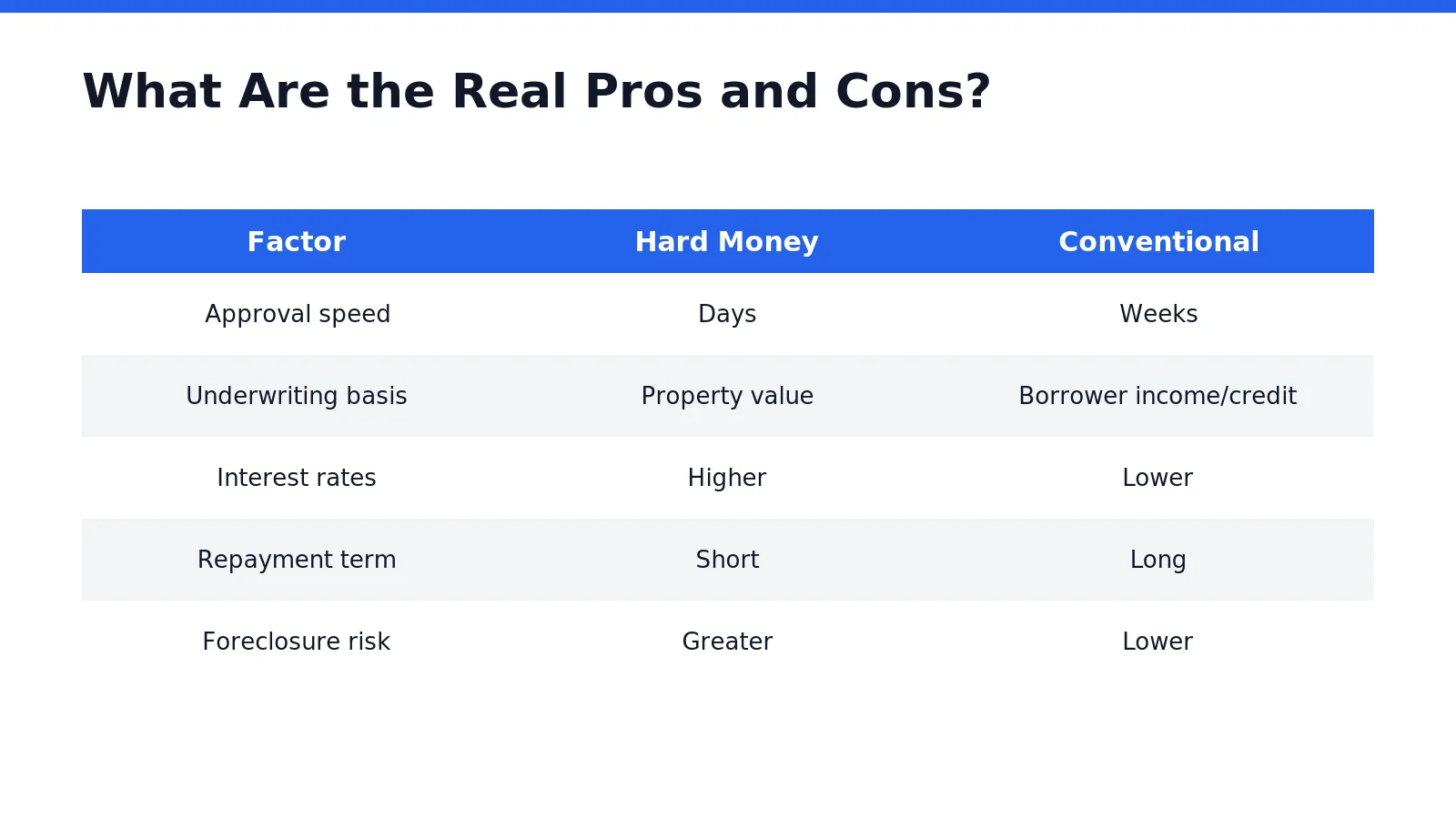
What Are the Real Pros and Cons?
Speed defines the advantage of asset-based lending. Approval moves faster than conventional underwriting, and qualification standards flex around the property rather than a borrower’s full financial history. That contrast sits at the heart of hard money loans vs traditional financing: one path rewards documentation and patience, the other rewards collateral value and timing.
Faster funding comes at a price, though. Higher interest rates, compressed repayment schedules, and elevated foreclosure exposure sit on the cost side of the ledger. Some lenders advertise financing up to 80% of a property’s value in under a week. A pace that amplifies risk as much as it accelerates closing.
Differences between hard money and conventional loans show up clearly when the two are placed side by side.
Is a hard money loan worth the higher cost?
For certain short-term real estate needs — a fix-and-flip purchase, a bridge before permanent financing, or a deal traditional lenders won’t touch — the added cost buys speed and flexibility that conventional underwriting can’t match. Careful weighing of costs against the timeline remains essential before signing.
Who benefits most from this financing structure?
Seasoned investors and fund managers working on tight acquisition windows tend to benefit most. Short holding periods absorb higher rates more easily than a primary residence purchase would.
Munshi Capital Inc. approaches this hard money financing explained landscape with transparency. Efficiency built into every conversation, helping clients avoid the cost surprises that often accompany asset-based terms. Property owners weighing a fast, certain exit can request a direct cash offer. Those still comparing paths forward can request your property assessment before committing to any structure.
When Does Traditional Financing Make More Sense?
Traditional financing fits best when timelines are flexible and borrower qualification carries more weight than property value alone. Conventional mortgages typically take weeks to underwrite, a tradeoff that makes sense for buyers who are not racing a closing deadline or competing against cash offers. Speed is not always the deciding factor, and for many buyers, lower long-term costs matter more than a fast close.
Hard money financing explained in simple terms means short-term, asset-based lending built for speed and property value rather than personal financial history. Traditional loans work in the opposite direction: they lean on income verification, credit history, and long repayment schedules to deliver lower rates over time. Munshi Capital Inc. serves first-time home buyers alongside seasoned investors and fund managers, populations for whom conventional terms often fit better than short-term, higher-cost alternatives.
Who Benefits Most From a Conventional Loan?
First-time home buyers purchasing a primary residence typically benefit most. They gain predictable payments, lower interest costs, and time to shop for the right property without pressure to close in days.
Seasoned investors building long-hold rental portfolios also lean toward conventional terms once a property is stabilized. Fund managers structuring long-term acquisitions often favor conventional debt for the same reason: cost efficiency over speed.
Differences between hard money and conventional loans ultimately come down to priorities:
Munshi Capital Inc. embodies a customer-centric approach, valuing every client’s time and offering clear, practical financial solutions across transaction types. For sellers of commercial property weighing options, Munshi Capital Inc. provides fast and fair cash offers, helping sellers maximize net proceeds while avoiding costly repairs and delays. Owners exploring that route can request a direct cash offer to compare outcomes before committing to a financing path.
Who Actually Relies on Hard Money Financing?
Investors chasing distressed properties at a discount make up the core audience for hard money loans. Fix-and-flip loans and rehab loans exist for one reason: speed. A buyer who spots underpriced real estate needs cash to close before the opportunity disappears. Conventional underwriting timelines rarely allow for that.
Hard Money Financing Explained in practical terms means matching the loan type to the borrower’s situation rather than forcing every client into one mortgage product. Munshi Capital Inc. specializes in mortgage financing solutions built for a wide range of clients, including first-time home buyers, seasoned investors, and fund managers. That range matters, because each group approaches financing with different priorities and different risk tolerances.
The borrower base generally breaks down into three categories:
- First-time home buyers seeking clarity on Differences Between Hard Money and Conventional Loans before choosing a path.
- Seasoned investors who need fast closings on distressed or undervalued properties.
- Fund managers deploying capital across multiple deals and requiring flexible structuring.
Do fund managers use hard money loans differently than individual investors?
Fund managers typically operate at a larger scale. Need financing strategies tied to portfolio-level goals rather than a single property. Munshi Capital Inc. applies proprietary insights and strategies to help fund managers. Investors capitalize on real estate opportunities systematically, not one transaction at a time.
Weighing Hard Money Loans vs Traditional Financing comes down to matching loan structure to strategy. Munshi Capital Inc. offers residential and commercial loan programs spanning first-time homebuyers to seasoned investors. Business owners nationwide, giving every borrower type a path suited to its own timeline and risk profile.
What Should You Ask Before Choosing a Lender?
Four questions determine whether a lender fits a borrower’s goals: program fit, process clarity, cost structure, and local market knowledge. First-time buyers, investors, and fund managers each carry different risk tolerances. The right lender should answer these questions plainly, without vague promises.
The starting point is program fit. A hard money financing explained conversation should begin with a loan specialist reviewing goals and matching them to the correct residential or commercial program. Borrowers gain more from this discussion than from any rate sheet. It clarifies which financing path actually serves the project.
Does the Lender Explain the Process Clearly?
Clarity matters as much as speed. A lender should guide borrowers through every stage, from application to closing, without confusing jargon or hidden surprises. Fund managers juggling multiple deals need this transparency to avoid closing delays that disrupt timelines.
What Are the Real Costs and Risks?
Cost comparison separates hard money loans vs traditional financing decisions from guesswork. Reviewing the differences between hard money and conventional loans means asking pointed questions:
- What is the interest rate, and how does it compare to conventional terms?
- How short is the repayment period, and what happens if it isn’t met?
- What foreclosure risk exists if the property doesn’t perform as expected?
These questions matter because faster approval and flexible qualification often come paired with higher interest rates, shorter repayment windows, and greater foreclosure exposure.
Local insight rounds out the evaluation. Programs, rates, and market conditions vary by city. Borrowers benefit from comparing options tailored to where they’re buying before signing anything. A lender who can speak to local conditions, not just national averages, offers a clearer picture of true cost and risk.
How Do You Decide Which Financing Fits You?
Financing choice depends on timeline, property type, and risk tolerance rather than a single “best” loan. A first-time home buyer purchasing a primary residence usually needs different terms than a fund manager acquiring a distressed multifamily asset. Matching the loan structure to the goal prevents costly mismatches later.
Hard Money Financing Explained in simple terms: it is a short-term, asset-based loan where approval hinges on property value, not personal credit history. This structure suits investors who need speed, but it carries higher costs and shorter repayment windows. Borrowers should weigh those costs and risks carefully before committing, since a fast closing does not offset an unsustainable repayment schedule.
The broader question of Hard Money Loans vs Traditional Financing comes down to priorities:
What Are the Main Differences Between Hard Money and Conventional Loans?
The core distinction lies in underwriting: conventional lenders scrutinize income, credit, and debt ratios. Hard money lenders center decisions on the property itself. Repayment periods differ sharply too, with conventional loans stretching across decades and hard money loans typically resolving within months to a couple of years.
Munshi Capital Inc., based in Walnut Creek, California, applies proprietary insights and strategies to guide first-time home buyers, seasoned investors, and fund managers toward the structure that actually fits their situation. The firm’s customer-centric approach values each client’s time and delivers clear, practical financial solutions for real estate transactions. Property owners weighing a sale alongside financing options can request a direct cash offer. Those needing clarity on current market value should request your property assessment before deciding on next steps.
Conclusion
In closing, the distinction between hard money loans and traditional financing fundamentally shapes your real estate strategy and timeline. Hard money loans deliver speed and flexibility for time-sensitive acquisitions and distressed properties. Traditional financing offers stability and lower costs for qualified borrowers with established credit profiles. Your optimal choice depends on your specific transaction parameters, investment objectives, and financial position. Munshi Capital Inc. provides comprehensive guidance to evaluate both pathways, ensuring you make informed decisions that align with your real estate goals and capitalize on available opportunities.
Leave a Reply