
Bank statement loans verify income through 12-24 months of personal or business bank statements instead of tax returns, making them ideal for self-employed borrowers whose returns don’t reflect true earnings. Munshi Capital Inc. guides clients through this straightforward application, underwriting, and closing process with full transparency and no hidden surprises.
Bank statement mortgages give self-employed professionals, freelancers, and business owners a path to home financing without tax returns as proof of income. Munshi Capital Inc. uses 12-24 months of personal or business bank statements to document earnings, serving California clients in Walnut Creek, Oakland, San Francisco, and Concord who need non-QM loan solutions.
Key Takeaways
- Bank statement loans use 12-24 months of bank statements to verify self-employed income instead of tax returns.
- Self-employed borrowers qualify for mortgages without requiring traditional documentation like W-2s or paystubs.
- Munshi Capital Inc. offers bank statement loans as part of our comprehensive financing solutions for non-traditional income earners.
- Our transparent underwriting process helps self-employed borrowers secure financing confidently with clear, honest communication throughout.
What Is a Bank Statement Mortgage, Exactly?
A bank statement mortgage verifies income through deposits recorded in personal or business accounts, not through W-2s or federal tax returns. Lenders review months of statements to calculate average earnings, giving self-employed professionals a realistic picture of what they actually bring home. This approach forms the foundation of this bank-statement-loan-guide-008 for borrowers whose income doesn’t fit a standard pay stub.
Munshi Capital Inc. positions this option within a broader set of residential loan programs, standing alongside FHA, VA, and USDA offerings. Business owners, freelancers, and gig workers gain access to a path toward homeownership that doesn’t hinge on net income shown after deductions. The lending process stays guided by a mission of transparency. Clients receive clear communication at every stage rather than vague promises.
Three features distinguish a self-employed-mortgage-options-008 approach built around bank statements:
- Deposits, not adjusted gross income, drive the qualification math
- Freelancers and contractors avoid penalties for legitimate business write-offs
- Financing stays built around the borrower, with clear answers delivered at each step
How does a bank statement mortgage differ from a conventional loan?
Conventional loans lean on tax returns. W-2 forms to confirm income, often shrinking a self-employed applicant’s qualifying number after deductions. A bank-statement-mortgage-008 instead counts actual cash flow moving through accounts. That distinction matters for business owners whose tax strategy minimizes taxable income while their real earnings stay strong.
Munshi Capital Inc. structures its bank statement program as one piece of a dependable, borrower-focused financing model. Clients working through self-employment income, seasonal revenue, or multiple income streams find structured guidance rather than guesswork, with every step explained plainly before moving forward.
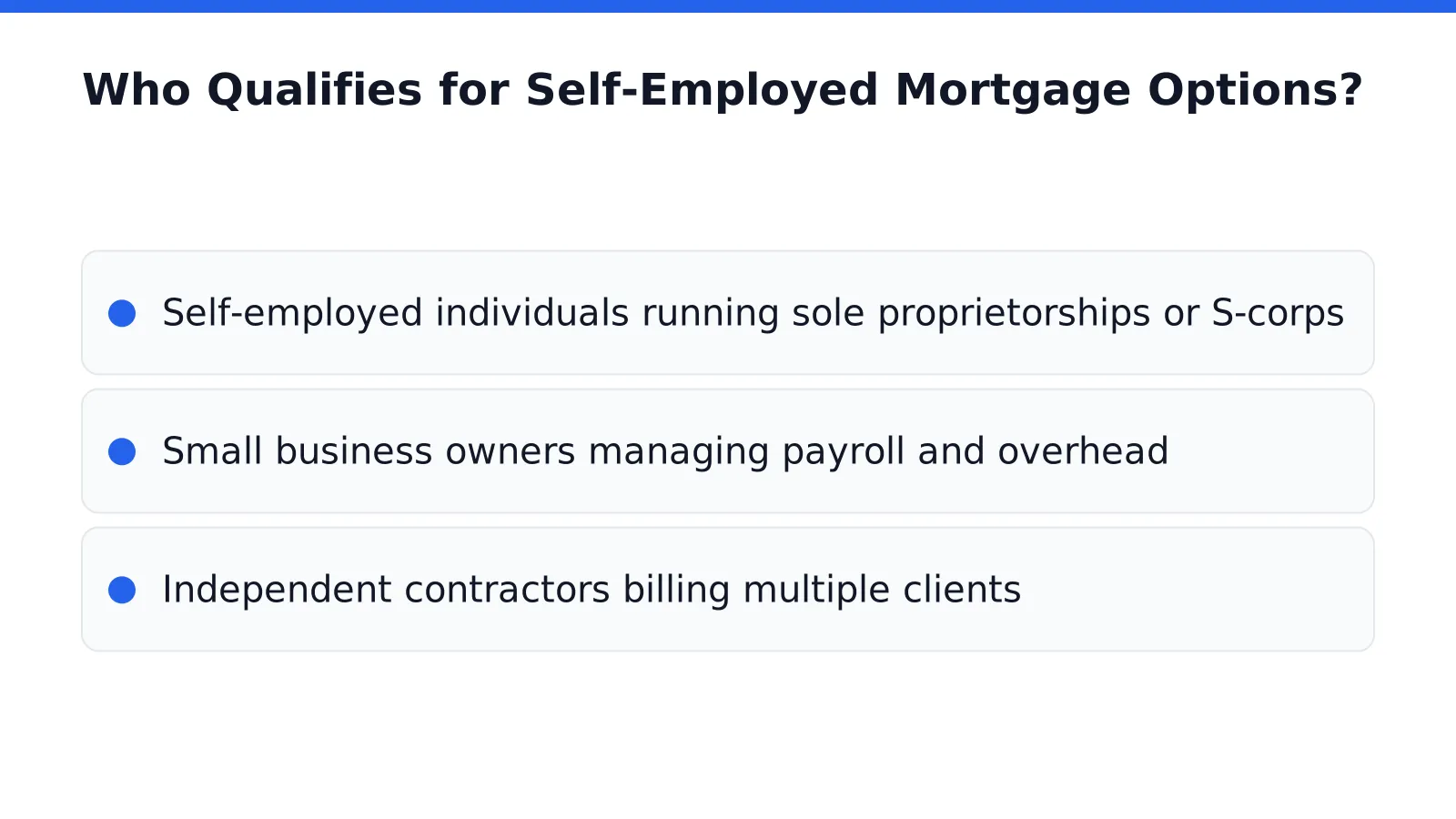
Who Qualifies for Self-Employed Mortgage Options?
Qualification for a self-employed mortgage option rests on income consistency, which may vary by job title. Freelancers, gig workers, and small business owners across Walnut Creek and the broader California market often meet the bar even when tax returns understate true earnings. Munshi Capital Inc. designs financing for a wide span of borrowers, extending from first-time homebuyers to seasoned investors, which means self-employed applicants sit squarely within the lending scope rather than on its margins.
Eligibility traces back to who actually uses this financing path. Bank statement loans are commonly used by:
- Self-employed individuals running sole proprietorships or S-corps
- Small business owners managing payroll and overhead
- Independent contractors billing multiple clients
Partial business ownership does not disqualify an applicant. Borrowers do not have to own 100 percent of the business to pursue a bank statement mortgage, a detail that broadens access for co-owners and partners who split revenue but still rely on business deposits as personal income.
Does Credit Score Affect Eligibility?
Credit history plays a role, but it works alongside income documentation rather than replacing it. Munshi Capital Inc.’s personalized guidance helps borrowers nationwide secure financing with confidence, matching each applicant’s full financial picture, deposits, credit, and business structure, to the right program.
Can New Business Owners Qualify?
Newer ventures face closer scrutiny of deposit consistency, since lenders look for a steady income pattern over time. A well-organized bank statement loan guide approach, paired with direct lender conversation, clarifies what documentation strengthens an application before submission. Reviewing bank activity early prevents last-minute surprises during underwriting.

How Many Bank Statements Do Lenders Need?
Most lenders request 12 to 24 months of personal or business bank statements before calculating qualifying income. That range gives underwriters enough deposit history to establish a reliable average monthly figure, which becomes the backbone of a self-employed mortgage options review. Fewer months rarely paint an accurate picture of earning power, and lenders know it.
Non-QM programs, the category under which a bank-statement-mortgage-008 typically falls, generally hold to this same 12-to-24-month standard. Borrowers submit either personal statements, business statements, or a combination of both. The exact requirement depends on how income flows through the business and how the lender structures its guidelines.
Why Do Lenders Average Deposits Instead of Net Income?
Average deposits reflect actual cash flow rather than the reduced figures that often appear after tax deductions. Underwriters total the deposits across the statement period and divide by the number of months reviewed. This method captures real earning capacity for business owners whose write-offs shrink taxable income on paper.
Does Submitting More Statements Improve Approval Odds?
Not necessarily. A longer statement history mainly smooths out seasonal swings and one-time deposits that could otherwise skew the average. Consistency across the full period matters more than the raw length of the review window.
A bank-statement-loan-guide-008 approach works best when applicants organize records before applying. Consider these steps:
- Gather 12 to 24 months of statements from the relevant personal or business accounts.
- Separate personal and business deposits if both accounts factor into the application.
- Flag large, irregular deposits that may require a written explanation.
Munshi Capital guides borrowers through this documentation step as part of a transparent application, underwriting, and closing process built on clarity rather than confusion. Modern technology paired with hands-on loan specialists keeps statement review moving without unnecessary delay. Borrowers ready to explore options can request a direct cash offer or request your property assessment to see how their deposit history translates into qualifying income.

What Underwriting Factors Affect Your Approval?
Approval hinges on how a lender weighs risk outside the standard tax-return model. Self-employed mortgage options exist precisely because non-QM products serve borrowers who fall short of conventional agency guidelines yet remain strong candidates on paper. Underwriters examine deposit consistency, credit history, prior financial setbacks, and the broader loan structure before issuing a decision.
Credit history carries significant weight, but it is not evaluated in isolation. Business owners with past financial hardship face additional scrutiny. Programs tied to the bank statement mortgage category often require a two-year seasoning period following a foreclosure, short sale, bankruptcy, or deed-in-lieu. That waiting period allows income stability to re-establish itself before a lender extends new credit.
How does a bank statement loan guide borrowers through credit setbacks?
A structured bank statement loan guide walks applicants through documentation timelines, seasoning requirements, and deposit review standards before they apply. Understanding these factors early prevents wasted applications and surprise denials. Freelancers and gig workers rebuilding credit benefit most from this upfront clarity.
What other loan products support self-employed investors?
Business owners expanding into property investment are not limited to one program. Munshi Capital also offers DSCR and hard money loans, giving investor-focused borrowers financing options beyond primary residence purchases. These products complement bank statement financing for clients scaling a portfolio.
Underwriting, ultimately, rewards consistency and transparency. Munshi Capital’s commitment to integrity and a wide range of loan products makes it a trusted resource for self-employed professionals and investors navigating non-traditional income documentation. Clients considering a sale alongside financing decisions can request a direct cash offer. Property owners weighing their options can request your property assessment to clarify next steps.
How Does Munshi Capital Simplify the Process?
Munshi Capital Inc. delivers quick pre-approvals paired with full visibility into loan status, from the first application to the closing table. Self-employed borrowers see exactly where their file stands at every stage, with no guesswork and no unexplained delays.
That transparency comes from a deliberate structure built on trust. Munshi Capital Inc.’s approach is rooted in clarity, honesty, and a service-driven ethos that guides borrowers through non-QM financing, including a bank statement mortgage built for income that tax returns alone don’t capture. Freelancers, gig workers, and small business owners benefit most, since conventional underwriting often undervalues their true cash flow.
What makes this process different from a typical mortgage application?
Borrower-first guidance replaces one-size-fits-all underwriting. Loan specialists walk applicants through documentation, timelines, and decision points so nothing feels hidden or rushed. For anyone comparing a bank statement loan guide against standard mortgage paperwork, the difference shows up in fewer surprises and clearer communication at each milestone.
Does location affect the loan process?
Local market knowledge shapes much of the guidance offered. Munshi Capital Inc. provides dedicated mortgage pages for individual California cities, including markets near Walnut Creek. Borrowers can review local programs, rates, and insights specific to where they plan to buy.
For readers weighing self-employed mortgage options, the combination matters: speed, honesty, and local context working together.
- Fast pre-approval timelines with transparent status updates
- Borrower-first communication at every underwriting stage
- City-specific loan program pages for California markets
- Dedicated guidance tailored to non-traditional income documentation
Clarity remains the constant. Every step, every document request, and every update ties back to a service model built for borrowers whose income doesn’t fit a standard mold.
FAQ
What is a bank statement mortgage?
A bank statement mortgage verifies self-employed income using 12-24 months of personal or business bank statements instead of tax returns, documenting actual deposits rather than adjusted gross income.
How does a bank statement mortgage differ from a conventional loan?
Conventional loans rely on tax returns and W-2 forms, which often shrink a self-employed applicant’s qualifying income after deductions. Bank statement loans count actual cash flow moving through accounts.
Who qualifies for a self-employed mortgage option?
Qualification rests on income consistency rather than job title. Freelancers, gig workers, contractors, and business owners with steady deposits can pursue bank statement financing through Munshi Capital Inc.
Conclusion
In closing, self-employed borrowers navigating the mortgage landscape benefit from lenders who understand the complexities of non-traditional income documentation. Bank statement loans provide a viable pathway to homeownership when traditional verification methods fall short. By partnering with a lender committed to transparency and personalized guidance, self-employed professionals gain access to straightforward underwriting processes and dependable support throughout their loan journey. The right financing partner removes uncertainty and delivers the clarity necessary to achieve your real estate objectives with confidence.
Leave a Reply