
FHA loans require a down payment as low as 3.5 percent of the purchase price, backed by Federal Housing Administration insurance under HUD since 1934. First-time home buyers and moderate-credit borrowers qualify through flexible credit standards, lower closing costs, and eligibility on one-to-four-unit properties nationwide through Munshi Capital Inc.
Key Takeaways
- FHA loans require down payments as low as 3.5% of the purchase price, making homeownership accessible for first-time buyers.
- The Federal Housing Administration insures FHA loans since 1934, allowing lenders to offer competitive rates and flexible credit requirements.
- FHA loans feature lower closing costs compared to conventional mortgages, reducing your upfront expenses at closing.
- Borrowers with limited savings or imperfect credit histories qualify for FHA financing, expanding homeownership opportunities across diverse financial situations.
What Makes an FHA Loan Different?
Government backing separates this loan type from conventional financing. An FHA loan guide starts with one core fact: the Federal Housing Administration, part of the U.S. Department of Housing and Urban Development, insures the loan. That insurance shifts risk away from private lenders, allowing them to extend more favorable terms to borrowers who might not otherwise qualify. First-time buyers and those with moderate credit scores benefit most from this arrangement.
This structure is not new. FHA loans have given American buyers a path to homeownership since 1934, making it one of the longest-standing mortgage programs in the country. Decades of use have refined the model into a stable, predictable option for borrowers entering the housing market with limited savings or imperfect credit histories.
Why does government insurance matter to borrowers?
Insurance protects the lender, not the buyer directly, but the effect reaches the buyer’s bottom line. Because the lender carries less risk, underwriting standards loosen, and pricing often improves compared to loans without that backing.
Munshi Capital Inc. includes FHA financing within a broader lineup of residential. Commercial loan programs built for borrowers at every stage, from first-time purchasers to seasoned investors. Clear mortgage information guides every step of the process, and transparency remains the operating standard from application through closing. No hidden fees, no unexplained conditions.
What should a first-time buyer compare before choosing FHA?
Qualifying for FHA financing often comes down to three factors:
- Credit score flexibility compared to conventional loans
- Down payment requirements
- Insurance premium obligations over the loan term
Weighing these factors against personal finances determines whether FHA financing fits a buyer’s long-term budget.

How Much Down Payment Do You Need?
Qualified borrowers can put down as little as 3.5% of the purchase price under an FHA loan guide for minimum investment. That figure makes homeownership reachable for buyers who haven’t saved a large cash cushion. No universal number applies to every borrower, though. The exact amount depends on credit profile, available gift funds, and local assistance programs.
Several factors shape the final down payment figure within any sound FHA mortgage info review:
- Credit score: Stronger scores generally support the lowest down payment tiers.
- Gift contributions: Funds from family members can cover part or all of the required amount.
- Down payment assistance programs: Local and state programs can reduce out-of-pocket costs further.
Can Family Members Help Cover the Down Payment?
Yes. Gift contributions from friends and family count toward the required down payment on an FHA-backed loan. This option matters for buyers who have steady income but limited savings. Combined with assistance programs, gifted funds often close the gap between what a buyer has saved and what closing requires.
How Does Munshi Capital Help Determine the Right Down Payment Strategy?
Munshi Capital’s loan specialists work directly with buyers to map out a financing path suited to their credit profile and savings. This guidance applies to first-time buyers and seasoned investors alike. Both groups benefit from a clear picture of what qualifying actually requires. The process for how to qualify for FHA financing moves through application and underwriting with transparency at each stage. No surprises emerge late in the process.
For buyers weighing their options, understanding the down payment variables early prevents wasted time on homes outside reach. Those ready to move forward can request a direct cash offer or request your property assessment to see where their numbers stand before committing further.
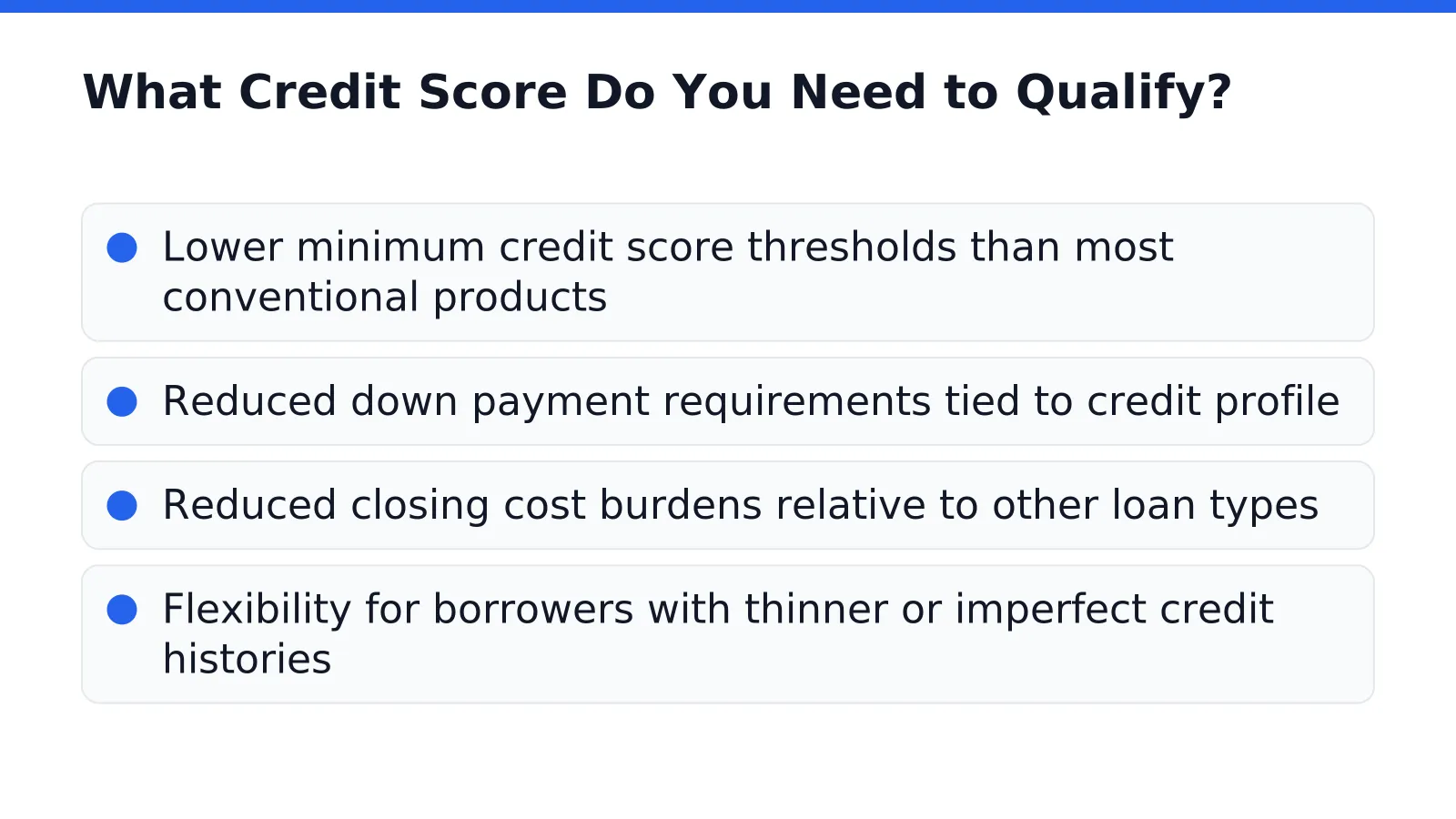
What Credit Score Do You Need to Qualify?
Credit score minimums for FHA financing sit well below conventional loan thresholds, making homeownership reachable for buyers with moderate credit histories. Federal Housing Administration backing exists specifically to extend access to borrowers who carry lower scores or haven’t saved a large down payment. This insurance structure shifts risk away from private lenders, which is why easier credit qualifying standards define the program.
Conventional loans often demand stronger credit files and larger reserves. FHA financing takes a different approach:
- Lower minimum credit score thresholds than most conventional products
- Reduced down payment requirements tied to credit profile
- Reduced closing cost burdens relative to other loan types
- Flexibility for borrowers with thinner or imperfect credit histories
Can Moderate Credit Still Get Approved?
Moderate credit scores do not automatically disqualify an applicant. The program’s design accounts for borrowers who haven’t had the opportunity to build pristine credit or stockpile significant savings. Approval depends on the full financial picture, not a single number.
How Does the Qualification Process Work?
Munshi Capital’s underwriting process centers on clarity, guiding moderate-credit borrowers through each step without unexpected hurdles. This full fha mortgage info approach means applicants understand requirements before submitting documentation, not after. Honest communication continues from initial application through closing, so no borrower faces surprise conditions late in the process.
Borrowers researching how to qualify for FHA financing benefit most from this complete FHA loan guide framework because it pairs federal flexibility with straightforward lender guidance. Scores matter, but transparency throughout underwriting matters just as much for a smooth closing.

What Other Costs Should You Expect?
Closing costs add up beyond the down payment, typically running between 2% and 6% of the home’s purchase price. Buyers researching a thorough FHA loan guide quickly learn that the down payment represents only part of the total cash needed at closing. Origination fees, appraisal costs, title insurance, and prepaid items like property taxes and homeowners insurance all factor into that range.
For a moderate-income buyer working with a tight budget, this gap between the sticker price and the actual closing bill can come as an unwelcome surprise. Planning ahead avoids scrambling for extra funds at the final signing table. A solid grasp of FHA mortgage info helps borrowers budget accurately from the start rather than discovering hidden costs late in the process.
Can Sellers Help Cover Closing Costs?
Yes. Sellers may contribute up to 6% of the home’s sale price toward a buyer’s closing costs under FHA guidelines. This concession, negotiated as part of the purchase agreement, reduces the cash a buyer needs on hand and often makes the difference for first-time purchasers stretching every dollar.
Typical closing cost categories include:
- Loan origination fees
- Appraisal and inspection fees
- Title insurance and recording fees
- Prepaid property taxes and homeowners insurance
Munshi Capital’s borrower-first guidance walks each client through these fees line by line, rooted in clarity and honesty rather than fine print. That transparency matters most for borrowers learning how to qualify for FHA financing while managing modest savings and moderate credit scores. A wide array of loan products, paired with integrity-driven service, positions the company as a trusted resource for buyers who want every cost explained before they commit to a loan.
How Does Munshi Capital Simplify FHA Loans?
Munshi Capital pairs modern technology with hands-on specialist service, removing the guesswork that stalls many first-time buyers. Speed matters here: delays and unclear status updates cost buyers negotiating leverage and, sometimes, the home itself. A complete fha-loan-guide-004 should eliminate that uncertainty, not add to it.
Borrowers working with Munshi Capital receive quick pre-approvals. Full visibility into their loan status from the first application through closing day. No guessing where a file sits. No unanswered calls. That transparency forms the backbone of reliable fha-mortgage-info-004 for buyers navigating their first purchase.
What makes Munshi Capital’s process borrower-first?
The company’s approach is rooted in clarity, honesty, and a service-driven commitment to each client’s goals. Instead of generic processing, moderate-credit borrowers get guidance built around their specific financial picture.
How does Munshi Capital support buyers figuring out qualification?
Understanding how-to-qualify-fha-004 requirements can overwhelm a first-time buyer facing credit questions or limited savings. Munshi Capital’s specialists walk through eligibility factors directly with each client, translating underwriting language into plain terms.
Munshi Capital’s value for FHA borrowers comes down to a few consistent commitments:
- Fast pre-approval timelines paired with ongoing status visibility
- Honest, borrower-first communication at every stage
- A wide array of loan products suited to varying credit profiles
- Specialist guidance alongside streamlined technology
That combination of integrity and product range makes Munshi Capital a dependable partner for first-time FHA buyers nationwide, rather than a one-size-fits-all lender.
FAQ
What is the minimum down payment for an FHA loan?
Qualified borrowers put down as little as 3.5% of the purchase price, making homeownership reachable for buyers without a large cash cushion. The exact amount depends on credit profile, gift funds, and local assistance programs.
Who backs FHA loans and why does it matter?
The Federal Housing Administration, part of HUD, insures FHA loans, shifting risk away from private lenders. This allows lenders to offer more favorable terms, flexible credit standards, and improved pricing to borrowers.
What factors should first-time buyers compare before choosing an FHA loan?
Buyers should weigh credit score flexibility compared to conventional loans, down payment requirements, and insurance premium obligations over the loan term. Weighing these factors against personal finances determines whether FHA financing fits a buyer’s long-term budget.
Conclusion
In closing, FHA loans represent a viable pathway for borrowers seeking homeownership with limited down payment resources. The combination of reduced capital requirements, flexible credit considerations, and streamlined underwriting processes positions FHA financing as a practical solution for first-time buyers and those rebuilding their financial profiles. By partnering with a mortgage specialist who prioritizes transparent communication and personalized guidance throughout the application and closing process, borrowers gain the clarity and support necessary to navigate this loan program confidently and secure financing aligned with their individual circumstances.
Leave a Reply