
Hard money and private lending deliver short-term, asset-based capital secured by real property rather than borrower credit history. Munshi Capital Inc. structures these loans for real estate investors and flippers needing fast closings outside conventional underwriting. Funding speed, property value, and exit strategy drive approval decisions, making these loans a practical bridge for time-sensitive acquisitions, rehabs, and commercial flips nationwide.
Key Takeaways
- Hard money loans provide fast funding by prioritizing property value over personal credit history and finances.
- Private money loans come from individual investors rather than institutional lenders, offering flexible terms for borrowers.
- Asset-based lending focuses on the collateral’s worth, enabling quick approvals within days instead of weeks.
- Short-term hard money loans typically range from 6 months to 3 years for investment property purchases.
What Exactly Is a Hard Money Loan?
A hard money loan funds property purchases and renovations using the asset itself as collateral, not the borrower’s credit profile. This short-term financing tool exists for one purpose: speed. Property investors facing a tight closing window or a distressed asset that a bank will not touch turn to this structure because it moves fast. Judges deals on property value, not paperwork.
Traditional mortgages take weeks to underwrite. Lenders comb through tax returns, employment history, and debt ratios before releasing funds. A hard money loan skips most of that. Approval rests on the property’s value and the deal’s math, which is why funding typically occurs within days to a few weeks, well ahead of conventional mortgage timelines.
Munshi Capital Inc. positions hard money lending as one of several specialized, investor-focused products in its portfolio, alongside DSCR loans built for rental property cash flow. Both serve borrowers who do not fit the standard underwriting box: flippers, rehabbers, and investors scaling a portfolio faster than conventional financing allows.
Who typically uses a hard money loan?
Fix-and-flip investors rely on this financing most often, since renovation timelines rarely match a 30-day conventional closing. Commercial buyers acquiring distressed property also use it when speed outweighs cost. Borrowers with strong equity but imperfect credit find it opens doors traditional lenders close.
How does it compare to other short-term capital?
Within a broader private lending options landscape, hard money loans sit alongside bridge finance structures that cover the gap between buying a property and securing permanent financing or selling the asset. The common thread: both favor collateral strength over borrower history. For investors building a hard money loan guide to compare across lenders, collateral value and exit strategy matter more than credit score.

How Does Private Lending Differ From Hard Money?
Private lending and hard money overlap in purpose but diverge in underwriting. Hard money loans rely strictly on the value of the real estate serving as collateral. Private money loans weigh that same property value alongside the borrower’s financial strength, including income, credit history, and overall liquidity.
That distinction matters for real estate investors comparing financing speed against financing cost. A hard money loan approach favors deals where the asset carries the loan on its own merits. A private lending approach suits borrowers who can strengthen their application with documented financial standing, sometimes unlocking better terms in exchange for more paperwork.
Which Option Fits a Fix-and-Flip Deal?
Flippers working on tight timelines typically lean toward asset-based underwriting, since speed matters more than personal financial documentation. A property with strong after-repair value can qualify quickly under this model. Borrowers with weaker credit but a solid asset still move forward without delay.
Is Private Lending Always Cheaper Than Hard Money?
Not necessarily. Terms depend on the individual lender’s risk assessment of both the property and the borrower’s financial profile. Cost and flexibility shift case by case rather than following a fixed rule.
Munshi Capital Inc. builds its investor-focused products, including bridge-finance-hard-money-010 solutions and DSCR programs, around these exact distinctions. Each loan structure serves a different financing scenario:
- Hard money: collateral-driven, faster approval, minimal income documentation
- Private lending: property plus borrower financials reviewed together
- DSCR financing: cash-flow focused, suited to rental property investors
Transparent, borrower-first guidance remains the foundation of every recommendation. Investors weighing these paths can request a direct cash offer to move a deal forward without delay.

When Should Investors Use Bridge Financing?
Bridge financing fits investors who need capital fast and cannot wait on conventional underwriting timelines. A closing deadline, an auction purchase, or a renovation project with a narrow resale window all call for this kind of short-term funding. Traditional mortgages move slowly; competitive acquisitions and time-sensitive flips rarely allow for that pace.
Munshi Capital Inc. structures its lending process around speed without sacrificing clarity. The company pairs modern technology with hands-on loan specialists, a combination built for deals that cannot afford delays. Investors pursuing bridge finance hard money solutions gain quick pre-approvals and full visibility into loan status from application through closing. That transparency matters when every week of holding costs eats into projected returns.
Is bridge financing right for every investor?
Not necessarily. Investors with flexible timelines or strong bank relationships may find conventional products cheaper. Those facing a tight acquisition window, however, often cannot wait for standard approval cycles, and bridge capital closes that gap.
What should investors check before signing?
Before committing, investors should review the following:
- Loan requirements, including property valuation standards and documentation
- Funding timelines and how they align with the project’s resale or refinance exit
- Alternative financing options, including a broader private lending options review
- Total repayment terms and how they affect overall project margin
Munshi Capital Inc. assigns personalized guidance to each borrower, helping clients nationwide match financing structure to actual investment goals. For investors weighing a hard money loan guide against a conventional path, that one-on-one support often determines whether the deal closes on schedule.
What Are the Real Costs and Risks?
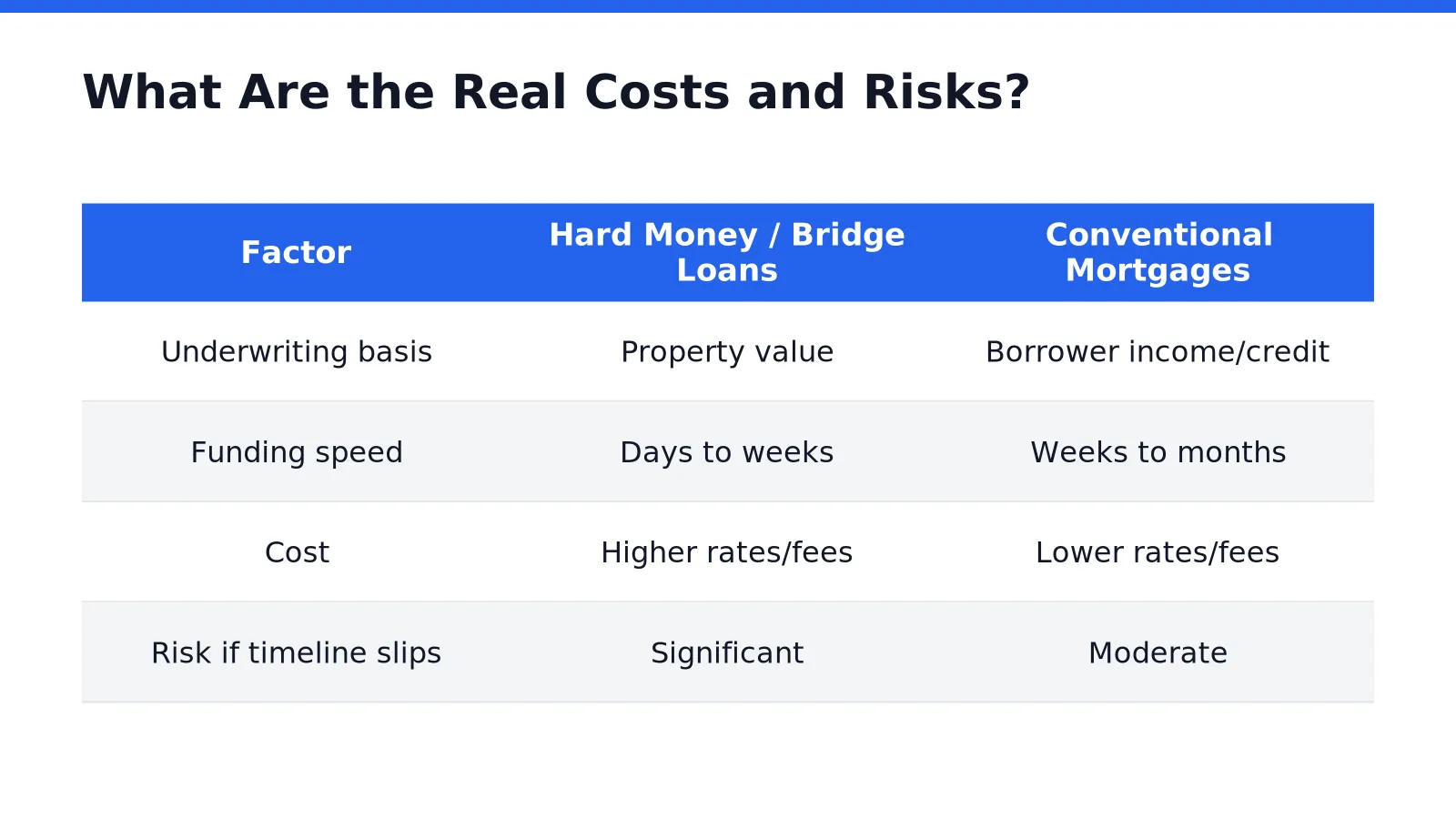
Speed carries a price tag. Hard money loans close faster than bank mortgages because lenders skip income verification and focus on the property itself. That convenience raises both the interest rate and the risk of default for borrowers who misjudge a renovation budget or resale timeline.
A hard-money-loan-guide-010 approach to evaluating financing should treat cost and risk as inseparable. Higher rates, shorter terms, and steep origination fees all stem from the same source: lenders accept less documentation and more uncertainty, so pricing reflects that gap.
Is private lending cheaper than hard money lending?
Not necessarily. Whether private-lending-options-010 arrangements cost less than hard money loans depends almost entirely on how each lender type gets defined. Large institutional hard money firms sometimes offer less flexibility than individual private lenders. Private lenders are not automatically the lower-cost choice. Terms vary widely from one private arrangement to the next.
Does bridge financing carry the same risk profile?
Short-term bridge-finance-hard-money-010 products share the same cost structure as other asset-based loans: fast access to capital in exchange for higher fees and a tighter payoff window. Flippers and commercial buyers need an exit strategy locked in before closing, not after.
Munshi Capital guides borrowers through application, underwriting, and closing with full visibility at each stage, reducing the chance of hidden-cost surprises common among alternative lenders. Property owners weighing these trade-offs can request a direct cash offer before committing to any short-term structure.
How Does Munshi Capital Simplify the Process?
Munshi Capital Inc. removes the guesswork from financing investment property by pairing every borrower with guidance built around their specific deal, not a generic checklist. Loan specialists walk flippers and investors through each program option with clear answers. Decisions get made faster and with fewer surprises. Speed matters most to investors chasing a tight closing window. Clarity matters when capital needs to move before a deal falls apart.
Munshi Capital’s suite reaches far beyond a single product. For borrowers researching a hard money loan guide before committing to short-term financing, the company’s loan specialists lay out requirements, costs, and timelines in plain terms rather than industry jargon. That same transparency extends to investors comparing private lending options against conventional bank underwriting, where personal credit and income documentation often slow approval.
What loan programs does Munshi Capital offer investors?
Munshi Capital Inc. specializes in mortgage financing designed for a wide range of borrowers, from first-time homebuyers to seasoned investors managing multiple properties. The product lineup includes:
- Residential and commercial loan programs
- DSCR loans for rental-income properties
- Hard money loans for time-sensitive acquisitions
- Bridge finance hard money solutions for investors moving between purchase and permanent financing
Why does personalized service matter for property flippers?
Flippers operate on deadlines bank underwriting rarely respects. Munshi Capital’s commitment to integrity, personalized service, and a wide array of loan products has made the company a trusted choice for investors nationwide who need certainty, not delays.
Sellers holding a distressed or time-sensitive property can request a direct cash offer to skip the financing wait entirely. Owners weighing their options can request your property assessment before choosing a loan path.
FAQ
What makes hard money loans different from traditional mortgages?
Hard money loans judge deals on property value and exit strategy rather than tax returns, employment history, or debt ratios. This asset-based approach lets Munshi Capital Inc. fund investor deals in days instead of weeks.
Who typically uses hard money financing?
Fix-and-flip investors rely on it most since renovation timelines rarely match conventional closings. Commercial buyers use it when acquiring distressed property quickly. Borrowers with strong equity but imperfect credit also find doors open through this structure.
How does private lending differ from hard money loans?
Hard money loans rely strictly on the collateral property’s value. Private lending weighs that same value alongside the borrower’s income, credit history, and liquidity. This makes private lending suited to borrowers who can str
Conclusion
In closing, hard money and private lending represent essential financing pathways for borrowers whose circumstances fall outside conventional lending parameters. These specialized loan products address time-sensitive acquisitions, non-traditional credit profiles, and investment strategies that demand flexibility and expedited funding. At Munshi Capital Inc., we recognize that every borrower’s financial situation is distinct, which is why our comprehensive suite of hard money and specialized lending solutions delivers transparent, personalized guidance throughout the entire process. Our commitment to clarity and dependable service ensures you navigate these complex financing options with confidence and full visibility into your loan journey.
Leave a Reply