
Investor mortgage and financing resources at Munshi Capital Inc. include DSCR loans, hard money financing, and Freddie Mac-backed investment property mortgages covering 1- to 4-unit properties. Real estate investors and landlords access FHA 203k renovation loans, conventional rehab/purchase financing, and city-specific loan program pages spanning markets from Los Angeles to Sacramento, with dedicated specialist guidance throughout underwriting.
Key Takeaways
- Munshi Capital Inc. offers specialized DSCR and hard money loans designed specifically for real estate investors.
- Our FHA 203k renovation loans combine purchase and renovation funding into one streamlined mortgage package.
- Investment property financing covers 1- to 4-unit residential properties including single-family homes, duplexes, and multi-family units.
- Transparent underwriting and fast pre-approvals ensure investors gain full visibility into loan status from application through closing.
What Will This Investor Financing Guide Cover?
This guide functions as an investor financing hub, mapping out the mortgage options available to property buyers building rental portfolios. Readers get a direct breakdown of loan types, qualification paths, and lending priorities before committing to a purchase.
Munshi Capital designs mortgage financing for a wide range of borrowers. First-time homebuyers and seasoned real estate investors both find structured options built around their financial profile. The lender offers a comprehensive suite of residential and commercial loan programs, including FHA, VA, USDA, and bank statement loans, each suited to different income documentation and credit situations.
The guide breaks down coverage into four core areas:
- Defining what counts as an investment property mortgage versus a standard home loan
- Reviewing available real estate investor loan programs and their documentation requirements
- Explaining how rental income factors into qualification
- Outlining the lending process from application through closing
What Counts as an Investment Property Loan?
An investment property loan is a mortgage used specifically to purchase a residential property intended for rental income, not personal occupancy. This distinction matters because underwriting criteria, down payment expectations, and interest calculations differ sharply from owner-occupied financing.
Why Does Loan Structure Matter for Investors?
Loan structure determines cash flow, leverage, and long-term portfolio flexibility. Selecting the wrong program can limit how many properties an investor finances or strain reserves unnecessarily.
Transparency anchors every section of this resource. Munshi Capital operates under a mission of clarity. Honest communication throughout the lending process, meaning investors see program terms and requirements laid out plainly rather than buried in fine print. Investment property finance decisions carry long-term consequences, from monthly cash flow to total portfolio capacity. Clarity at the outset protects against costly missteps later. Property owners weighing a sale alongside a refinance benefit from reviewing all terms carefully before locking into new financing commitments.
Which Loan Programs Fit Your Investment Goals?
Loan selection depends on property type, renovation needs, and portfolio strategy. Four main paths serve investors: specialized investor products, Freddie Mac backed options, broad residential and commercial programs, and combined purchase-construction loans. Matching the right program to the right deal protects cash flow and prevents costly delays.
Munshi Capital Inc. structures its investor financing hub around products built specifically for non-owner-occupied strategies. DSCR loans and hard money loans sit at the center of this offering, serving borrowers whose qualification hinges on property performance rather than traditional income documentation. These options give investors flexibility when a deal moves fast or when rental income, not a pay stub, tells the real story.
What makes an investment property loan different from a standard mortgage?
Freddie Mac’s investment property mortgage framework answers this directly: these products let lenders originate loans on 1- to 4-unit investment properties while customizing terms to each borrower’s strategy. That structure supports real estate investor loans built for buy-and-hold owners, small multifamily buyers, and portfolio builders alike.
Which program fits a renovation purchase?
Conventional rehab and purchase loans combine the acquisition cost and construction funding into one loan for smaller projects. Larger rehab work typically requires a two-closing process instead. Investors tackling a fixer-upper should confirm project scope early, since that scope determines which path applies.
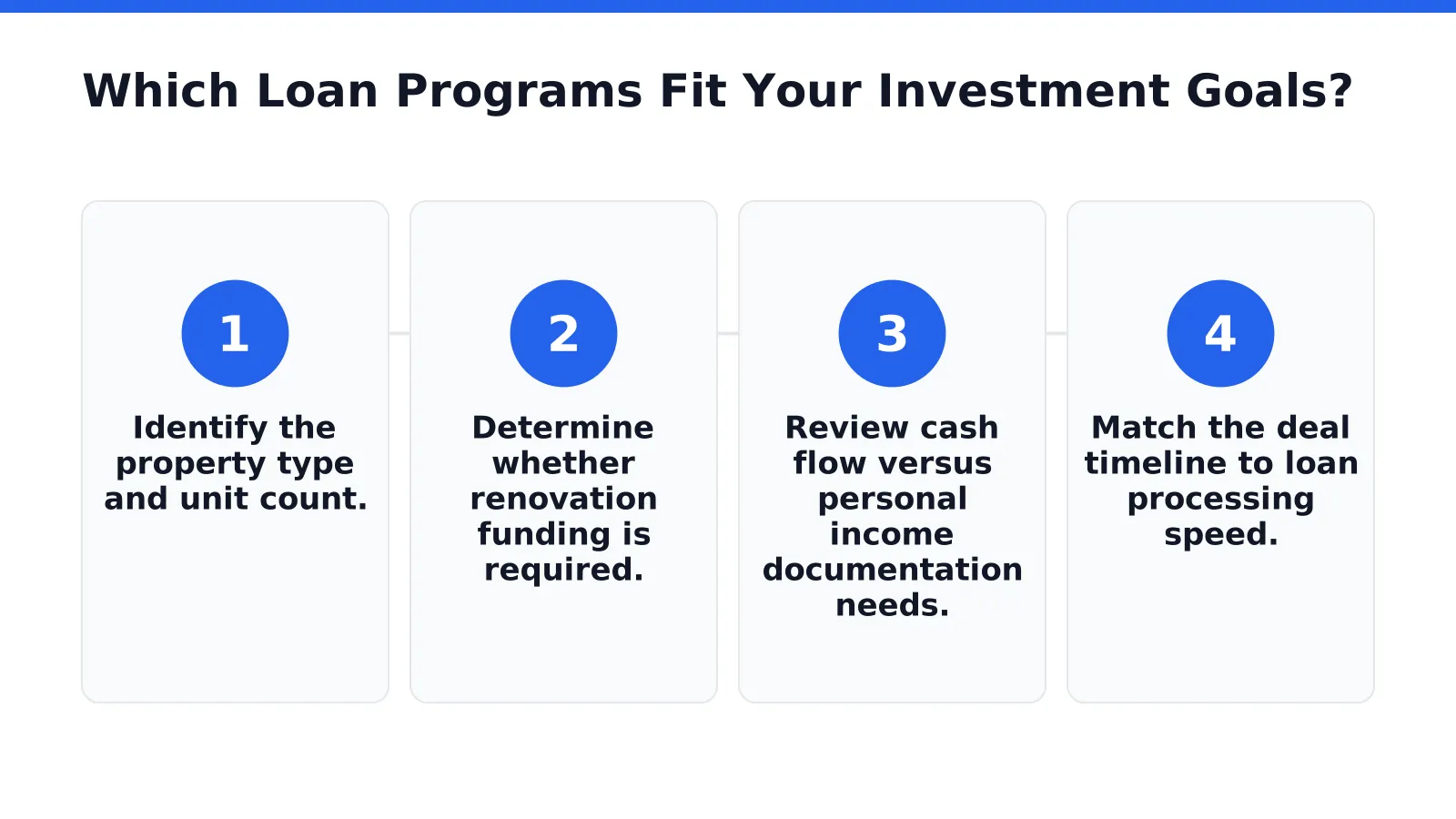
Munshi Capital Inc. rounds out investment property finance solutions with a full suite of residential. Commercial programs, each shaped around the borrower’s financial picture rather than a one-size template. Follow these steps when narrowing program choice:
- Identify the property type and unit count.
- Determine whether renovation funding is required.
- Review cash flow versus personal income documentation needs.
- Match the deal timeline to loan processing speed.
Property owners ready to move forward on an existing holding should request a direct cash offer before committing to new financing terms.

What Documents Do You Need Before Applying?
Document preparation determines how quickly an application moves from submission to approval. Investors who gather proof of income, asset statements, and property details before starting save time once underwriting begins. A disorganized file, by contrast, stalls the process and delays closing on a competitive deal.
The application itself starts simply. A quick, secure intake form collects borrower goals and identifies which residential. Commercial loan program fits the investor’s strategy, whether that’s a rental acquisition, a multi-unit purchase, or a portfolio refinance. This initial step sets the foundation for the broader investor financing hub experience. Borrowers move through application, underwriting, and closing with structured guidance at each stage.
What financial documents should investors have ready?
Lenders evaluating real estate investor loans typically request recent bank statements, tax returns, and proof of rental income or reserves. Down payment documentation carries particular weight. A single-family investment property typically requires a minimum down payment of 15%. 2-4 unit properties generally require at least 25%. Investors should confirm which bracket applies before gathering statements, since the reserve requirement shifts significantly between the two.
Does property type change the paperwork?
Yes. Multi-unit properties generally require additional documentation around projected rental income and unit-by-unit breakdowns. Single-family purchases involve a narrower set of requirements, which simplifies underwriting.
Investors preparing a complete file should assemble:
- Two years of tax returns and W-2s or 1099s
- Two to three months of bank and asset statements
- Proof of entity formation, for purchases made under an LLC
- Current mortgage statements for existing rental properties
Accurate, upfront documentation supports sound investment property finance decisions and keeps the underwriting timeline on track from the first submission to closing.
How Do You Secure Pre-Approval as an Investor?
Pre-approval requires a documented, step-by-step process rather than a single application. Investors who follow a structured path toward an investment property finance decision reach closing faster and with fewer surprises. Munshi Capital Inc. pairs modern technology with hands-on loan specialist support, a combination that produces quick pre-approvals and full visibility into loan status at every stage.
Follow these steps to move from inquiry to pre-approval:
- Gather financial documentation, including tax returns, bank statements, and current rental income records.
- Identify the target property type: single-family, multi-unit, or commercial.
- Submit an application through the real estate investor loans program that fits the borrower’s financial picture.
- Allow the underwriting team to verify income, reserves, and property cash flow.
- Receive a pre-approval letter with clear terms and no hidden conditions.
Existing rental income strengthens an application. Investors already managing property can use current rental market value to help qualify. That income offsets the added mortgage obligation. This gives seasoned landlords an advantage over first-time buyers with no rental history.
What documents does an investor need before applying?
Lenders require recent tax returns, bank statements, and proof of reserves before reviewing a file. Investors with existing rental units should also include lease agreements and rent rolls. Complete documentation shortens the review timeline considerably.
Why does pre-approval matter for portfolio growth?
Pre-approval signals financial readiness to sellers and agents, strengthening negotiating position. It also clarifies borrowing capacity before an investor commits to a purchase contract. Munshi Capital Inc.’s commitment to integrity. A broad catalog of loan products, part of its broader investor financing hub, supports dependable pre-approval outcomes for investors building portfolios nationwide.
How Does Underwriting Differ for Investment Properties?
Underwriting for rental properties demands stronger financial proof than a standard home purchase. Lenders evaluating a non-owner-occupied purchase weigh rental income potential alongside a borrower’s capacity to carry an additional mortgage payment. Investment loans require healthier cash reserves. Sturdier financial standing than conventional, owner-occupied underwriting, a distinction that catches many first-time landlords off guard.
This stricter review process forms the backbone of any serious investor-financing-hub-015. Documentation and income projections carry more weight than credit score alone. Buyers building a rental portfolio should prepare these items before applying:
- Gather two years of tax returns and bank statements showing reserve funds.
- Pull projected rental income figures, often based on a market rent schedule or existing lease.
- Calculate debt-to-income ratios that include the new mortgage payment.
- Confirm reserves cover several months of payments across all owned properties.
What makes investment property underwriting stricter than a primary residence loan?
Primary residence underwriting centers on personal income and occupancy intent. Real-estate-investor-loans-015 underwriting instead centers on whether the property itself generates enough income to support the debt, plus whether the borrower holds sufficient reserves if a unit sits vacant.
Why does rental income matter so much in the approval decision?
Rental income functions as a second income stream in the lender’s eyes, reducing reliance on personal wages alone. A property projected to cash flow strongly improves approval odds, even for borrowers carrying existing mortgages.
Munshi Capital Inc. built its review process on clarity. Honesty, treating every stage of investment-property-finance-015 underwriting as an opportunity for borrower-first guidance rather than guesswork. A dedicated team walks investors nationwide through documentation requirements before surprises surface at closing. Property owners ready to move forward can request your property assessment to understand how a specific rental unit measures up against underwriting standards.
What Are DSCR and Hard Money Loans?
DSCR loans and hard money loans represent two specialized financing tools built for property investors rather than traditional homebuyers. DSCR stands for debt service coverage ratio, a calculation lenders use to measure whether a property’s rental income covers its mortgage obligations. Hard money loans, by contrast, rely on the asset itself as collateral, offering faster access to capital for time-sensitive deals.
Munshi Capital Inc. includes both products within its investment property finance lineup, built specifically to serve investor-focused borrowing needs. Unlike conventional mortgages that weigh personal income. Employment history heavily, these loan types shift the underwriting focus toward the property’s earning potential or its resale value. That shift matters for investors juggling multiple properties, variable income streams, or tight closing timelines.
How does a DSCR loan qualify a borrower?
A DSCR loan qualifies borrowers based on the rental income a property generates relative to its debt obligations, not personal pay stubs or tax returns. This structure suits landlords scaling a portfolio, since each property gets evaluated on its own financial merit. Investors with strong rental cash flow but complex personal finances often find this path more accessible than conventional underwriting.
What makes hard money loans different from standard mortgages?
Hard money loans close faster because approval cent
FAQ
What investor-focused loan products does Munshi Capital offer?
Munshi Capital provides DSCR loans, hard money financing, and Freddie Mac-backed investment property mortgages. These programs cover 1- to 4-unit properties, giving investors tailored options built around rental income strategies and portfolio goals.
How does Munshi Capital ensure transparency throughout the loan process?
Munshi Capital operates under a mission of clarity and honest communication, laying out program terms and requirements plainly. Investors gain full visibility into loan status from application through closing, supported by dedicated specialist guidance.
What property types qualify for investment property financing?
Investment property financing covers 1- to 4-unit residential properties, including single-family homes, duplexes, and multi-family units. FHA 203k renovation loans also combine purchase and renovation funding into one streamlined mortgage package.
Leave a Reply