
Home equity loans and HELOCs both let homeowners borrow against their property’s equity, functioning as second mortgages paid alongside an existing first mortgage. A home equity loan delivers a fixed lump sum upfront. A HELOC operates like a credit card, offering a revolving credit line against the home’s appraised value for renovations, debt consolidation, or investment needs.
Key Takeaways
- Home equity loans provide a lump sum of borrowed money against your home’s equity in one transaction.
- HELOCs function like credit cards, allowing you to draw funds as needed against your home’s equity.
- Both products require your home as collateral, securing the borrowed amount through your property’s appraised value.
- Homeowners access these tools when their property value exceeds their mortgage balance, unlocking their investment’s potential.
What Exactly Is Home Equity, and Why Tap It?
Home equity represents the value gap between a property’s current worth and the remaining balance owed on its mortgage. That gap is not idle math. Once a home is worth more than what is owed, the difference becomes a financial resource homeowners can convert into usable funds for renovations, debt consolidation, or investment opportunities.
Appraised value drives the entire equation. Lenders calculate borrowing power against that appraised figure, which means a property’s market standing directly determines how much cash a homeowner can access. This explains why many property owners pursue a thorough home equity guide before committing to any borrowing decision.
How Do Homeowners Actually Access This Value?
Borrowing against appraised value turns dormant equity into cash for home improvement projects, education costs, or unexpected large expenses. Two primary paths exist: a lump-sum loan or a revolving credit line, each reviewed in detail through proper heloc loan information resources. The right choice depends on spending timeline and repayment preference.
Why Choose a Strategic Equity Partner?
Munshi Capital Inc. delivers personalized guidance built for borrowers nationwide, from first-time buyers to seasoned investors. Its commitment to integrity and a broad catalog of loan products position the company as a dependable resource for homeowners weighing equity options.
Consider these common uses of accumulated equity:
- Major renovation projects that increase property value
- Consolidation of high-interest debt into one manageable payment
- Funding for investment properties or business ventures
- Coverage for unexpected large expenses, such as medical costs
Homeowners exploring a cash-out home equity strategy should weigh long-term goals against short-term liquidity needs before signing any agreement.
How Does a Home Equity Loan Work?
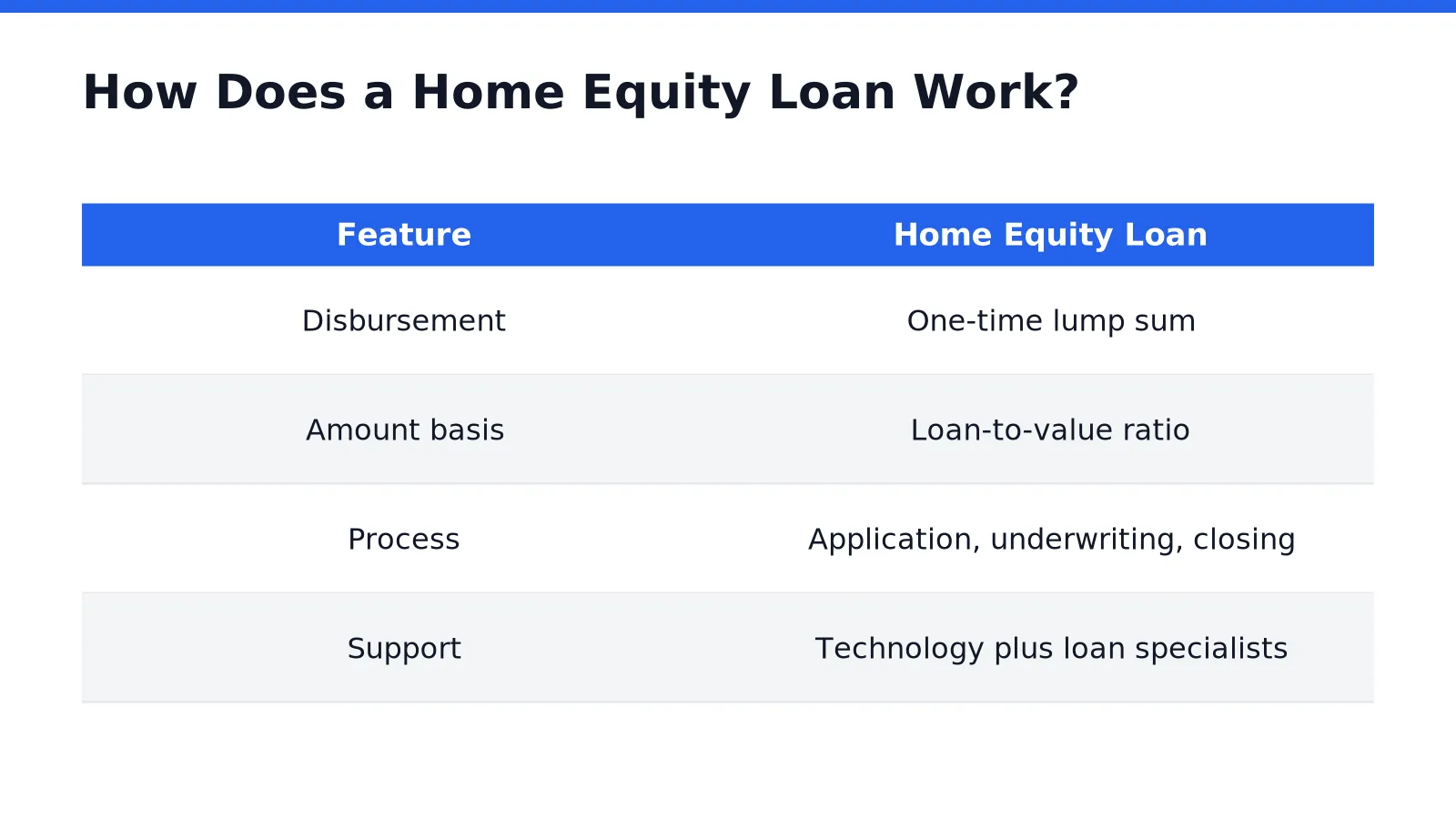
A home equity loan delivers funds to qualified borrowers in a single, lump-sum disbursement. The amount available depends on the loan-to-value ratio, which compares the loan balance to the home’s appraised worth. Homeowners sitting on substantial equity gain access to a defined sum upfront, rather than a revolving credit line.
This structure makes the home-equity-guide-017 process distinct from other borrowing options tied to a property’s value. Funds arrive at closing in one payment, giving borrowers clarity on exactly what they owe and when repayment begins.
What happens during the application process?
Borrowers move through a straightforward sequence: application, underwriting, and closing. Each stage prioritizes ease and understanding, with no hidden surprises buried in the fine print. Loan specialists guide clients through documentation and approval, keeping the timeline predictable from start to finish.
Is a home equity loan fast to close?
Processing speed benefits from a combination of modern technology and hands-on specialist support. This pairing supports quick turnaround on lump-sum equity financing, which matters for homeowners facing time-sensitive renovation costs or debt consolidation deadlines.
Borrowers researching heloc-loan-information-017 often discover that the loan version suits different goals than a credit line. A line of credit allows repeated draws; a home equity loan does not.
For investors exploring cash-out-home-equity-017 strategies, this lump-sum model offers predictable terms for funding renovations or strategic property purchases, backed by a lending approach built for borrowers across the financing spectrum.

How Does a HELOC Differ From a Loan?
A home equity line of credit functions as a revolving credit source. A home equity loan delivers a single lump sum. Borrowers draw funds from a HELOC multiple times, up to an available maximum, repaying and redrawing as needs arise. A traditional loan offers no such flexibility; the amount disbursed at closing is final.
This distinction matters for homeowners weighing renovation costs against unpredictable timelines. A kitchen remodel with staged contractor payments fits a revolving line better than a fixed payout. A one-time debt consolidation, by contrast, often suits a lump-sum structure.
Both products share a critical structural feature: when an existing mortgage is in place, the new borrowing becomes a second mortgage. That second loan sits on top of the first mortgage, requiring its own monthly payment alongside the existing one.
Is a HELOC the Same as a Second Mortgage?
Yes, when a homeowner already carries a primary mortgage. Both a HELOC and a standard home equity loan are classified as second mortgages in that scenario, repaid in addition to the first loan. Homeowners should budget for two separate obligations, not one.
Munshi Capital Inc. guides borrowers through this comparison with a transparency-first mission, explaining second-mortgage mechanics clearly before any paperwork begins. That clarity, honesty, and service-driven approach extends to every revolving-equity conversation, helping clients considering a cash-out home equity strategy choose the structure that actually fits their financial picture rather than defaulting to whichever product sounds simplest.

Which Option Fits Cash-Out Needs or Renovations?
The right choice depends on how the funds will be used. Renovation projects with a defined budget, such as a kitchen remodel or a single-phase addition, typically suit a lump-sum structure. Ongoing or uncertain costs, like phased investment property upgrades or ongoing education expenses, often fit better with a revolving line. Both structures rely on the same foundation: home equity pledged as collateral to secure funds for renovation, education costs, emergency expenses, or high-interest debt consolidation.
Cost matters as much as structure. Equity-based borrowing frequently carries a lower interest rate than personal loans or credit cards, which makes a cash-out home equity strategy more efficient for large expenses than unsecured debt. Homeowners consolidating high-interest balances often save meaningfully on interest over the life of the loan compared to carrying that debt on a card.
Which option works best for real estate investors?
Investors weighing cash-out strategies against portfolio growth have options beyond a standard home equity loan or HELOC. Munshi Capital Inc.’s lineup includes DSCR and hard money loans, specialized products built for deploying equity into additional investment properties. These programs sit alongside a broader suite of residential and commercial loan options designed around each borrower’s financial picture, whether the goal is renovation, consolidation, or expansion.
Homeowners uncertain which path fits their situation can request your property assessment to clarify available equity before committing. Investors ready to move on a specific opportunity can request a direct cash offer to evaluate funding options against project timelines.
How Do You Choose and Apply With Confidence?
Confidence comes from matching loan structure to financial goal before signing anything. A clear comparison between a lump-sum loan and a revolving credit line answers most of the uncertainty borrowers face. Munshi Capital Inc. built its lending practice on this principle: transparency first, paperwork second.
A reliable home equity guide breaks the decision into three questions: How much cash is needed? How predictable should payments be? How soon will the funds be repaid? Borrowers planning a single renovation often prefer the fixed structure of a loan. Investors managing ongoing or unpredictable costs frequently lean toward a line of credit instead.
What Should Homeowners Compare Before Applying?
Reviewing rate structure, repayment flexibility, and draw access side by side prevents costly mismatches.
Sound HELOC loan information clarifies how draw periods, repayment phases, and variable rates interact over time.
Why Does Working With a Dependable Lender Matter?
A lender offering clear answers and guidance through every program reduces guesswork at application time. Munshi Capital Inc. delivers quick pre-approvals and full visibility into loan status, so borrowers see exactly where their application stands. That visibility matters most when pursuing a cash-out home equity strategy for debt consolidation or investment, since timing and terms directly affect long-term cost.
Homeowners weighing these options can request a direct cash offer to understand available equity. Request your property assessment to confirm current home value before choosing a path forward.
FAQ
What is the main difference between a home equity loan and a HELOC?
A home equity loan provides a fixed lump sum upfront. A HELOC functions like a revolving credit line, letting homeowners draw funds as needed against their home’s equity.
How is borrowing power determined for these loans?
Lenders calculate borrowing power using the home’s appraised value and the loan-to-value ratio, which compares the loan balance to the property’s current worth.
What can homeowners use their home equity funds for?
Homeowners commonly use equity funds for major renovations, consolidating high-interest debt, funding investment properties or business ventures, and covering unexpected large expenses like medical costs.
Conclusion
In closing, understanding the distinctions between home equity loans and HELOCs empowers you to make informed decisions aligned with your financial objectives. Whether you require a lump sum or flexible access to capital, these instruments provide legitimate pathways to leverage your home’s equity strategically. Munshi Capital Inc. stands ready to guide you through the application and underwriting process with complete transparency, ensuring you secure financing that matches your unique circumstances and goals with clarity and confidence.
Leave a Reply