
Cash-out refinancing converts home equity into funds for debt consolidation, home improvements, or investment property acquisition, with closing costs and prepaid items rolled into the new loan balance. Fannie Mae and Freddie Mac guidelines govern eligibility. Munshi Capital Inc. structures these loans for homeowners and investors nationwide seeking tailored equity solutions beyond standard rate-and-term options.
Key Takeaways
- Cash-out refinances replace your mortgage with a larger loan, providing immediate cash for debt consolidation or home improvements.
- Cash-out refinance rates typically run 0.25 to 0.5 percentage points higher than standard refinance rates.
- Borrowers leverage home equity strategically to pay off higher-cost debt, reduce monthly payments, or fund property upgrades.
- Munshi Capital Inc. guides you through cash-out refinance options with transparent terms and personalized solutions for your financial goals.
What Is a Cash-Out Refinance, Exactly?
A cash-out home loan replaces an existing mortgage with a larger one, handing the homeowner the difference in cash. The new loan pays off the old balance first. Whatever equity gets tapped beyond that amount becomes available funds at closing. Skip this step without understanding the mechanics, and homeowners risk borrowing against equity they can’t easily rebuild.
Lenders apply specific rules before approving one of these transactions. An eligible deal must pay off an existing mortgage through a new first mortgage secured by the same property. Finance a home already owned free and clear. That structure separates a legitimate equity-based refinance for equity from other lending products that merely add debt without replacing the original loan.
How does a cash-out refinance differ from a home equity loan?
A cash-out refinance replaces the entire mortgage with one new, larger loan and a single monthly payment. A home equity loan, by contrast, sits as a second lien on top of the existing mortgage, leaving two separate payments. Borrowers choosing between the two should weigh how each affects total monthly obligations, not just upfront cash received.
Munshi Capital Inc. builds its lending approach on trust, prioritizing clear, borrower-first guidance at every stage of the process. The company serves a wide range of clients, from first-time homebuyers to experienced property investors exploring a cash-out-refinance-guide-018 style strategy for long-term wealth building. Munshi Capital Inc. offers residential and commercial loan programs including FHA, VA, USDA, and bank statement loans. Well as specialized products like DSCR and hard money loans.
Which Debts and Projects Qualify for Payoff?
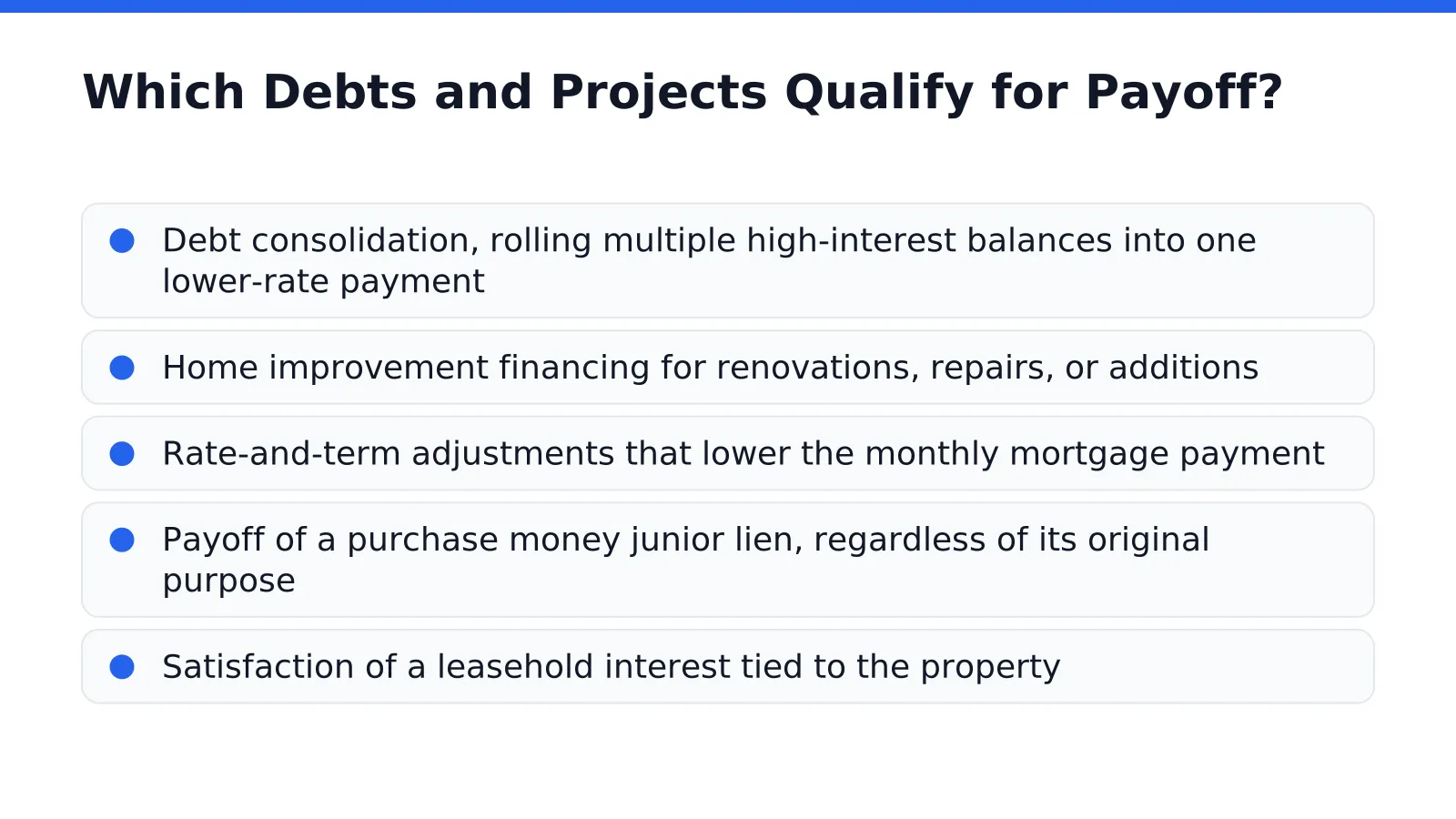
Lenders approve cash-out proceeds for a wide range of purposes, from debt consolidation to home renovation projects. A cash-out home loan gives borrowers access to built-up equity, and that money can flow toward several distinct financial goals. Qualifying uses include consolidating high-interest debt, funding home improvements, lowering a rate and monthly payment, paying off a purchase money junior lien, or satisfying a leasehold interest.
Not every use builds equal value, though. Renovation spending and permanent payoff of high-interest debt tend to strengthen a borrower’s long-term financial position. Short-term spending that doesn’t change underlying habits simply converts home equity into temporary relief, without lasting benefit.
What Are the Best Uses for Cash-Out Refinance Funds?
The strongest uses increase property value or eliminate costly debt for good. Home improvement projects, such as kitchen remodels or structural repairs, often raise resale value and justify the new loan balance. Paying off credit cards or personal loans carrying high interest rates reduces total debt cost, provided spending patterns actually change afterward.
Common qualifying uses for a refinance for equity include:
- Debt consolidation, rolling multiple high-interest balances into one lower-rate payment
- Home improvement financing for renovations, repairs, or additions
- Rate-and-term adjustments that lower the monthly mortgage payment
- Payoff of a purchase money junior lien, regardless of its original purpose
- Satisfaction of a leasehold interest tied to the property
Does the Project Have to Relate to the Home?
No single rule requires that proceeds stay tied to the property itself. Lenders generally extend flexibility across consolidation, lien payoff, and leasehold scenarios, not just renovation. Munshi Capital’s cash-out refinance guide approach centers on matching loan structure, including FHA, VA, USDA, and bank statement programs, to each borrower’s specific financial picture before funds get allocated. That personalized guidance helps borrowers select a payoff strategy aligned with their actual goals, not a one-size-fits-all formula.

How Do Investors Use Equity Strategically?
Property investors convert built-up equity into new acquisitions, renovation funds, or portfolio expansion through specialized loan products. A cash-out home loan does more than free up cash. It becomes a tool for scaling a real estate portfolio without liquidating existing assets. Munshi Capital Inc. supports this strategy with DSCR and hard money loan products, giving investor-focused borrowers additional pathways to deploy equity toward new purchases rather than letting it sit idle.
Seasoned investors rarely use equity for a single purpose. Instead, they layer strategies depending on market timing and property type. Common approaches include:
- Funding a down payment on an additional investment property
- Covering renovation costs to raise rental income or resale value
- Consolidating higher-interest business or property debt into one loan
- Buying out a co-owner’s equity stake under special circumstances
That last use case matters more than investors often realize. A special purpose cash-out refinance allows a borrower to use refinance proceeds specifically to buy out a co-owner’s equity, a structure that resolves ownership disputes or partnership exits without forcing a property sale.
Does rolling in closing costs actually help cash flow?
Yes. Closing costs, financing costs, and prepaid items can be folded into the new loan amount rather than paid out of pocket at closing. This preserves liquidity, letting investors redirect cash toward acquisitions or repairs instead of transaction fees.
Is a cash-out home loan only for homeowners?
No. Munshi Capital Inc. serves seasoned investors and business owners nationwide, not just owner-occupants. The same refinance for equity principle that helps a first-time buyer applies equally to an investor building a multi-property portfolio, just with different underwriting paths like DSCR qualification.

What Does This Financing Cost Over Time?
Cash-out refinance pricing carries a premium over standard refinance rates. A cash-out home loan typically costs a quarter to half a percentage point more in interest, a gap that compounds across a 15- or 30-year term. That difference sounds small on paper. Spread across hundreds of thousands of dollars in principal, it adds real dollars to total interest paid.
How much more does a cash-out refinance cost monthly?
The exact monthly difference depends on loan size, term, and credit profile. Even a modest rate increase raises the payment enough to offset some of the cash received upfront. Borrowers evaluating a cash-out-refinance-guide style breakdown should weigh that added monthly cost against what the cash unlocks, whether debt payoff, renovation, or investment capital.
Munshi Capital frames the decision around the borrower, not the transaction. Guidance runs through every loan program with clear answers, not guesswork. Homeowners understand the full cost picture before signing anything.
That transparency extends to the process itself. Application, underwriting, and closing move forward without hidden surprises on fees or rate adjustments.
Does the lender affect what a cash-out refinance costs?
Lender execution matters as much as the headline rate. Modern technology paired with hands-on service from Munshi Capital’s loan specialists keeps cost disclosures. Loan terms moving quickly and transparently. Faster, clearer processing reduces the uncertainty that often compounds the expense of refinancing for equity.
Homeowners comparing this path against other equity options should consider:
- Rate premium relative to a standard refinance
- Total interest over the full loan term
- Closing costs rolled into the new balance
- Long-term value of the cash-out purpose versus its carrying cost
Property owners weighing these numbers against a faster exit can request a direct cash offer instead. Request your property assessment to compare equity options side by side.
How Should You Start the Refinance Process?
Starting a cash-out refinance begins with a clear financial goal, not a loan application. Homeowners weighing a cash-out refinance guide first ask what the money will accomplish, whether paying off high-interest credit card debt or funding a home improvement project. That goal shapes every decision that follows, from loan size to repayment timeline.
Munshi Capital’s lending team builds the next step around transparency. Borrowers move through application, underwriting, and closing with clarity and speed, free of confusing jargon or hidden surprises. A mission of transparency keeps every conversation honest. Homeowners understand exactly what a cash-out home loan will cost and deliver before signing anything.
What Documents Does a Homeowner Need to Begin?
Lenders typically request income verification, current mortgage statements, and a recent home valuation before issuing a pre-approval. Gathering these documents early speeds up underwriting and limits delays once the file moves forward. Homeowners who organize paperwork ahead of time avoid the back-and-forth that stalls many refinance applications.
Pre-approval arrives quickly once documentation is complete, and full visibility into loan status continues from start to finish. For homeowners exploring refinancing for equity to consolidate debt or renovate a property, the process works best as a partnership rather than a transaction:
- Define the goal for the cash before applying.
- Assemble income, mortgage, and valuation records.
- Review loan terms with a lending specialist for full clarity.
Homeowners ready to move forward can request a direct cash offer on built-up equity. Those still weighing options should request your property assessment before committing to any loan structure.
FAQ
What can cash-out refinance funds be used for?
How is a cash-out refinance different from a home equity loan?
A cash-out refinance replaces the entire mortgage with one new, larger loan and a single monthly payment. A home equity loan sits as a second lien, leaving two separate payments.
Who can benefit from Munshi Capital Inc.’s cash-out refinance guidance?
Munshi Capital Inc. serves first-time homebuyers to experienced property investors, offering transparent terms and personalized solutions through FHA, VA, USDA, bank statement, DSCR, and hard money loan programs.
Conclusion
In closing, cash-out refinancing represents a strategic financial tool for homeowners and investors seeking to leverage accumulated equity toward meaningful objectives. Whether addressing debt consolidation, funding home improvements, or capitalizing on investment opportunities, the decision to pursue a cash-out refinance demands careful evaluation of your unique financial circumstances and long-term goals. Munshi Capital Inc. provides the transparent guidance and comprehensive loan programs necessary to navigate this decision with confidence, ensuring you secure financing aligned with your specific needs and objectives.
Leave a Reply