
Lenders typically require a debt-to-income ratio of 40% or lower for qualified mortgages, calculated by dividing monthly debt payments by gross monthly income. Munshi Capital Inc. guides borrowers through FHA, VA, USDA, and bank statement loan options, matching DTI calculations to the most suitable program for approval.
Debt-to-income ratio is your monthly debt payments divided by gross monthly income, expressed as a percentage. A back-end DTI of 40% or higher signals high risk to lenders. Munshi Capital Inc. guides borrowers through calculating this figure accurately and matches them to FHA, VA, USDA, DSCR, or bank statement loan programs fitting their ratio.
Debt-to-income ratio calculators divide total monthly debt payments by gross monthly income, producing a percentage lenders use to evaluate mortgage qualification. Walnut Creek homebuyers and investors enter income and obligations into Munshi Capital Inc.’s calculator to measure borrowing capacity before applying for FHA, VA, USDA, bank statement, or DSCR loan programs.
Key Takeaways
- Your debt-to-income ratio divides monthly debt payments by monthly gross income to determine mortgage eligibility.
- Lenders evaluate DTI alongside credit history as critical factors when assessing your loan qualification and terms.
- Understanding your DTI empowers you to make informed decisions about your financial readiness for homeownership.
What Do You Need Before Calculating DTI?
Two figures matter most: total monthly debt payments and total monthly gross income. A borrower’s debt-to-income ratio, known as DTI, divides the first number by the second and expresses the result as a percentage. Lenders use this figure to judge a borrower’s ability to repay a mortgage. Accuracy at the gathering stage determines how useful the result will be later.
Before running the numbers through a debt-to-income ratio calculator guide or any similar tool, Walnut Creek buyers and investors should collect documentation rather than estimate from memory. Loose estimates produce misleading ratios and can derail a pre-approval conversation before it starts.
What documents are needed to calculate DTI accurately?
Gather recent pay stubs, tax returns, and statements for every recurring debt, including credit cards, auto loans, student loans, and existing mortgages. Self-employed applicants and investors should also pull profit-and-loss statements, since gross income calculations differ from salaried employment.
- Collect all monthly debt obligations, including minimum credit card payments, auto loans, student loans, and child support.
- Document gross monthly income from pay stubs, tax returns, or profit-and-loss statements.
- List any additional income sources, such as rental income or investment distributions.
- Organize figures by category before entering them into a DTI calculation tool.
Who can help interpret the results?
A borrower does not need to review these numbers alone. Munshi Capital loan specialists work with clients to review financial goals. Match them to a residential or commercial loan program suited to their situation. From the initial application through closing, the process moves with clarity and speed, avoiding confusing jargon or hidden surprises.
Understanding how to calculate DTI correctly before applying saves time and strengthens negotiating position with any lender.
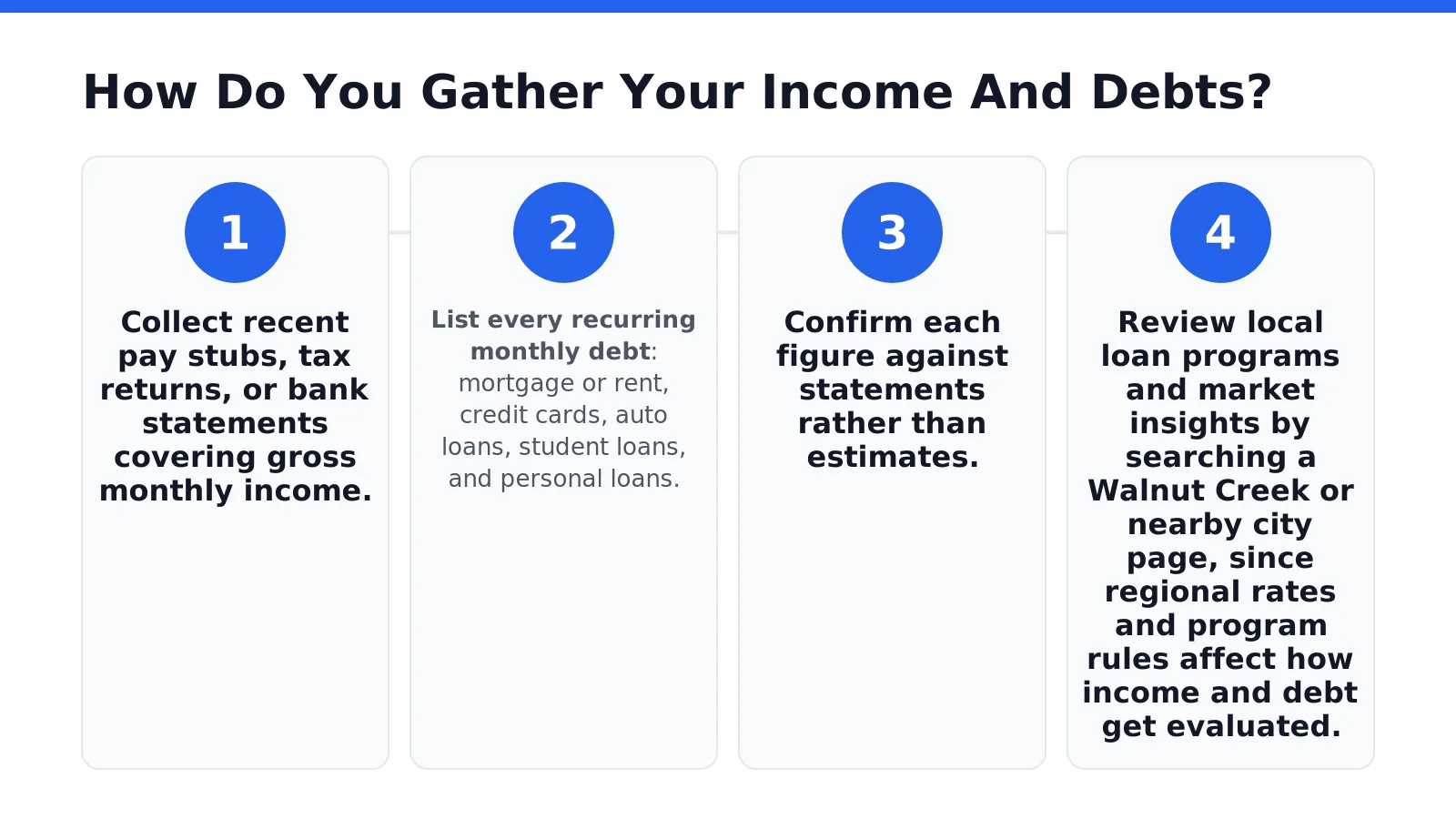
How Do You Gather Your Income And Debts?
Accurate figures come first, before any calculation begins. A reliable DTI calculation tool depends entirely on complete income records and a full list of monthly debts. Skipping a single obligation produces a ratio that misleads a lender and delays approval.
Munshi Capital Inc. serves a wide range of borrowers, from first-time homebuyers to seasoned investors, and each profile carries different income and debt documentation needs. A W-2 employee gathers pay stubs and tax returns. An investor relying on rental income or bank statement loans assembles different records entirely. Because loan programs such as FHA, VA, USDA, and bank statement financing are each built around a client’s unique financial picture, the documents that count toward DTI shift depending on the program.
What Debts Count Toward DTI?
DTI calculations typically include monthly debt payments such as rent or mortgage, credit cards, car payments, and other recurring debt obligations. Leaving out a smaller line item, like a personal loan or child support payment, still skews the final ratio.
Follow these steps to assemble a complete picture before using any DTI calculator guide:
- Collect recent pay stubs, tax returns, or bank statements covering gross monthly income.
- List every recurring monthly debt: mortgage or rent, credit cards, auto loans, student loans, and personal loans.
- Confirm each figure against statements rather than estimates.
- Review local loan programs and market insights by searching a Walnut Creek or nearby city page, since regional rates and program rules affect how income and debt get evaluated.
Borrowers who complete these steps before applying move through underwriting with fewer delays and clearer how to calculate DTI results.

How Do You Calculate Front-End And Back-End DTI?
Lenders rely on two distinct calculations to assess a borrower’s financial standing: a front-end ratio and a back-end ratio. Each figure measures a different slice of monthly obligations. Together they form the core of any DTI calculator guide used in mortgage underwriting.
The front-end ratio divides housing costs, including the projected mortgage payment, property taxes, and insurance, by gross monthly income. The back-end ratio takes a wider view. It adds in every recurring debt: car loans, credit cards, student loans, and child support, then divides that total by the same gross monthly income figure. Walnut Creek homebuyers comparing loan offers will typically see both numbers presented side by side.
Why are two DTI numbers reported instead of one?
Lenders list front-end and back-end figures together as a percentage pairing, often written as 36/43. This format lets underwriters see housing affordability and total debt load in one glance. A borrower might show a reasonable front-end percentage. An elevated back-end figure once auto loans and credit card balances enter the equation.
What steps does a borrower follow to calculate both ratios?
- Total projected monthly housing costs (principal, interest, taxes, insurance).
- Divide that housing total by gross monthly income to produce the front-end ratio.
- Add every other recurring debt payment to the housing total.
- Divide the combined sum by gross monthly income to produce the back-end ratio.
Munshi Capital pairs modern technology with direct guidance from loan specialists. This DTI calculation tool process stays fast and transparent. That combination gives Walnut Creek borrowers quick pre-approvals. Full visibility into their loan status from application through closing, removing guesswork from how to calculate DTI before an offer goes in.
What DTI Ratio Satisfies Mortgage Lenders?
Mortgage lenders generally favor a back-end debt-to-income ratio below 40 percent. Calculate Your Debt to Income Ratio identifies that threshold or higher as a sign of elevated borrower risk. A higher ratio signals greater risk to the lender and can block mortgage approval once it exceeds accepted limits. For homebuyers and investors in Walnut Creek, CA, understanding this threshold matters before submitting any loan application.
A DTI calculator guide helps clarify where a borrower stands relative to lender expectations. Rather than guessing, applicants can run their numbers through a structured process and see exactly how close they sit to the risk line. This clarity becomes especially valuable for real estate investors juggling multiple properties and income streams.
How Does a Lender Decide If a DTI Ratio Is Too High?
Lenders weigh the ratio against program-specific limits, and anything approaching or exceeding 40 percent on the back end raises red flags. The decision isn’t arbitrary; it reflects the lender’s risk tolerance for repayment ability. Borrowers near that line often face additional scrutiny or requests for compensating factors.
What Should Borrowers Do Before Applying?
- Gather all monthly debt obligations, including credit cards, auto loans, and existing mortgages.
- Confirm gross monthly income across all verifiable sources.
- Run the figures through a DTI calculation tool to see the resulting percentage.
- Compare that result against the 40 percent risk benchmark before submitting documentation.
Munshi Capital Inc. brings a diverse suite of residential and commercial loan programs to borrowers working through this exact process, from first-time buyers to seasoned investors. Its transparent, borrower-first guidance helps applicants interpret their results honestly, rather than guessing at what a lender will accept. Learning how to calculate DTI correctly, early, prevents wasted applications and protects credit inquiries from going to waste. Borrowers ready to explore their options can request a direct cash offer. Move forward with a clear view of their financing path.
What Mistakes Should You Avoid With DTI?
Mistaken assumptions about DTI figures trip up even well-prepared borrowers in Walnut Creek, CA. A serious error treats any DTI calculation tool result as a guarantee of loan approval. Such results serve educational purposes only and do not constitute a denial or approval of credit. Lenders still review full financial documentation before issuing a final decision.
A second mistake involves ignoring the spending side of the equation. Improving a DTI profile starts with a basic principle: earning more than one spends. Investors and first-time buyers chasing a lower ratio often focus solely on increasing income while overlooking recurring expenses that quietly inflate monthly obligations.
Does a high DTI mean automatic loan denial?
Not necessarily. A high ratio signals risk, but context matters. Borrowers working through Munshi Capital’s straightforward application, underwriting, and closing process encounter no hidden surprises once their figures are confirmed. The lending team emphasizes clarity at every stage of review.
What should borrowers do before running a DTI calculation tool?
Gather every recurring debt obligation first: auto loans, student loans, credit cards, and child support. Skipping this step produces an inaccurate baseline and misleads budgeting decisions for homes in Walnut Creek and nearby markets.
Common mistakes to avoid:
- Treating a DTI calculator guide result as a loan commitment rather than a planning estimate
- Omitting irregular debts like personal loans from the how to calculate DTI process
- Delaying outreach to a loan specialist until after an offer is made
Munshi Capital’s personalized guidance helps borrowers nationwide secure financing confidently once their ratio is fully understood, reducing costly missteps before closing. Borrowers evaluating their next step can request your property assessment to clarify how current equity supports their financing goals.
FAQ
What is a debt-to-income ratio?
Debt-to-income ratio divides your total monthly debt payments by your gross monthly income, expressed as a percentage. Lenders use this figure to evaluate mortgage qualification and your ability to repay a loan.
What documents do I need before calculating DTI?
Gather recent pay stubs, tax returns, and statements for every recurring debt, including credit cards, auto loans, student loans, and mortgages. Self-employed applicants pull profit-and-loss statements since gross income calculations differ from salaried employment.
What DTI ratio do lenders typically require for approval?
Munshi Capital Inc. matches borrowers to FHA, VA, USDA, DSCR, or bank statement programs based on their ratio.
Conclusion
In closing, understanding your debt-to-income ratio represents a critical foundation for mortgage qualification and financial planning. By calculating this metric accurately and addressing areas of concern before applying, you position yourself for stronger approval odds and more favorable loan terms. The mortgage process demands clarity and precision, qualities that define responsible borrowing. Armed with this knowledge, you can approach your financing decision with confidence, knowing exactly where you stand and what lenders will evaluate when considering your application.
Leave a Reply