
Scenario planning requires entering different loan amounts, interest rates, and loan terms, such as 15-year versus 30-year, into Munshi Capital Inc.’s mortgage calculator to compare monthly payments and total interest. Adjusting down payment percentages and property tax estimates reveals how each variable shifts affordability, helping buyers and investors identify the structure that fits their long-term budget.
Key Takeaways
- Mortgage calculators map your financial journey, eliminating guesswork and wasted time in home purchase planning.
- Input property price, down payment, taxes, insurance, and HOA dues for accurate monthly obligation estimates.
- DSCR calculations compare monthly costs to rental income, essential for investor-focused financing decisions.
- Transparent scenario planning reveals full loan costs upfront, aligning with our commitment to honest communication.
Why Model Loan Scenarios Before You Shop?
Modeling loan scenarios in advance prevents costly surprises and reveals which price range actually fits a budget. Skipping this step turns house hunting into guesswork. A buyer who shops first and calculates later often wastes weeks touring homes that never should have made the list, then loses more time renegotiating a budget mid-search.
Financial planning without a map wastes time, money, and energy, much like driving cross-country without directions. A buyer who runs the numbers first avoids that detour entirely. Scenario planning turns an abstract price tag into a concrete monthly obligation, long before an offer gets written.
Calculator best practices call for testing more than one borrowing structure rather than locking onto a single number. Comparing scenarios side by side exposes tradeoffs that a single estimate hides.
Does scenario planning work for investors as well as first-time buyers?
Yes. Munshi Capital Inc. structures loan programs for both first-time homebuyers and seasoned investors, so calculator scenario planning applies across the borrower spectrum. An investor modeling rental income against debt obligations needs the same rigor as a first-time buyer comparing starter homes.
What makes scenario planning trustworthy?
Transparency makes the difference. Munshi Capital Inc. builds its lending process around clear communication, so using mortgage calculators becomes part of a broader commitment to showing borrowers exactly where their numbers stand, long before closing day arrives.

What Inputs Drive An Accurate Calculator Estimate?
Three figures determine the baseline number: loan amount, interest rate, and loan term. A calculator computes this base payment first, then layers additional costs on top of it. Skipping any one of these inputs produces a number that looks clean but means little once closing day arrives.
The base payment alone never reflects the true monthly obligation. Property taxes, homeowners insurance, and association dues sit alongside the loan payment. Consumer tools often bundle these into a figure called PITI (principal, interest, taxes, and insurance). Leaving out local tax rates or dues understates the real cost, sometimes by a meaningful margin.
What Happens If Taxes Or Insurance Get Left Out?
Omitting taxes or insurance from the calculation produces a payment estimate that looks lower than reality demands. Buyers who budget only against the base loan figure often face a payment shock once full billing begins. Accurate calculator best practices require entering every recurring cost, not just the loan principal and interest.
Do Different Loan Programs Change The Output?
Loan structure changes the math significantly. Munshi Capital’s suite of FHA, VA, USDA, and bank statement loan programs each generate distinct calculator outputs. Down payment minimums, rate structures, and qualifying income rules vary by program.
Comparing programs side by side is one of the clearest calculator scenario planning exercises available to a buyer:
Buyers serious about using mortgage calculators effectively should treat the loan amount, rate, and term as the foundation, then add every recurring housing cost, and finally test the same purchase price across multiple loan programs before settling on one.

How Do Investors Use DSCR In Scenario Planning?
Investors run rental numbers through a mortgage calculator to see whether a property pencils before committing capital. For a rental purchase, comparing the total monthly housing obligation against expected rental income produces the debt service coverage ratio, known as DSCR. That single figure tells an investor whether rent covers the mortgage payment or falls short. It becomes the backbone of sound calculator scenario planning (calculator-scenario-planning-118).
Running multiple purchase scenarios side by side reveals patterns a single calculation never shows. One of the core calculator best practices for investors involves testing different purchase prices, down payments, and interest rate assumptions against the same rental income figure. This approach exposes exactly how much loan a given rent payment can support. Whether a deal still works if rates shift.
What does a DSCR number actually tell an investor?
A calculator output shows whether a deal pencils and how much loan the rental income can carry. A ratio above break-even signals the property generates enough rent to cover its own debt service. A ratio below that threshold flags a deal that depends on outside cash flow to survive.
Why run several scenarios instead of one?
Markets shift, rents fluctuate, and rate environments change month to month. Testing several scenarios at once, rather than relying on one static number, builds a buffer against those shifts. Using mortgage calculators this way turns a single estimate into a stress test.
Munshi Capital’s DSCR and hard money loan products serve investors who build their purchase strategy around rental income rather than personal income documentation.
What Are Calculator Best Practices For Reliable Numbers?
Reliable numbers come from treating a mortgage calculator as a planning tool, not a final verdict. Sound calculator best practices (calculator-best-practices-118) start with one rule: every output is a draft of the loan file, never the answer itself. A calculator does not know what a specific lender will actually count toward income, debt, or reserves. The figure on screen is a starting point for conversation, not a closing disclosure.
This distinction matters most during scenario planning with a calculator. Testing different down payments, rates, or loan terms reveals how a purchase might perform, but every result stays an illustrative estimate. None of it constitutes a credit offer or a commitment to lend. Treating a scenario run as pre-approval leads buyers to make offers on homes that may not pencil once a lender reviews actual documentation.
How accurate are online mortgage calculators?
Online calculators give directionally useful numbers but skip details unique to each borrower’s file. Property taxes, insurance, HOA dues, and credit profile all shift the real payment. The projection serves planning purposes; underwriting determines the final figure.
How should buyers verify calculator results?
Buyers should confirm projections with a lender who reviews income, credit, and property documentation. Munshi Capital Inc. pairs those estimates with a straightforward underwriting process. Numbers a borrower models early hold up through closing rather than shifting at the last stage.
Practical steps for using mortgage calculators (use-mortgage-calculators-118) effectively:
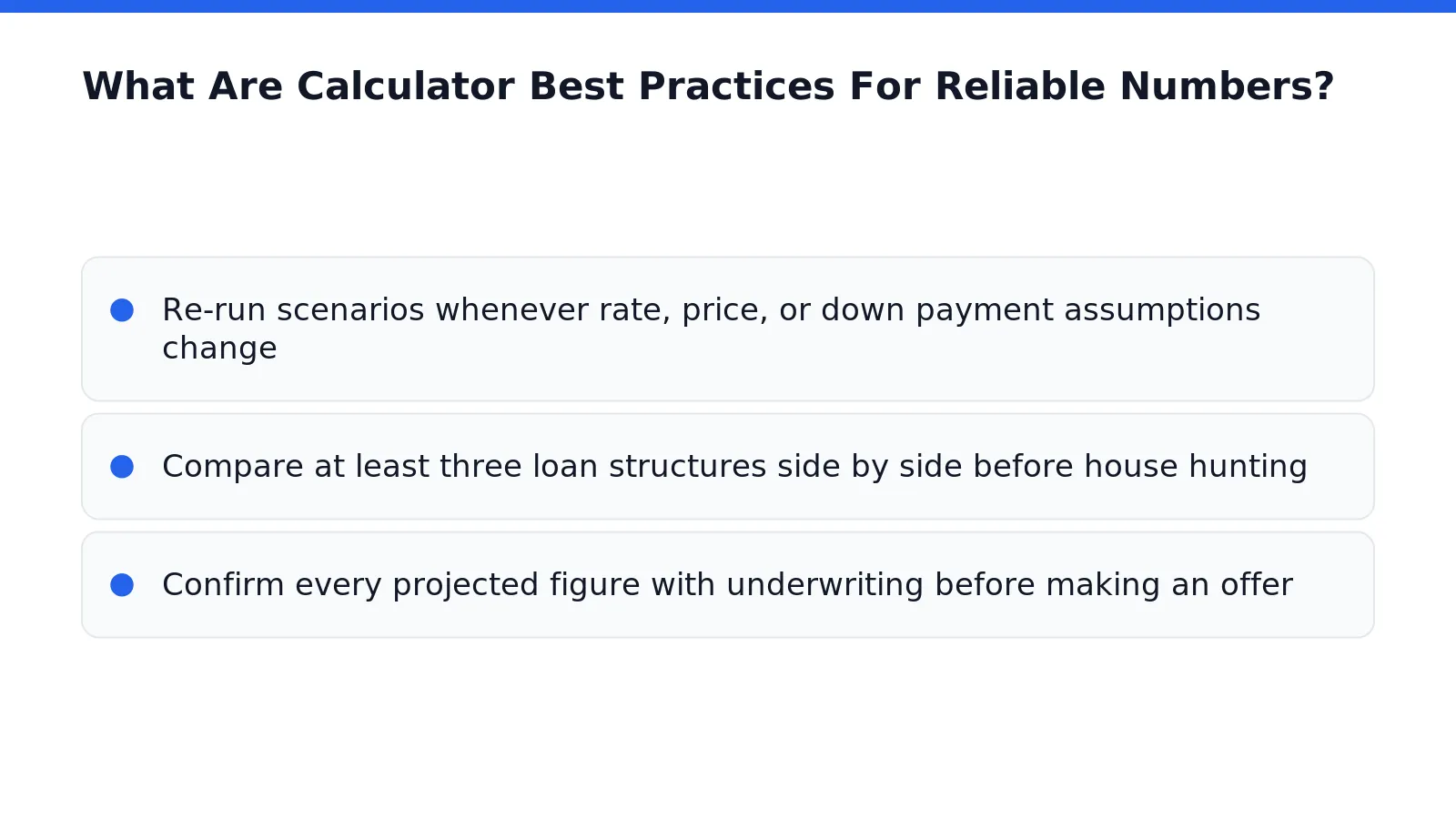
- Re-run scenarios whenever rate, price, or down payment assumptions change
- Compare at least three loan structures side by side before house hunting
- Confirm every projected figure with underwriting before making an offer
Buyers who skip that verification step risk negotiating from numbers a lender never confirms.
How Should You Turn Estimates Into Action?
A calculator output marks a starting point, not a finish line. Converting that estimate into an actual loan requires a lender who can validate the numbers and move the file forward. Munshi Capital Inc. carries buyers from a rough monthly-payment figure to full pre-approval, with complete visibility into loan status at every stage.
Strong calculator best practices treat the tool as a planning instrument, then pair it with real underwriting. Numbers alone do not close a deal; documentation, credit review, and program fit do. That’s where a lender’s product range matters.
What makes a lending partner suited to this next step?
A broad loan menu matters because every buyer’s scenario looks different. Munshi Capital Inc.’s wide array of loan products, from FHA and VA to bank statement and DSCR financing, gives first-time buyers and seasoned investors alike a path suited to their financial picture. That breadth, combined with personalized service, is why borrowers across the country treat the company as a trusted choice for turning a calculator scenario into actual financing.
Buyers ready to act can take a few concrete steps:
- Gather income documentation that matches the loan type modeled in the calculator.
- Compare property price points against local market data before applying.
- Request a direct cash offer on a current property to clarify available down payment funds.
- Discuss scenario results directly with a loan specialist for guidance on program fit.
Scenario planning for calculators only pays off when paired with expert review. Munshi Capital Inc. offers guidance through every loan program, giving buyers clear answers and dependable service as they move from projection to purchase. Sellers weighing a sale to fund that next purchase can also request your property assessment before setting a budget.
FAQ
What inputs produce an accurate mortgage calculator estimate?
Loan amount, interest rate, and loan term form the baseline payment. Property taxes, homeowners insurance, and HOA dues layer on top, together forming the true PITI monthly obligation.
Why does scenario planning matter before house hunting begins?
Running numbers first turns an abstract price tag into a concrete monthly obligation. Buyers who shop before calculating often waste weeks touring homes that never fit their actual budget.
How does DSCR fit into investor scenario planning?
DSCR calculations compare monthly housing costs to rental income, giving investors a clear picture of cash flow. Munshi Capital Inc. structures investor-focused financing around this comparison for informed decisions.
Conclusion
In closing, mortgage calculators serve as indispensable tools for informed financial planning, enabling borrowers to evaluate multiple scenarios and understand the true cost of homeownership or investment properties. By systematically testing variables and projecting outcomes, you establish a clear foundation for your lending decisions. When you are ready to move forward with confidence, our loan specialists stand prepared to guide you through the application and underwriting process with the same transparency and precision you applied to your scenario planning, ensuring your financing aligns precisely with your verified financial objectives.
Leave a Reply