
Mortgage underwriting determines whether a lender approves or denies a loan application, typically within 40 to 50 days. Underwriters evaluate credit history and score, income documentation, debt-to-income ratio, assets, and a home appraisal. California borrowers, including self-employed applicants, face program-specific criteria across FHA, VA, USDA, bank statement, and DSCR loans offered through Munshi Capital Inc.
Key Takeaways
- Underwriting takes 40 to 50 days after application submission to verify your loan approval eligibility.
- Lenders review credit history, credit score, and complete financial profile to assess repayment capacity.
- Loan processors gather and organize all necessary documentation for thorough underwriting review and verification.
- Final verification confirms you’re equipped to repay your mortgage in full and on time.
What Happens During Mortgage Underwriting?
Underwriting determines whether a lender approves or denies a mortgage application. A lender reviews the applicant’s full financial picture, verifies supporting documents, and weighs risk before issuing a final decision. For homebuyers and investors in Walnut Creek, this stage often feels like the most mysterious part of the loan process, largely because it happens behind the scenes.
Munshi Capital Inc. serves a wide range of borrowers, including first-time homebuyers and seasoned investors, across different loan programs. Because underwriting criteria shift depending on the program, borrowers benefit from guidance at every stage. This loan underwriting explained approach gives clients visibility into what reviewers actually check, rather than leaving them guessing.
How does the underwriting process stay transparent for borrowers?
Munshi Capital walks clients through application, underwriting, and closing with a consistent focus on clarity. Surprises get minimized, not because the process is simplified, but because communication happens at each checkpoint. Borrowers in California’s competitive housing markets, including self-employed applicants with non-traditional income documentation, gain confidence from knowing exactly where their file stands.
What makes Munshi Capital’s underwriting process faster?
Speed matters most to investors moving on tight timelines. Munshi Capital’s process is built to deliver quick pre-approvals alongside full visibility into loan status, from the first document request to the closing table. This underwriting criteria guide mindset, pairing speed with transparency, helps Walnut Creek buyers act decisively in fast-moving transactions.
Understanding what underwriters look for early in the process reduces last-minute delays. Borrowers who prepare documentation in advance, and who stay responsive during review, typically move through underwriting with fewer interruptions. Those ready to move forward can request a direct cash offer or request your property assessment to begin evaluating financing options with clarity from day one.

What Do Underwriters Actually Look For?
Underwriters base every mortgage decision on three core factors: credit, capacity, and collateral. These three C’s form the backbone of loan-underwriting-explained-025, the standard framework lenders use to decide whether a borrower qualifies for financing. For Walnut Creek homebuyers and California investors, understanding this framework removes much of the guesswork from the approval process.
Each of the three C’s answers a different question about a borrower’s financial picture.
- Credit: history of on-time payments, overall credit score, and management of existing accounts
- Capacity: income stability and the ability to repay the loan given current and future obligations
- Collateral: the property itself, confirmed through appraisal to secure the loan amount
Loan officers review credit history, income documentation, and outstanding debts together, not in isolation. A strong credit score paired with heavy outstanding debt still raises red flags during review. This is the essence of the underwriting criteria guide 025 that shapes every file, whether the applicant is a first-time buyer in Walnut Creek or a seasoned investor scaling a property portfolio across California.
What documents do underwriters check most closely?
Pay stubs, tax returns, and bank statements receive the closest scrutiny, since they verify income consistency and spending patterns. Debt-to-income calculations rely heavily on these records. Self-employed borrowers often face additional document requests to confirm steady cash flow.
Does the loan program change what underwriters look for?
Yes. Program type shapes the specific checklist within what underwriters look for 025. Munshi Capital Inc. structures FHA, VA, USDA, and bank statement loans around each borrower’s financial profile, so documentation requirements shift accordingly. For investors, DSCR and hard money loans emphasize property cash flow and collateral value over traditional income verification, reflecting investor-focused underwriting priorities rather than standard W-2 analysis.

How Long Does Underwriting Take To Complete?
Underwriting typically takes between 40 and 50 days to complete, according to Bankrate’s reporting on the mortgage underwriting process. For a Walnut Creek buyer racing toward a closing date, that window shapes everything from rate locks to moving plans. Missing it by even a week can mean a lost rate lock or a renegotiated purchase agreement.
Several factors move the timeline faster or slower: document completeness, loan type, and how quickly a borrower responds to underwriter requests. Self-employed applicants and investors often face additional scrutiny, since income verification requires more documentation than a standard W-2 file.
Why Does Underwriting Take So Long?
Underwriters verify credit history, income, assets, and the property’s appraised value before signing off. Each of these checks depends on third parties: credit bureaus, employers, appraisers. Delays in any one area stretch the full timeline.
Munshi Capital Inc. shortens that waiting period by pairing modern technology with hands-on loan specialists, giving borrowers full visibility into loan underwriting explained from submission to closing. Rather than leaving clients guessing, the team tracks each file’s status and flags missing items before they stall the process.
Can Borrowers Speed Up Their Underwriting Timeline?
Yes. Submitting complete documentation upfront, responding promptly to underwriter requests, and avoiding new credit activity during the review all help. This underwriting criteria guide approach reflects the personalized guidance that helps California borrowers, from first-time buyers to seasoned investors, move through financing with confidence. Understanding what underwriters look for before applying removes much of the uncertainty that extends closing timelines.
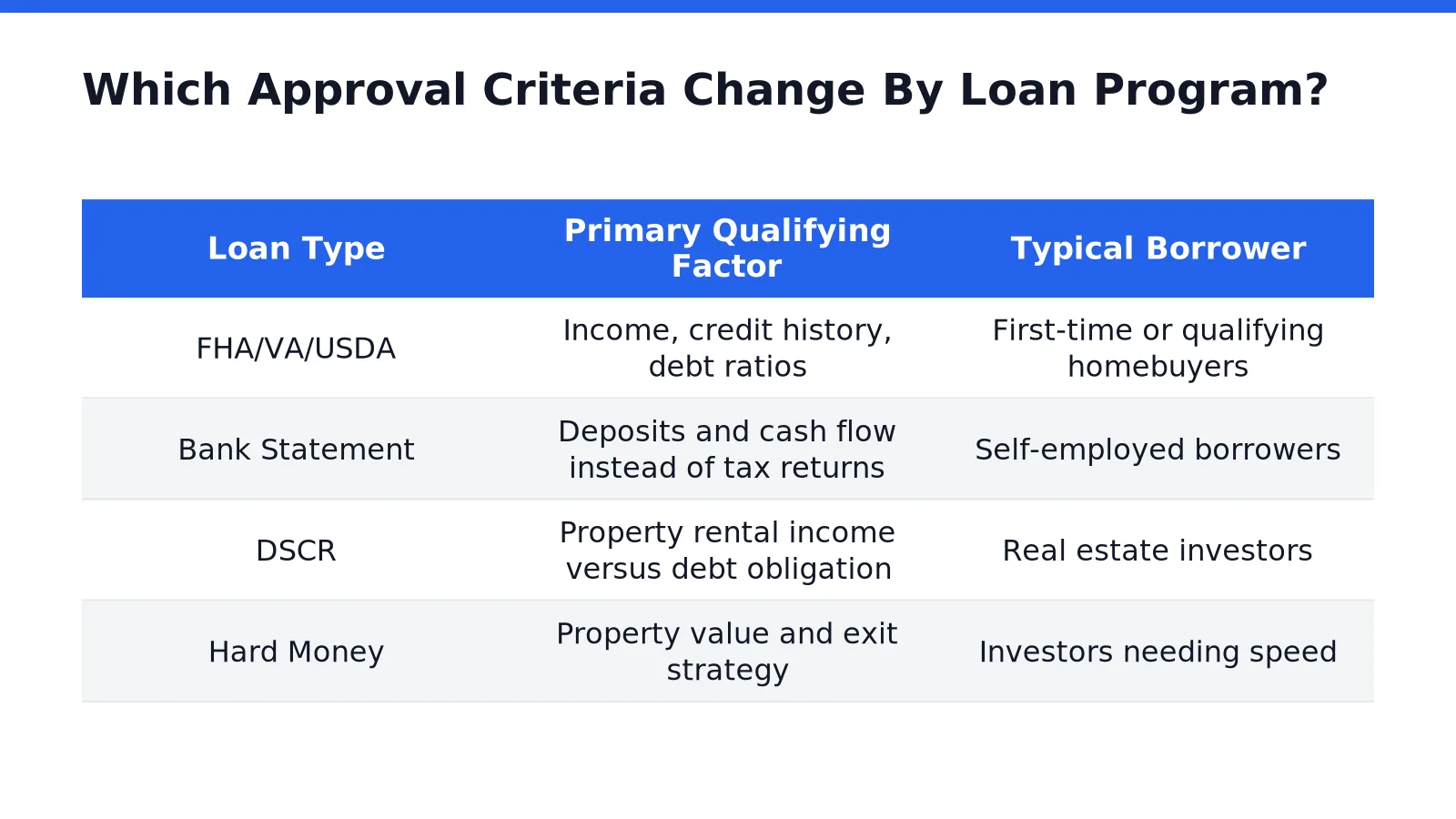
Which Approval Criteria Change By Loan Program?
Approval standards shift based on loan type, borrower profile, and how income gets verified. Each program carries its own rulebook, built to match a specific financial situation. A first-time buyer with salaried income faces different scrutiny than a self-employed investor financing a rental property.
Loan underwriting explained starts with one principle: guidelines exist to confirm a borrower qualifies for a given home loan. Mortgage underwriting guidelines set the standards lenders use to determine eligibility, and those standards vary by program design, not borrower preference. FHA, VA, USDA, and bank statement loans each get matched to a client’s unique financial picture, meaning the documents and thresholds reviewed differ from one program to the next.
How Do Underwriting Rules Differ For Investors Versus Homeowners?
Investors often qualify through property performance rather than personal income. DSCR and hard money loans give investors financing options built around the asset’s cash flow, not a W-2 or tax return. This matters for Walnut Creek investors buying rental units where personal income alone would not support traditional approval.
The table below outlines how criteria shift across common program types.
What Stays Consistent Across Every Program?
Regardless of program, the underwriter still confirms that a borrower’s financial profile matches the lender’s qualification guidelines and loan criteria. This underwriting criteria guide principle holds whether the file involves a government-backed loan or an investor-focused product. The documentation changes; the goal of verifying repayment ability does not.
How Can You Prepare For Approval?
Preparation starts with organized paperwork and realistic expectations about the review ahead. Walnut Creek homebuyers and California investors who understand loan underwriting explained in plain terms avoid delays. Reduce the risk of a denied application. Gaps in documentation or inconsistent financial records slow the process down and raise red flags for reviewers.
A clear underwriting criteria guide helps borrowers anticipate what lenders expect before submitting an application. Munshi Capital Inc. is built on trust and commits to transparent, borrower-first guidance throughout preparation and approval. That approach stays rooted in clarity and honesty, positioning the firm as a reliable partner through every stage of the loan journey.
What Should Self-Employed Borrowers Gather Before Applying?
Self-employed applicants in California benefit from assembling tax returns, profit-and-loss statements, and bank records ahead of time. Lenders rely on this documentation to verify income stability, especially when traditional pay stubs are not available.
Does Preparation Really Affect the Final Decision?
Yes. The underwriter reviews the completed file and makes the final call to approve or deny the application. Thorough preparation does not guarantee approval, but it removes avoidable obstacles from that decision.
Borrowers evaluating what underwriters look for should focus on three areas:
- Documentation accuracy: consistent income, asset, and identity records
- Financial readiness: manageable debt relative to income
- Property details: information that supports the loan request
Munshi Capital Inc. offers guidance through every loan program with clear answers and dependable service for borrowers across Walnut Creek and California.
FAQ
How long does mortgage underwriting take?
Underwriting takes 40 to 50 days after application submission to verify loan approval eligibility. Munshi Capital Inc. keeps borrowers informed at each checkpoint throughout this review.
What factors do underwriters evaluate during the review?
These three C’s, credit, capacity, and collateral, form the standard framework for approval decisions.
Does Munshi Capital Inc. offer underwriting guidance for self-employed borrowers?
Yes, Munshi Capital Inc. serves self-employed applicants in California with program-specific criteria across FHA, VA, USDA, bank statement, and DSCR loans. Personalized guidance helps borrowers navigate non-traditional income documentation confidently.
Conclusion
In closing, understanding mortgage underwriting and approval criteria empowers borrowers to navigate the lending landscape with confidence and clarity. Munshi Capital Inc. recognizes that each borrower’s financial situation is distinct, which is why our comprehensive loan programs, from FHA and VA options to bank statement and DSCR solutions, are structured to accommodate diverse circumstances. Our commitment to transparent communication and personalized guidance throughout the application, underwriting, and closing process ensures you understand every step of your financing journey. By partnering with our experienced loan specialists, you gain access to both advanced technology and hands-on expertise that delivers dependable service and fast pre-approvals, positioning you to achieve your real estate objectives with integrity and confidence.
Leave a Reply