
Closing costs cover lender, title, and government fees paid at settlement, typically including origination charges, appraisal, title insurance, and prepaid taxes or insurance. Freddie Mac reports average closing periods near 43 days. Munshi Capital Inc. offers a comprehensive suite of residential and commercial loan programs including FHA, VA, USDA, and bank statement loans, itemizing each fee for full transparency before signing.
Key Takeaways
- Closing costs are upfront expenses paid at closing, separate from your down payment, to complete your purchase.
- Typical closing costs include origination charges, service provider fees, government taxes, and mortgage and insurance costs.
- The closing process takes approximately 43 days from application submission, depending on document processing and inspections.
- Munshi Capital Inc. provides transparent breakdowns of all closing costs upfront, eliminating hidden surprises throughout your loan journey.
What Exactly Are Closing Costs?
Settlement expenses, not the down payment, make up the bulk of what buyers owe at the closing table. A closing costs guide defines these charges as upfront fees paid to complete a home purchase, covering everything from loan origination to title work. Missing this distinction early creates budgeting gaps that catch buyers off guard right before signing day.
Many first-time buyers assume the down payment covers the entire upfront obligation. It does not. The down payment is a separate payment, due at the same time as settlement charges, but calculated and paid independently. Treating the two as one line item leads to underfunded closings and last-minute scrambling for cash.
Are closing costs the same for every loan type?
No. Mortgage closing fees shift depending on the loan program selected. FHA, VA, USDA, and bank statement loans each carry distinct fee structures tied to underwriting requirements, insurance mandates, and documentation standards. A borrower comparing programs needs figures specific to the loan in question, not a generic estimate.
How does Munshi Capital help borrowers prepare?
Munshi Capital Inc. guides borrowers through a clear application, underwriting, and closing sequence designed to eliminate guesswork. This structure means settlement charges surface early, not as a surprise at signing. The approach applies across loan types, so whether a borrower pursues FHA, VA, USDA, or bank statement financing, the path toward estimating closing costs stays consistent and transparent from the first conversation through the final signature.
Which Fees Make Up Mortgage Closing Fees?
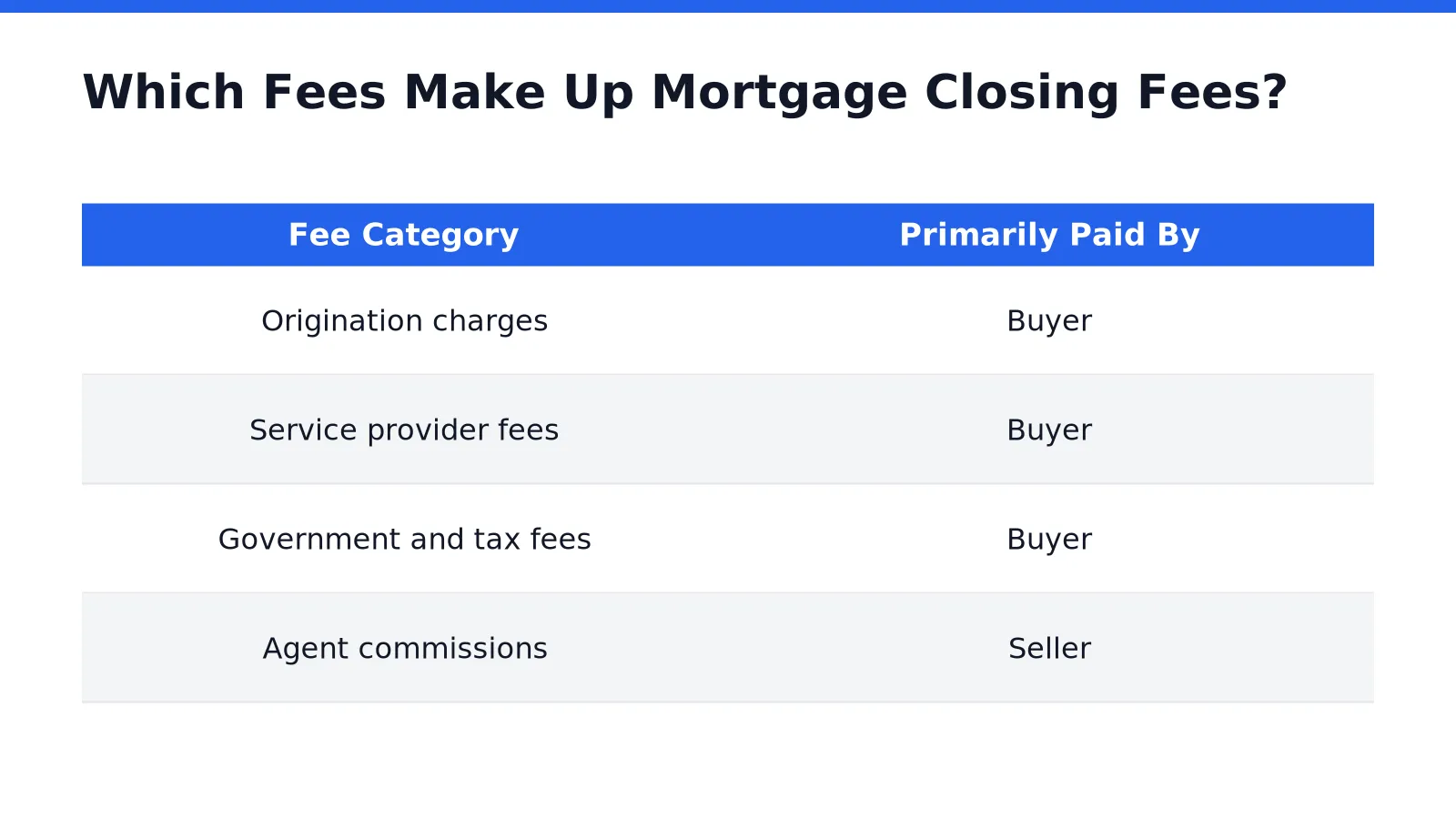
Four categories make up nearly every settlement statement: origination charges, service provider fees, government and tax-related fees, and mortgage and insurance costs. Each category covers a different part of the transaction, from lender processing to local recording offices. Missing a line item at the budgeting stage leaves buyers scrambling for cash days before closing.
A clear closing-costs-guide-026 separates these categories so clients can plan ahead rather than react to surprise charges. Origination charges cover the lender’s work to process and underwrite the loan. Service provider fees pay for appraisals, title searches, and inspections. Government and tax-related fees fund recording and transfer taxes. Mortgage and insurance costs include items like prepaid interest and homeowners insurance premiums.
Who Pays Closing Costs, Buyers or Sellers?
Buyers and sellers do not split the bill evenly. Buyers typically shoulder most mortgage-closing-fees-026 tied to the loan itself, including origination and lender-service charges. Sellers, meanwhile, carry costs connected to the home, with real estate agent commissions forming the largest share of what they owe. Negotiation can shift some buyer-side costs onto the seller, depending on market conditions.
Do Investors Pay Different Closing Fees Than Homebuyers?
Investors often see a different mix of charges than traditional residential buyers. Munshi Capital Inc. structures DSCR and hard money loan products for seasoned investors, whose transactions carry fee line items that standard owner-occupant loans rarely include. Residential and commercial loan solutions get built around each client’s financial picture. That picture determines which fees apply at the closing table.
Learning to estimate closing costs early prevents last-minute shortfalls and keeps the transaction on schedule.

How Can You Estimate Closing Costs Early?
Early estimates start with a realistic range, not a guess. Closing cost totals shift based on the home, the loan type, the lender, and other underwriting requirements. No single number applies to every borrower. Treating an early estimate as a moving target, rather than a fixed figure, keeps the budgeting process honest from the start.
A reliable closing-costs-guide-026 approach begins with matching a property. Loan program to a lender capable of producing accurate figures quickly. Munshi Capital Inc. pairs modern technology with hands-on loan specialists, which speeds pre-approval and keeps borrowers informed of expected mortgage-closing-fees-026 well before the closing table. That combination matters because fee estimates change as underwriting uncovers more details about the property and the loan structure.
What information do borrowers need before requesting an estimate?
Lenders need the purchase price, loan program, and property location to generate a meaningful figure. Credit profile and down payment amount also shape service and government-related fees. Gathering these details first avoids rework and delay.
Why does visibility matter during underwriting?
Full visibility into loan status, from application through closing, lets borrowers track fees as they move through underwriting. Costs can shift when inspections, appraisals, or title work reveal new requirements. Monitoring these changes in real time prevents surprises at signing.
Borrowers ready to begin the estimate-closing-costs-026 process can take a few concrete steps:
- Submit a quick application outlining property type and loan goals.
- Review program options with a Munshi Capital loan specialist.
- Request an itemized cost breakdown before locking a rate.
- Track fee updates through closing using the lender’s status tools.
Those who want a cost comparison without a full application can request your property assessment to see how local market conditions affect their specific fee range.

How Do You Reduce Out-Of-Pocket Costs?
Borrowers lower upfront expenses through down payment assistance, seller negotiations, and lender transparency. Several practical levers exist before the closing table, and most require action weeks in advance rather than last-minute scrambling.
Down payment assistance programs often extend beyond the down payment itself. Many allow borrowers to apply the same assistance funds toward settlement expenses, shrinking the cash required at signing. Checking eligibility early matters, since program rules and funding availability vary by lender and location.
Negotiation offers another path to savings. A motivated seller may agree to cover a portion of the buyer’s fees as part of the purchase agreement. Lender credits present a second option, trading a slightly higher rate for reduced upfront charges. Rolling certain costs into the loan balance spreads expense over the life of the mortgage instead of demanding it in a single payment.
Can Lender Credits Really Lower My Bill?
Yes. Lender credits reduce the amount due at closing in exchange for a modestly higher interest rate. Borrowers planning a long-term hold should weigh that tradeoff carefully before accepting.
Munshi Capital’s mission of transparency keeps every charge visible throughout underwriting, so clients avoid last-minute surprises. This closing-costs-guide-026 approach, paired with a borrower-first philosophy rooted in clarity and honesty, supports confident financial planning long before signing day. Clients seeking a personalized breakdown can request your property assessment to understand which strategies apply to their specific loan.
What Should You Remember Before Closing?
Clarity matters more than speed in the final days before signing. Borrowers who review every line item avoid surprises at the table. A solid closing costs guide gives homebuyers, refinancers, and investors a checklist for that final stretch, not just a list of fees to memorize.
Munshi Capital guides borrowers through every step from application to closing with clarity and speed, leaving no hidden surprises buried in paperwork. That approach extends into the final walkthrough of fees, where questions get answered before signatures happen, not after.
What makes a lender trustworthy at closing?
Trust comes from consistency, not promises made once and forgotten. Munshi Capital’s integrity, personalized service, and wide array of loan products have made it a trusted choice for homebuyers and investors nationwide. Borrowers benefit from guidance built around their specific financial picture rather than a one-size-fits-all script.
Three things to confirm before signing:
- Every mortgage closing fee matches what was disclosed earlier in the process.
- Loan terms reflect the program actually chosen, not a generic default.
- Questions about any charge get a plain-language answer, not jargon.
Munshi Capital delivers mortgage financing built around the borrower, offering clear answers through every loan program, right up to the closing table. That borrower-first guidance stays rooted in trust and transparent communication from application through final signature.
FAQ
What are closing costs?
Closing costs are upfront fees paid at settlement, separate from the down payment, covering origination charges, service provider fees, government and tax-related fees, and mortgage and insurance costs.
Do all loan types have the same closing costs?
No. FHA, VA, USDA, and bank statement loans each carry distinct fee structures tied to underwriting requirements, insurance mandates, and documentation standards, so figures vary by loan program.
How does Munshi Capital help borrowers understand closing costs?
Munshi Capital Inc. guides borrowers through a clear application, underwriting, and closing sequence, itemizing each fee upfront so settlement charges surface early instead of as a surprise at signing.
Conclusion
In closing, understanding closing costs and fees represents a critical step toward informed borrowing decisions. Munshi Capital Inc. remains committed to demystifying these expenses through transparent communication. Straightforward guidance, ensuring you navigate the lending process with complete clarity. Our loan specialists provide personalized support throughout your journey, eliminating surprises and building confidence in your financing choice. When you partner with us, you gain not merely a lender, but a dedicated advocate committed to your financial success.
Leave a Reply