
Self-employed professionals in Walnut Creek, CA gain access to Non-QM loan programs through Munshi Capital Inc., which evaluate bank statements and business cash flow instead of W-2s or tax returns. These solutions address variable income and tax write-offs common among freelancers and small business owners, supporting FHA, VA, USDA, DSCR, and bank statement loan paths toward homeownership.
Key Takeaways
- Self-employed borrowers access mortgages without traditional W-2 income documentation through bank statement loans.
- Non-QM loan programs eliminate tax return requirements, streamlining approval for freelancers and business owners.
- Munshi Capital Inc. offers DSCR and hard money loans specifically designed for investor-focused financing needs.
- Our transparent underwriting process provides quick pre-approvals with full visibility from application through closing.
Why Do Self-Employed Borrowers Face Mortgage Hurdles?
Traditional underwriting favors predictable, documentable paychecks. Business owners, freelancers, and independent contractors rarely fit that mold, even when their income is strong and stable. Lenders built their standard rulebook around W-2 employees. A tax return full of legitimate business write-offs can look weaker on paper than it really is.
This mismatch creates real friction for the self-employed workforce. Self-employed Americans make up a workforce too large for lenders to treat as a niche exception.
Why do lenders scrutinize self-employed income more closely?
Underwriters rely on consistent income trends to predict future ability to repay a loan. Variable revenue, seasonal contracts, and multiple income streams complicate that math, triggering extra documentation requests and longer review timelines.
What makes qualifying harder for business owners specifically?
Deductions that lower a tax bill also lower the income figure a conventional lender counts toward approval. A business owner earning a comfortable living can appear underqualified once write-offs are factored in, even though cash flow tells a different story.
Munshi Capital Inc. structures its self-employed mortgage guide approach around that reality rather than against it. Its mortgage financing is built around the borrower, offering guidance through every loan program with clear answers and dependable service. Because each client’s financial picture looks different, the company designs self-employed loan options and bank-statement solutions to fit circumstances that standard underwriting overlooks, from fluctuating revenue to multiple business entities. Independent professionals in Walnut Creek and nearby communities deserve financing built for how they actually earn, not a format designed for someone else’s paycheck.
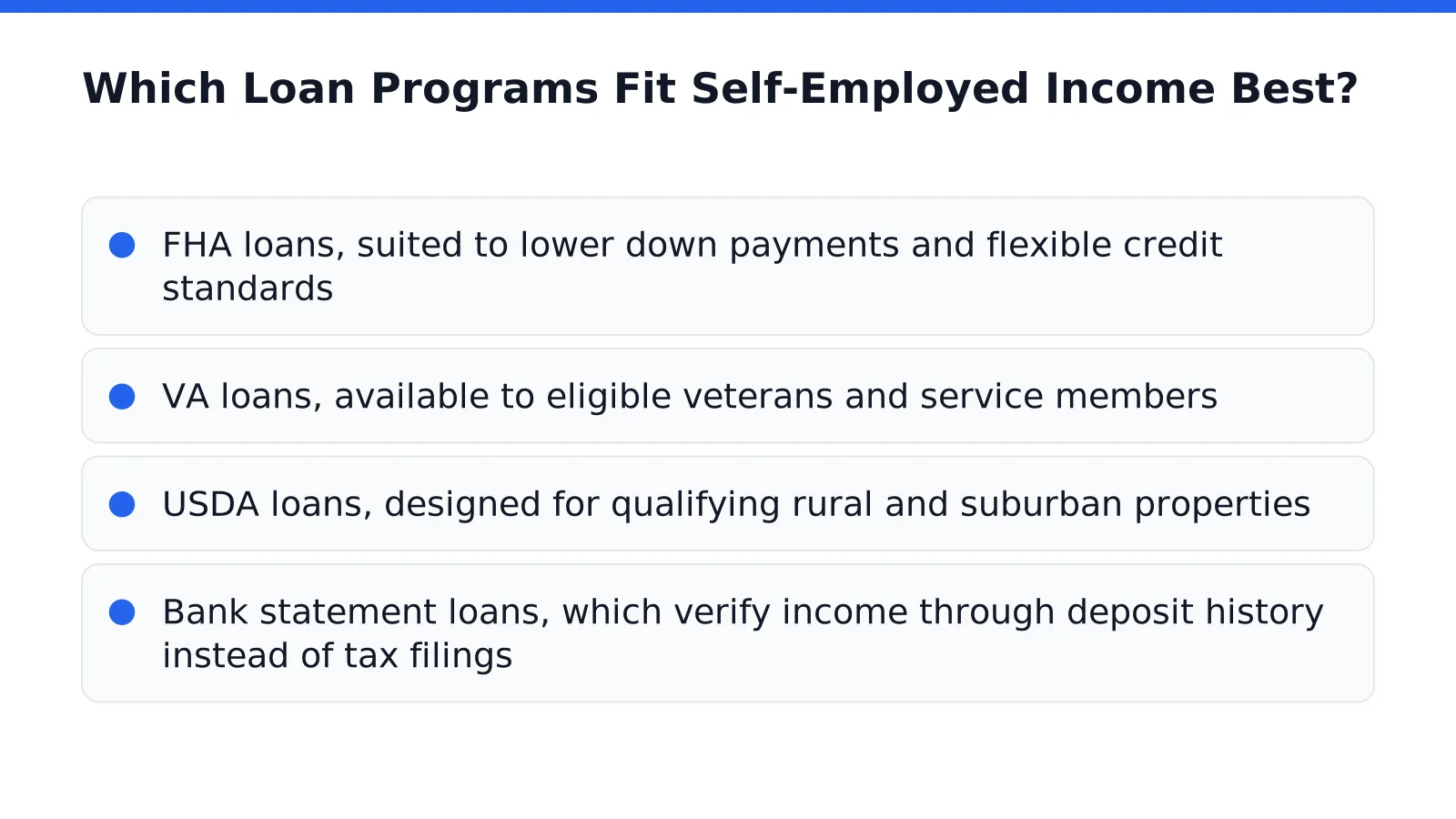
Which Loan Programs Fit Self-Employed Income Best?
Self-employed professionals in Walnut Creek qualify for several mortgage paths, each built around a different way of proving income. Munshi Capital Inc. structures its offerings around this reality, pairing government-backed options with alternative-documentation programs designed for variable earnings. A freelancer with strong cash flow but thin tax returns needs a different approach than a contractor with steady 1099 income. The right program depends on how income gets documented.
Munshi Capital Inc. specializes in mortgage financing built for a wide range of borrowers, from first-time homebuyers to seasoned investors. That range includes:
- FHA loans, suited to lower down payments and flexible credit standards
- VA loans, available to eligible veterans and service members
- USDA loans, designed for qualifying rural and suburban properties
- Bank statement loans, which verify income through deposit history instead of tax filings
Investors in the Walnut Creek market also gain access to DSCR loans. Hard money financing, both structured around property cash flow and asset value rather than personal income documentation.
What is a Non-QM loan, and why does it matter for self-employed borrowers?
A Non-QM loan sits outside the standard “qualified mortgage” rulebook, using alternative documentation instead of tax returns. This makes it one of the more practical self-employed-loan-options-028 available. Write-offs and income swings on a Schedule C no longer stand in the way of approval. Borrowers show earning power through bank deposits, business activity, or assets instead.
How does a bank statement loan work?
Underwriters review twelve to twenty-four months of personal or business bank statements to calculate qualifying income. This What Is a Bank Statement Loan and How Does It Work? approach to financing bypasses net-income figures shaped by deductions, focusing instead on actual cash flow. For a business owner whose tax returns understate true earnings, this method reflects income more accurately. Building a sound self-employed-mortgage-guide-028 strategy starts with matching income documentation to the right program.

How Do Bank Statement Solutions Prove Your Income?
Bank statements replace W-2s and tax returns as proof of earning power. Deposits across months reveal cash flow patterns that traditional underwriting often overlooks. For self-employed professionals in Walnut Creek, this shift removes a major barrier to approval.
Bank-statement solutions rely on alternative documentation, such as monthly statements or 1099 forms, rather than the standard paperwork required of salaried employees. This approach suits the reality of running a business: income arrives unevenly, write-offs reduce taxable earnings, and a single pay stub never tells the full story.
Who benefits most from this documentation approach?
Small business owners, contractors, gig workers, and freelancers see the clearest advantage. Each group earns income differently, and bank statement review meets them at the point of actual cash flow rather than forcing their finances into a W-2 template.
What documents do lenders actually review?
Verification varies by program, but lenders typically examine:
- Personal or business bank statements covering a set number of months
- Tax returns, when available and relevant to the loan type
- Business financial records, including profit and loss statements
- 1099 forms for contractors and gig-based earners
This layered review lets underwriters judge true earning capacity, not just what a tax return shows after deductions.
A self-employed mortgage guide built around this method gives business owners a realistic path to approval. Rather than penalizing legitimate write-offs, it credits actual deposits as evidence of ability to repay. Munshi Capital Inc. includes bank statement loans within its broader suite of residential. Commercial programs, giving Walnut Creek borrowers access to self-employed loan options that reflect how they actually earn, not how a standard form assumes they should.

What Documents Strengthen a Self-Employed Application?
Strong documentation turns variable income into a clear, underwritable story. Business owners, freelancers, and independent contractors often struggle to document fluctuating earnings and extensive tax write-offs, which can muddy a traditional application. Preparation closes that gap. With proper paperwork assembled in advance, self-employed applicants may obtain mortgage approval more smoothly and avoid delays that stall a closing timeline.
Certain records consistently carry weight in underwriting review. A well-organized file typically includes:
- Bank statements covering 12 to 24 months, used in bank-statement-solutions-028 programs to establish cash flow without relying on tax returns
- Profit-and-loss statements prepared for the business
- Proof of business licensing or registration
- Evidence of consistent deposits across multiple accounts, when applicable
What if tax returns don’t reflect true income?
Many self-employed professionals write off business expenses aggressively, which lowers taxable income on paper even when actual cash flow stays strong. This mismatch is exactly why alternative documentation exists. Programs built around bank deposits or asset verification look past the deductions. Focus on what the business actually brings in.
Does a thin file disqualify a borrower?
Not necessarily. A self-employed mortgage guide approach prioritizes context over a single document. Munshi Capital Inc. maintains a mission of transparency, emphasizing clarity and honest communication at every stage of the lending process. Borrowers move through application, underwriting, and closing with no hidden surprises. The full picture, not just a tax return, shapes the decision.
For business owners weighing financing options, exploring self-employed loan options early allows time to gather the right records before an offer is even on the table. Homeowners ready to move forward can request your property assessment to see how current equity. Income documentation line up with available programs.
How Does Munshi Capital Guide You to Closing?
A dedicated loan specialist walks each borrower through every stage of financing, from first application to final signature. Self-employed professionals in Walnut Creek face a different underwriting path than salaried applicants, and personalized guidance closes that gap. Munshi Capital’s team studies each client’s goals and income structure before recommending a loan path. Freelancers and contractors avoid guesswork and wasted paperwork.
Technology drives speed; people drive judgment. That pairing lets Munshi Capital issue quick pre-approvals while keeping loan status visible at every step. Borrowers see where their file stands, what remains outstanding, and what comes next, without chasing updates.
What Happens After Submitting a Loan Application?
Once a file enters underwriting, specialists review income documentation, whether that means bank statements, 1099s, or business cash flow. This self-employed mortgage guide approach keeps communication direct, so applicants always know their standing. Surprises at closing become rare when visibility stays constant throughout.
Why Does Loan Program Variety Matter for the Self-Employed?
Business owners rarely fit one mortgage mold. Munshi Capital’s range of residential and commercial programs gives borrowers several self-employed loan options rather than a single rigid product. Independent contractors with seasonal income, multiple revenue streams, or significant write-offs need bank-statement solutions built around real cash flow, not a single tax-return snapshot.
This combination, integrity, tailored service, and broad product access, builds trust nationwide. For Walnut Creek homebuyers and investors ready to move forward, the next step starts with a conversation with a specialist who understands self-employed income. Sellers of investment or business property exploring a faster exit alongside their financing options can request a direct cash offer to compare timelines before committing to a loan path.
FAQ
Can self-employed borrowers qualify for a mortgage without tax returns?
Yes, Non-QM loan programs through Munshi Capital Inc. evaluate bank statements and business cash flow instead of tax returns, addressing variable income and write-offs common among freelancers and business owners.
Why do self-employed applicants face more mortgage scrutiny?
Underwriters rely on consistent income trends. Variable revenue, seasonal contracts, and multiple income streams trigger extra documentation requests and longer review timelines.
What loan options does Munshi Capital Inc. offer self-employed borrowers?
Munshi Capital Inc. pairs government-backed programs like FHA, VA, and USDA with alternative-documentation options including bank statement loans, DSCR loans, and hard money loans for investor-focused needs.
Conclusion
In closing, self-employed borrowers navigating the mortgage landscape require financing solutions that acknowledge the complexity of non-traditional income documentation. Munshi Capital Inc. addresses this reality through specialized loan programs, including bank statement and DSCR options, designed specifically for entrepreneurs and independent professionals. Our commitment to transparency and personalized guidance ensures that your unique financial profile receives thorough evaluation and honest communication throughout the lending process. By combining modern technology with dedicated loan specialists, we deliver the clarity and dependable service necessary to transform your homeownership or investment objectives into reality.
Leave a Reply