
DSCR loan qualification for real estate investors depends on property cash flow, not personal income. Munshi Capital Inc. evaluates the debt service coverage ratio, typically requiring a minimum 680 credit score, sufficient rental income, down payment or equity, reserves, and an appraisal confirming value for non-owner-occupied investment properties nationwide.
Key Takeaways
- DSCR loans qualify borrowers on property cash flow rather than personal income and tax returns.
- Non-owner-occupied investment properties with acceptable rental income evidence meet core DSCR loan eligibility requirements.
- Minimum credit scores, down payment equity, and sufficient reserves demonstrate financial stability to lenders.
- Property appraisal, title insurance, and acceptable condition documentation complete the DSCR qualification process.
What Is a DSCR Loan for Real Estate Investors?
A DSCR Loan for Real Estate Investors is an investment property loan that bases approval on the property’s cash flow rather than the borrower’s personal income and assets. Qualification hinges on rental performance, not pay stubs or tax filings. This structure opens financing to first-time buyers without years of reportable income. To seasoned investors whose tax returns show heavy deductions.
Underwriting works differently here than it does for a conventional mortgage. Lenders evaluate whether a property’s qualifying rental income can cover its proposed monthly housing payment. Tax returns, W-2s, and pay stubs take a back seat to one central question: does the property pay for itself?
For fund managers overseeing multiple acquisitions, this income-based model simplifies scaling. Instead of re-proving personal income with every new purchase, each property stands on its own financial merit.
How Does DSCR Differ From a Traditional Mortgage?
Traditional mortgages weigh a borrower’s personal income, debt, and employment history above all else. A DSCR structure instead measures the ratio between rental income and the property’s debt obligation. This shift lets investors qualify using the income the property generates, rather than relying primarily on personal earnings.
Who Uses DSCR Financing Most Often?
First-time buyers entering real estate investing, seasoned investors expanding portfolios, and fund managers acquiring properties at scale all rely on this financing structure. Each group benefits from reduced dependence on personal income documentation.
Munshi Capital Inc. includes DSCR loans among its specialized, investor-focused lending products, alongside hard money loans designed for time-sensitive acquisitions. These programs sit within a broader suite built for borrowers whose financial pictures do not fit conventional underwriting molds.
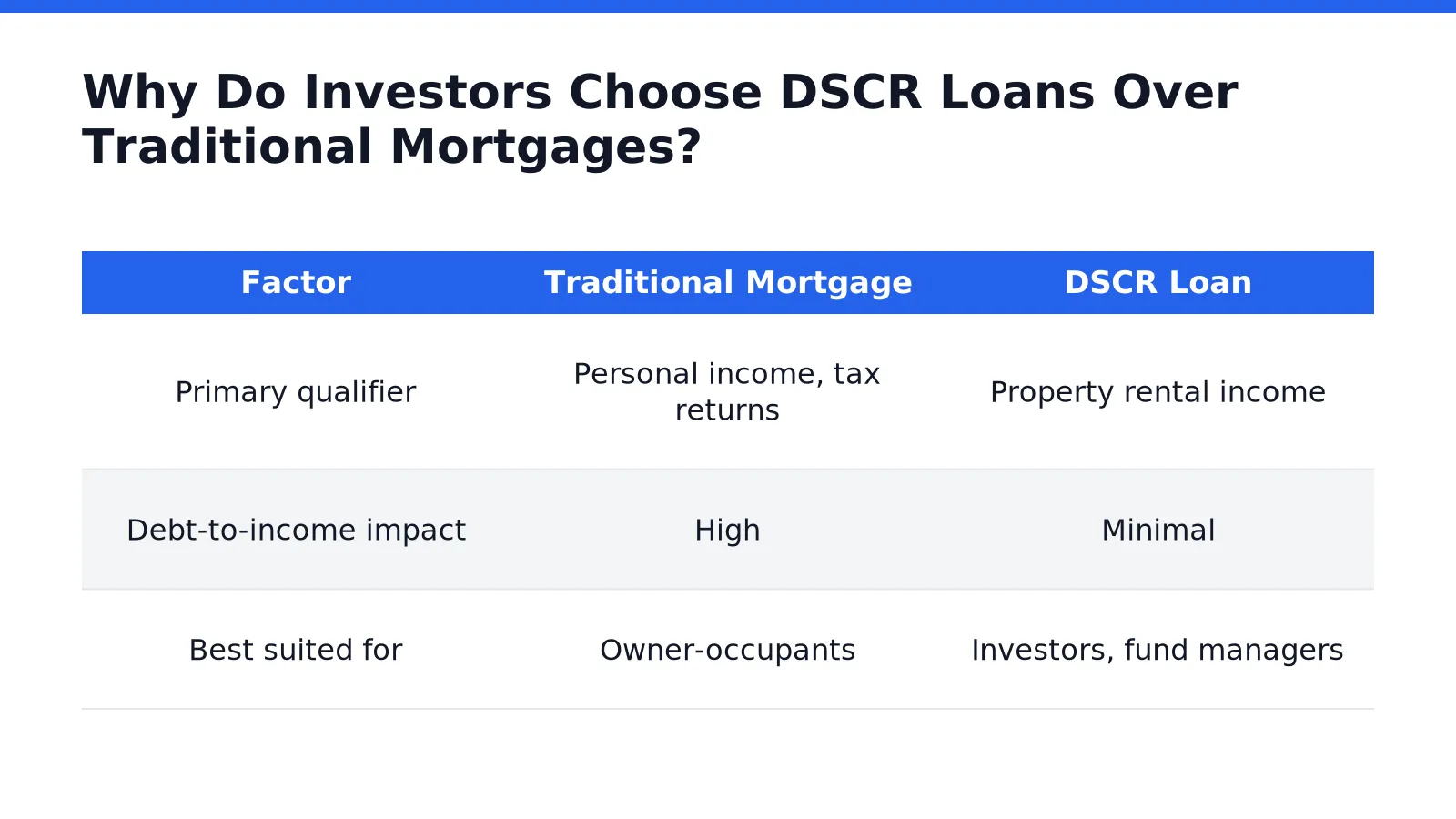
Why Do Investors Choose DSCR Loans Over Traditional Mortgages?
Traditional mortgages weigh personal income, tax returns, and debt-to-income ratios above all else. DSCR Loans for Real Estate Investors shift that calculation entirely, qualifying borrowers based on the cash flow a property generates rather than a paycheck. That distinction matters most for investors carrying multiple mortgages or non-traditional income streams that would sink a conventional application.
Investors new to real estate often face the same obstacle as seasoned portfolio holders: too much existing debt on paper, even when the properties themselves perform well. DSCR financing was built specifically for this gap. It suits borrowers who are new to real estate or who carry other debt obligations that would otherwise make them ineligible for a traditional mortgage.
Who Benefits Most From a DSCR Loan?
First-time investors acquiring a rental property often struggle to prove income the way a W-2 employee can. Seasoned investors with several financed properties hit debt-to-income ceilings that traditional underwriting cannot look past. Fund managers assembling multiple acquisitions face similar limits when lenders insist on evaluating personal finances property by property.
DSCR Loan Eligibility Requirements differ sharply from conventional underwriting:
How to Qualify for DSCR Loans comes down largely to the subject property’s performance rather than the borrower’s resume. Munshi Capital Inc. structures its DSCR and hard money programs specifically for this investor-focused lane, separate from standard residential financing. Personalized guidance helps borrowers nationwide determine whether a DSCR loan or a conventional path fits their portfolio strategy, with confidence built on matching the right loan to the right income profile.
What Are the Core DSCR Loan Eligibility Requirements?
DSCR Loan Eligibility Requirements cover a defined set of factors lenders review before approving financing on a rental property. Real estate investors seeking approval must satisfy criteria tied to the property itself, not solely to personal income.
Lenders evaluating a DSCR Loans for Real Estate Investors application typically assess an eligible non-owner-occupied investment property, documented rental income, and a qualifying monthly property payment. Sufficient debt service coverage ratio, acceptable credit history, and adequate down payment or equity round out the core financial checks. Closing funds, cash reserves, a satisfactory appraisal, acceptable property condition, clear title, proper insurance, and entity or vesting documentation for investors holding title through an LLC or similar structure complete the review.
The table below breaks down these categories at a glance.
How to Qualify for DSCR Loans Without W-2 Income?
How to Qualify for DSCR Loans depends on rental cash flow rather than tax returns or pay stubs. First-time buyers and seasoned investors alike must still present acceptable credit, a down payment or equity position, and property documentation that satisfies appraisal and title review.
Does Every DSCR Loan Have the Same Requirements?
No single standard applies across every lender or deal. Requirements vary by program, transaction type, property, loan size, state, and borrower profile, meaning no two investor files look identical. Fund managers evaluating multiple properties should expect different reserve, credit, or equity thresholds from one loan to the next.
Credit standards offer one concrete benchmark: many lenders set a minimum credit score around 680 for DSCR loan approval. Stronger profiles typically unlock better pricing. Final terms always rest on current approved guidelines and the loan documents issued at closing, which control over any general summary.
How Is the DSCR Ratio Calculated for a Property?
A property’s debt service coverage ratio comes from a simple division: monthly rental income divided by the monthly mortgage payment. This single number tells lenders whether a rental property generates enough cash to cover its own debt obligation, independent of the borrower’s personal income. A ratio above 1.0 signals the property earns more than it owes each month. A ratio below 1.0 means the rent falls short, raising risk for the lender.
For real estate investors evaluating DSCR loans for real estate investors, this calculation forms the backbone of how to qualify for DSCR loans without submitting tax returns or pay stubs. Fund managers overseeing multiple properties benefit from this approach because each asset gets judged on its own merit rather than the fund’s overall balance sheet.
The ratio alone, however, rarely tells the full underwriting story.
What else do lenders check beyond the ratio?
Lenders also review several property-level and loan-level factors as part of complete underwriting. These additional checks shape the DSCR loan eligibility requirements a borrower ultimately faces:
- Rental income documentation and market comparables
- Loan-to-value ratio relative to the purchase price or appraised value
- Property type, such as single-family, multifamily, or short-term rental
- Loan purpose, including purchase, rate-and-term refinance, or cash-out
- Reserve funds available after closing
Munshi Capital Inc. combines underwriting technology with hands-on loan specialists to move investors through pre-approval quickly. First-time buyers gain the same visibility into loan status as seasoned investors, with no guesswork about where a file stands. That transparency matters most when timing a rental purchase in a competitive market.
How Do Credit Score and Down Payment Rules Work?
Credit score and down payment requirements set the baseline for DSCR loan eligibility requirements, and lenders apply both in tandem. A minimum credit score of 680 stands as a common benchmark among lenders offering these programs. Real estate investors who clear that threshold gain access to financing structured around rental income, not personal tax returns.
Score and pricing move together. A higher credit score generally produces a better interest rate and more favorable loan terms for the investor. Fund managers overseeing multiple acquisitions benefit most from this dynamic. Even modest rate improvements compound across a portfolio of properties.
Down payment rules follow a similarly direct structure. DSCR loans typically require a down payment between 20% and 25% of the purchase price. First-time buyers entering investment real estate should budget for this range before shopping for a property, rather than assuming conventional mortgage minimums apply.
Can Investors Put Down Less Than 20%?
Some lenders offer lower down payment options to borrowers who combine strong credit with prior investment property experience. Seasoned investors with a track record of managing rental properties may qualify for reduced equity requirements. First-time investors, by contrast, should expect to meet the standard range until a repayment history develops.
Investors evaluating financing strategy should treat credit score and down payment as the first filter. How to qualify for DSCR loans starts here, before underwriters even review rental income or property cash flow. Strengthening credit ahead of application remains the most direct lever an investor controls.
How Much Do Credit Score Minimums Vary by Lender?
Credit score minimums for DSCR Loans for Real Estate Investors shift considerably depending on the lender and the specific program selected. Fund managers and seasoned investors comparing offers often discover that no single threshold applies across the market.
Many programs set the starting bar around a 640 credit score, according to DSCR Loans Explained: Requirements, Rates & Refinance. That figure represents a baseline rather than a guarantee of approval. Some lenders tighten requirements when the property’s income coverage weakens. Newfi, for example, requires a minimum 660 score once the debt service coverage ratio drops below 1.00, a distinction that matters for investors purchasing properties with thinner cash flow margins.
Does a Higher Credit Score Help Beyond Just Approval?
Stronger credit profiles influence more than the approval decision itself. Investors with higher scores typically access better leverage, more competitive pricing, improved loan terms, and greater structural flexibility. First-time buyers transitioning into investment property ownership benefit from understanding this link early, since it directly shapes long-term borrowing costs.
Lender-by-lender variation is the norm, not the exception, which is why DSCR Loan Eligibility Requirements deserve close comparison before an investor commits to a program:
Not all DSCR loans are structured the same way. This variance explains why how to qualify for DSCR loans depends heavily on which lender and program an investor targets. Fund managers evaluating multiple properties should treat credit score minimums as one variable among several. Coverage ratio, leverage, and property cash flow interact with credit standing to determine final loan terms.
How Do DSCR Requirements Vary by Lender and Property?
Lender guidelines for DSCR Loans for Real Estate Investors shift based on who holds the loan and what property secures it. No single rulebook applies across the market. Credit thresholds, down payment amounts, minimum coverage ratios, and reserve requirements all move depending on the lending source and the asset type involved.
Wholesale investors and direct lenders set their own risk tolerances, and those differences show up in the fine print. Two borrowers with identical properties can face entirely different terms from different sources. The variation touches several categories at once, not just one line item.
Factors that commonly shift between lenders include:
- Minimum credit score thresholds
- Down payment or equity requirements
- Acceptable debt service coverage ratio minimums
- Required reserve amounts
- Property type restrictions and condition standards
Does property type affect DSCR loan terms?
Property type plays a direct role in how DSCR Loan Eligibility Requirements get applied. Commercial assets, for instance, are typically underwritten around the income and value the property generates, with terms built around the specific investment strategy behind the purchase. Multifamily buildings, mixed-use properties, and single-family rentals each carry distinct underwriting expectations tied to their income profiles.
Why do guidelines change so often?
Approved guidelines and final loan documents govern every DSCR transaction. Those terms can be updated by the lender at any time. Investors learning how to qualify for DSCR loans should confirm current terms before assuming eligibility across different property types. Relying on outdated assumptions creates unnecessary risk during underwriting. Financing built around property income and flexible terms, tailored to the investment strategy at hand, remains available to business owners and real estate investors nationwide, with current guidelines determining the final outcome in every case.
What Other Investor Loan Programs Pair With DSCR Financing?
Hard money loans pair most directly with DSCR financing for investors building a repeatable acquisition strategy. Munshi Capital Inc. offers DSCR Loans for Real Estate Investors alongside hard money products as specialized, investor-focused financing options, giving a fund manager or a seasoned investor more than one lever to pull depending on the stage of a deal.
A short-term hard money loan often covers the acquisition and renovation of a distressed property. Once the property stabilizes and starts producing rental income, a DSCR loan can replace that short-term debt with longer-term financing based on the property’s cash flow rather than the borrower’s personal tax returns. This sequencing matters for first-time buyers testing an investment strategy. For fund managers scaling a portfolio across multiple properties at once.
How does the application process work when combining loan types?
Borrowers move through a straightforward application, underwriting, and closing process regardless of which loan type they select. The structure is built for ease and understanding, with no hidden surprises along the way. Understanding how to qualify for DSCR loans matters here, since lenders review property income first rather than personal income documentation.
Which investor loan programs work alongside DSCR financing?
Investors typically combine DSCR financing with:
- Hard money loans for acquisition and rehab phases
- Commercial mortgage programs for multifamily or mixed-use holdings
- Bank statement loans for self-employed investors building a portfolio
Meeting the DSCR loan eligibility requirements for refinancing out of short-term debt protects long-term cash flow. Avoids forced sales under time pressure.
Munshi Capital Inc. specializes in mortgage financing built around borrowers ranging from first-time homebuyers to seasoned investors. That range, paired with a commitment to integrity and personalized service, positions the firm as a trusted resource for investors nationwide who need more than one financing tool working together.
FAQ
What credit score is required for a DSCR loan?
Munshi Capital Inc. typically requires a minimum 680 credit score for DSCR loan qualification, alongside sufficient rental income, down payment or equity, reserves, and a confirming appraisal.
How does DSCR loan qualification differ from traditional mortgage underwriting?
DSCR loans qualify borrowers based on property cash flow rather than personal income, debt, or employment history. Lenders assess whether rental income covers the monthly housing payment instead of reviewing tax returns and pay stubs.
Who benefits most from DSCR financing?
First-time buyers without years of reportable income, seasoned investors with heavy tax deductions, and fund managers acquiring multiple properties all benefit from DSCR financing’s income-based qualification model.
Conclusion
In closing, understanding DSCR loan qualifying criteria positions real estate investors to make informed financing decisions aligned with their investment objectives. Munshi Capital Inc. recognizes that investor financing demands specialized expertise and transparent guidance throughout the underwriting process. Our comprehensive DSCR loan program, combined with personalized support from our loan specialists, ensures you navigate qualification requirements with clarity and confidence. We remain committed to delivering the straightforward, dependable service that empowers investors nationwide to secure the right financing for their portfolio growth.
Leave a Reply