
Hard money loans give Investors property buyers short-term, asset-based financing secured by real estate, with interest rates between 8% and 15%, closing in as few as 10 business days. Approval depends on collateral value, not personal credit history. Munshi Capital Inc., based in Walnut Creek, CA, provides this investor-focused financing nationwide, including throughout Investors markets.
Key Takeaways
- Hard money loans offer fast funding secured by real property, typically closing in days instead of weeks.
- Interest rates range from 8% to 15%, reflecting the higher risk profile compared to traditional mortgages.
- These short-term, asset-based loans prioritize property value over personal credit, enabling flexible qualification for real estate investors.
- Hard money financing serves as a bridge solution for property acquisitions and renovations when speed and certainty matter most.
What Is a Hard Money Loan for Investors?
A hard money loan is a secured loan backed by real property, built specifically for purchasing or renovating investment assets. For investors evaluating properties nationwide, this financing structure offers a path that standard mortgages cannot match. Approval hinges on the property’s collateral value, not the borrower’s financial résumé.
Hard money lenders weigh the merits of the investment opportunity rather than the investor’s credit history. The property under contract serves as collateral, and its value drives the lending decision. This shifts the underwriting focus away from pay stubs and credit scores toward market value, repair budgets, and exit strategy.
Who Actually Lends This Money?
These loans do not come from conventional banks. Instead, funding flows from individual investors, investing groups, and specialized financing companies that understand asset-based lending. Investors and fund managers working across multiple markets often rely on this network rather than a single local bank branch.
Munshi Capital Inc. structures hard money loan requirements around the property’s income potential and collateral value, serving investors nationwide, including those sourcing deals far from the company’s Walnut Creek, CA base.
Short-Term, Asset-Based: Explained Simply
Hard Money Loans Explained in one sentence: they are short-term, asset-based financing tools secured by real estate, typically issued by private or nonbank lenders. Investors use them for:
- Fix-and-flip acquisitions requiring fast closing
- Bridge financing between purchase and permanent loan
- Properties that traditional underwriting would reject
- Renovation projects tied to a tight resale timeline
Seasoned investors and fund managers ready to move on a deal can request a direct cash offer or request your property assessment to evaluate collateral value before committing to terms.
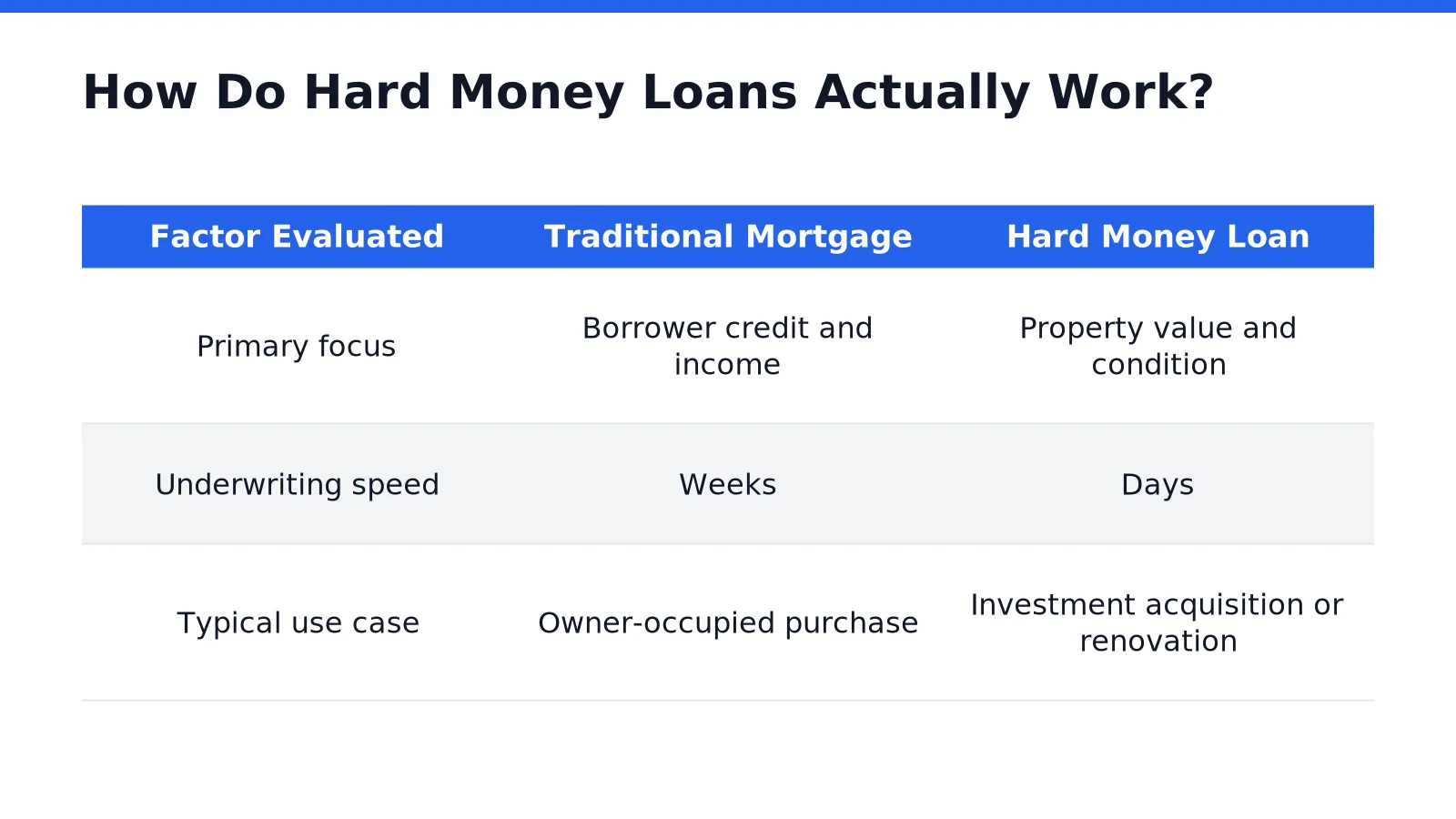
How Do Hard Money Loans Actually Work?
A short-term, asset-based loan funds the purchase or renovation of an investment property. Hard Money Loans Explained simply: the property itself, not the borrower’s income history, carries the weight of the transaction.
Investors evaluating fix-and-flip deals or rental acquisitions often need capital faster than a conventional lender can deliver. Hard money financing meets that need by focusing on the property’s value rather than the applicant’s personal finances. This structure removes weeks of income verification and bank-statement review from the timeline.
What makes hard money lending different from a traditional mortgage?
Traditional mortgages weigh credit scores, tax returns, and debt ratios before issuing a decision. Hard money loans work differently. They are secured by real property and function as short-term bridge or last-resort financing, typically deployed when speed matters more than rate.
How does the approval process actually move faster?
Approval speed comes down to what the lender examines first. Collateral value drives the decision, not a credit file. What is a hard money loan approval process favors the asset’s condition, location, and resale or rental potential.
Because lenders prioritize collateral over creditworthiness, approval moves considerably faster than conventional underwriting allows. Fund managers juggling multiple acquisitions benefit from that compressed timeline. Sellers facing a tight closing window value it too. Understanding this collateral-first mechanism is the foundation for meeting hard money loan requirements before applying.

What Hard Money Loan Requirements Should Investors Know?
Qualification for a hard money loan rests on property value, not personal credit history. Lenders evaluate the collateral first, which explains why approval moves faster than a conventional mortgage. For investors weighing financing on a new acquisition, understanding these mechanics matters before signing anything.
Hard money loan requirements differ sharply from bank underwriting standards. Collateral-based review allows closings in as little as 10 business days, since lenders skip the lengthy income verification and credit-scoring steps traditional mortgages demand. Speed comes at a price, though. Interest rates on these loans typically run between 8% and 15%, a range that reflects the higher risk lenders absorb when creditworthiness takes a back seat to asset value.
Investors should also expect financing caps tied to the property itself. Some lenders advertise loans reaching up to 80% of a property’s value. The exact ceiling varies by deal structure and lender appetite. Flexible qualification standards make these loans accessible to borrowers who might not clear conventional underwriting, but that flexibility carries tradeoffs.
Are hard money loans harder to qualify for than regular mortgages?
They are generally easier to qualify for, since lenders weigh the property’s value above the borrower’s income or credit score. That flexibility helps investors move quickly on time-sensitive deals. The exchange, however, includes shorter repayment windows and a heightened risk of foreclosure if repayment stalls.

When Should Investors Use Hard Money Financing?
Investors turn to hard money financing when a deal depends on speed rather than low rates. Hard Money Loans Explained in simple terms: these are short-term, asset-based loans tied to a property’s value instead of a borrower’s credit profile. Traditional financing moves at a bank’s pace; hard money moves at an investor’s pace.
Timing drives most decisions here. A bridge loan scenario illustrates this well: when a seasoned investor needs to close before a competing buyer does, hard money loans serve as short-term bridge or last-resort financing built for moments when speed is critical. Fund managers juggling multiple acquisitions often rely on this structure to avoid losing a property to a slower-moving buyer.
What situations call for hard money loans?
Fix-and-flip projects remain the clearest use case. Investors often use hard money loans to finance property renovations and resale. The loan term typically aligns with the renovation and sale timeline rather than a 30-year mortgage schedule.
Beyond flips, these loans suit a narrower range of circumstances:
- Acquiring investment property when conventional underwriting would take too long
- Funding renovations before a property qualifies for permanent financing
- Covering short-term real estate needs when traditional lending isn’t practical
What is a hard money loan not designed for?
What is a hard money loan meant to replace is a long-term mortgage; it is not. The structure fits transitional needs, primarily buying or renovating investment property, not holding it for decades. Fund managers and first-time investors alike should match the loan’s short duration to a clear exit strategy before borrowing. Understanding Hard Money Loan Requirements upfront prevents mismatched expectations about repayment timing.
What Benefits Do Hard Money Loans Offer Investors?
Speed defines the primary advantage for investors pursuing properties in competitive markets. Hard money loans explained simply: these are financing tools built around the asset, not the applicant’s financial history. For investors, delayed financing often means a lost deal or a missed renovation window. Munshi Capital Inc. structures hard money products for Investors to close quickly, with funding decisions tied to the property’s value rather than months of income documentation.
That value-based approach changes who qualifies. What is a hard money loan at its core? It is a short-term, asset-based loan that prioritizes collateral over credit score. Investors with uneven income histories, prior credit challenges, or limited time to assemble tax returns often find this path more accessible than a conventional mortgage.
Term length matters just as much as approval speed.
Why do investors choose shorter loan terms?
Shorter terms, typically six to 18 months, align naturally with renovation and resale timelines. Investors who flip properties rarely want a 30-year commitment on a six-month project. A compressed term keeps carrying costs contained while the property moves toward sale or refinance.
Investors weighing a time-sensitive acquisition can request a direct cash offer to compare financing paths before committing capital. Those evaluating an existing property’s position within a portfolio can also request your property assessment to clarify value ahead of underwriting decisions.
What Risks Should Investors Weigh Before Borrowing?
Elevated interest rates and low loan-to-value ratios top the list of concerns for property investors nationwide. These terms make hard money loans a poor fit for anyone planning to live in the property long-term. Investors purchasing rental units, fix-and-flip projects, or multifamily assets across the country face a different calculation than owner-occupants, since speed and flexibility matter more than low monthly payments.
Shorter repayment periods add further pressure. Compared with conventional mortgages, hard money loans compress the payoff window, and that compression raises the stakes if renovation timelines slip or resale markets soften. Greater foreclosure risk follows directly from this structure: miss a payment or blow past the term, and the lender can move to reclaim the collateral.
Can an investor lose the property with a hard money loan?
Yes. Because the loan is secured by the real estate itself, failure to meet repayment terms carries significant risk of losing the pledged asset. Investors managing multiple projects or fund portfolios across different markets should treat this risk as a planning variable, not an afterthought.
Before committing capital, investors should weigh costs against risks using a clear framework:
- Exit timeline: Does the project’s completion date leave margin before the loan matures?
- Rate tolerance: Can projected returns absorb higher financing costs?
- Collateral exposure: What happens to the portfolio if one property faces foreclosure?
Munshi Capital Inc. serves investors and fund managers across the country with transparent terms on every financing option, including hard money products. Clients weighing a purchase can request a direct cash offer or request your property assessment to clarify next steps before signing.
How Fast Can Investors Close a Hard Money Loan?
Closings happen in as little as 10 business days, according to Hard Money Loan: Definition, Uses, and Pros & Cons. That timeline reflects collateral-focused underwriting, a process where lenders weigh the property’s value rather than the borrower’s personal credit history. For investors competing on distressed listings or auction properties, that speed often determines whether a deal closes at all.
Hard money loans explained in simple terms: short-term financing secured by real estate, built for speed over flexibility. Traditional mortgage underwriting stretches across weeks of document review and income verification. Hard money financing skips much of that friction, moving faster because the asset itself carries the risk assessment.
Why Do Hard Money Loans Close So Much Faster Than Traditional Mortgages?
Traditional lenders scrutinize tax returns, employment history, and debt ratios before approving a mortgage. Hard money lenders instead evaluate the collateral property’s market value and condition. This narrower focus removes layers of underwriting, which is what a hard money loan fundamentally changes about the approval process.
Speed carries a tradeoff that investors must plan around before signing.
What Should Investors Confirm Before Closing?
Investors should map out an exit strategy before the loan funds, since repayment windows run between six and 18 months. A fix-and-flip sale, refinance, or lease-up plan needs a realistic timeline that fits inside that window. First-time buyers and fund managers alike benefit from requesting a direct cash offer comparison before committing to short-term terms. Should request your property assessment early to confirm valuation accuracy ahead of underwriting.
How Can Munshi Capital Help Investors Qualify?
Qualification for investors starts with matching the loan structure to the deal, not forcing the deal into a rigid box. Munshi Capital Inc. structures mortgage financing for borrowers ranging from first-time homebuyers to seasoned investors, which means an investor evaluating a rental property in a competitive market gets terms built around that property’s income potential rather than a generic template. For fund managers and portfolio investors scaling across multiple properties, that flexibility carries real weight.
Hard Money Loans Explained through Munshi Capital’s lens means pairing short-term, asset-based financing with DSCR options built for investor cash flow. These specialized products exist precisely for buyers who need speed or whose income documentation does not fit conventional underwriting molds.
What Is a Hard Money Loan for an Investor Buying Property Sight Unseen?
For an investor acting quickly on a property, it functions as asset-backed capital tied to the property’s value rather than the borrower’s tax returns. That structure lets a fund manager move on a time-sensitive acquisition without waiting on a lengthy conventional review.
What Are the Hard Money Loan Requirements Investors Should Prepare For?
Requirements center on the property itself: its value, condition, and projected income. Munshi Capital guides borrowers through a straightforward application, underwriting, and closing sequence with no hidden surprises along the way.
Behind that process sits a combination of technology and human oversight. Fast, transparent handling is backed by modern platforms and the hands-on attention of loan specialists, which translates into:
- Quick pre-approvals investors can act on
- Full visibility into loan status at every stage
- Direct communication instead of guesswork
Investors weighing a purchase can request a direct cash offer. Sellers assessing current value can request your property assessment to clarify next steps.
FAQ
What interest rates do hard money loans carry?
Hard money loans carry interest rates between 8% and 15%, reflecting the higher risk profile compared to traditional mortgages. Munshi Capital Inc. structures these loans around the property’s collateral value and income potential.
How fast does a hard money loan close?
Hard money loans close in as few as 10 business days, far faster than conventional mortgage timelines. This speed comes from focusing underwriting on property value rather than income verification.
What determines approval for a hard money loan?
Approval depends on the collateral value of the property, not the borrower’s personal credit history or income documentation. Lenders assess market value, repair budgets, and exit strategy to make the lending decision.
Conclusion
In closing, hard money loans represent a strategic financing mechanism for investors requiring expedited capital deployment and flexible underwriting criteria. The speed, accessibility, and asset-based structure of these loans address critical gaps in traditional lending pathways, enabling investors to capitalize on time-sensitive opportunities and navigate complex financial profiles. When paired with transparent guidance and personalized loan structuring, hard money financing becomes a dependable tool for building and scaling investment portfolios across diverse market conditions.
Leave a Reply