
Capturing featured snippets, People Also Ask boxes, and local packs requires structured, question-based content paired with city-specific pages. Munshi Capital Inc. demonstrates this through dedicated mortgage pages for 20 markets, including Los Angeles, Sacramento, and San Diego, pairing local loan programs with clear, direct answers search engines extract first.
Key Takeaways
- Google displays over 30 SERP features, requiring strategic optimization to capture borrower attention and clicks.
- Featured snippets, People Also Ask boxes, and local packs dominate search results, pushing organic listings lower.
- Targeting these features requires clear, direct answers that address borrower questions about loan programs and financing options.
- Optimizing for SERP features increases visibility for first-time homebuyers and investors searching for transparent mortgage guidance.
What Will You Need to Start This SERP Playbook?
Three assets matter most: a mapped content inventory, a working knowledge of current SERP feature types, and a willingness to format pages for extraction. A mortgage content team already has raw material for this work. Loan programs spanning FHA, VA, USDA, and bank statement options each represent a distinct topic cluster. Clusters are the building blocks of any serp-feature-playbook-105.
Before writing a single page, the scope of the opportunity needs defining. More than 30 distinct SERP feature types now compete for the same query, which means no single ranking tactic covers the field. Teams that treat organic position as the only goal will miss carousels, knowledge panels, and answer boxes sitting above it.
Why does the SERP keep changing?
Google launched featured snippets in 2014 and has layered in maps, carousels, AI Overviews, and dozens of additional elements since. A content calendar built for 2014-era SEO will underperform against today’s mixed results page. Planning for target-featured-snippets-105 work now means building pages flexible enough to answer questions directly, in formats Google can elevator and display.
What role does local optimization play?
Multi-market lenders need local-pack-optimization-105 baked into their content structure from the start, not added later. City-specific loan pages, sourced from the same program library, give each market its own answer surface. A lending operation built on technology-backed pre-approvals and transparent loan-status tracking already understands fast, visible delivery. Content built with that same speed and clarity wins the same trust on the search results page.
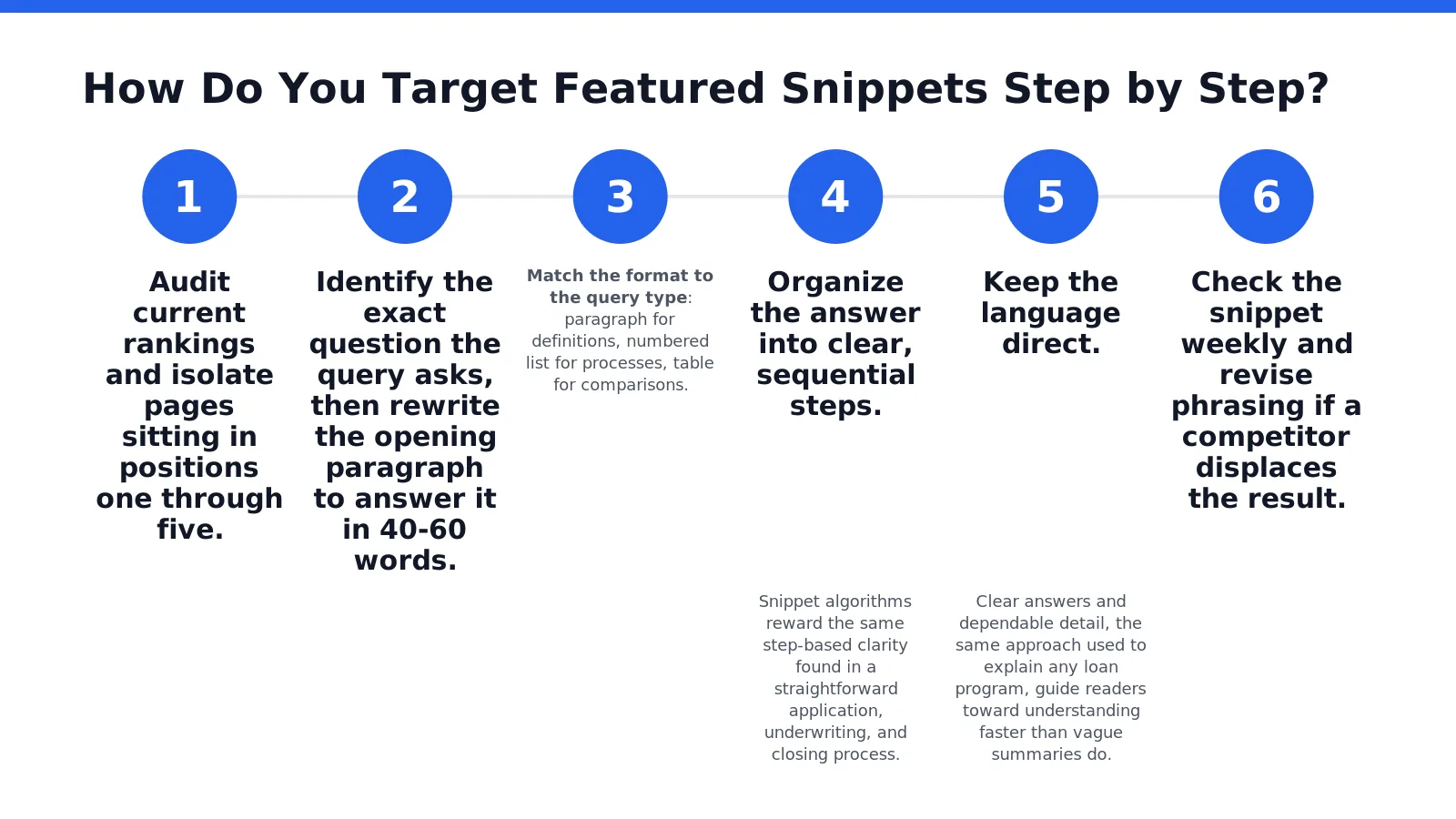
How Do You Target Featured Snippets Step by Step?
Capturing position zero follows a specific sequence, not guesswork. Featured snippets are concise summaries pulled programmatically from a page and placed above every other organic result, a placement search marketers call position zero. Building a serp feature playbook turns that placement into a repeatable outcome instead of a lucky break.
Before starting, confirm the target page already ranks in positions one through five for the query in question. Pages at that level represent the strongest opportunity for snippet capture, since existing top-five content needs refinement rather than a full rebuild.
- Audit current rankings and isolate pages sitting in positions one through five.
- Identify the exact question the query asks, then rewrite the opening paragraph to answer it in 40-60 words.
- Match the format to the query type: paragraph for definitions, numbered list for processes, table for comparisons.
- Organize the answer into clear, sequential steps. Snippet algorithms reward the same step-based clarity found in a straightforward application, underwriting, and closing process.
- Keep the language direct. Clear answers and dependable detail, the same approach used to explain any loan program, guide readers toward understanding faster than vague summaries do.
- Check the snippet weekly and revise phrasing if a competitor displaces the result.
Teams serious about targeting featured snippets should treat the task as ongoing maintenance, not a one-time edit.
What type of content wins a featured snippet most often?
Paragraph-format snippets win most often, since they match how people phrase direct questions. Lists and tables follow closely for process and comparison queries. Placing a strong answer near the top of the page raises visibility even when no snippet appears.
Should local businesses target featured snippets differently?
Local businesses benefit from pairing snippet work with local pack optimization, since both features frequently share the same results page. A page written with clear, direct answers also strengthens the signals that local pack rankings depend on. The two efforts reinforce each other rather than compete for the same attention.

How Do You Win People Also Ask Placements?
Winning a People Also Ask box requires answering a specific question in two to three plain sentences, placed directly beneath a matching heading. Google’s results page exists to send searchers to an answer fast, not to keep them scrolling. That design logic rewards content built around concise, direct responses rather than long introductions.
A sound serp feature playbook treats every subheading as a candidate question. Each one needs an immediate, self-contained answer before any elaboration follows. This structure gives the algorithm a clean block of text to elevator and display.
Why does structure matter more than length?
Short, well-labeled answers extract cleanly; sprawling paragraphs do not. A question-and-answer format mirrors how mortgage specialists address borrower concerns: directly, without burying the response in qualifiers. Munshi Capital Inc.’s approach to personalized guidance, addressing each borrower’s goals plainly, reflects the same direct-answer discipline that these placements reward.
What should each answer block include?
- State the direct answer in the first sentence.
- Follow with one supporting fact or example.
- Keep the full block under 60 words.
- Use the exact phrasing of the question in the heading above it.
Clarity carries more weight than cleverness here. Munshi Capital Inc.’s emphasis on honest, unambiguous communication throughout the lending process, from application through closing, demonstrates the same transparent tone that these boxes favor. Content that hedges or buries its conclusion rarely earns the spot.
Pairing this discipline with efforts to target featured snippets. Strengthen local pack optimization rounds out a visibility strategy that competes for several result types on one page, rather than just one.
How Do You Optimize Your Local Pack Rankings?
Local pack rankings improve when a mortgage company builds city-specific web pages, demonstrates trustworthy service, and matches the speed local searchers expect. Munshi Capital Inc. follows this exact model, maintaining dedicated local landing pages for cities including Los Angeles, San Diego, and Sacramento. Each page carries local loan programs, current rates, and market insights tailored to that city’s buyers.
Local search visibility depends on more than a map pin. Google’s results page mixes organic map listings with paid placements, so a complete local pack optimization strategy accounts for both. Ranking in the map section without a presence in nearby ad space still leaves visibility on the table.
A serp-feature-playbook approach applies the same discipline to maps that it applies to text results. These are the core moves:
- Build a unique landing page for every target city, not a duplicate template.
- Populate each page with specific loan programs and rate information relevant to that market.
- Maintain consistent service standards across first-time buyer, investor, and business-owner segments.
- Keep response times fast, backed by both technology platforms and loan specialist staff.
What Makes a Local Page Rank Well?
A local page ranks well when it reflects genuine local relevance rather than a copied national template. Munshi Capital Inc.’s city pages succeed because they pair local loan data with a broad product catalog spanning FHA, VA, USDA, DSCR, and bank statement loans. That combination signals depth and reliability to both searchers and Google’s ranking systems.
Does Trust Signal Local Ranking Strength?
Trust factors heavily into local visibility, since Google favors businesses that demonstrate consistency and credibility. Munshi Capital Inc.’s integrity-driven, transparent process serves as exactly this kind of signal. A company serving homebuyers and investors nationwide, with no hidden surprises in its process, builds the trust that local pack algorithms reward over time.
What Mistakes Sabotage Your SERP Feature Results?
Vague, jargon-heavy answers sabotage SERP feature placements more than any algorithm update. Buried structure, not lack of effort, keeps strong content off the top of the page. A well-researched post gets buried under answer boxes, maps, and product ads when organic clicks keep shrinking, a frustrating but common outcome for sites without a disciplined serp feature playbook.
Several recurring errors explain why pages lose this real estate:
- Writing answers that ramble instead of stating a direct, extractable fact in the first sentence.
- Skipping structured formatting (numbered steps, short definitions) when targeting featured snippets.
- Ignoring local signals entirely, which weakens local pack optimization for city-specific searches.
- Burying the main point under qualifiers and caveats Google’s extraction algorithm cannot parse.
Munshi Capital Inc. built its content model on trust and transparent, borrower-first guidance, rooted in clarity, honesty, and a service-driven ethos. That same discipline, clear language over hedging, applies directly to winning snippet real estate.
Why do clear answers outperform jargon-filled ones?
Search engines extract concise, confident statements, not qualified explanations. Content written with the clarity and honesty of a reliable advisor earns placement because it answers the question without forcing readers to dig for meaning.
Does ignoring local intent cost visibility?
Yes. Pages that skip city-specific detail lose ranking position to competitors who anchor content in exact locations.
FAQ
What is position zero?
Position zero is the placement of a featured snippet, a concise summary pulled programmatically from a page and placed above every other organic result. Google has used this feature since launching featured snippets in 2014.
Why does local optimization matter for multi-market lenders?
Multi-market lenders need local-pack-optimization built into content structure from the start, not added later. City-specific loan pages, sourced from the same program library, give each market its own answer surface for search results.
What is the first step to targeting featured snippets?
Audit current rankings and isolate pages sitting in positions one through five, since existing top-five content needs refinement rather than a full rebuild. Then rewrite the opening paragraph to directly answer the query in 40-60 words.
Conclusion
In closing, mastering featured snippets, People Also Ask sections, and local pack visibility requires a strategic alignment of content clarity, structural precision, and localized relevance. By implementing these evidence-based optimization techniques, mortgage professionals and real estate stakeholders establish authoritative positioning within search results, directly connecting with borrowers actively seeking financing solutions. This disciplined approach to search visibility transforms organic discovery into a dependable channel for client acquisition, reinforcing your market presence through transparent, data-driven strategies that resonate with your target audience.
Leave a Reply