
First-time California borrowers start by confirming eligibility, gathering financial documents, and choosing between SBA 7(a), 504, or microloan programs. Munshi Capital Inc. guides clients through application, underwriting, and closing, offering fast pre-approvals and full visibility into loan status at every step.
First-time California borrowers begin by confirming eligibility. SBA 7(a), 504, and microloan programs each set unique requirements based on business income and ownership structure. Munshi Capital Inc. guides applicants through document preparation, lender matching, and E-Tran submission, offering transparent, step-by-step support for California small business owners pursuing competitive, SBA-guaranteed financing terms.
Key Takeaways
- SBA-guaranteed loans offer competitive rates comparable to non-guaranteed loans with lower down payment requirements.
- The Capital Access Financial System (CAFS) streamlines loan origination and servicing through Electronic Lending–Origination (E-Tran).
- First-time borrowers access three primary SBA loan types: 7(a), 504, and microloans for flexible financing.
- SBA loans include continued counseling and education support to help you start and successfully operate your business.
What Will You Need Before You Apply?
California business owners preparing for an SBA loan need three categories of proof ready before submitting any paperwork: income documentation, ownership records, and evidence of where the business operates. Eligibility hinges on these factors first, not on credit score alone. Skipping this preparation stage causes delays later in underwriting, often forcing applicants to restart parts of the SBA loan process from scratch.
Lenders evaluate SBA Loan Application Steps against a consistent checklist. Before scheduling a meeting with a lender serving California markets, gather the following:
- Proof the business meets SBA size standards for its industry
- Financial statements showing the capacity to repay the loan
- A written explanation of the business purpose and planned use of funds
- Ownership documents verifying the character and structure of the business
- Records confirming where the business operates within California
Businesses with weaker credit histories are not automatically disqualified. Startup funding remains possible even with past credit challenges, provided the other criteria hold up under review. A California bakery owner in Fresno or a logistics operator in Oakland, for example, may still qualify despite a thin credit file if income and repayment capacity check out.
What documents does a lender typically request first?
Lenders generally request income records, business formation documents, and a repayment plan before anything else. These items confirm size eligibility and ownership structure early, avoiding wasted time on applications that cannot proceed.
Is a perfect credit score required to qualify?
No. Even applicants with bad credit may qualify for startup funding when business income and repayment ability meet SBA criteria. Understanding how to apply for an SBA loan means focusing preparation on these fundamentals rather than credit alone.

How Do You Meet SBA Eligibility Requirements?
Eligibility for an SBA loan hinges on the specific lender and program chosen, not a single universal checklist. Standards vary by what the business does to generate income, how ownership is structured, and where operations sit, a factor that matters for California businesses spanning agriculture, tech, and retail. Skipping this review early in the SBA loan process risks wasted weeks on an application that never qualifies.
Lenders disclose the full eligibility list for the program applied to, removing guesswork from the equation. California entrepreneurs working through how to apply for an SBA loan should treat that disclosure as the starting checklist, not a formality to skim.
Follow these SBA Loan Application Steps to confirm fit before submitting paperwork:
- Identify the SBA program matching the business purpose, whether 7(a), 504, or microloan.
- Request the lender’s complete eligibility list for that program.
- Compare business income source, ownership character, and California operating location against the list.
- Flag gaps immediately and ask the lender how to resolve them before applying.
Do SBA Loans Cost More Than Regular Business Loans?
No. SBA-guaranteed loans generally carry rates and fees comparable to non-guaranteed loans. California business owners are not paying a premium for the federal backing. The guarantee exists to widen access, not to inflate cost.
Why Choose an SBA-Backed Loan Over a Conventional One?
SBA loans are partially backed by the U.S. Small Business Administration, which opens the door to more flexible terms and competitive rates than many conventional options. For California investors and fund managers weighing financing structures, that backing often means qualifying for terms a conventional lender would not offer.
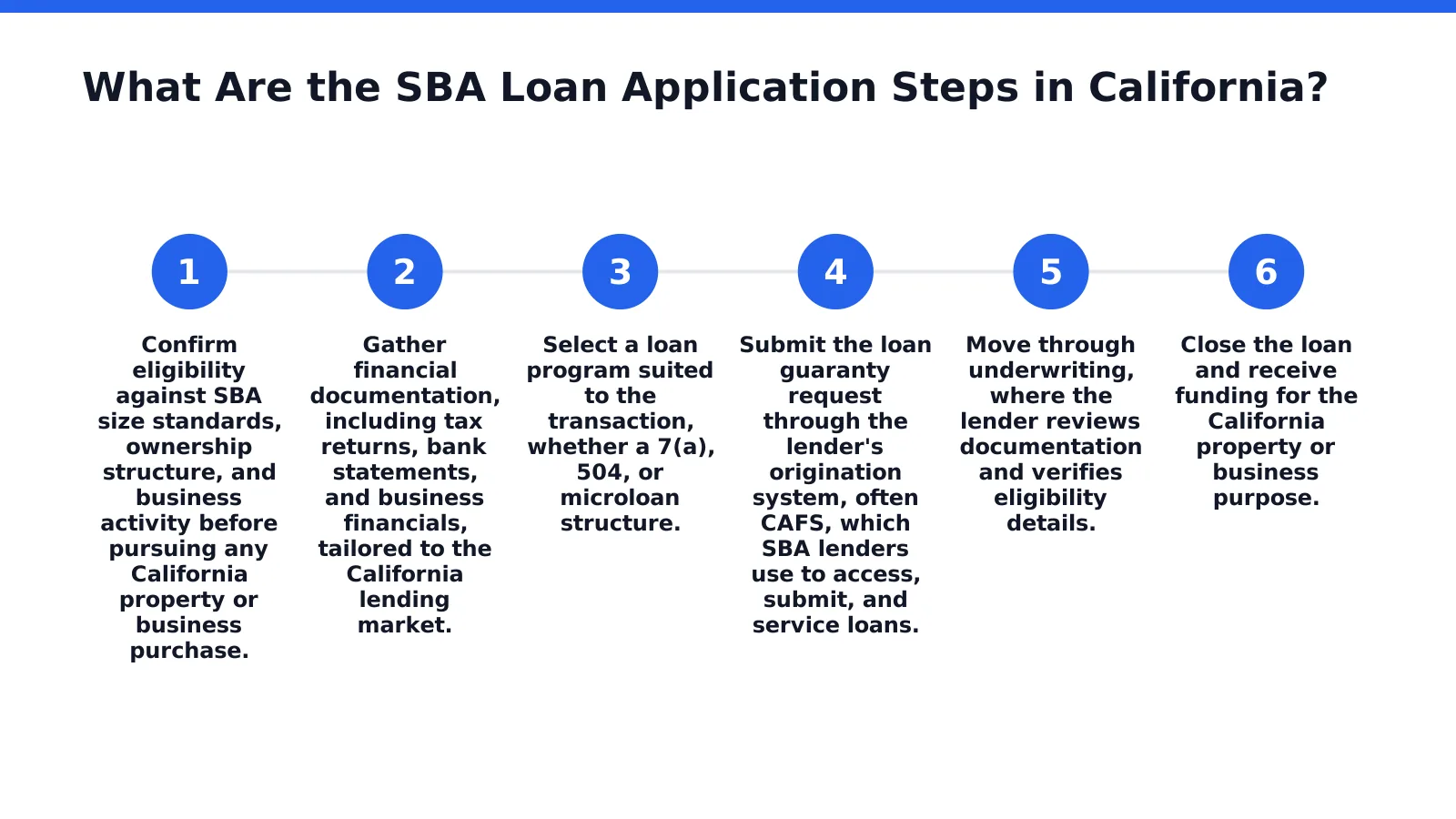
What Are the SBA Loan Application Steps in California?
Confirming eligibility marks the first of the SBA Loan Application Steps that California business owners. Property investors must complete before submitting paperwork. Skipping this step wastes time on a loan program a business or investment entity does not qualify for, delaying access to capital in competitive markets like Los Angeles, San Diego, and the Central Valley.
Understanding how to apply for an SBA loan matters most to California first-time buyers. Fund managers juggling multiple financing options. The procedure, while detailed, follows a logical order:
- Confirm eligibility against SBA size standards, ownership structure, and business activity before pursuing any California property or business purchase.
- Gather financial documentation, including tax returns, bank statements, and business financials, tailored to the California lending market.
- Select a loan program suited to the transaction, whether a 7(a), 504, or microloan structure.
- Submit the loan guaranty request through the lender’s origination system, often CAFS, which SBA lenders use to access, submit, and service loans.
- Move through underwriting, where the lender reviews documentation and verifies eligibility details.
- Close the loan and receive funding for the California property or business purpose.
Is the SBA Loan Process Hard to Navigate Alone?
The SBA loan process does not have to overwhelm a first-time buyer or seasoned investor, even when the steps feel unfamiliar at first. Breaking the process into sequential stages, from eligibility through closing, makes each decision point manageable. Munshi Capital Inc. guides California borrowers through application, underwriting, and closing with no hidden surprises at any stage.
What Documents Does an SBA Application Require?
California applicants typically prepare financial statements, tax filings, and ownership records before submission. Fund managers overseeing multiple properties should organize entity documentation separately for each asset. Munshi Capital Inc. helps clients across California sequence these requirements correctly, reducing back-and-forth with lenders and keeping the timeline moving toward funding.
How Long Does the SBA Loan Process Take?
Sixty to ninety days separates a submitted application from funded capital for most borrowers, according to Capital Bank’s coverage of SBA lending. California entrepreneurs seeking financing for property acquisitions or business expansion should plan around that window rather than assume a faster turnaround. The SBA loan process moves at a pace tied directly to loan size, intended use of funds, and how prepared the applicant is before submission.
Loan size matters most. A microloan for a small retail operation in Fresno clears underwriting faster than a 504 loan financing a multi-unit commercial property in San Diego. Readiness matters just as much. Fund managers and seasoned investors who arrive with financial statements, tax returns, and a clear use-of-funds narrative already organized tend to move through review faster than first-time applicants scrambling to assemble documentation mid-process.
Why Does the SBA Loan Process Take So Long?
SBA programs exist to extend affordable, business-friendly financing to entrepreneurs who might not qualify elsewhere. That flexibility requires a thorough, detailed underwriting and pre-approval review, which is precisely what makes the SBA loan process time-intensive rather than instant.
What Are the Basic SBA Loan Application Steps?
- Gather financial documentation, including tax returns and business statements.
- Submit the application package for review.
- Complete underwriting and pre-approval.
- Close and receive funding.
Understanding how to apply for an SBA loan before starting the paperwork shortens the timeline considerably. Munshi Capital Inc. pairs modern underwriting technology with hands-on loan specialists serving California buyers. Investors, delivering quick pre-approvals and full visibility into loan status at every stage. California property owners ready to move forward can request a direct cash offer. Those still evaluating their options can request your property assessment to clarify next steps.
What Mistakes Should First-Time Borrowers Avoid?
First-time borrowers across California often rush the SBA loan process, expecting a quick approval instead of a careful, document-heavy review. This miscalculation costs time. The SBA loan process rewards preparation; applicants who understand the timeline before applying tend to see the strongest payoff for the time invested.
A second mistake involves overlooking the structural advantages built into SBA financing. Business owners from San Diego to Sacramento sometimes compare SBA products only on interest rate, missing lower down payment requirements, flexible overhead terms, and the absence of collateral on certain loan types. Ignoring these features leads some California buyers toward costlier conventional financing when an SBA option would serve them better.
Is Skipping Loan Counseling a Costly Error?
Yes. Some SBA loans include ongoing counseling and education designed to help new business owners run operations after closing. Declining this support leaves first-time investors. Fund managers without guidance once funds arrive, raising the risk of mismanagement in a competitive California market.
Munshi Capital Inc. guides California clients through how to apply for an SBA loan with an emphasis on clarity and honest communication. Borrowers avoid hidden surprises when they follow these SBA Loan Application Steps:
- Review timeline expectations before submitting documents.
- Compare SBA-specific benefits against conventional options.
- Confirm whether counseling support applies to the chosen loan.
FAQ
Which SBA loan programs can first-time California borrowers choose from?
First-time borrowers choose between SBA 7(a), 504, and microloan programs, each offering flexible financing with unique requirements based on business income and ownership structure.
How does Munshi Capital Inc. support the SBA loan application process?
Munshi Capital Inc. guides applicants through document preparation, lender matching, and E-Tran submission, providing transparent, step-by-step support and full visibility into loan status at every stage.
What happens if a borrower skips document preparation before applying?
Skipping document preparation causes delays during underwriting, often forcing applicants to restart parts of the SBA loan process from scratch.
Conclusion
In closing, navigating the SBA loan application process as a first-time borrower in California requires methodical preparation, thorough documentation, and access to reliable guidance throughout each stage. The pathway from initial inquiry through final approval demands clarity at every juncture, from understanding eligibility requirements to presenting a compelling business case to lenders. By approaching the process with organized financial records, realistic projections, and a clear understanding of your business objectives, you position yourself for success. Partnering with experienced lending professionals who prioritize transparent communication. Personalized support transforms what can appear as a complex undertaking into a manageable, straightforward journey toward securing the capital your business requires.
Leave a Reply