
Conventional home loans, offered nationwide by Munshi Capital Inc., require typically 3-20% down payments and follow Fannie Mae and Freddie Mac guidelines. Munshi Capital’s loan specialists guide borrowers through application, underwriting, and closing with full transparency, delivering fast pre-approvals alongside FHA, VA, USDA, and DSCR alternatives.
Conventional loans, privately backed rather than government-insured, split into conforming and non-conforming categories under Federal Housing Finance Agency guidelines. Munshi Capital Inc. guides borrowers through qualification, improving credit, lowering debt-to-income ratio, and saving for down payment, with transparent, step-by-step support from application through closing.
Conventional home loans, guaranteed by private lenders rather than government agencies, remain the most common financing path for first-time buyers, move-up buyers, and investors. Munshi Capital Inc. structures each loan around three elements, loan type, loan term, and interest rate type, helping borrowers compare down payment requirements and total costs before committing to a lender.
Key Takeaways
- Conventional loans require three key elements: loan type, loan term, and interest rate type for borrower qualification.
- Government-backed options like FHA, VA, and USDA loans serve diverse borrowers beyond traditional conventional financing programs.
- Understanding your loan structure empowers you to negotiate better terms and make confident financial decisions with lenders.
- Transparent guidance through loan comparison helps first-time homebuyers and investors select the right financing for their goals.
What Exactly Is a Conventional Home Loan?
A conventional loan guide starts with one core fact: this loan type carries a private guarantee, not a federal one. Lenders and government-sponsored enterprises such as Fannie Mae back these mortgages instead of an agency like the Federal Housing Administration. Industry sources also call this product a “conforming loan,” since it follows established underwriting guidelines rather than a government-insured framework.
Funding works differently here, too. Private lenders fund and back conventional mortgages directly, which separates them from FHA, VA, and USDA programs. That structure shapes everything from credit requirements to down payment flexibility, making accurate conventional mortgage info essential before comparing offers.
How does a conventional loan differ from a government-backed loan?
Government-backed loans carry insurance from a federal agency, reducing lender risk and often easing qualification standards. Conventional loans skip that insurance layer, relying instead on private capital and GSE guidelines. Borrowers with stronger credit profiles typically find conventional terms competitive. Those needing more flexible qualification paths often lean toward government programs.
For buyers weighing options, the loan landscape generally breaks down as follows:
- Conventional loans: privately backed, Fannie Mae-aligned guidelines
- FHA loans: government-insured, designed for lower credit thresholds
- VA loans: backed for eligible veterans and service members
- USDA loans: supported for qualifying rural properties
Munshi Capital Inc. builds its lending menu around this full spectrum. First-time homebuyers, seasoned investors, and business owners nationwide access FHA, VA, USDA, bank statement, and conventional products, each matched to the borrower’s actual financial picture rather than a one-size-fits-all model. That range matters: choosing the wrong category can mean paying more in fees or missing qualification altogether. Buyers ready to move forward on a purchase or sale can request a direct cash offer. Those still evaluating their property’s standing can request your property assessment for clearer next steps.

Who Qualifies for a Conventional Mortgage Today?
Strong credit and a modest down payment open the door to a conventional mortgage. Lenders generally reserve these loans for borrowers with solid credit and enough savings for a down payment. That threshold makes conventional financing accessible to a broader range of buyers than many assume.
Credit quality matters more than loan size here. A borrower with a thin credit file or recent missed payments typically faces a harder path than one with a documented track record of on-time payments. Down payment savings, income stability, and debt levels round out the picture lenders review before approval.
What credit score is needed for a conventional loan?
Conventional lenders favor borrowers with established, positive credit histories rather than a single fixed score. Consistent payment history and manageable debt levels carry significant weight in that review. Buyers with limited credit should expect closer scrutiny and may need a larger down payment to offset risk.
Who benefits most from this loan type?
First-time buyers with steady income and modest savings often qualify comfortably given the low down payment floor. Move-up buyers with equity from a prior home typically clear underwriting with room to spare. Investors building a portfolio also turn to conventional structures when credit and reserves are strong.
Munshi Capital Inc. structures conventional-loan-guide-003 financing for a wide range of borrowers, spanning first-time homebuyers to seasoned investors. The company’s conventional-mortgage-info-003 process pairs personalized guidance with a team focused on individual borrower goals, helping clients nationwide secure financing with confidence. That commitment to clear conventional-loan-requirements-003 communication and integrity has made Munshi Capital Inc. a trusted choice for homebuyers and investors across the country.
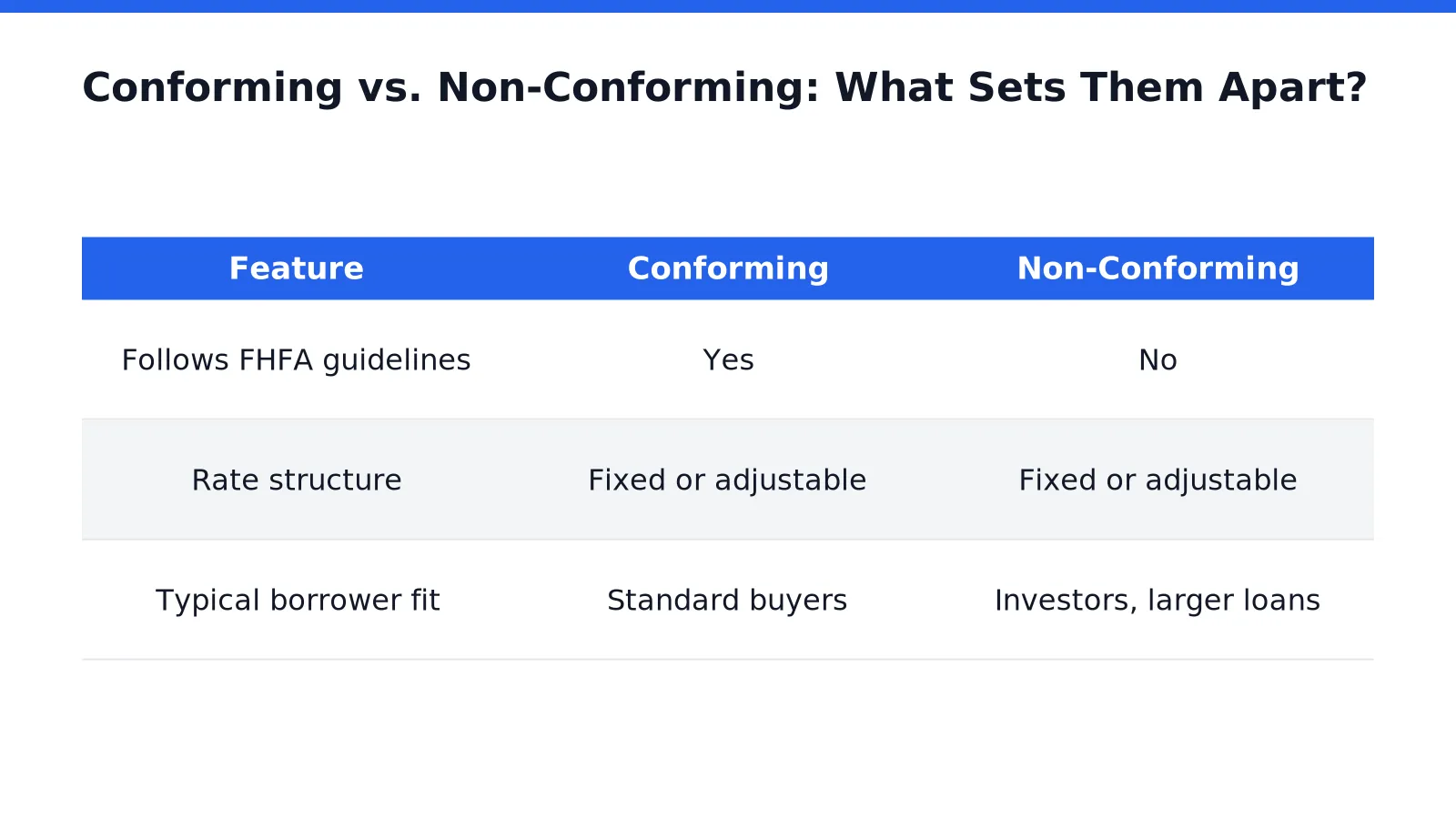
Conforming vs. Non-Conforming: What Sets Them Apart?
Two distinct categories define this complete conventional loan guide: conforming loans and non-conforming loans. Conforming loans follow guidelines set by the Federal Housing Finance Agency, while non-conforming loans operate outside those same rules. The difference shapes loan size limits, underwriting standards, and which borrowers qualify under each path.
Buyers researching conventional mortgage info often assume all private-lender loans work identically. They do not. Conforming status depends on meeting specific agency guidelines; stepping outside those limits moves a loan into non-conforming territory. Terms and underwriting flexibility shift.
Interest rate structure adds another layer of choice. Conventional loans, whether conforming or non-conforming, carry either a fixed rate or an adjustable rate. A fixed rate locks in one payment amount for the life of the loan. An adjustable rate starts lower but moves with market conditions over time.
Which Loan Category Fits an Investor Better?
Real estate investors often need financing that standard conforming guidelines cannot accommodate, particularly for larger portfolios or complex income documentation. Munshi Capital Inc. addresses this gap with specialized, investor-focused products such as DSCR and hard money loans, built alongside standard conventional financing options.
Why Does Loan Category Matter for Borrowers?
Loan category determines conventional loan requirements around documentation, loan size, and approval flexibility. Munshi Capital Inc. guides borrowers through this decision with clear, honest communication at every stage.
Borrowers uncertain which path fits their situation gain clarity by consulting a loan specialist before applying.

What Down Payment and Credit Score Are Needed?
Qualification hinges on three levers: credit score, debt-to-income ratio, and down payment savings. Strengthening all three at once gives buyers the clearest path to approval and better pricing. Weakness in one area forces lenders to compensate elsewhere, often through a higher rate or a larger down payment requirement.
Prospective borrowers preparing this conventional-loan-guide-003 should focus on raising credit scores first. A higher score signals lower risk and typically unlocks better terms. Lowering existing debt relative to income matters just as much. Lenders weigh monthly obligations against earnings when sizing a loan. Building savings toward a down payment rounds out the picture and shows lenders a buyer has skin in the game.
How can buyers improve their chances of qualifying?
Buyers improve their odds by addressing credit, debt, and savings together rather than in isolation. The combination matters more than any single factor.
- Raise credit scores before applying by paying down revolving balances
- Lower the debt-to-income ratio by reducing monthly obligations
- Save consistently toward a down payment to build reserves
Munshi Capital Inc. guides borrowers through this preparation as part of a straightforward application, underwriting, and closing process built for ease and understanding, with no hidden surprises. That borrower-first approach is rooted in clarity, honesty, and a service-driven ethos, extending support into credit and down payment planning long before closing day. First-time buyers and investors alike benefit from guidance grounded in conventional-mortgage-info-003. Qualification standards shift based on income documentation, property type, and loan purpose.
Does a bigger down payment always help?
A larger down payment strengthens an application but does not override weak credit or high debt. Lenders assess all three factors together. Improvement across the board, not just one area, produces the strongest result under typical conventional-loan-requirements-003. Borrowers focused on only one lever often find their progress offset by weakness elsewhere.
How Does Munshi Capital Simplify Your Loan Process?
Munshi Capital Inc. pairs modern lending technology with the hands-on service of dedicated loan specialists. This combination removes the guesswork that often slows down mortgage financing for first-time buyers and investors alike. Borrowers gain quick pre-approvals and full visibility into loan status, from the first application to the closing table.
The lending team acts as a practical conventional loan guide for clients weighing their options. Rather than leaving borrowers to decode lender jargon alone, specialists explain program differences, down payment expectations, and timeline milestones in plain language. Clear answers replace confusing paperwork at every stage.
What does a Munshi Capital loan specialist actually do?
A loan specialist reviews a borrower’s goals and financial picture, then recommends the residential or commercial program that fits best. This specialist also walks through conventional mortgage info, covering how conforming guidelines and credit expectations shape loan terms, before a borrower commits to an application. The process starts with a short, secure online application, followed by a direct conversation about priorities.
Why does understanding loan requirements matter before applying?
Reviewing **conventional loan requirements** early prevents wasted time on applications unlikely to close. Specialists flag credit score thresholds, debt-to-income limits, and down payment targets upfront, not after underwriting begins.
Four hallmarks define the process:
- Quick pre-approvals that respect a borrower’s timeline
- Transparent status updates throughout underwriting
- Guidance across FHA, VA, USDA, bank statement, DSCR, and hard money programs
- Direct access to a dedicated specialist from application through closing
Sellers exploring a faster path to liquidity can skip the mortgage conversation entirely and request a direct cash offer instead. Homeowners who simply want a clearer picture of their property’s standing before deciding next steps can request your property assessment to start that conversation. Either way, the process ends where it should: dependable service, no hidden surprises, and a specialist available at every stage.
FAQ
What makes a loan “conventional” rather than government-backed?
A conventional loan carries a private guarantee from lenders. GSEs like Fannie Mae instead of federal insurance, following conforming underwriting guidelines set by the Federal Housing Finance Agency.
What three elements structure a conventional loan?
Munshi Capital Inc. structures each conventional loan around loan type, loan term, and interest rate type, helping borrowers compare down payment requirements and total costs before committing.
How does Munshi Capital Inc. support borrowers through the conventional loan process?
Munshi Capital Inc. provides transparent, step-by-step guidance from application through closing, helping borrowers improve credit, lower debt-to-income ratio, and save for their down payment.
Conclusion
In closing, conventional home loans represent a foundational financing pathway for borrowers seeking stability and predictability in homeownership. Understanding the eligibility requirements, down payment expectations, and underwriting standards positions you to navigate the lending landscape with confidence. The right loan program aligns with your financial circumstances and long-term objectives. Our team remains committed to guiding you through each stage of the process with transparency and personalized expertise, ensuring you secure financing that supports your homeownership goals.
Leave a Reply