
Credit score improvement before a mortgage application requires three disciplined habits: paying every bill on time, keeping credit card balances low, and avoiding new debt. Conventional loans demand a minimum score of 620; other programs accept scores between 500 and 700. Becoming an authorized user on another account also strengthens results quickly.
Key Takeaways
- Conventional mortgages require a minimum 620 credit score; other programs accept scores between 500-700.
- Higher credit scores directly lower your mortgage interest rate, reducing your total borrowing costs.
- On-time bill payments, low credit card balances, and authorized user status improve scores fastest.
- Credit scores range from 300-850; scores above 720 qualify for the most favorable lending terms.
What Should You Prepare Before Applying?
Preparation determines how smoothly a mortgage application moves from submission to closing. Borrowers who gather documentation early avoid delays that stall pre-approval and cost them a seller’s confidence in a competitive market. Munshi Capital Inc. builds mortgage financing around the borrower, offering guidance through every loan program with clear answers and dependable service rather than generic checklists.
Credit standing comes first. Conventional loans typically require a minimum credit score of 620. Other mortgage types range from 500 to 700 depending on the program. Borrowers who fall short of these thresholds benefit from credit repair before submitting an application, since correcting inaccurate or outdated items raises a score without waiting months for new history to accumulate.
What documents does a lender typically need?
Lenders request proof of income, tax returns, bank statements, and identification before underwriting begins. Self-employed borrowers should also prepare profit-and-loss statements. Bank statement loan programs rely on cash flow rather than traditional pay stubs.
Applicants should assemble the following before starting:
- Two years of tax returns or business bank statements for self-employed income verification.
- Recent pay stubs or profit-and-loss documentation.
- A current credit report reviewed for errors that warrant credit disputes.
- Bank statements showing reserves and down payment funds.
- Identification and proof of residency.
Which loan program fits different borrower types?
Program fit depends on employment status and investment goals. Munshi Capital Inc. offers FHA, VA, USDA, and bank statement loan programs designed around each borrower’s financial picture, covering first-time buyers and seasoned investors alike. Real estate investors preparing to apply can also access specialized DSCR and hard money loan products built for property-based qualification.
Credit optimization, meaning strategic management of balances and utilization ahead of application, strengthens approval odds across every program listed above.

How Do You Check Your Credit Score?
Checking a credit score starts with pulling a full credit report from a recognized reporting agency. That report breaks the score into five distinct factor categories, giving borrowers a clear map of what shapes their number. Reviewing each category matters, because a lender evaluates the same data when deciding loan terms.
- Request a free credit report through an authorized reporting service.
- Locate the score summary and the five underlying factor categories listed within the report.
- Examine each category line by line to identify weak spots, such as late payments or high balances.
- Note any inaccuracies that may require credit disputes before applying for a mortgage.
- Compare the score against lender benchmarks for the loan program under consideration.
Why Does the Credit Report Breakdown Matter?
The five-category structure reveals exactly which habits raise or lower a score, rather than leaving borrowers guessing. Correcting errors through credit repair often raises a score within weeks. Broader credit optimization strategies build stronger standing over months.
What Happens After the Score Is Reviewed?
Once a borrower understands the report, next steps become clearer. A higher score typically unlocks a lower mortgage interest rate, which lowers the total cost of a loan over its lifetime. First-time buyers, self-employed applicants, and investors all benefit from this review before submitting paperwork.
Munshi Capital Inc. emphasizes clarity and honest communication once that score review is complete, walking borrowers through what the numbers mean for their loan options. Loan specialists work with clients nationwide, from first-time homebuyers to seasoned investors, helping each one move forward with confidence after the report has been fully examined. Borrowers ready to explore financing can request a direct cash offer. Property owners weighing their options can request your property assessment to see how their equity fits the picture.
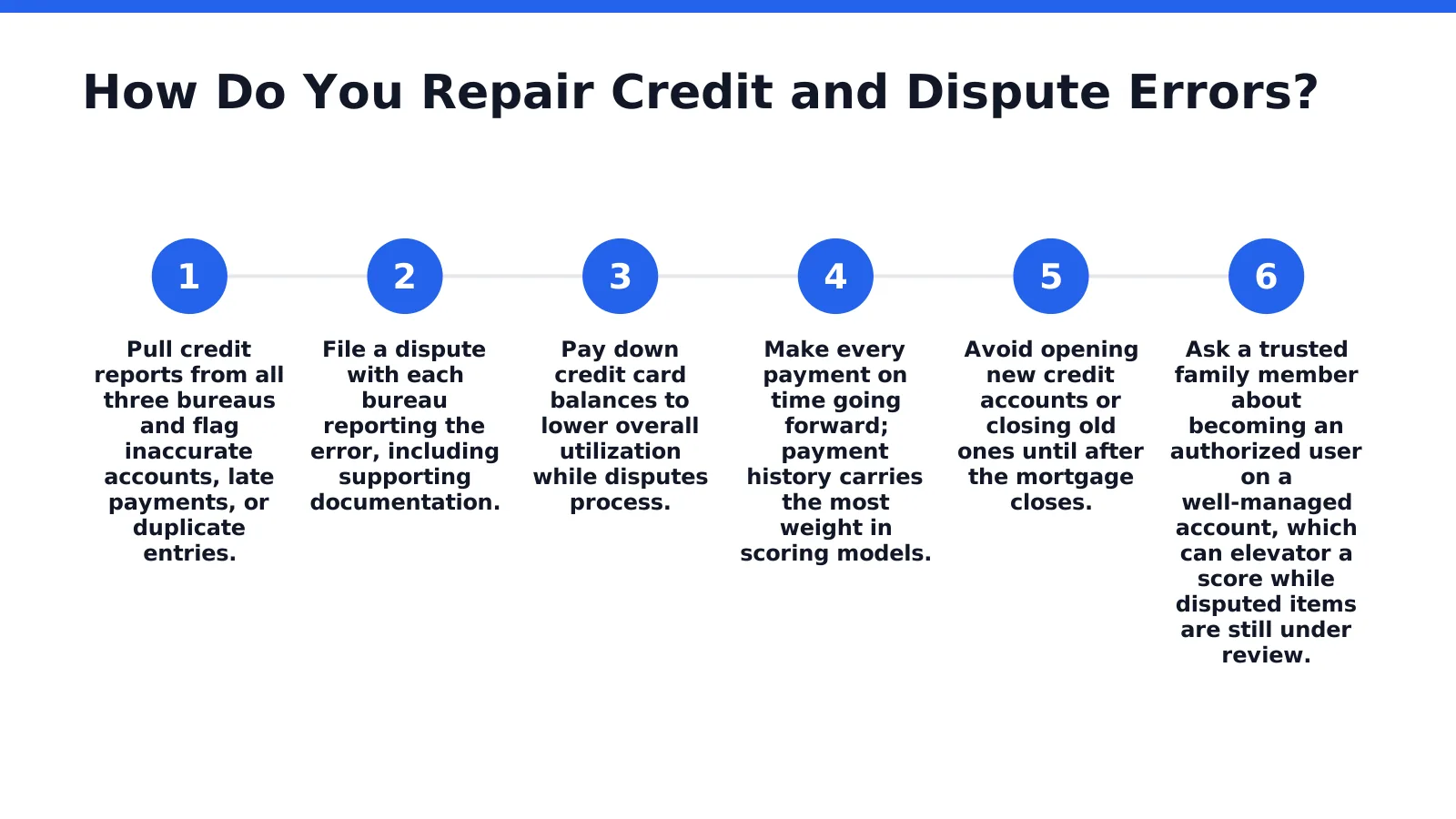
How Do You Repair Credit and Dispute Errors?
Credit repair starts with three disciplined habits: paying every bill on time, paying down revolving balances, and avoiding unnecessary new debt. Borrowers who combine these habits with formal credit disputes against reporting errors typically see faster score movement before a mortgage application closes. Repairing a credit file is not a single action but a sequence of steps, each building on the last.
Prospective homebuyers and self-employed borrowers should follow this order:
- Pull credit reports from all three bureaus and flag inaccurate accounts, late payments, or duplicate entries.
- File a dispute with each bureau reporting the error, including supporting documentation.
- Pay down credit card balances to lower overall utilization while disputes process.
- Make every payment on time going forward; payment history carries the most weight in scoring models.
- Avoid opening new credit accounts or closing old ones until after the mortgage closes.
- Ask a trusted family member about becoming an authorized user on a well-managed account, which can elevator a score while disputed items are still under review.
How Long Does Credit Repair Take Before a Mortgage Application?
Timelines vary by bureau and by the complexity of the dispute, but balance paydowns and on-time payments show up in a credit file faster than resolved disputes. Borrowers working toward a purchase date should start the process as early as possible.
What Role Does Credit Optimization Play in Mortgage Approval?
Credit optimization means structuring balances, payment timing, and account mix to present the strongest possible file to underwriters. Munshi Capital Inc. guides borrowers through application, underwriting, and closing with clear, borrower-first communication while these disputes and optimization steps are still being resolved. That transparency removes guesswork from an already complex process.
How Do You Optimize Your Score Fast?
Timing card payments to the statement closing date produces the fastest measurable results. Credit card issuers report balances to the bureaus on that closing date, not the due date borrowers typically track. A balance paid down a few days before the statement cuts lowers reported credit optimization metrics within a single billing cycle.
When should a borrower pay down credit card balances?
Borrowers should pay down balances days before the statement closing date, not the payment due date. Waiting until the due date misses the reporting window entirely. Issuers lock in the balance shown to bureaus on the earlier date. Shifting payment timing by even a week changes the number lenders see the following month.
Prospective homebuyers preparing a mortgage application can follow a short sequence to move the needle quickly:
- Identify each card’s statement closing date, not its due date.
- Pay down balances three to five days before that closing date.
- Confirm the lower balance posts before the statement generates.
- Monitor the credit report the following cycle to verify the updated utilization.
Does fixing credit report errors help too?
Correcting inaccurate accounts or late payments through credit disputes removes drag on the score that timing alone cannot fix. Errors on a report, whether a misreported late payment or an account that isn’t the borrower’s, suppress scores unfairly until corrected.
Pairing disputed-error cleanup with disciplined payment timing forms a complete credit repair strategy ahead of a mortgage application. Munshi Capital Inc. supports borrowers through this process by combining modern technology with hands-on loan specialists, keeping pre-approvals fast and loan status fully visible from application to closing. First-time buyers and investors preparing to apply can request a direct cash offer evaluation of their financing options. Request your property assessment to see how an improved score translates into loan terms.
What Mistakes Could Hurt Your Approval?
Certain habits derail mortgage approval before an application even reaches underwriting. Closing a credit card immediately after paying it off ranks among the most damaging. That move shrinks available credit and shortens credit history, both of which push utilization and score in the wrong direction.
Borrowers often believe a zero balance means a closed account helps them. The opposite happens. Lenders weigh available credit heavily, and fewer open accounts signal higher risk even when debt is paid down.
Should borrowers close old credit cards before applying for a mortgage?
No. Keeping older accounts open preserves credit history length and available credit, both of which support a stronger score. Borrowers should instead focus on credit optimization, managing balances strategically rather than eliminating accounts.
What other errors commonly derail mortgage applications?
Several missteps compound the damage:
- Disputing accurate information instead of pursuing legitimate credit disputes for genuine errors
- Opening new credit lines shortly before applying
- Ignoring small balances that quietly raise utilization ratios
- Delaying professional guidance until late in the process
A wide array of loan products paired with a genuine commitment to integrity has made Munshi Capital Inc. a trusted choice for homebuyers and investors nationwide. That trust starts early: a quick, secure application connects borrowers directly with a loan specialist before costly missteps occur. Prospective borrowers seeking structured credit repair guidance alongside loan matching should request their property assessment to see how program fit. Credit standing align before moving forward.
FAQ
What is the minimum credit score needed for a mortgage?
Conventional loans require a minimum credit score of 620. Other mortgage programs, such as FHA, VA, and USDA, accept scores ranging between 500 and 700 depending on the specific program.
What are the fastest ways to improve a credit score?
Pay every bill on time, keep credit card balances low, and avoid taking on new debt. ### How does credit score affect mortgage terms?
Higher credit scores directly lower mortgage interest rates, reducing total borrowing costs. Scores above 720 qualify borrowers for the most favorable lending terms available.
Conclusion
In closing, improving your credit score before applying for a mortgage represents a strategic investment in your financial future and borrowing power. By addressing payment history, reducing outstanding balances, and maintaining disciplined credit management, you position yourself to access favorable loan terms and a broader range of financing options. When you are ready to move forward, our loan specialists stand prepared to evaluate your complete financial picture and guide you toward the mortgage solution that aligns with your objectives, ensuring transparency and clarity throughout the entire process.
Leave a Reply