
Interest rates directly set your monthly payment and total borrowing cost, even though the Federal Reserve doesn’t set mortgage rates outright, its decisions move them, as seen when the
Mortgage rates track, but do not mirror, Federal Reserve policy. The Federal Open Market Committee held its benchmark rate steady at its June 16-17 meeting, yet lender pricing still shifted. For Walnut Creek buyers, higher rates raise monthly
Key Takeaways
- The Federal Reserve’s rate decisions directly influence mortgage rates lenders offer to homebuyers nationwide.
- Even small interest rate drops meaningfully reduce borrowing costs and improve home affordability for buyers.
- Mortgage rates fluctuate independently from Fed decisions, requiring personalized guidance to understand your specific situation.
- Rising or falling rates create refinancing opportunities that deserve transparent analysis from qualified loan specialists.
Why Do Rate Swings Matter For Your Budget?
Small shifts in borrowing costs change how much house a buyer can afford. How much a homeowner pays each month. A quarter-point move in interest rates sounds minor. It reshapes monthly payments and purchasing power for buyers across Walnut Creek and beyond. That gap between “affordable” and “out of reach” often comes down to timing, not income.
Munshi Capital Inc. builds mortgage financing around each borrower’s goals, not a generic rate product. Guidance covers every loan program with clear answers and dependable service. A shift in mortgage rates doesn’t derail a plan already in motion. Loan specialists work with borrowers nationwide, helping clients act with confidence the moment conditions change.
How much does a quarter-point rate drop actually change?
A quarter-point drop can meaningfully affect what a buyer can afford and the size of the monthly payment. That difference matters most for:
- First-time buyers stretching a budget to qualify
- Move-up buyers comparing loan sizes across neighborhoods
- Investors calculating cash flow on a rental purchase
- Homeowners weighing a refinance against current equity
Munshi Capital’s borrower-first approach rests on transparency, honesty, and a service-driven ethos. That foundation matters most precisely when rates swing and decisions can’t wait for perfect information.

How Does The Federal Reserve Shape Mortgage Pricing?
The Federal Reserve does not set mortgage rates directly. Its policy decisions shape the broader pricing environment that lenders use to calculate the rate a borrower ultimately sees. For Walnut Creek homebuyers watching rate headlines, that distinction matters more than it sounds.
Mortgage pricing moves through a chain of signals, not a single switch. The Fed adjusts its benchmark rate based on inflation and employment data. Lenders respond by repricing loans against bond market conditions tied to that benchmark. This is why mortgage rates can shift even when the Fed itself stays quiet.
Did the Fed just change rates?
No. At its June 16-17 meeting, the Federal Open Market Committee voted to hold its benchmark rate steady, continuing a pattern seen throughout 2026. That stability does not mean mortgage pricing stood still; lenders still adjust offers based on bond yields and investor expectations.
Why does a steady Fed still mean rate movement for buyers?
Lenders price loans off longer-term bond yields, not the Fed’s overnight rate alone. The relationship between short- and long-term yields, often described through the yield curve, shapes how aggressively lenders compete on pricing.
Munshi Capital’s specialists translate this chain for clients directly, rather than leaving borrowers to decode Fed statements alone. Guided by a mission of transparency, the team explains:
- How a held or shifted benchmark rate feeds into bond pricing
- Why two borrowers can see different rate quotes in the same week
- What loan structure best fits current pricing conditions
Backed by technology and hands-on loan specialists, Munshi Capital delivers fast, transparent updates. Borrowers understand rate movement before it affects their offer.
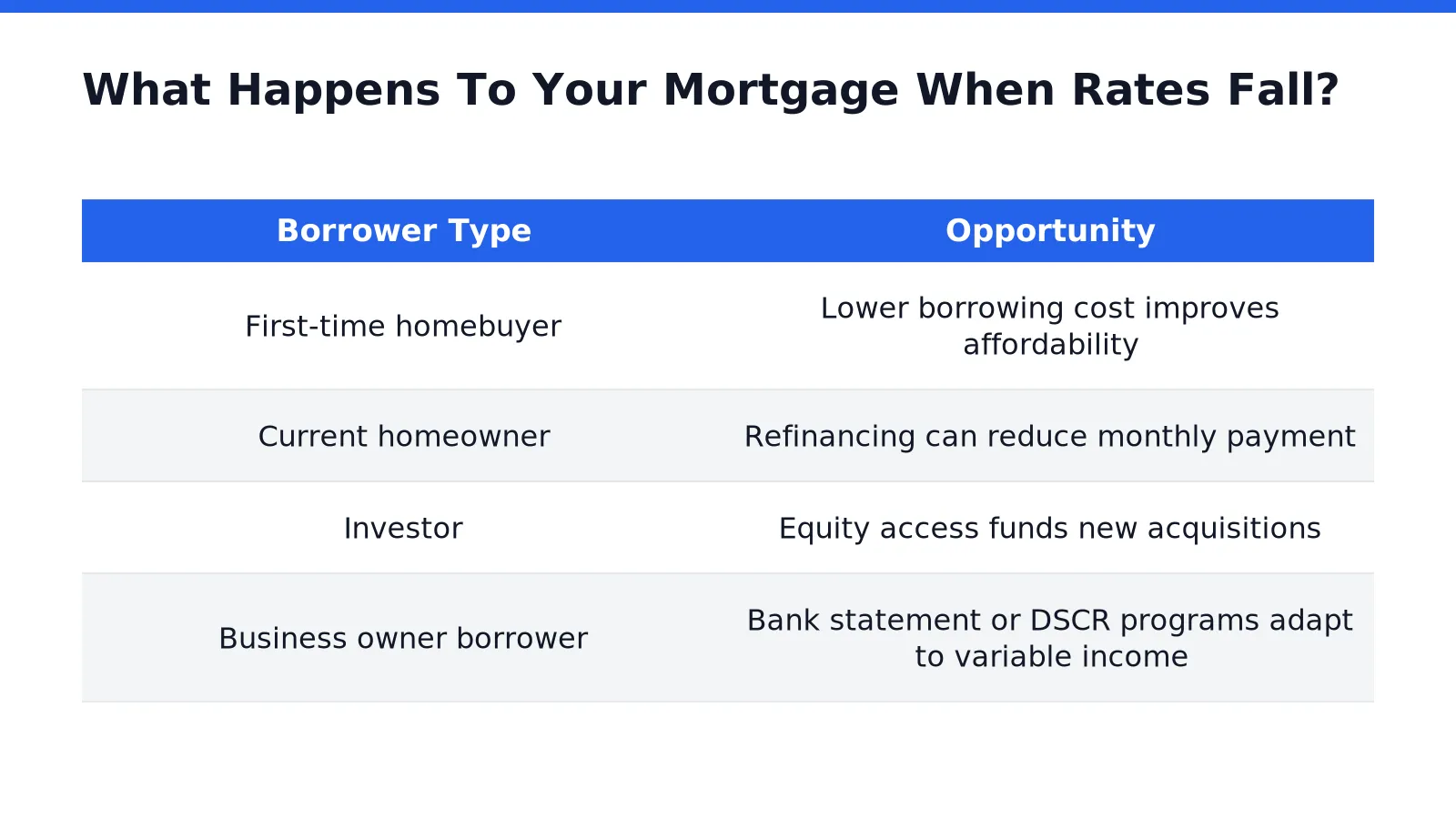
What Happens To Your Mortgage When Rates Fall?
A rate decline opens three doors at once: home purchase, refinancing, and home equity access. Falling interest rates often create genuine financial opportunity across all three paths. The size of that opportunity depends on loan amount, closing costs, and how long a borrower keeps the home. Missing the window matters: borrowers who wait too long to act can watch favorable pricing disappear as conditions shift again.
Speed separates borrowers who capture savings from those who miss them. Munshi Capital Inc. moves clients through a straightforward application, underwriting, and closing process built for exactly this moment. A dip in rates translates into real action rather than a missed opportunity. Quick pre-approvals, paired with full visibility into loan status, let borrowers lock in favorable terms before the market moves again.
Does every borrower benefit the same way when rates drop?
No. A first-time buyer chasing affordability needs a different structure than an investor refinancing a rental portfolio. Because Munshi Capital Inc. offers FHA, VA, USDA, bank statement, DSCR, and hard money programs, the right structure gets matched to each borrower’s situation, regardless of where rates sit.
Which borrowers gain the most from a rate decline?
Each path demands its own timing and paperwork. A transparent, well-guided process keeps borrowers from losing ground while rates move, turning a narrow window into a secured outcome instead of a missed chance.

What Other Forces Push Mortgage Rates Up Or Down?
Two forces outside the Federal Reserve’s direct control shape loan pricing: inflation and the bond market. Both deserve attention from Walnut Creek buyers tracking mortgage rates before locking a loan.
Inflation erodes purchasing power over time. When prices climb, lenders respond by setting higher rates on new loans to protect their returns. For a homeowner shopping for financing, that means periods of elevated inflation often translate directly into higher borrowing costs, regardless of what the Fed decides at any single meeting.
Why do bonds affect my mortgage rate?
Mortgage-backed securities compete with other bonds for investor capital. Movement in interest rates across the broader bond market, including shifts in the yield curve, changes how attractive those securities look to investors. When demand for mortgage-backed securities weakens, lenders adjust pricing to stay competitive, which can push mortgage rates higher even without a Fed rate change.
A quick snapshot of what drives each force:
Sorting out these moving parts without guidance leaves many buyers reacting to headlines instead of planning ahead. Munshi Capital’s commitment to integrity, personalized service, and a broad range of loan products gives borrowers a steady resource when inflation data and bond-market swings seem to conflict.
That grounded approach matters most when signals get noisy. Built on clarity and honesty, Munshi Capital’s guidance helps borrowers interpret inflation trends, Fed policy, and bond-market behavior as one connected picture rather than separate puzzles. For Walnut Creek homeowners weighing a sale timeline against shifting financing costs, that clarity starts with a simple step: request your property assessment and see how current conditions apply to your situation.
How Should You Respond To Shifting Rates Today?
Shifting rates call for informed guidance, not guesswork. Borrowers who work with a dedicated loan specialist gain a clearer read on current interest rates. The loan program that fits their monthly budget. Rate movements alone rarely tell the full story; context matters more than the headline number.
A loan specialist translates raw rate data into practical choices. Walnut Creek buyers comparing mortgage rates across lenders benefit from a professional who can explain how shifts in the yield curve affect pricing on fixed versus adjustable products. That kind of interpretation turns market noise into a usable plan.
Munshi Capital’s approach to borrower guidance does not change with the rate cycle. Whether rates climb or fall, the trust-based, borrower-first service stays consistent. Clarity, honesty, and a service-driven ethos define the lending relationship regardless of market direction.
Technology-backed, transparent processes give borrowers constant visibility into where their loan stands, even as rates move quickly. Fast turnaround paired with honest communication closes the gap between a rate headline and a real decision.
Does a transparent loan process matter more when rates are volatile?
Yes. Transparency throughout the lending process means no surprises appear mid-application, even when the rate environment changes week to week. Borrowers see every disclosure, cost, and status update as the loan moves toward closing, which matters most when conditions shift fast.
Should homeowners wait for lower rates before refinancing?
Timing depends on loan size, closing costs, and how long the home will be kept. A dedicated loan specialist reviews that financial picture before recommending a specific program or rate-lock strategy, rather than reacting to a single market headline.
FAQ
Does the Federal Reserve set mortgage rates directly?
No. The Fed’s policy decisions shape the broader pricing environment. Lenders calculate their mortgage rates based on bond market conditions tied to that benchmark.
Why do mortgage rates move even when the Fed holds steady?
Lenders price loans off longer-term bond yields, not just the Fed’s overnight rate, so pricing shifts with bond yields and investor expectations even without a Fed change.
Who can help borrowers navigate rate changes with confidence?
Munshi Capital Inc.’s loan specialists provide transparent, borrower-first guidance across every loan program, helping clients nationwide act confidently the moment rate conditions shift.
Conclusion
In closing, interest rates fundamentally shape the economics of mortgage financing, influencing both monthly obligations and long-term wealth accumulation for borrowers. Understanding this relationship empowers you to make informed decisions aligned with your financial objectives. At Munshi Capital Inc., we recognize that each borrower’s situation demands personalized analysis and transparent guidance. Our loan specialists work to clarify how rate environments affect your specific loan program, whether residential, commercial, or investor-focused, ensuring you navigate this critical decision with complete visibility and confidence throughout the entire lending process.
Leave a Reply