
Real estate market cycles follow four distinct phases: recovery, expansion, hyper supply, and recession, forming a continuous wave pattern rather than isolated events. Investors who track these phases position acquisitions and financing decisions more strategically. Each stage carries different risk levels, pricing dynamics, and opportunity windows for mortgage timing and property returns.
Key Takeaways
- Real estate moves through four distinct phases: Recovery, Expansion, Hyper Supply, and Recession in continuous cycles.
- Understanding market cycles helps investors project property income and capital appreciation with greater accuracy and confidence.
- Timing your purchase or investment strategy to the current cycle phase maximizes returns and minimizes risk exposure.
- Both residential and commercial property investors must monitor cycle phases to identify optimal entry and exit opportunities.
What Exactly Is a Real Estate Market Cycle?
A real estate market cycle describes the repeating sequence of growth, peak, slowdown, and bottom that property markets move through over time. Prices and demand never climb in a straight line. Instead, they follow market cycles that echo the broader economy’s own pattern of expansion and contraction.
Four distinct phases make up this pattern:
- Expansion: demand rises, construction increases, and prices climb
- Peak: growth tops out and supply starts catching up with demand
- Contraction: sales slow, inventory builds, and price gains flatten
- Trough: the market bottoms out before the next upswing begins
This wave-like structure, often called the housing cycle when applied to residential property, repeats continuously. One trough phase leads directly into the next expansion, forming a loop rather than a one-time event.
Why do real estate cycles matter for financing decisions?
Timing a mortgage application against the right phase changes the borrowing picture substantially. Rates, inventory, and seller flexibility all shift depending on where the market sits in its cycle.
Munshi Capital Inc. builds mortgage financing around each borrower’s position within that cycle, not a generic timeline. Guidance runs through every loan program with clear answers. Decisions rest on where the market actually stands rather than guesswork.
Does every local market follow the same cycle?
No single calendar governs every city or region. Local real estate trends can lag or lead the national pattern depending on jobs, construction activity, and population shifts. Munshi Capital’s approach stays rooted in clarity. Honesty, offering borrower-first guidance regardless of which phase a given local market occupies.

What Are the Four Phases of the Cycle?
Four distinct phases define commercial and residential property movement: recovery, expansion, hypersupply, and recession. Each phase carries its own signals for financing decisions, rental income projections, and resale timing. Missing a phase shift costs property owners thousands in mistimed purchases or missed refinancing windows.
Commercial property markets generally progress through this sequence in order, moving from recovery into expansion, then hypersupply, then recession. The pattern does not stop at recession, either. The downturn phase feeds directly back into the next recovery, forming a continuous wave rather than a one-time cycle. Investors who treat the cycle as a repeating loop, not a straight line, position themselves to act before competitors notice the shift.
How Does Each Phase Affect a Buyer’s Strategy?
Recovery favors patient buyers willing to purchase before demand returns in force. Expansion rewards those who move quickly, since rents and values climb alongside new construction. Hypersupply signals caution, as vacancy rates creep upward and competition for tenants intensifies. Recession often presents the sharpest buying opportunities, though financing becomes harder to secure.
Why Does Loan Strategy Matter Across These Phases?
Borrowers face different qualification hurdles depending on where the housing cycle sits. A first-time buyer entering during recovery needs different support than a seasoned investor acquiring distressed assets during recession.
Munshi Capital Inc. serves both ends of that spectrum, from first-time homebuyers to seasoned investors, with financing structured for each phase. A broad product lineup, paired with a commitment to transparency, positions the company as a steady partner regardless of where local market cycles currently stand. That range matters because real estate trends shift unevenly across regions. A borrower’s optimal loan program in one phase rarely matches the best option in another.

How Long Does the Housing Cycle Typically Last?
A full housing cycle spans roughly 18 years, according to economist Homer Hoyt’s research tracing the pattern back to the year 1800. That span covers four distinct phases, and each phase carries its own risks for buyers, sellers, and investors who misjudge the timing. Missing the turn between phases often means overpaying at the peak or selling too early during recovery.
Hoyt’s long-run data gives property owners a historical anchor, but cycles rarely move at a uniform pace. Some expansions stretch longer than others; some recessions correct faster. Current indicators place most U.S. markets in late expansion or early hypersupply, with inventory climbing and price growth cooling. That combination signals a market approaching its ceiling, not one still accelerating.
What phase is the market in right now?
Rising housing inventory paired with slowing price appreciation points to the late expansion or early hypersupply stage. This phase typically precedes a cooling period, so buyers gain more negotiating leverage while sellers face longer days on market.
Why does cycle timing matter for financing decisions?
Mortgage approval speed becomes critical once market conditions start shifting. Munshi Capital Inc. pairs modern underwriting technology with hands-on loan specialists, allowing borrowers to move quickly as conditions change. Clients receive fast pre-approvals along with full visibility into loan status at every stage, a necessity when market cycles turn faster than expected.
Real estate trends shift gradually at first, then accelerate near a phase transition. Property owners who track these signals, and pair them with responsive financing, position themselves ahead of the next turn rather than reacting after it has already happened.
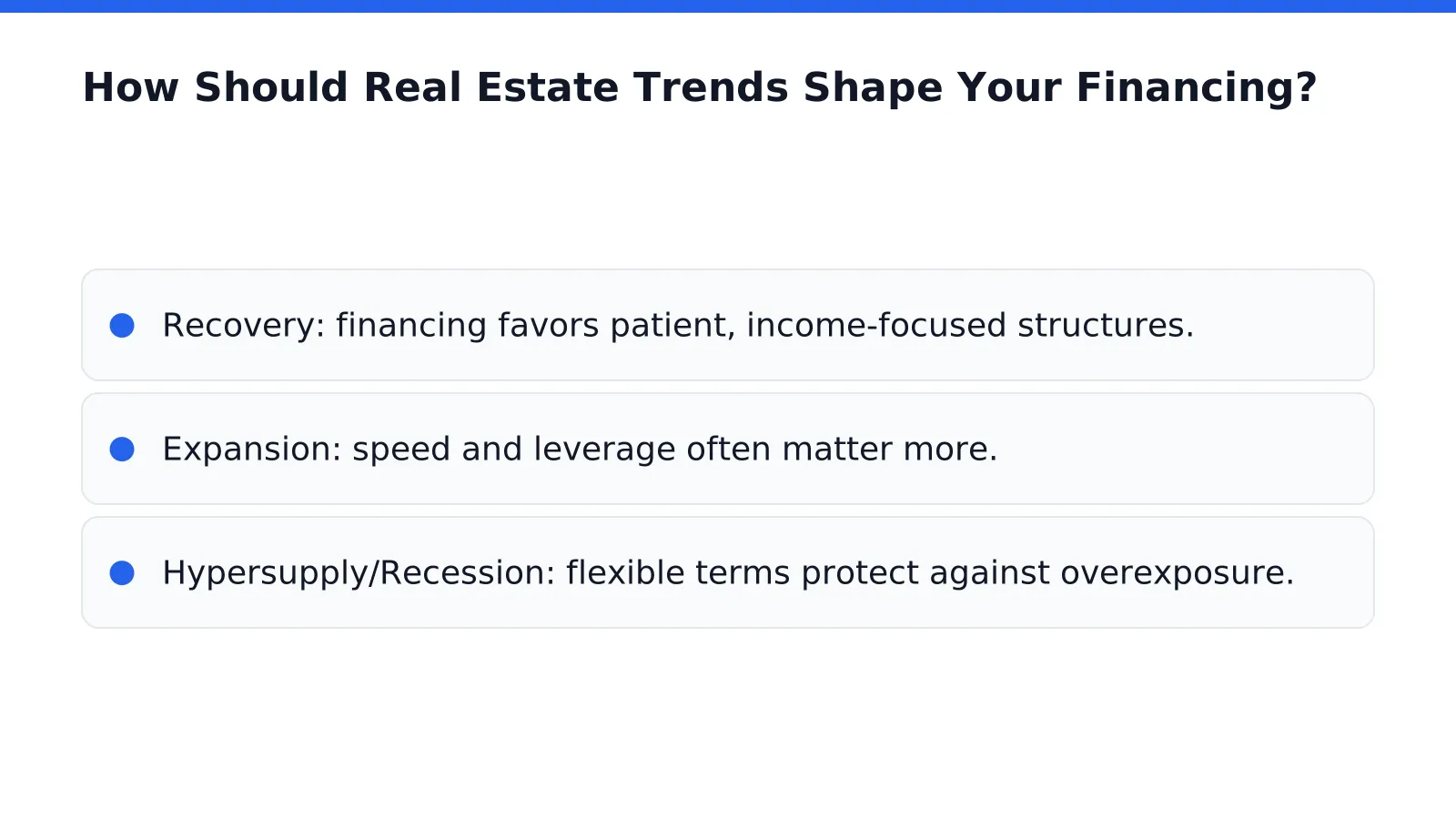
How Should Real Estate Trends Shape Your Financing?
Financing choices should match the stage of the cycle, not fight against it. Rising inventory, slowing price growth, or a tightening rental market each call for a different loan structure. Reading real estate trends before locking in a mortgage product protects both cash flow and long-term returns.
Cycle-sensitive acquisitions need flexible tools. DSCR and hard money loans give investors options built specifically for timing-driven deals, whether the goal is a quick close on a distressed property or a rental purchase qualified on projected income rather than personal tax returns. These products exist because rigid, one-size financing rarely survives a shifting market.
Speed matters just as much as structure. A straightforward application, underwriting, and closing process removes the surprises that cost deals when conditions move fast. Delays during a hypersupply phase, for example, can turn a strong offer into a missed opportunity.
Why Does Timing Matter for Mortgage Financing?
Projecting income and appreciation depends on knowing where a market sits in its cycle. Matching the loan strategy to that stage helps maximize returns rather than erode them.
What Role Does Guidance Play in Changing Markets?
Personalized guidance from a dedicated team helps borrowers nationwide move with confidence, regardless of whether the broader housing cycle points toward recovery or recession. Markets differ by region and by phase:
- Recovery: financing favors patient, income-focused structures.
- Expansion: speed and leverage often matter more.
- Hypersupply/Recession: flexible terms protect against overexposure.
Property owners weighing a sale timed to these shifts can request a direct cash offer. Those still assessing value should request your property assessment before deciding on next steps.
What Should You Watch and Do Next?
Timing a purchase or sale starts with tracking local inventory, price momentum, and financing availability together. These three signals reveal where a market sits within broader market cycles and whether conditions favor buyers or sellers. Reacting to headlines alone leaves investors and homeowners exposed to decisions made too early or too late.
Munshi Capital Inc. built its mission around transparency, keeping every borrower informed with clear, honest communication from application through closing. That clarity supports better-timed decisions, since clients see loan terms and timelines without guesswork clouding the process. The company’s broader approach rests on the same foundation: clarity, honesty, and a service-driven commitment that makes it a reliable partner across long-term buying or investing strategies.
How does loan selection change across the housing cycle?
Different phases call for different financing tools. A comprehensive suite of residential and commercial programs, including FHA, VA, USDA, and bank statement loans, covers borrowers at nearly every stage of the housing cycle, from first-time buyers to seasoned investors.
Why does pairing data with a lender matter?
Reading real estate trends without expert guidance invites costly timing mistakes. Pairing cycle awareness with a data-driven financing partner can mean the difference between an optimal purchase window and an expensive miscalculation.
Owners weighing a sale should request a direct cash offer. Buyers assessing value should request your property assessment before locking in financing.
FAQ
What are the four phases of a real estate market cycle?
The cycle moves through recovery, expansion, hyper supply, and recession in a continuous wave. Each phase carries distinct risk levels, pricing dynamics, and opportunity windows for mortgage timing and property returns.
How does Munshi Capital approach financing around market cycles?
Munshi Capital builds mortgage financing around each borrower’s position within the cycle rather than a generic timeline. Their loan programs deliver clear answers so decisions rest on actual market conditions, not guesswork.
Do all local real estate markets move through the cycle together?
No single calendar governs every city or region. Local trends lag or lead the national pattern based on jobs, construction, and population shifts. Munshi Capital offers borrower-first guidance regardless of a market’s current phase.
Conclusion
In closing, understanding real estate market cycles equips borrowers and investors with the strategic foundation necessary to make informed financing decisions aligned with their long-term objectives. By recognizing the patterns of expansion, peak, contraction, and recovery, you position yourself to secure financing at optimal moments and structure your portfolio accordingly. At Munshi Capital Inc., we recognize that each market phase demands distinct financing strategies. Our comprehensive loan programs and transparent guidance ensure you navigate these cycles with confidence, supported by specialists who understand your unique financial picture and committed to delivering the dependable service your investment timeline requires.
Leave a Reply