
Lender-required homeowners insurance must cover dwelling replacement cost, name the mortgage holder as loss payee, and stay active for the full loan term. Fannie Mae mandates “Special” form coverage for one- to four-unit properties, per Guide section B7-3-02. Munshi Capital Inc. guides first-time homebuyers, refinancers, and investors through these requirements before closing, ensuring no coverage gaps delay funding.
Key Takeaways
- Lenders require homeowners insurance to protect your property against unexpected losses like fire, theft, or weather damage throughout your mortgage term.
- Your dwelling coverage must be sufficient to fully rebuild your home if it’s destroyed, as determined by your lender’s appraisal.
- Maximum deductibles on homeowners insurance policies are set by lender requirements for one- to four-unit properties to ensure adequate protection.
- Additional coverage for specific risks like floods or earthquakes protects your investment and satisfies lender requirements beyond standard homeowners insurance policies.
Why Do Lenders Require Homeowners Insurance Before Closing?
Lenders generally require proof of homeowners insurance before a mortgage closes because the property secures the loan itself. Without coverage, a lender’s financial stake in the home sits exposed to fire, storm damage, or other unexpected loss. The lender’s collateral and the borrower’s investment both need protection before funds change hands.
This requirement is not a bureaucratic hurdle designed to slow anyone down. It exists to confirm that a fire, burglary, or storm will not leave either party absorbing a total loss alone. First-time buyers and seasoned investors alike encounter this condition at closing, regardless of loan type or property use.
Munshi Capital Inc. builds its lending process around clarity on exactly this point. Clients move through application, underwriting, and closing with a clear explanation of insurance requirements at each stage, so nothing about coverage arrives as a last-minute surprise. Financing stays built around the borrower, with guidance through every loan program and dependable answers along the way.
What Happens If a Borrower Skips Insurance Before Closing?
Closing simply will not happen without proof of active coverage. Lenders treat this documentation as a condition of funding, not a suggestion.
Borrowers who delay shopping for a policy often face closing-date pressure or last-minute scrambling for quotes. Securing coverage early avoids that risk entirely.
Does Insurance Connect to Mortgage Escrow?
Yes, insurance premiums typically flow through mortgage escrow accounts. The lender collects a portion of the annual premium with each monthly payment. Pays the insurer directly when the bill comes due.
This structure keeps coverage active for the life of the loan without relying on the borrower to remember renewal dates. Investors managing multiple properties especially benefit from this consistency. A lapse on any one property could expose both the asset and the loan to risk.

What Coverage Must Your Policy Actually Include?
Lenders set specific standards for one- to four-unit properties. A policy must be written on a Special coverage form. An equivalent, and must meet a defined list of minimum perils. Falling short on this point delays closing and can derail a purchase entirely.
Dwelling coverage must also match reality. Coverage amounts need to be sufficient to rebuild the home from the ground up, not just match the purchase price or outstanding loan balance. A gap between rebuild cost and policy limits leaves borrowers exposed to out-of-pocket losses after a major claim. Lenders will flag the shortfall before funding.
Homeowners insurance on a standard policy carries a notable blind spot: earthquake and flood damage fall outside typical coverage. Borrowers in flood zones or seismic regions need to add separate coverage to satisfy full lender insurance requirements. Skipping this step does not just create a compliance problem; it leaves the property, and the borrower’s equity, unprotected against the exact disasters most likely to cause catastrophic loss.
Does Homeowners Insurance Automatically Cover Floods or Earthquakes?
No. Standard policies exclude both perils by default. Coverage for flood or earthquake damage requires a separate endorsement or standalone policy. Lenders in high-risk zones often require proof of that additional coverage before closing.
What Happens If Coverage Falls Short of Lender Standards?
Underwriters will reject the policy and request a revised one before funding proceeds. Munshi Capital’s loan specialists work directly with borrowers to confirm coverage meets lender standards, including on specialized products like DSCR and hard money loans for investor borrowers. Getting this verified early avoids last-minute closing delays. Borrowers ready to move forward can request a direct cash offer and keep their timeline intact.

How Does Mortgage Escrow Pay Your Premium?
Mortgage escrow pays the insurance premium by setting aside a portion of each monthly payment until the bill comes due. Most borrowers never write a separate check for coverage. Instead, homeowners insurance costs get folded directly into the mortgage payment and routed through an escrow account.
The lender collects the insurance portion of every payment and holds those funds in mortgage escrow. When the premium bill arrives, the lender pays the insurance company directly from that account. No action from the homeowner is required once the arrangement is set.
This structure protects both parties. Lenders confirm coverage stays active; borrowers avoid the risk of a missed payment lapsing their policy.
What happens if escrow runs short?
Shortages happen when premiums rise faster than the account anticipated. Lenders typically adjust the monthly payment to cover the gap and rebuild the reserve over time. Borrowers receive an annual escrow statement showing exactly how funds were collected and spent.
Does every mortgage include an escrow account?
Not always, but it remains the common setup for most residential loans, particularly for first-time buyers with lower down payments. Investors and seasoned buyers sometimes negotiate different terms, depending on loan type and lender policy.
Munshi Capital structures its lending process so borrowers see exactly how escrow. insurance requirements affect their payment before closing, not after. Clients get full visibility into loan status, including how insurance costs are tracked and paid, from application through closing. The process avoids jargon and hidden surprises, so homebuyers, refinancers, and investors understand their obligations upfront. Buyers ready to move forward can request a direct cash offer. Property owners weighing their options can request your property assessment to clarify next steps.
What Happens If Your Coverage Lapses?
A lapse in coverage puts the entire loan at risk. Lenders require active homeowners insurance for the full term of a mortgage. Any gap in that protection violates the terms borrowers agreed to at closing. Missing a renewal, even briefly, can trigger consequences far beyond a simple paperwork issue.
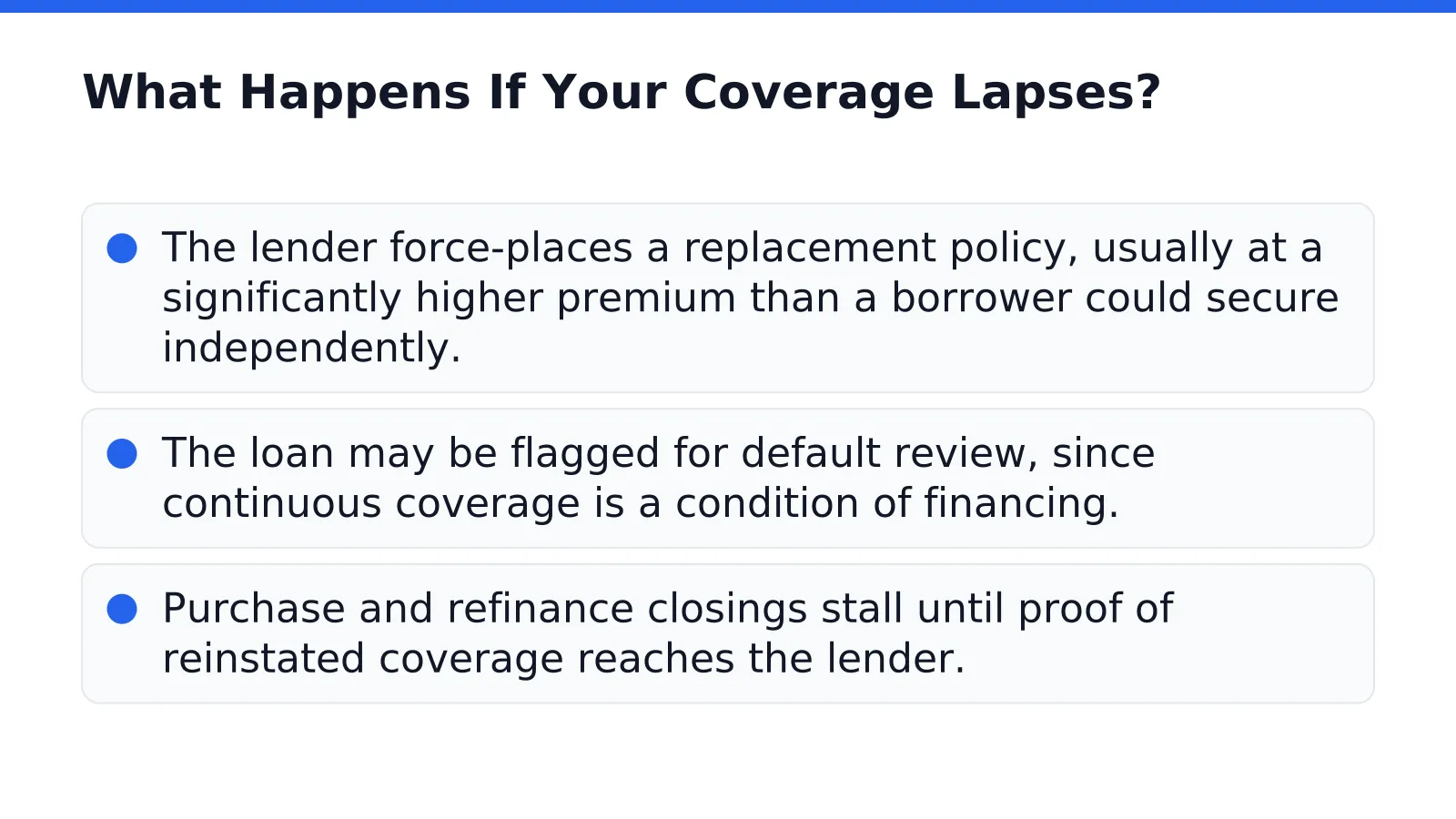
Here is what typically follows a lapse:
- The lender force-places a replacement policy, usually at a significantly higher premium than a borrower could secure independently.
- The loan may be flagged for default review, since continuous coverage is a condition of financing.
- Purchase and refinance closings stall until proof of reinstated coverage reaches the lender.
Mortgage escrow accounts exist to prevent exactly this outcome. Premiums get paid automatically from escrow funds each year, which removes the risk of a missed payment causing cancellation. Lapses still happen, though, often from insurer nonrenewal, property condition disputes, or administrative delays unrelated to the borrower’s payment history.
Can a lender force-place insurance after a lapse?
Yes. Once a policy lapses, the lender has the right to purchase coverage on the borrower’s behalf and bill the cost directly. Force-placed policies protect only the lender’s interest in the property, not the homeowner’s personal belongings or liability exposure.
How does Munshi Capital help borrowers avoid a lapse?
Munshi Capital’s team stays focused on understanding each client’s goals from application through closing, catching insurance gaps before they jeopardize financing. That commitment to integrity and personalized service means borrowers meet lender insurance requirements without last-minute surprises or forced coverage costs eating into their budget.
How Can Munshi Capital Simplify Your Insurance Steps?
Munshi Capital reduces the guesswork around lender insurance steps by pairing loan structuring with clear, upfront guidance. Borrowers preparing for closing often struggle to match coverage levels to loan terms. Munshi Capital’s loan programs are built to account for that from the start.
The company offers residential and commercial loan programs, including FHA, VA, USDA, and bank statement loans, each designed around a different borrower’s financial picture. A first-time buyer with a lower down payment faces different insurance requirements than an investor financing a multi-unit property. Munshi Capital tailors the loan structure accordingly. That alignment matters because coverage terms, deductibles, and escrow calculations shift depending on the program selected.
Modern technology moves the process faster, too. Munshi Capital pairs digital tools with hands-on loan specialists, which supports quicker pre-approvals while borrowers gather insurance documentation. Faster pre-approval means less scrambling to meet carrier deadlines before closing day arrives.
What Does the Application Process Look Like?
Borrowers start with a quick, secure application. From there, they share their financing goals and timeline with a Munshi Capital loan specialist, who identifies which residential or commercial program fits best. This early conversation gives borrowers room to line up homeowners insurance and mortgage escrow arrangements before underwriting deadlines hit.
Why Does Transparency Matter Here?
Munshi Capital operates on a borrower-first philosophy built on trust. Guidance stays rooted in clarity and honesty rather than fine print surprises.
That approach gives borrowers a dependable framework for insurance decisions:
- Clear communication about which coverage terms the loan program requires
- Direct access to a loan specialist throughout underwriting
- A service-driven process designed to avoid last-minute closing delays
FAQ
Why do lenders require homeowners insurance before closing?
The property secures the loan, so lenders need protection against fire, storm damage, or other losses that could leave their collateral exposed. Munshi Capital Inc. explains this requirement clearly throughout underwriting so it never surprises borrowers at closing.
What happens if a borrower doesn’t secure insurance before closing?
Closing does not happen without proof of active coverage. Lenders treat this documentation as a funding condition, not a suggestion. Borrowers who delay shopping for a policy risk last-minute scrambling and closing-date pressure.
How does homeowners insurance connect to mortgage escrow?
Insurance premiums typically flow through escrow accounts, with lenders collecting a portion of the annual premium each month and paying the insurer directly. This keeps coverage active for the loan’s full term without relying on borrowers to track renewal dates.
Conclusion
In closing, homeowners insurance represents a non-negotiable component of mortgage financing, protecting both your investment and your lender’s interests. Understanding these requirements positions you to navigate the lending process with confidence and clarity. At Munshi Capital Inc., we recognize that mortgage financing extends beyond loan approval, it encompasses comprehensive guidance through every requirement and decision point. Our commitment to transparent communication ensures you understand precisely what insurance coverage your lender mandates and why. With personalized support from our loan specialists, you secure the right financing while meeting all protective measures your mortgage demands.
Leave a Reply