
Address: 3100 Oak Rd STE 120 Walnut Creek CA 94597
Call: 877-343-7379
Email: info@munshi.biz
We value your time
Learn the secrets of mortgage world and save on your most expensive budget item!
Eager to know more on how to save on your mortgage?
join us to learn more
Information you were waiting for is available right here! From first time home buyers to seasoned investor and fund managers rely on this information to make informed decisions about their real estate financing.
Options to Avoid Foreclosure in California: A 2026 Homeowner Resource Guide
In the first quarter of 2026, one in every 1,189 properties in California faced a foreclosure sale. If you've received a Notice of Default, it's easy to feel like the clock has already run out. However, a foreclosure notice is a starting point for a legal process, not an immediate eviction. You still have several reliable options to avoid foreclosure California homeowners can use to protect their equity and their financial future.
We understand the anxiety that comes with aggressive debt collectors and complex legal notices. It's a heavy burden to carry, especially when you're worried about your credit score and your family's stability. This guide is designed to replace that confusion with a clear, actionable roadmap. You'll discover the legal, financial, and strategic paths available right now to stop the auction and regain your peace of mind. We'll walk through 2026 legislative updates like AB 2424, the expanded CalAssist Mortgage Fund, and how a strategic cash sale can help you extract your remaining equity. Whether you want to keep your home through a refinancing consultation or need a fast, as-is exit, you have more control over this situation than the banks might lead you to believe.
Key Takeaways
- Learn how the non-judicial process works and why acting within the initial 90-day Notice of Default window is critical for saving your home.
- Identify the specific options to avoid foreclosure California lenders provide, including loan modifications and forbearance agreements that can lower your monthly burden.
- Discover how to access free HUD-approved housing counseling and state-specific grants to navigate negotiations with your bank.
- Compare strategic exit strategies like a direct cash sale to protect your remaining equity and bypass the credit damage associated with a short sale.
- Explore how local refinancing consultations can help you consolidate debt and find a sustainable path to staying in your home.
Understanding the California Foreclosure Timeline: Why Early Action Matters
California is primarily a non-judicial foreclosure state. This means your lender doesn't have to go through the court system to seize and sell your property. The process moves quickly because it bypasses judge-led hearings, often concluding in just a few months. If you're currently researching options to avoid foreclosure California laws provide, you must respect the speed of this timeline. Understanding the Foreclosure Process is your first line of defense in protecting your equity and your home.
The 120-Day Pre-Foreclosure Rule
Federal law provides a significant buffer before the state's clock starts ticking. Under federal guidelines, a mortgage servicer generally cannot start the foreclosure process until you're more than 120 days delinquent on your payments. This four-month window is your most flexible period for resolution. It's the ideal time to pursue a private cash sale or a refinancing consultation to settle the debt. During this phase, you can often sell the property in its current state without the pressure of an impending auction date.
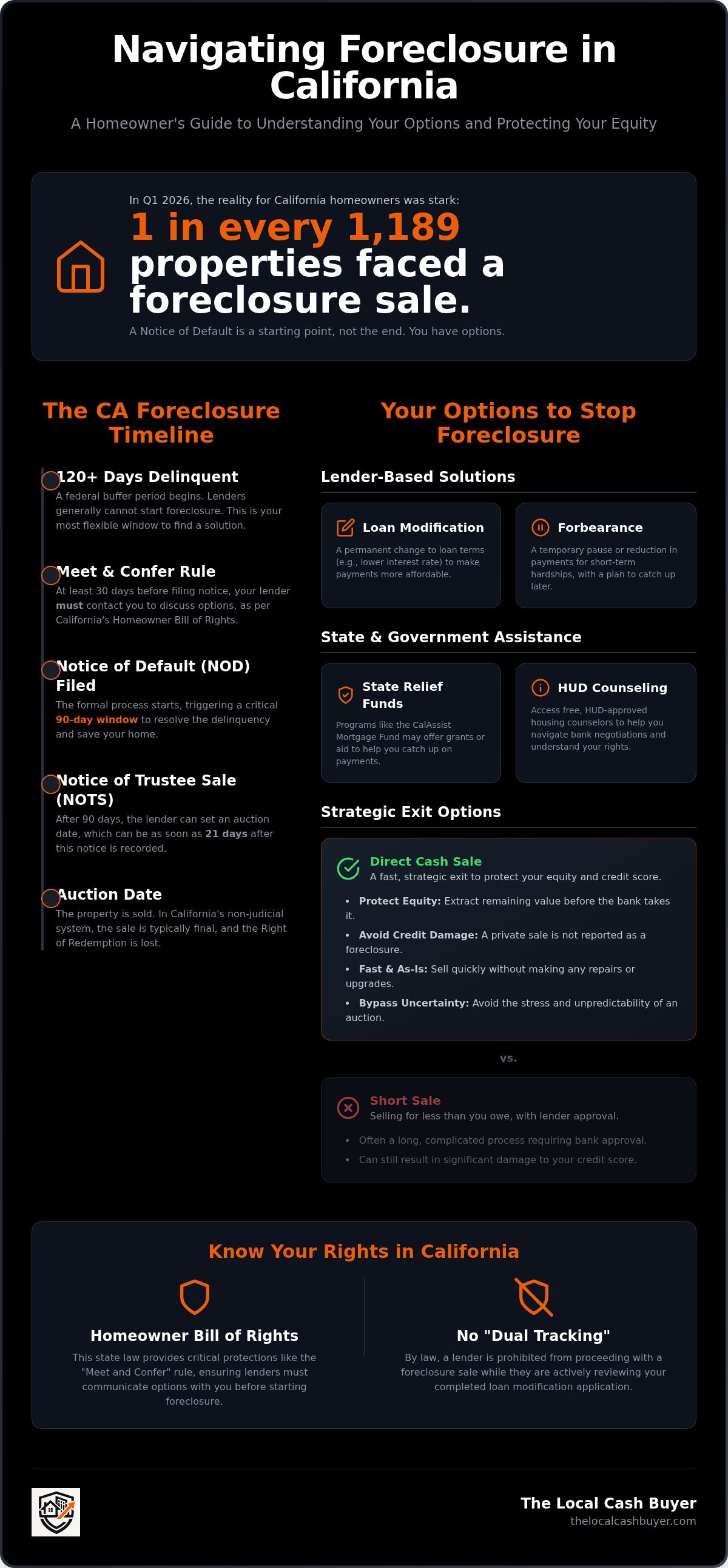
The Notice of Default is the first formal legal document recorded in the county where your property is located and it triggers a mandatory 90-day statutory period for the homeowner to resolve the delinquency.
Non-Judicial vs. Judicial Foreclosure in CA
Most lenders in California choose the non-judicial route because it's efficient and cost-effective. Since there's no court oversight, you won't automatically get a day in court to explain your situation. However, the state does have built-in protections. California's "Homeowner Bill of Rights" requires a "Meet and Confer" process. Your lender must contact you to discuss your financial situation and present potential options to avoid foreclosure California residents can utilize, such as loan modifications, at least 30 days before they can file a Notice of Default.
This requirement ensures that you aren't blindsided by legal filings. If the lender fails to meet these procedural steps, it can sometimes delay the process, though it rarely stops it entirely. It's a signal that you need to move toward a resolution immediately.
After the 90-day Notice of Default period expires, the lender can record a Notice of Trustee Sale (NOTS). This document sets a specific auction date, which can be as soon as 21 days after the notice is recorded. In California's non-judicial system, once the auction is complete, you generally lose your "Right of Redemption." Unlike some states where you can buy the house back after the sale, California auctions are usually final. This makes the time between the Notice of Default and the auction date the most critical window for saving your credit and extracting any remaining equity from the property.
Lender-Based Solutions: Loan Modifications and Forbearance
If you've missed payments, your first instinct might be to avoid the bank. Don't. Your lender actually has several formal options to avoid foreclosure California homeowners can use to stay in their properties. The most direct path is reinstatement, where you pay the full past-due amount plus fees in a single lump sum. If that isn't feasible, you may qualify for a loan modification or a forbearance agreement. Engaging with your servicer early is one of the most effective ways of avoiding foreclosure in California, as it opens doors to programs that aren't available once an auction is scheduled.
A loan modification is a permanent change to your mortgage terms. The lender might lower your interest rate, extend the loan term, or roll the past-due balance into the principal to make your monthly payment affordable. In contrast, a forbearance agreement is a temporary pause. It's helpful if you’ve had a short-term hardship, like a medical emergency, but you must have a plan to catch up later. California law strictly prohibits dual tracking. This means a lender cannot proceed with a foreclosure sale while they're still evaluating a completed loss mitigation application. For homeowners seeking professional guidance on these complex bank negotiations, a refinancing consultation can provide the clarity needed to choose the right path.
How to Apply for a Loan Modification
The application process starts with a complete financial package. You'll need to provide tax returns, bank statements, and a "Hardship Letter" that explains why you fell behind and how your situation has improved. Never ignore mail from your loan servicer; these packages often contain time-sensitive applications. The California Homeowner Bill of Rights protects you here, requiring lenders to provide a single point of contact so you aren't bounced between departments. If you submit a complete application at least five business days before a scheduled sale, the lender must stop the foreclosure process to review your request.
Repayment Plans and Partial Claims
If you don't qualify for a full modification, a repayment plan might be the answer. This spreads your past-due balance over several months, adding a portion to your regular payment until you're current. For those with FHA-insured loans, a partial claim is a powerful tool. The FHA can pay the lender a one-time sum to bring your mortgage current, and you pay that back only when you sell the home or finish your mortgage. When dealing with uncooperative lenders, keep a log of every call, including the date, time, and the name of the representative. This documentation is vital if you need to prove the lender isn't following state-mandated options to avoid foreclosure California law requires them to offer.
California State Relief: Grants and HUD-Approved Counseling
If you're feeling overwhelmed by bank notices, you aren't alone. California has established several state-funded options to avoid foreclosure California residents can access to bridge the gap during financial hardship. These programs are designed to provide a safety net when traditional bank negotiations stall. As of February 2026, the CalAssist Mortgage Fund is active and expanded, offering up to $100,000 in non-repayable grants for homeowners affected by qualifying disasters, such as the 2025 firestorms. Income limits for these programs have increased significantly to help more families; in Los Angeles County, for instance, the household income limit is now $281,400.
The Role of a HUD Counselor
HUD-approved housing counselors act as a professional bridge between you and your lender's loss mitigation department. They understand the nuances of the regional market and the specific internal requirements of major banks. A counselor helps you prepare the Request for Mortgage Assistance (RMA) package, ensuring your financial documentation is accurate and your hardship letter is persuasive. This professional oversight is often more effective than calling the lender yourself, as counselors have direct lines to decision-makers. HUD counseling is free and mandatory for certain relief programs.
California Finance Housing Agency (CalHFA) Resources
The California Housing Finance Agency provides specialized resources for both first-time buyers and distressed owners. You can verify if your specific loan qualifies for state-level relief by visiting their online portal or speaking with an approved specialist. These programs often include subordinate loans or secondary financing options that can resolve a default without requiring an immediate cash outlay. By utilizing these state-backed options to avoid foreclosure California homeowners can often find a path to stability that their primary lender might not have mentioned.
For low-income homeowners, local Legal Aid organizations offer a vital defense against predatory lending or procedural errors by servicers. Additionally, if you're a senior or a disabled homeowner, you may qualify for the State Controller’s Property Tax Postponement Program. This allows you to defer current-year property taxes on your principal residence, freeing up monthly cash flow to keep your mortgage current. These state resources provide a layer of protection that ensures you don't have to face the foreclosure process without expert support.
Strategic Exit Options: Selling Fast vs. Short Sales
Sometimes the best path forward isn't staying in the property, but preserving the wealth you've built within it. If you've realized that the monthly payments are no longer sustainable, you need to evaluate options to avoid foreclosure California homeowners can use to exit on their own terms. A strategic sale allows you to protect your credit score and, in many cases, walk away with a check for your remaining equity. Waiting for the bank to take the home at auction usually means losing every dollar of value you've accumulated over the years.
Traditional Listing vs. Cash Buyer
A traditional sale is often the first choice for owners with significant equity and a long runway before the auction date. However, listing a home on the open market while in the foreclosure process is difficult. Most traditional buyers rely on bank financing, and many lenders won't approve a mortgage for a property with an active Notice of Default. Additionally, the typical 30 to 45 day closing period for a retail buyer might be too slow if your auction is just weeks away. You can learn more about the specifics in our guide on Stop Foreclosure: How to Sell Your House Fast in Northern California.
A direct cash sale removes these hurdles. Because a cash buyer doesn't need bank approval, they can close the transaction in as little as seven days. This allows you to stop the auction and settle the debt immediately. You won't need to worry about repairs, cleaning, or hosting open houses while under stress. If you need a fast resolution, you can request a direct cash offer to see if this path fits your timeline.
Calculating Your Equity Before It’s Gone
Many homeowners don't realize how much equity they actually have. To estimate your net proceeds, start with the current market value and subtract your mortgage balance, any secondary liens, and unpaid property taxes. If you let the home go to a public auction, the property often sells for much less than market value, and the trustee's fees will eat into any remaining funds. Taking control of the sale yourself ensures you are the one who benefits from the home's appreciation. For a deeper look at this process, see our Sell Your House Behind on Mortgage in California: 2026 Homeowner Guide.
If your home is underwater, meaning you owe more than it's worth, a short sale might be necessary. New legislation in 2026, specifically AB 1542, has reduced lender approval timelines for short sales from 120 days to approximately 84 days. While a short sale requires lender approval and does impact your credit, it's often viewed more favorably than a foreclosure. Another alternative is a Deed in Lieu of Foreclosure, where you voluntarily transfer the title to the lender. This is a final options to avoid foreclosure California residents use to walk away without the stigma of a formal foreclosure mark on their record.
Navigating Financial Distress with Local Expertise in Northern California
While state programs and bank-led modifications provide a broad framework for relief, local market conditions in Northern California often require a more specialized approach. When you're dealing with a property in San Jose, Walnut Creek, or Forster City, a generic online estimate won't give you the full picture of your home's actual worth. The Local Cash Buyer provides straight-shooting, regional expertise to help you evaluate the most effective options to avoid foreclosure California homeowners can use to protect their financial future. Whether you want to stay in your home or need a clean break, we focus on practical outcomes that respect your privacy and your timeline.
Refinancing Consultation: A Path to Retention
If your goal is to keep your home, a professional refinancing consultation can reveal alternative financing paths you might not have considered. Traditional banks often have rigid criteria that don't account for the unique equity positions found in high-value markets like Walnut Creek or San Jose. We look at your specific situation, including debt consolidation needs, inheritance issues, or property disputes related to a divorce. Our local knowledge allows us to perform a precise equity assessment, which is the foundation for any successful refinancing strategy. By consolidating high-interest debt into a more manageable mortgage structure, you can resolve the default and find a sustainable way to remain in your community.
The Frictionless Cash Exit
There are times when the most logical choice is a direct acquisition. If the foreclosure timeline has progressed too far for a traditional listing, or if you simply don't want the stress of repairs and open houses, a frictionless cash exit is the fastest way to stop the auction. We provide no-nonsense, as-is offers that allow you to walk away with your equity intact and your credit protected from a formal foreclosure mark. You won't have to worry about agent commissions, hidden fees, or the uncertainty of buyer financing falling through at the last minute.
- Speed: We can often close the entire transaction in as little as 7 to 14 days.
- Simplicity: You sell the house exactly as it is right now, meaning no cleaning or staging is required.
- Certainty: A direct cash purchase eliminates the traditional hurdles of inspections and appraisals that often derail sales.
We understand that every situation is unique, and there is no one-size-fits-all solution for financial distress. Our role is to act as a reliable partner, offering the quiet authority and honest feedback you need to make an informed decision. If you're ready to explore your options to avoid foreclosure California laws and market conditions allow, we're here to help you move from a state of difficulty to a state of resolution. Contact The Local Cash Buyer for a no-pressure consultation and take the first step toward reclaiming your peace of mind.
Take Control of Your Financial Future Today
Navigating a potential foreclosure is a high-stakes process, but you don't have to face it without a plan. The most important takeaway is that time is your most valuable asset. Whether you're within the 120-day pre-foreclosure window or have already received a Notice of Default, acting quickly preserves your ability to choose the best outcome. You have several options to avoid foreclosure California homeowners can use to protect their equity, from state-funded grants and loan modifications to a strategic as-is cash sale.
We provide the local expertise you need in Walnut Creek, San Jose, and Forster City to evaluate these paths with clarity. If your goal is to stay in your home, our professional refinancing consultations offer a way to consolidate debt and find a sustainable monthly payment. If you need a fast, frictionless exit to stop an auction, we offer direct cash closings that respect your privacy and your timeline. Don't wait for the bank to make the decision for you. Get a no-obligation cash offer or refinancing consultation today and start moving toward a resolution. You have the power to resolve this situation and protect what you've built.
Frequently Asked Questions
How long do I have to stop a foreclosure in California?
You generally have until the moment the trustee sale is finalized to stop the foreclosure process. In California, the non-judicial timeline typically lasts between seven and ten months from your first missed payment. This window includes a 90-day period following the Notice of Default and a 21-day notice period before the auction. Acting during the earlier stages gives you the most flexibility to negotiate or sell.
Can I sell my house if I have a Notice of Default in California?
You absolutely have the right to sell your home privately even after a Notice of Default has been recorded. This is often one of the most effective options to avoid foreclosure California homeowners use to protect their remaining equity. As long as the sale closes and the lender is paid in full before the trustee auction, you can walk away with your credit score intact and cash in hand.
What is the California Homeowner Bill of Rights?
The California Homeowner Bill of Rights is a series of state laws designed to ensure fair lending practices for people in financial distress. It specifically prohibits "dual tracking," which is when a lender continues the foreclosure process while simultaneously reviewing your loan modification application. It also requires your loan servicer to provide a single point of contact to ensure you receive consistent information about your case.
Does a short sale hurt my credit as much as a foreclosure?
A short sale is generally less damaging to your credit score and future borrowing ability than a completed foreclosure. While both will impact your credit, a short sale is often viewed more favorably by future lenders. Homeowners who complete a short sale can sometimes qualify for a new mortgage in as little as two to three years; a foreclosure often requires a seven-year wait.
Can I stop a foreclosure by filing for bankruptcy in California?
Filing for bankruptcy stops a foreclosure immediately through a legal mechanism called an automatic stay. This stay prevents the lender from moving forward with the auction while the bankruptcy case is active. While this is a powerful tool to gain time, it's often a temporary solution. You'll still need a long-term plan to address the mortgage arrears or sell the property during the stay.
What happens to my equity if my house is sold at a trustee auction?
Any equity remaining after your mortgage, secondary liens, and trustee fees are paid off at an auction technically belongs to you. However, homes sold at trustee auctions rarely reach their full market value, and high administrative fees can quickly deplete your proceeds. Selling the home yourself before the auction is usually the only way to ensure you maximize the return on your investment.
How can a refinancing consultation help me avoid foreclosure?
A refinancing consultation helps you find options to avoid foreclosure California banks often overlook by analyzing your total debt-to-equity ratio. A professional can identify alternative lending structures or debt consolidation strategies that make your monthly payments sustainable. If you have significant equity but poor credit, a local expert can often find private financing solutions that traditional retail banks simply don't offer to distressed borrowers.
Will a cash buyer pay off my mortgage and liens?
A reputable cash buyer will pay off your existing mortgage, any delinquent property taxes, and all recorded liens during the escrow process. This ensures that the title is cleared and the foreclosure process is legally terminated. Because the buyer uses their own funds, they don't need to wait for bank appraisals or loan approvals, which allows for a guaranteed closing before your scheduled auction date.

Contact Info
Address: 3100 Oak Rd STE 120 Walnut Creek CA 94597
NMLS# 2250879
877-343-7379
info@munshi.biz
© Copyright 2025. Munshi Capital Inc. All rights reserved.