
Address: 3100 Oak Rd STE 120 Walnut Creek CA 94597
Call: 877-343-7379
Email: info@munshi.biz
We value your time
Learn the secrets of mortgage world and save on your most expensive budget item!
Eager to know more on how to save on your mortgage?
join us to learn more
Information you were waiting for is available right here! From first time home buyers to seasoned investor and fund managers rely on this information to make informed decisions about their real estate financing.
What Happens to Property in Probate California? The 2026 Guide
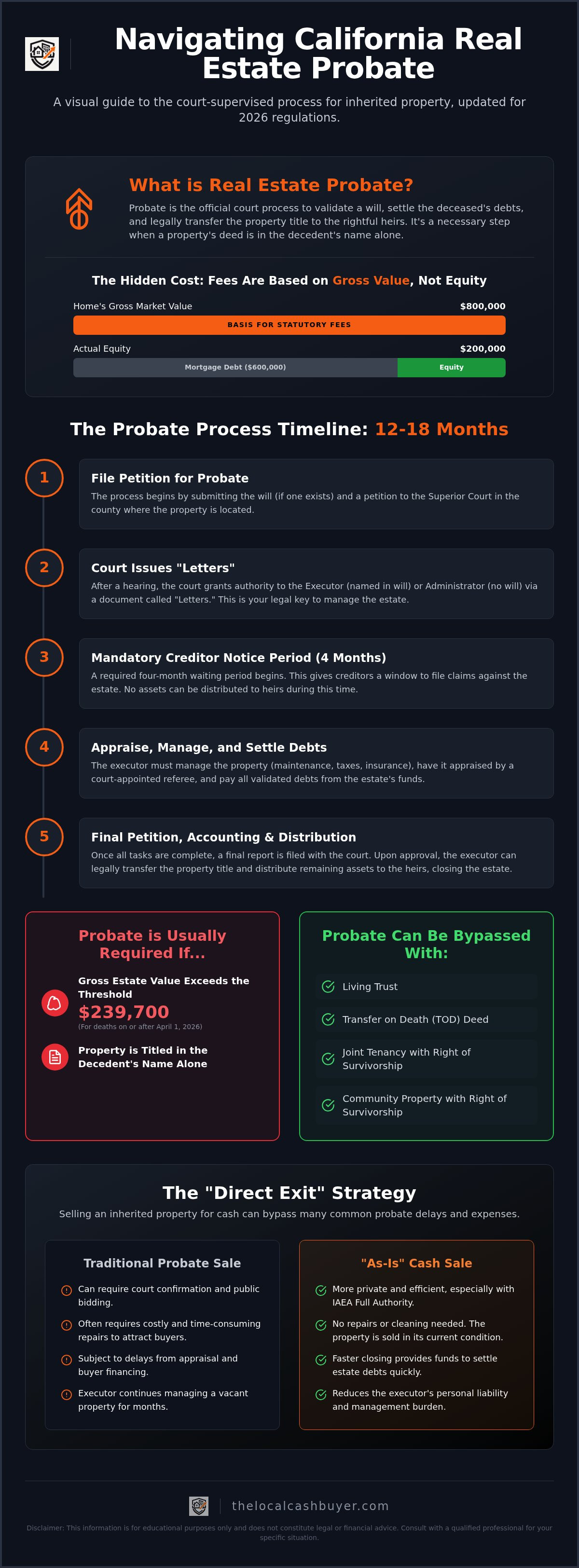
Did you know the California probate court calculates its fees based on what your inherited home is worth, not how much equity is actually left after the mortgage? It's a frustrating reality for many families who find themselves stuck in a legal system that feels designed to drain the estate's value while a vacant house sits and gathers dust. Understanding exactly what happens to property in probate California is the first step toward protecting your inheritance from being consumed by court costs and maintenance fees.
You're likely feeling the weight of legal jargon and the fear of personal liability for the estate's debts. We understand that pressure. This 2026 guide will show you exactly how the court handles real estate and how you can manage or sell the property without the typical two-year wait. We'll cover the updated $239,700 small estate threshold, explain which assets skip court, and outline a clear timeline for the process. You'll also discover a way to liquidate the home quickly so you can stop worrying about repairs and start focusing on your family's future.
Key Takeaways
- Learn exactly what happens to property in probate California, including the court-supervised steps required to transfer a home's title to heirs or buyers.
- Understand the updated 2026 small estate thresholds and how assets like Living Trusts or Transfer on Death deeds can bypass the court system entirely.
- Identify the financial risks of leaving a probate property vacant, from insurance lapses to statutory fees calculated on the home's gross market value.
- Discover the typical 12-to-18-month probate timeline and the specific legal "Letters" an executor needs to gain control of the estate.
- Explore the "direct exit" strategy of selling an inherited property as-is for cash to avoid the delays of the probate referee and the cost of traditional repairs.
What is Probate in California and Why Does Real Estate Go Through It?
Probate is the court-supervised process of authenticating a will and distributing assets to the rightful heirs. To better understand the fundamentals of What is Probate, it's helpful to view it as a safety net for creditors and heirs alike. The court's primary goal is clear. It wants to verify that all valid debts are settled and that the legal title to the home transfers to the correct person. California probate is the legal bridge between a deceased owner and their heirs. Understanding what happens to property in probate California starts with realizing that the court wants to ensure every debt is paid and every title transfer is documented correctly.
In California, real estate is often the primary reason an estate enters formal probate. While bank accounts or personal items might be easy to move, a house is a fixed asset with a recorded deed. You can't simply hand over the keys and change the name on the title without a court order or a specific legal instrument like a trust. This process ensures that no one sells the property out from under the rightful beneficiaries or ignores the deceased person's final wishes.
The Role of the Personal Representative or Executor
If you've been tasked with managing an estate, your specific title depends on whether a will exists. An Executor is the person specifically named in a will to handle the estate. If there is no will, the court appoints an Administrator instead. Regardless of the title, your legal duty is to protect the property's value during the proceedings. This isn't just a suggestion; it's a fiduciary responsibility. If you neglect a property in San Jose or Walnut Creek and allow it to fall into disrepair, you could face personal liability for the loss in value. You must keep the lawn mowed, the taxes paid, and the structure secured until the court grants permission to distribute or sell the asset.
When is Probate Mandatory in California?
California law uses a "Total Estate Value" to decide if you must go through the full court system. For individuals who pass away on or after April 1, 2026, the small estate threshold is $239,700. Because even a small home or vacant lot in the Bay Area usually exceeds this value, real property almost always triggers formal probate. How you hold the title also matters. If the property is held in Joint Tenancy or as Community Property with Right of Survivorship, it might skip the court process. However, if the deed is in the decedent's name alone, you'll likely need to navigate the full probate timeline to figure out what happens to property in probate California before any sale can occur.
The Step-by-Step Timeline of Property in California Probate
Understanding what happens to property in probate California requires a close look at the court's calendar. The process begins when you file a Petition for Probate with the local Superior Court, such as those in Santa Clara or Contra Costa County. After a hearing, the court issues "Letters." These documents are your official badge of authority. They prove to banks, utility companies, and title officers that you have the legal right to manage the estate's assets. Without these letters, you're essentially locked out of the deceased person's financial life.
Once you have authority, the mandatory four-month creditor notice period begins. This is a non-negotiable pause in the California probate process. It gives lenders and agencies time to file claims against the estate. You cannot distribute property or final sale proceeds to heirs until this window closes and all valid debts are settled. Only after the court approves a final report and petition for distribution can you officially transfer the title and close the estate. If the thought of managing a house for a year or more feels overwhelming, you can explore a direct sale to a local buyer to simplify your responsibilities.
The 'Power of Sale' and Independent Administration of Estates Act (IAEA)
The Independent Administration of Estates Act (IAEA) is a vital tool for executors who want to move quickly. If the court grants you "Full Authority" under the IAEA, you gain the 'Power of Sale.' This allows you to sell the real estate without seeking a judge's approval for every specific detail. In San Jose and Walnut Creek, heirs often prefer this independent path. It skips the formal court-confirmation process and the public bidding wars that often occur in a courtroom. It's a much more private and efficient way to handle what happens to property in probate California when the goal is a clean break.
Estimated Timeframes for Bay Area Courts
Patience is required when dealing with the local court system. Most probate cases in San Jose and Walnut Creek take a minimum of 12 to 18 months to reach completion. Several factors can push this timeline even further. Missing heirs, contested wills, or complicated tax issues can easily extend the process to two years. During this time, the house remains "in limbo." You are responsible for the mortgage, property taxes, and general upkeep. If the house is vacant, you also face the risk of vandalism or squatters. Preparing for this long-term commitment is the only way to avoid the financial strain of a house stuck in the system.
Which Properties Skip Probate? (The $184,500 Rule and Beyond)
Not every piece of real estate is doomed to a year of court hearings and legal delays. If the deceased owner utilized specific legal tools, the transition can happen in weeks rather than months. Understanding what happens to property in probate California often reveals that the "standard" process is optional for those who planned ahead. While the court is the default path, several legal shortcuts allow a home to pass directly to heirs without a judge's involvement.
The most effective tool is a Living Trust. Assets held in a trust bypass the court system entirely because the trust technically owns the property. Other common methods include:
- Joint Tenancy with Right of Survivorship: The property automatically transfers to the surviving owner.
- Transfer on Death (TOD) Deeds: This allows an owner to name a beneficiary who takes title immediately upon their death.
- Community Property with Right of Survivorship: This is a common California shortcut for spouses that simplifies the transfer of the family home.
For those wondering what happens to property in probate California when no trust exists, the state has updated its "small estate" rules for 2026. If an individual dies on or after April 1, 2026, the threshold for personal property to skip formal probate is $239,700. For deaths occurring between April 1, 2025, and March 31, 2026, the limit is $208,850. Additionally, California now offers a simplified petition process for primary residences valued at up to $750,000, which provides a much faster alternative for modest homes.
Determining the Value of the Estate
To see if you qualify for these simplified procedures, you need an official valuation. A court-appointed Probate Referee typically handles this task. They determine the Fair Market Value of the property at the exact time of death. The referee charges a fee of 0.1% of the asset's value for this appraisal. In high-value markets like San Jose or Walnut Creek, even a small condo can quickly exceed small estate limits. This is why the California Courts Self-Help Guide is so important; it helps you determine if your property's value forces you into a formal proceeding or allows for a simplified transfer.
The Benefits of Avoiding Probate
Avoiding the court saves more than just time. Probate is a public process, meaning any neighbor or creditor can look up the estate's details in public records. Trusts and simplified petitions offer much more privacy. Cost is another major factor. Statutory probate fees are calculated on the gross value of the home, not the equity. If a house is worth $1 million, the combined legal and executor fees are $46,000, even if the mortgage is $900,000. Bypassing the court keeps that money in the family's pockets. Finally, speed is the ultimate benefit. Trust administration can often be completed in a few weeks, while formal probate rarely finishes in under eight months.
The Executor’s Burden: Managing Real Estate in Limbo
Being an executor is a job, not just a title. While the court manages the legal paperwork, you are responsible for the physical structure of the home. Many people don't realize that a standard homeowners insurance policy usually becomes void if a property is vacant for more than 30 or 60 days. If a pipe bursts or a fire occurs in a vacant house in Walnut Creek, the insurance company might deny the claim. You'll need to secure "probate homeowners insurance" or a vacant home policy to stay protected. This is a critical part of what happens to property in probate California that often catches families off guard.
Security is another major concern. A vacant house in San Jose can quickly become a target for vandalism or squatters. You have a legal duty to keep the asset secure for the heirs. If the property is filled with years of belongings or suffers from deferred maintenance, the burden feels even heavier. You must balance the need to preserve the home's value with the reality of the estate's available cash. If you're dealing with a difficult cleanup, you might find our guide on How to Sell a Hoarder House helpful for managing the logistics of an overwhelmed property.
Property Maintenance and Utilities
Keeping the lights on and the lawn mowed costs money. Ideally, these expenses are paid from the estate's liquid assets. If the estate is "cash poor," you might find yourself paying out-of-pocket and seeking reimbursement later. It's vital to maintain the "as-is" condition of the home. If the roof starts leaking or the garden becomes an eyesore, the property value drops, and you could be held liable for the loss. You don't need to perform major renovations, but you must prevent the home from deteriorating further. If the financial strain of maintenance is too much, you can sell the property for cash to stop the monthly drain on your resources and move the process forward.
Mortgages, Taxes, and Liens
Mortgages don't stop for probate. While federal law generally prevents lenders from triggering a "Due on Sale" clause immediately after a death, the payments must still be made. You also need to navigate California's property tax laws. Under Proposition 19, inherited properties are often reassessed to current market value unless they become the primary residence of the heir. This can lead to a massive jump in annual tax bills. If the house has more debt than value, or if the liens are piling up, you'll need to work closely with the court to determine the best exit strategy. Understanding what happens to property in probate California means knowing that the debts stay with the property until they are settled or the asset is sold.
The Direct Exit: Selling a Probate Property for Cash
Once the court issues your Letters, you finally hold the legal key to the estate's largest asset. For many executors, especially those living outside of California, the physical reality of the house becomes the biggest hurdle. You don't have to spend months flying back and forth to manage contractors or clean out decades of belongings. A direct cash sale offers a way to bypass the standard market delays and settle the estate's debts quickly. When considering what happens to property in probate California, remember that you have the authority to choose the most efficient exit strategy once the court grants the Power of Sale.
A cash offer acts as a "path of least resistance." It allows you to skip the mandatory inspections and the public bidding process that can drag on for months. You can close the sale in a fraction of the time it takes for a traditional buyer to secure a mortgage. This speed is vital when the estate is facing mounting maintenance costs or property tax deadlines. By choosing a direct sale, you ensure that the inheritance stays protected from the costs of a house stuck in legal limbo.
Traditional Listing vs. Cash Buyer in Probate
Listing a probate home on the traditional market often reveals hidden costs that drain the estate's value. You'll likely face 6% in agent commissions, staging fees, and a long list of repairs demanded by a buyer's lender. Traditional buyers often struggle with probate timelines. They want a move-in-ready home and a predictable closing date, which the probate court rarely provides. If you want to see how this compares to a streamlined process, read our Sell My House for Cash guide for Bay Area homeowners. Most traditional buyers will walk away if the court delays the closing, but a cash buyer remains steady throughout the process.
How The Local Cash Buyer Simplifies the Process
We provide a straightforward solution for families in San Jose, Walnut Creek, and Forster City. We buy properties exactly as they are. This means you don't have to spend a single weekend hauling away old furniture or fixing a leaky roof. Whether you are dealing with a hoarder house or a property that has been vacant for years, our goal is to make the transition frictionless. Our local expertise helps us navigate the specific requirements of the Santa Clara and Contra Costa County courts. To learn more about the local legal landscape, check out our guide on How to Sell a House in Probate San Jose. We provide the liquidity you need to pay off creditors and distribute the remaining funds to heirs without the usual two-year wait. Understanding what happens to property in probate California is much easier when you have a partner who handles the heavy lifting for you.
Move Forward with Clarity and Confidence
Navigating the California probate system is a marathon, not a sprint. You now know that the process usually takes 12 to 18 months and that 2026 thresholds, like the $239,700 small estate limit, offer some shortcuts for specific situations. Whether you are managing a vacant home in San Jose or a complex hoarder house in Walnut Creek, your priority is protecting the equity for your family. Understanding exactly what happens to property in probate California allows you to make decisions based on facts rather than the stress of legal jargon.
If the burden of maintenance, insurance, and court delays feels like too much, you have a faster option. We specialize in providing a "path of least resistance" for executors. You can Get a Fair Cash Offer for Your Inherited Property Today and skip the repairs, cleaning, and agent commissions. We use our local expertise to close quickly once you have your Power of Sale; we buy properties in any condition with zero hidden fees. You don't have to wait years to resolve the estate. Take the first step toward a frictionless transition and reclaim your peace of mind today.
Frequently Asked Questions
Can I sell a house while it is still in probate in California?
Yes, you can sell the property as long as you have been granted "Letters" by the court giving you legal authority. If you have full authority under the Independent Administration of Estates Act (IAEA), you can often sell the home without a specific court hearing for the sale itself. This is a common way to manage what happens to property in probate California when the estate needs cash to pay off creditors or taxes.
How long does the probate process typically take in San Jose?
Most probate cases in San Jose and the surrounding Santa Clara County take between 12 and 18 months to reach completion. The mandatory four-month creditor claim period serves as a minimum floor, but local court backlogs often push the timeline much further. If the estate involves contested claims or complex real estate valuations, you should prepare for a process that lasts closer to two years.
Who is responsible for the mortgage payments during probate?
The estate is legally responsible for the mortgage, but the executor must ensure the payments are actually made to prevent foreclosure. If the estate lacks liquid cash, the executor might need to pay out-of-pocket and seek reimbursement later or sell the house quickly to settle the debt. While federal law usually prevents lenders from calling the loan immediately, they still require regular monthly payments to keep the loan in good standing.
What are the statutory probate fees for executors and attorneys in California?
California Probate Code §10810 sets specific fees based on the gross value of the estate, not the equity. For 2026, the rates remain 4% of the first $100,000, 3% of the next $100,000, and 2% of the next $800,000. For a home appraised at $1 million, the statutory fee for the attorney is $23,000, and the executor is entitled to an additional $23,000, totaling $46,000 in mandatory fees.
Do I need to clean out a hoarder house before selling it during probate?
No, you aren't required to clean or repair the property if you choose a direct "as-is" sale. While traditional buyers typically need a cleared house to secure financing, a cash purchase allows you to leave the belongings and deferred maintenance exactly as they are. This approach removes the physical and financial burden of a massive cleanup from the executor while still allowing the estate to liquidate the asset.
What happens if the deceased person didn't leave a will for their property?
The estate will be distributed according to California's intestate succession laws. The court will appoint an Administrator to manage what happens to property in probate California instead of an Executor named in a will. Assets generally pass to the closest living relatives, starting with a surviving spouse and children, then moving to parents or siblings if no immediate family members are found.
Can I live in the house while it is going through probate?
You can often stay in the home if you are a surviving spouse or a legal heir, but the executor still has a duty to protect the estate's value. If your residence interferes with a necessary sale to pay off estate debts, the court may require you to move. You must also ensure the property remains properly insured, as many standard homeowners policies will lapse if the house is considered vacant or in transition.
How can I avoid probate for my own property in the future?
The most reliable way to bypass the court system is to place your real estate into a Revocable Living Trust. Other options include using a Transfer on Death (TOD) deed or holding the title as Community Property with Right of Survivorship. These strategies allow the property to transfer directly to your heirs the moment you pass away, which avoids the public record, court delays, and expensive statutory fees.

Contact Info
Address: 3100 Oak Rd STE 120 Walnut Creek CA 94597
NMLS# 2250879
877-343-7379
info@munshi.biz
© Copyright 2025. Munshi Capital Inc. All rights reserved.