
Address: 3100 Oak Rd STE 120 Walnut Creek CA 94597
Call: 877-343-7379
Email: info@munshi.biz
We value your time
Learn the secrets of mortgage world and save on your most expensive budget item!
Eager to know more on how to save on your mortgage?
join us to learn more
Information you were waiting for is available right here! From first time home buyers to seasoned investor and fund managers rely on this information to make informed decisions about their real estate financing.

Selling a House During Divorce in the Bay Area: A 2026 Homeowner’s Guide
In the high-stakes Bay Area market, speed and certainty are the most valuable currencies during a divorce. It's an exhausting reality that when you need to sell house during divorce Bay Area, the emotional weight is often matched by the sheer complexity of local real estate laws. You're likely feeling the pressure of mounting legal fees, the high cost of local relocation, and the anxiety of prepping a home for sale while your personal life is in flux. It's a heavy burden to carry when you're already managing a major life transition.
We believe that property division shouldn't add to your stress. This guide provides the clarity you need to navigate California community property laws and find the fastest path to a clean financial break. You'll learn how to handle the unique tax requirements in cities like San Jose and Walnut Creek without losing your equity to endless commissions. We'll preview the "as-is" sale process, explain how to avoid months of intrusive open houses, and show you how to maximize your cash payout. By the end of this article, you'll have a straightforward roadmap to resolve your housing situation and start your next chapter with financial confidence.
Key Takeaways
- Understand how California's 50/50 community property rules and the "Date of Separation" impact your equity split in high-value markets like Walnut Creek.
- Compare the financial implications of a spouse buyout versus a deferred sale to determine which strategy protects your post-divorce stability.
- Learn how to sell house during divorce Bay Area without falling into the "condition trap" of costly repairs or losing equity to standard real estate commissions.
- Use a localized checklist for San Jose and Walnut Creek properties to gather essential documents and coordinate with your attorney before signing any agreements.
- Explore the benefits of a direct cash purchase to ensure a fast closing that satisfies court-ordered deadlines and provides a clean financial break.
Understanding California Community Property Law in 2026
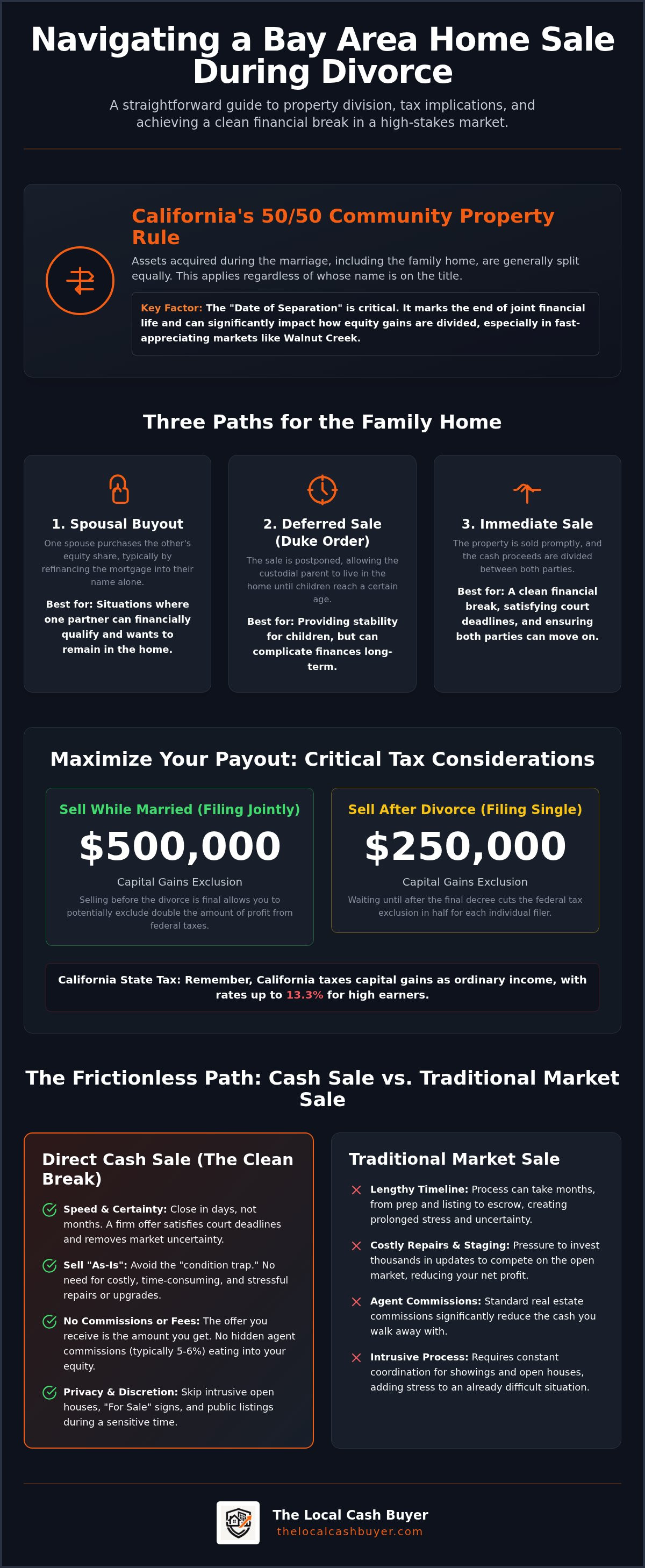
California law is built on a straightforward principle: what you build together, you own together. Under the state's community property rules, most assets acquired during the marriage are split 50/50. This includes the family home, regardless of whose name is on the title. Understanding California Community Property Law is the first step toward a fair settlement. In high-value markets like Walnut Creek, the "date of separation" is the most important variable. This date determines when your joint financial life ended and your separate life began. If home values rise sharply after this date, that extra equity might belong solely to the spouse living in the home, making the timing of your valuation essential.
While the 50/50 split is the default, exceptions exist for inherited property or assets you owned before saying "I do." If you received a home as a gift, it remains yours. However, the rapid appreciation seen in the Bay Area often blurs these lines. When a home gains hundreds of thousands of dollars in value, determining which portion of that growth is "community" and which is "separate" requires precision. It's common for couples to fight over these numbers when the stakes are this high.
Community vs. Separate Property in Real Estate
The down payment often creates the biggest point of contention. If you used separate funds for the deposit but joint earnings for the monthly mortgage, the home is no longer purely separate. California uses a specific legal calculation to solve this. A Moore-Marsden interest calculation determines the community's share of the home's equity based on the amount of community funds used to reduce the mortgage principal. If you need to sell house during divorce Bay Area, identifying these financial threads early prevents delays in the settlement. Using community income to pay down a separate mortgage principal creates a joint interest that must be addressed.
The Role of the Court in Property Division
Courts prefer that couples reach an agreement on their own, but they won't wait forever. If conflict prevents a resolution, a judge may order a forced sale. This mandate requires the home to be sold so the proceeds can be divided according to the law. Judges typically view private cash sales more favorably than public auctions because they provide a clear, certain value without the risk of a market downturn. You must provide the court with documented proof of value, such as a certified appraisal or a formal purchase agreement. Having a firm offer in hand can often convince a judge that a quick sale is the most equitable path forward for everyone involved.
Three Ways to Handle the Family Home During a Divorce
Choosing how to divide your largest asset is often the most significant hurdle in a separation. You generally have three paths to consider. First, a buyout allows one spouse to remain in the home by paying the other their share of the equity. Second, a deferred sale, often called a Duke Order, permits the custodial parent to stay in the home until the children reach a certain age. Third, an immediate sale involves liquidating the property and splitting the cash. If you decide to sell house during divorce Bay Area, an immediate sale is often the most direct route to a clean break and financial independence.
Each choice carries distinct tax consequences in 2026. If you sell while still married and filing jointly, you can exclude up to $500,000 in capital gains from your federal taxes. If you wait until after the divorce is finalized to sell as a single filer, that exclusion drops to $250,000. It is also vital to remember that California continues to tax capital gains as ordinary income, with rates reaching as high as 13.3 percent for high earners. Understanding these thresholds early prevents expensive surprises during tax season.
The Logistics of a Spousal Buyout
If one spouse wants to stay, they must qualify for a new mortgage on their own. This process involves refinancing the existing debt to remove the departing spouse's name and legally releasing them from the liability. Determining a fair price is the next challenge. Instead of relying on a single agent's opinion, many couples hire two independent appraisers and average the results to ensure transparency. If you are considering this path, a refinancing consultation can help you understand your current equity position and borrowing capacity without the pressure of a traditional bank environment.
Selling the House and Splitting the Proceeds
When both parties agree to sell, the first hurdle is setting a price. Disagreements often arise regarding which repairs are necessary to attract buyers in a competitive market. In cities like Walnut Creek or San Jose, many owners feel pressured to spend thousands on staging and modernizing. If you can't agree on a renovation budget, selling "as-is" removes that friction entirely. Once the home closes escrow, the title company typically distributes the proceeds directly to each spouse based on the percentage agreed upon in your settlement. If you want to skip the repair debate and move on quickly, you can request a direct offer to simplify the transition and secure your payout faster.
The Unique Challenges of the Bay Area Real Estate Market
The Bay Area market moves fast for some, but divorce adds a layer of "sticky" friction that traditional data often ignores. With median home prices in Walnut Creek sitting at $1,241,200, the financial stakes are incredibly high. A standard 5 or 6 percent real estate commission on a home at this price point translates to over $70,000 in lost equity. This is money that could otherwise fund your relocation or cover mounting legal fees. When you factor in San Jose's Measure E transfer taxes for properties over $2.3 million, the cost of a traditional sale becomes even more staggering. Every dollar lost to fees is a dollar taken away from your fresh start.
Privacy is another hurdle that many homeowners overlook. Traditional listings require open houses, which essentially invite the public into your personal crisis. In a high-conflict separation, having strangers and neighbors walking through your home can feel like an intrusive spotlight on your private life. If you want to sell house during divorce Bay Area, maintaining your discretion is often just as important as the final sale price.
Why Traditional Listings Can Fail Divorcing Couples
A traditional sale requires a level of "forced cooperation" that many couples simply cannot maintain. Coordinating showings requires both parties to agree on a schedule and keep the home in pristine condition. If one spouse feels slighted, they may intentionally sabotage the sale by refusing entry to buyers or leaving the property in disarray. These delays can cause a deal to collapse, leaving you stuck with holding costs like a 6.84 percent mortgage and high local property taxes. To bypass these risks, it is often more efficient to learn how to sell house fast no fees California and move directly to a closing date that fits your court-ordered timeline.
Managing Repairs and Staging Costs
Bay Area buyers in 2026 expect "turn-key" perfection, creating what we call the "Condition Trap." If your home needs a new roof or a kitchen refresh to compete, you face a difficult question: who pays for it? Disagreements over a $20,000 renovation budget can stall a divorce for months. In a 50/50 split, one spouse might lack the liquid cash to contribute, leading to further legal friction. The ROI on pre-sale repairs is often lower than homeowners expect once you factor in the stress of contractor management during a legal battle. Choosing an "as-is" sale removes this burden entirely, allowing you to walk away without spending another dime on a property you no longer wish to own.
Sale Checklist for San Jose and Walnut Creek Owners
Success in property division requires a methodical approach. If you need to sell house during divorce Bay Area, following a strict checklist keeps the process moving and reduces conflict. Before you list or sign an offer, consult your divorce attorney. They ensure any agreement aligns with your final decree and protects your long-term interests. Next, gather every financial record related to the property. This includes your current mortgage balance, any secondary lines of credit, and potential tax liens. Having these numbers in front of you prevents last-minute surprises at the closing table.
You must also set a "bottom line" net profit with your spouse. Both parties need to agree on the minimum amount they will accept after all debts and fees are settled. Once you have a target number, choose your method of sale. A traditional sale involves months of prep and public showings, while a cash buyer offers speed and privacy. To finalize the process after the sale, you may need to execute a Quitclaim Deed. This legal document formally transfers your interest in the property to the buyer or the other spouse, ensuring the title is clear for the new owner.
Dealing with Liens and Debt
Unresolved debt can stall your progress and complicate your settlement. If you need to sell house with liens, it is possible to settle those obligations directly from your sale proceeds at closing. Prioritizing joint debt payoff is essential to protect both of your credit scores during this transition. If the home is "underwater," meaning it is worth less than the mortgage balance, you must coordinate a short sale with your lender. This requires bank approval and can extend your timeline significantly, so identifying this issue early is critical.
The 'As-Is' Alternative for Distressed Properties
In the competitive Bay Area market, an "as-is" sale means the buyer accepts the home in its current state. There are no requirements for repairs, cleaning, or professional staging. This is particularly helpful for neglected properties or if you need to learn how to sell a hoarder house without the emotional or physical strain of a clean-out. If the property has fallen into disrepair during the separation, a cash investor is often the most logical partner. It allows you to get a direct cash offer and exit the situation without the burden of a renovation project.
Why a Cash Sale is the Frictionless Path to a Clean Break
When you decide to sell house during divorce Bay Area, the goal is often a swift resolution rather than a long, drawn-out market battle. A cash sale provides a definitive end date that traditional listings simply cannot match. If you are facing court-ordered deadlines or simply want to finalize your decree, closing in as little as 7 days offers the speed you need to move forward. This rapid timeline allows both parties to receive their equity and begin their separate lives without waiting for the typical 30 to 45-day escrow period common in San Jose or Walnut Creek.
Certainty is the other major benefit. In the current market, where 30-year fixed mortgage rates sit between 6.5 percent and 6.84 percent, many traditional buyers rely on financing that can fall through at the last minute. A cash offer eliminates financing contingencies entirely. You also gain total simplicity in the process. There is no need for deep cleaning, professional staging, or hauling away old furniture. If there are items you no longer want, you can simply leave them behind. We handle the cleanup, allowing you to walk away with only what you truly need for your next chapter.
Avoiding Agent Commissions and Closing Costs
Skipping the traditional listing process keeps a significant amount of equity in your pocket. In high-value areas like Walnut Creek, where the median home price is $1,241,200, a standard 6 percent agent commission totals over $74,000. When you add in transfer taxes and typical seller concessions, the costs mount quickly. By choosing a direct sale to The Local Cash Buyer, you bypass these fees entirely. This transparency allows both spouses to know the exact "walk-away" number immediately, removing the guesswork from your financial settlement. You can then reinvest those thousands of dollars into your new, separate residences or use them to cover legal expenses.
Next Steps: Getting Your Fair Cash Offer
Our process is designed to be as neutral and straightforward as possible. We understand that communication between spouses can be difficult during a separation, so we work with both parties to ensure the transaction is transparent and fair. From the initial contact to the final no-obligation offer, we provide a clear path forward without the pressure of traditional sales tactics. If you want to sell house during divorce Bay Area with total clarity and no hidden hurdles, the first step is a simple conversation about your property's current state. Get a no-pressure cash offer for your Bay Area home today.
Moving Forward with Financial Clarity
Resolving property division in 2026 requires a practical strategy for our unique local market. You now understand how California community property laws and high holding costs impact your final payout. Choosing a structured path helps you avoid the "condition trap" and preserves your equity for your future. If you need to sell house during divorce Bay Area, a direct sale provides the most predictable route to a clean financial break.
We are local experts who buy houses in their current condition; this means you won't have to coordinate repairs or cleaning with an ex-spouse. There are no agent commissions or hidden fees to reduce your proceeds. This process turns a complex legal obligation into a simple, logical transaction. Get a Fair Cash Offer and Start Your New Chapter today. You deserve the relief of a certain closing and the freedom to move forward with confidence.
Frequently Asked Questions
Can I sell my house during a divorce without my spouse's consent in California?
No, you generally cannot sell a community property home without your spouse's written consent or a court order. California law requires both owners to sign the deed to validly transfer the title. If one party refuses to cooperate, the other must petition the court for a "forced sale" to resolve the deadlock and divide the assets.
How long does it take to sell a house for cash during a divorce?
A cash sale can be completed in as little as 7 days once a purchase agreement is signed. This speed is ideal if you need to sell house during divorce Bay Area to meet strict court-ordered deadlines. Because there are no bank appraisals or financing contingencies, the process moves much faster than a traditional 30 to 45-day escrow period.
Do we have to split the house proceeds 50/50 if I paid the mortgage?
Yes, the default rule for community property is an equal 50/50 split, even if only one spouse made the payments. However, you may be entitled to "Epstein credits" for mortgage payments made with separate funds after your date of separation. Your attorney can help calculate these credits to ensure you receive a fair reimbursement from the final sale proceeds.
Is it better to sell the house before or after the divorce is finalized?
Selling before the divorce is finalized often provides better tax benefits for most couples. In 2026, married couples filing jointly can exclude up to $500,000 in capital gains, while single filers are limited to $250,000. Selling early also provides the liquid cash needed to fund separate households and pay for your ongoing legal representation.
What if my spouse is refusing to sign the papers to sell the house?
You can petition the court for an order to sell the property if your spouse refuses to sign the necessary documents. A judge can appoint a "receiver" or grant one spouse the authority to sign on behalf of the other to ensure the sale proceeds. This is common when the home is at risk of foreclosure or a sale is required for equity division.
How do we determine the value of our Bay Area home during a divorce?
Most couples use a certified appraisal or a direct offer from a professional buyer to establish a fair market value. In high-value areas like San Jose, where the median home price is around $891,500, an accurate valuation is essential. Using a neutral third-party assessment prevents bias and provides a figure that the court and both spouses can accept.
Can we avoid paying agent commissions if we sell to a cash buyer?
Yes, you completely bypass agent commissions when you sell to a direct cash buyer. This is a common strategy to sell house during divorce Bay Area because it preserves more equity for the couple to split. On a median-priced Walnut Creek home, skipping a 6 percent commission saves you approximately $74,000 in transaction costs.
What happens to the house if we are behind on mortgage payments during the divorce?
If you fall behind on payments, the property may enter foreclosure, which can destroy the credit scores of both spouses. Selling the home quickly to a cash buyer can stop the foreclosure process and save whatever equity remains in the property. It is important to act before the bank schedules a trustee sale to ensure you still control the proceeds.

Contact Info
Address: 3100 Oak Rd STE 120 Walnut Creek CA 94597
NMLS# 2250879
877-343-7379
info@munshi.biz

© Copyright 2025. Munshi Capital Inc. All rights reserved.