
Address: 3100 Oak Rd STE 120 Walnut Creek CA 94597
Call: 877-343-7379
Email: info@munshi.biz
We value your time
Learn the secrets of mortgage world and save on your most expensive budget item!
Eager to know more on how to save on your mortgage?
join us to learn more
Information you were waiting for is available right here! From first time home buyers to seasoned investor and fund managers rely on this information to make informed decisions about their real estate financing.

Mortgage Loan Strategies: A Comprehensive Guide to Real Estate Financing in 2026
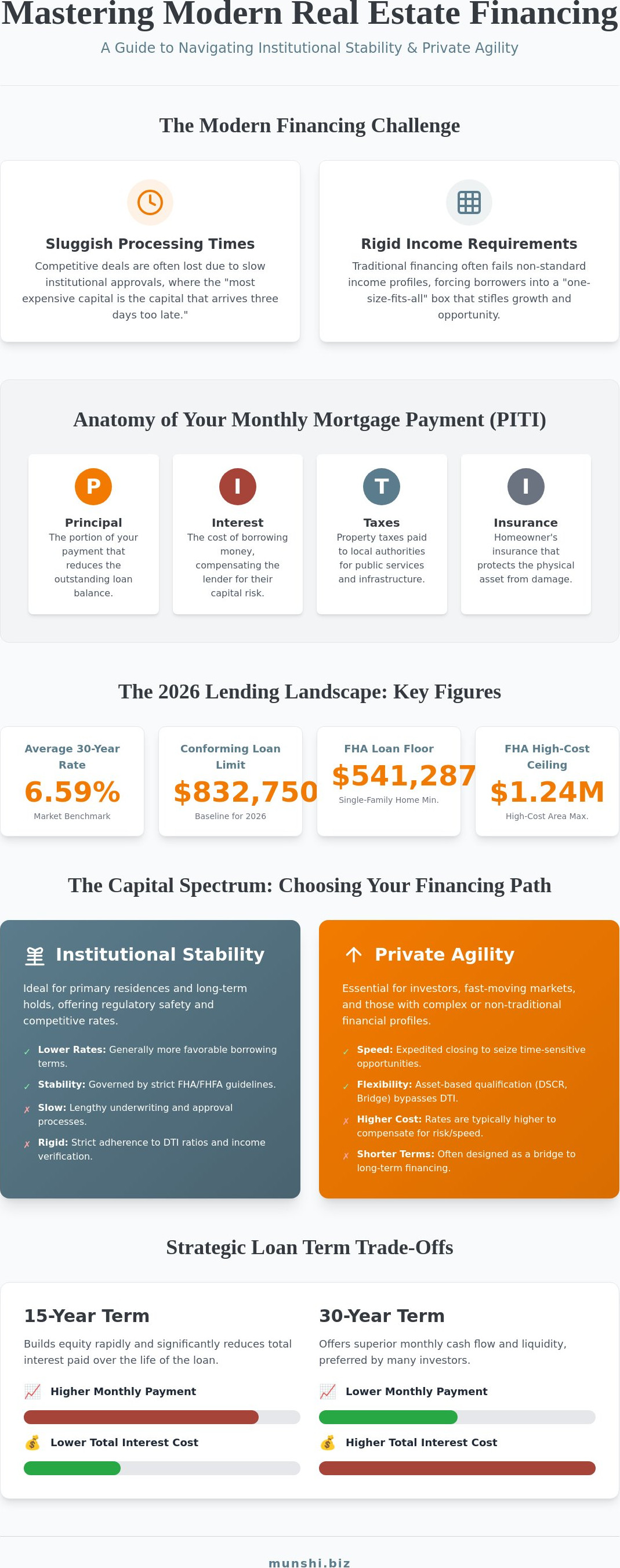
The most expensive capital you'll ever use is the capital that arrives three days too late for a closing. In a market where the average 30-year fixed mortgage loan currently sits at 6.59 percent, success requires more than just chasing the lowest decimal point. It demands a sophisticated understanding of how to pivot between institutional stability and private lending agility. You've likely felt the frustration of an institutional "no" because your income doesn't fit a standard box, or perhaps you've watched a competitive deal slip away due to sluggish processing times. These obstacles are common, but they shouldn't be the ceiling of your growth.
We recognize that your financial profile is rarely one-dimensional, and your financing shouldn't be either. This guide will help you master the complexities of modern real estate financing, from navigating the 2026 conforming loan limit of $832,750 to utilizing high-leverage investment capital. We'll examine how to secure competitive rates while maintaining the tactical speed needed to win in a fast-moving market. You'll gain a clear roadmap for leveraging assets effectively, whether you're eyeing a primary residence within the $541,287 FHA floor or scaling a portfolio with DSCR and bridge strategies.
Key Takeaways
- Identify the core components of a mortgage loan to effectively manage your monthly PITI obligations and preserve liquidity.
- Distinguish between the stability of traditional FHA and Conventional products and the tactical agility offered by private capital.
- Leverage asset-based qualification strategies to bypass the limitations of traditional debt-to-income ratios for non-traditional income profiles.
- Navigate the 2026 lending landscape with precision by aligning your strategy with current conforming and Jumbo loan limits.
- Expedite your time-to-close through a structured financing roadmap that balances institutional expertise with customized loan architecture.
The Anatomy of a Modern Mortgage Loan
A mortgage loan is fundamentally a legal contract where real estate serves as the primary collateral for the debt. This arrangement provides a comprehensive overview of mortgages as foundational instruments for wealth creation rather than mere liabilities. At its core, the agreement ensures that the lender maintains a security interest in the property while the borrower gains the capital necessary for acquisition or leverage. It's a structured partnership designed to facilitate ownership while managing financial risk for both parties involved.
Your monthly obligation is rarely just a repayment of borrowed funds. It's comprised of four distinct pillars often referred to as PITI: Principal, Interest, Taxes, and Insurance. The principal reduces the outstanding balance. The interest compensates the lender for the capital risk. Taxes fund local infrastructure and schools. Insurance protects the physical asset from unforeseen damage. Understanding how these components interact is vital for any borrower aiming to maintain long-term liquidity and property stability.
Accountability in the lending sector is maintained through the Nationwide Multistate Licensing System (NMLS). This regulatory framework ensures that loan originators meet rigorous educational and ethical standards. Working with an NMLS-licensed professional, such as the experts at Munshi Capital Inc., provides a layer of security; it ensures your financing is structured within the strict bounds of federal and state law. This oversight is what separates professional, transparent lending from the opaque practices of the past.
Principal and Interest Mechanics
Interest rates don't exist in a vacuum. They're influenced by market benchmarks like the 10-year Treasury yield and your specific credit risk profile. Your Loan-to-Value (LTV) ratio also plays a critical role. A lower LTV typically signals lower risk to the lender, which can translate into more favorable borrowing terms and increased purchasing power. Amortization is the systematic process of retiring a debt through scheduled payments that gradually shift from interest-heavy to principal-focused over time.
Loan Terms and Amortization Choices
Choosing between a 15-year and a 30-year term is a study in trade-offs. A 15-year term builds equity rapidly and reduces total interest costs, but it requires a higher monthly commitment. Conversely, a 30-year term offers superior monthly cash flow, which is often preferable for investors looking to maximize liquidity. In high-rate environments, Adjustable-Rate Mortgages (ARMs) can serve as a tactical bridge. They offer lower initial rates before a future refinance becomes viable. For sophisticated investors, balloon payments allow for short-term structures that facilitate rapid acquisition before a planned exit or a transition into a traditional mortgage loan structure.
Traditional vs. Private Real Estate Financing
Success in real estate requires matching the right capital structure to your specific exit strategy. Traditional financing, typically secured through a mortgage loan, provides the long-term stability needed for primary residences. These institutional products are governed by strict guidelines and conforming limits, which the Federal Housing Finance Agency increased to a baseline of $832,750 for 2026. While these paths offer competitive rates, they often lack the speed and flexibility required for complex investment scenarios or high-value acquisitions that fall outside standard boxes.
Private real estate financing fills the gaps left by traditional banking. Where a bank sees a "no" due to non-traditional income or complex tax returns, a private lender sees an opportunity based on asset value or property potential. This agility is essential for professionals who need to move quickly or bypass the documentation hurdles of standard underwriting. Understanding how to prepare for the mortgage process involves recognizing whether your goals align with institutional safety or private-market speed.
Government-Backed and Conforming Loans
FHA loans remain a cornerstone for buyers seeking low down payments and credit flexibility. For 2026, the FHA floor for single-family homes is $541,287, scaling up to a $1,249,125 ceiling in high-cost areas. Conventional loans offer a distinct advantage by allowing borrowers to eventually eliminate mortgage insurance once equity reaches 20 percent. For those exceeding conforming limits, Jumbo loans provide the necessary capital for luxury properties, though they require more significant reserves and higher credit scores. Specialized programs like VA and USDA options further support veterans and rural buyers with targeted benefits.
Asset-Based and Investor Solutions
Investment strategies often demand capital that ignores personal debt-to-income ratios. DSCR loans allow you to qualify based on the property’s projected rental income rather than your personal tax returns. This is a game-changer for scaling portfolios without the constraints of traditional employment verification. When speed is the priority, Hard Money loans use property equity as the primary underwriting factor, allowing for closings in a fraction of the time required by banks. Fix-and-Flip financing and Bridge loans provide the tactical liquidity needed to rehabilitate distressed assets or cover the gap between a sale and a new purchase. If you're managing a complex portfolio, consulting with a strategic lending partner can help you determine which structure maximizes your leverage.
Qualifying for a Mortgage: Beyond the W-2
Traditional underwriting often penalizes the very entrepreneurship that builds wealth. If you're self-employed, your tax returns likely show significant deductions that lower your taxable income. While this is efficient for tax purposes, it can be a hurdle when applying for a mortgage loan through a standard bank. The industry is evolving to meet this challenge. We're seeing a decisive transition from rigid Debt-to-Income (DTI) ratios toward asset-based qualification models that prioritize your overall financial strength over a single line on a tax form.
Underwriters evaluate risk through a framework known as the "Five C’s of Credit": Character, Capacity, Capital, Collateral, and Conditions. Character reflects your credit history and reliability. Capacity measures your ability to repay. Capital considers your down payment and reserves. Collateral evaluates the property’s market value. Conditions look at the broader economic environment. Gaining a perspective on how mortgages work through this lens allows you to highlight your strengths where a standard application might fail. It’s about demonstrating stability through diverse data points rather than just a W-2.
The Role of Documentation and Credit
Lenders typically offer two primary paths for documentation: Full-doc and Lite-doc. Full-doc remains the standard for Conventional and FHA products, requiring exhaustive tax returns and pay stubs. Lite-doc programs, such as bank statement loans, utilize 12 to 24 months of business or personal deposits to verify actual cash flow. You should begin optimizing your credit profile 6 to 12 months before a major purchase. This involves reducing revolving balances and avoiding new credit inquiries. High liquid reserves are equally critical. They don't just improve your approval odds; they often lower your interest rate by proving you can weather market volatility.
Leveraging the DSCR Model for Scaling
The Debt Service Coverage Ratio (DSCR) model is the premier tool for the professional real estate investor. It bypasses personal income entirely to focus on the property's ability to pay for itself. This calculation is simple: divide the gross monthly rental income by the monthly PITI. If the resulting ratio is 1.0 or higher, the property is considered self-sustaining. Professional investors prefer this model because it facilitates rapid portfolio expansion without the constraints of personal income verification. DSCR lending effectively removes the glass ceiling of personal DTI by shifting the underwriting focus from the borrower's paycheck to the asset's performance.
The Roadmap to Funding: From Application to Closing
The journey from initial inquiry to property ownership is a methodical progression that transforms a financial vision into a tangible asset. It's not a "black box" but a structured series of milestones designed to validate your mortgage loan application and secure your capital. By understanding each phase, you can anticipate requirements and maintain the momentum necessary to win in a competitive market.
- Phase 1: Prequalification and the Initial Strategic Consultation. This stage defines your borrowing capacity and aligns your goals with the most effective loan product.
- Phase 2: Property Appraisal and Verification of Collateral Value. A professional valuation ensures the asset's worth supports the debt structure and protects your equity.
- Phase 3: The Underwriting "Deep Dive" and Conditional Approval. A specialist reviews your full financial profile to ensure compliance with all lending guidelines.
- Phase 4: Clear to Close and the Final Signing Process. This is the final milestone where all conditions are met, and the legal transfer of funds occurs.
Prequalification vs. Preapproval
In a fast-moving market, a prequalification is merely a starting point. A robust preapproval letter is your most powerful negotiation tool. It signals to sellers that your mortgage loan has already undergone preliminary scrutiny. While a prequalification typically involves a soft credit pull with no impact on your score, a preapproval requires a hard inquiry and a comprehensive document review. This distinction is critical for setting realistic expectations. For instance, while a Hard Money loan might close in 7 to 10 days, a traditional Conventional loan typically requires 30 to 45 days. Knowing these timelines allows you to structure your offer with confidence.
Underwriting and Appraisal Nuances
The appraisal serves as a vital safeguard. It protects both the lender’s capital and your equity by ensuring the purchase price aligns with current market data. Common underwriting hurdles, such as large unexplained deposits or recent changes in business structure, can often be resolved through proactive communication and detailed letters of explanation. Title insurance and escrow companies act as neutral third parties during this time. They ensure the title is free of liens and manage the secure transfer of funds during the final signing. This layer of oversight ensures that every participant is protected as the transaction concludes.
If you're ready to move beyond the "black box" of traditional banking, start your strategic consultation with Munshi Capital today.
Strategic Facilitation with Munshi Capital
The divide between institutional stability and private lending agility is where many high-level real estate opportunities are lost. Munshi Capital exists to eliminate that friction. We provide a full spectrum of lending solutions that range from fast-closing Hard Money to the long-term stability of a traditional mortgage loan. By combining deep market intelligence with tactical flexibility, we ensure that your capital structure is an asset rather than an obstacle. Led by NMLS licensed professional Amish Munshi, our team understands that entrepreneurs require a partner who speaks the language of growth, not just the language of compliance.
Navigating the 2026 market requires more than just access to funds. It requires a partner who understands the nuances of the current 6.59 percent average rate environment and the strategic implications of the $1,249,125 Jumbo loan threshold in high-cost areas. We move beyond the transactional nature of traditional banking to offer a proactive partnership. This approach allows us to structure complex deals for investors who need to bridge the gap between acquisition and long-term stabilization without the delays common in large institutional banks.
Tailored Financing for Every Objective
Seasoned fund managers and first-time buyers alike trust our process because we offer a comprehensive suite of products under one roof. You don't have to manage multiple relationships to secure different types of capital. Whether you need a Fix-and-Flip loan for a rapid rehabilitation project or a DSCR loan to scale a rental portfolio, our team provides the customized architecture your deal requires. We specialize in solving the "funding gap" for investors. This happens when a property has immense potential but doesn't yet meet the rigid requirements of a conventional bank. We provide the bridge capital to secure the asset and the long-term financing to hold it.
Your Partner in Real Estate Growth
We believe in building relationships that extend far beyond a single transaction. Our goal is to serve as a visionary guide throughout your entire real estate journey. This means providing you with more than just a check; it means offering the data-driven insights and market intelligence you need to make informed decisions in a shifting economy. You'll have access to a network that prioritizes transparency, efficiency, and actionable outcomes. We value your time and prioritize clear communication at every stage of the process. When you're ready to optimize your financing strategy and secure the capital needed for your next acquisition, we're prepared to execute.
Your financial future deserves a partner who values precision and speed. Schedule a strategic consultation with Munshi Capital to align your real estate goals with the most effective capital structures available in 2026.
Scaling Your Portfolio with Strategic Capital
Mastering real estate financing in 2026 requires a shift from passive borrowing to strategic capital management. You've learned that a mortgage loan is a sophisticated tool for leverage; it functions best when matched precisely to your specific exit strategy. Success hinges on your ability to pivot between traditional conforming products and the tactical agility of private money. By leveraging asset-based qualification and understanding current loan limits, you can bypass traditional constraints and scale your portfolio with confidence.
Munshi Capital, led by NMLS licensed professional Amish Munshi (NMLS# 2049293), provides the expert guidance needed to navigate these complex environments. We specialize in both traditional mortgage products and private capital solutions, offering the fast, flexible funding required for residential and investment properties alike. Our approach ensures you have access to Hard Money, DSCR, and Conventional options under one roof. This versatility allows you to maintain momentum regardless of market volatility or documentation challenges.
It's time to move with the precision and speed that the current market demands. Secure Your Real Estate Financing with Munshi Capital to begin your next chapter of growth. Your vision for wealth creation deserves a partner committed to your long-term success.
Frequently Asked Questions
What is the difference between a mortgage loan and a personal loan?
A mortgage loan is a secured debt specifically tied to real estate as collateral, whereas a personal loan is typically unsecured and carries higher interest rates. Because a mortgage is collateralized, lenders can offer significantly larger capital amounts and longer repayment terms, often extending up to 30 years. Personal loans are generally restricted to smaller sums and shorter terms. This structural difference makes mortgages the primary instrument for high-value asset acquisition.
How much down payment do I really need for a mortgage in 2026?
You typically need between 3.5 percent and 20 percent of the purchase price depending on the specific loan program you select. FHA loans allow for a down payment as low as 3.5 percent, which is ideal for preserving liquidity. Conventional loans often require 5 to 20 percent. If you're seeking a Jumbo loan for a high-value property, expect a requirement of at least 20 percent to mitigate the lender's increased capital risk.
Can I get a mortgage loan if I am self-employed?
Yes, you can absolutely secure a mortgage loan as a self-employed borrower by utilizing bank statement programs or asset-based qualification. Traditional W-2 documentation isn't the only path to approval. Lenders can verify your ability to repay by reviewing 12 to 24 months of business deposits. This approach focuses on your actual cash flow rather than the net income shown on your tax returns after business deductions.
What is a DSCR loan and how does it help real estate investors?
A Debt Service Coverage Ratio (DSCR) loan qualifies a property based on its rental income rather than the borrower's personal income. It helps investors scale their portfolios quickly because it removes the limitations of personal debt-to-income ratios. If the property's gross monthly rent covers the monthly PITI payment, the asset effectively qualifies itself. This makes it a premier choice for professional investors who prioritize cash-flowing real estate.
How long does the mortgage loan process typically take from start to finish?
The mortgage process generally takes between 30 and 45 days for traditional products, though private lending options can close much faster. Hard Money and Bridge loans are designed for speed and can often fund within 7 to 14 days. Traditional FHA or Conventional loans require more extensive underwriting and third-party appraisals, which extends the timeline. Your specific closing date depends on the complexity of your financial profile and the property type.
What are the current mortgage interest rates for 2026?
Current average rates for a 30-year fixed mortgage loan sit at approximately 6.59 percent, while 15-year fixed rates average 5.99 percent. These figures represent national benchmarks as of July 2026. Your individual rate will vary based on your credit score, loan-to-value ratio, and chosen loan product. Market trends have kept rates in the mid-6 percent range for much of the year as the Federal Reserve monitors economic stability.
What is a Hard Money loan and when should I use one?
A Hard Money loan is a short-term, asset-based financing solution used primarily by real estate investors for rapid acquisitions or property rehabilitation. You should use one when speed is more critical than the interest rate or when a property doesn't yet qualify for traditional financing. These loans focus on the equity in the collateral rather than your personal credit history. They are perfect for fix-and-flip projects or time-sensitive bridge scenarios.
What does 'Clear to Close' mean in the mortgage process?
"Clear to Close" means the underwriter has reviewed all documentation and confirmed that every loan condition has been satisfied. It's the final green light before the closing documents are sent to the title or escrow company. At this stage, your financing is officially secured. You should avoid making any large purchases or opening new credit lines once you receive this status to ensure a smooth final signing.

Contact Info
Address: 3100 Oak Rd STE 120 Walnut Creek CA 94597
NMLS# 2250879
877-343-7379
info@munshi.biz
© Copyright 2025. Munshi Capital Inc. All rights reserved.