
Commercial loan case studies from Munshi Capital Inc. document real financing outcomes across industries, including a $5,861,500 hardware facility loan, a $2,800,000 tourism project, and a $1,835,000 childcare property deal. Each case illustrates structured terms based on property income. Value, giving business owners and investors measurable benchmarks for comparable financing decisions.
Key Takeaways
- Munshi Capital Inc. finances diverse commercial sectors including hardware, retail, tourism, childcare, and agriculture operations.
- Commercial loan amounts range from $1,170,000 to pricing varies demonstrating our capacity for substantial business financing.
- Our transparent underwriting process delivers quick closings, enabling business owners to execute growth strategies rapidly.
- Personalized loan specialists guide commercial borrowers through specialized financing options tailored to their operational needs.
What Do Commercial Loan Case Studies Reveal?
Commercial loan case studies (commercial-loan-case-studies-039) reveal patterns in how financing gets structured, approved, and closed for real-world properties. Munshi Capital Inc. provides commercial mortgage financing for business owners and real estate investors nationwide, and the results show up across property types rather than a single niche.
Office buildings and mixed-use properties appear frequently among documented transactions. These deals illustrate how lenders evaluate income potential and asset value rather than relying solely on personal credit history. Reviewing small business finance stories (small-business-finance-stories-039) side by side with property data gives borrowers a realistic picture of financing timelines and documentation requirements before they apply.
What makes a commercial closing successful?
Successful closings depend on clear communication between borrower and lender, accurate property valuation, and realistic underwriting timelines. Munshi Capital’s lending approach is built on trust. Transparent, borrower-first guidance, with clarity and honesty shaping every stage of the loan process. That structure reduces surprises at the closing table.
Why do loan amounts vary so widely across case studies?
Property type, income performance, and intended use all drive loan size. One documented hardware industry transaction closed at $5,861,500 in financing, showing how asset-backed deals scale well beyond typical residential amounts.
Common threads across commercial closing examples (commercial-closing-examples-039) include:
- Financing tied to the property’s income and value, not just borrower credit
- Property types spanning offices, mixed-use buildings, and industrial sites
- A transparent process from application through closing
- Loan sizes that scale with asset value and business need
Owners weighing a sale or refinance can request a direct cash offer to compare options before committing to a long underwriting timeline.

How Are Commercial Mortgages Structured for Investors?
Commercial mortgages get built around the property, not the borrower’s paycheck. Loan amounts scale with the property. Owners and investors finance everything from a small retail space to a large industrial facility. Financing is capped by loan-to-value, meaning the property itself carries most of the underwriting weight.
Term structure follows a similar logic. Investors choose loan terms that match the repayment schedule to the investment’s holding period and cash flow projections. A short-term bridge strategy looks different from a 25-year hold, and the term options reflect that range.
Underwriting diverges sharply from residential lending here. Rather than leaning on tax returns or W-2s, commercial loan case studies consistently show approvals built on cash flow and asset-based evaluation. The property’s income, occupancy, and collateral value drive the decision.
What determines loan-to-value on a commercial property?
A stronger net operating income or lower-risk asset class often supports financing closer to that ceiling.
Why does commercial underwriting focus on property income instead of personal income?
Commercial programs get structured around the income and value of the property, not personal earnings alone. This approach lets investors scale a portfolio without each new acquisition hinging on individual income documentation.
These small business finance stories and broader commercial closing examples share a common thread: flexible terms built around the asset, giving business owners a financing path shaped by what the property produces.

What Do SBA Financing Stories Teach Owners?
SBA financing stories teach owners that speed, documentation, and clear use of funds determine outcomes. These commercial loan case studies show lenders moving fast when a borrower presents a solid plan. A moving and storage company closed a $3.3 million SBA 7(a) loan in under 30 days, using the funds to purchase commercial property and support working capital needs. That timeline challenges the assumption that SBA loans always drag on for months.
Similar small-business-finance-stories patterns appear in franchise lending. A coatings franchise secured SBA financing covering three distinct needs:
- Franchise licensing fees
- Working capital for daily operations
- Equipment purchases for service delivery
Combining multiple funding categories into a single loan reduces paperwork and consolidates repayment into one structure.
How fast can an SBA loan actually close?
Closing speed depends on preparation, not just loan size. The moving company’s 30-day close on a $3.3 million deal proves that complex, high-dollar transactions can move quickly when documentation stays organized from day one.
Why do lenders highlight SBA loan volume?
Volume signals market depth and lending capacity. One SBA-focused lender originated more than $600 million in SBA loans in a single year, according to First Bank of the Lake’s published case study data. That figure demonstrates how active the SBA lending market remains for owners seeking capital.
These commercial-closing-examples reinforce one lesson: preparation, not loan size, dictates timeline and outcome.
What Do Real Commercial Closing Examples Show?
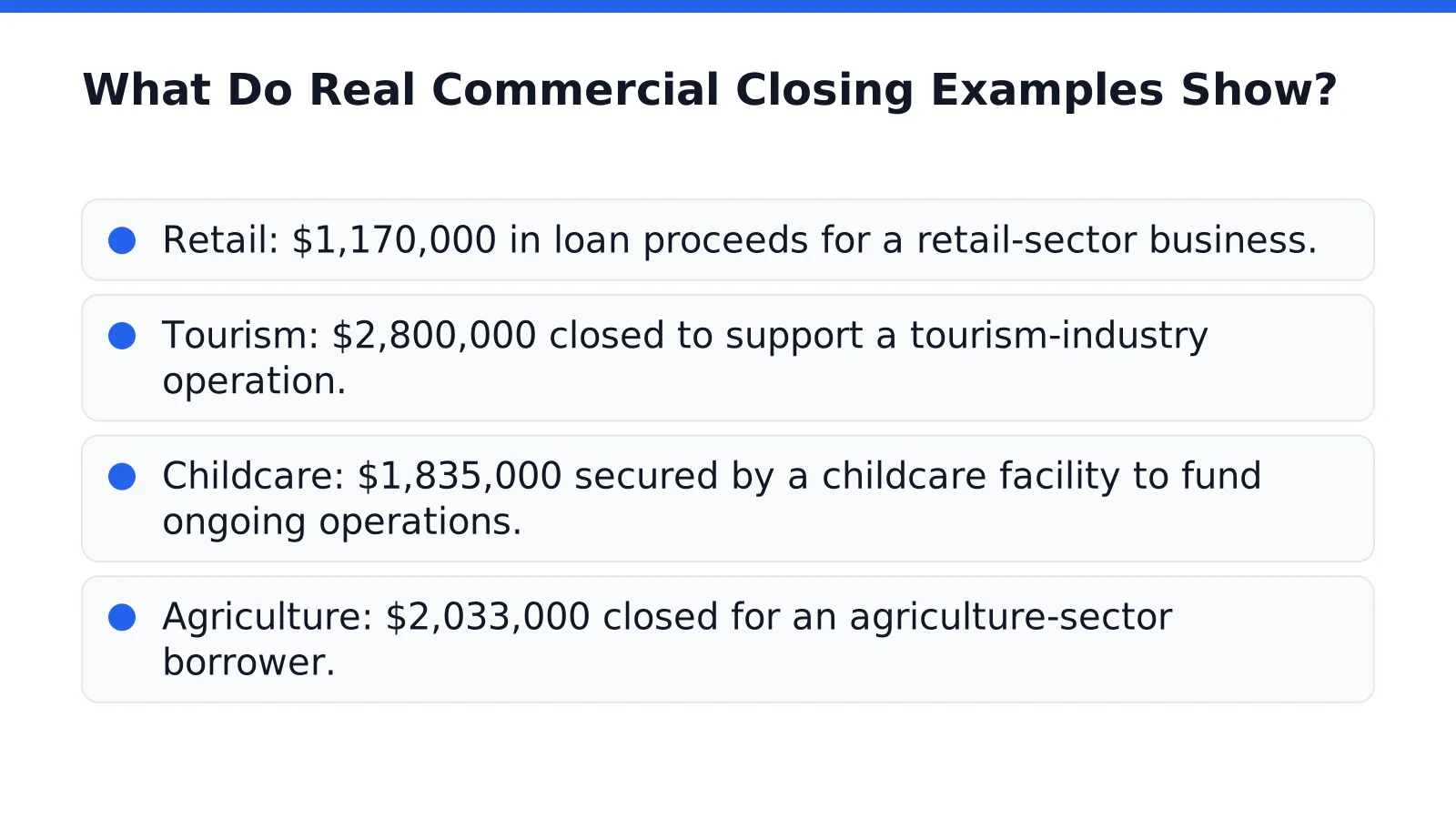
Real commercial closing examples document loan amounts spanning more than pricing varies million, from a $1,170,000 retail transaction to a $2,800,000 tourism-industry closing. Four sectors anchor the record: retail, tourism, childcare, and agriculture. Each closing confirms that loan size tracks the borrower’s industry, property use, and operating needs, not a fixed template.
These commercial loan case studies break down as follows:
- Retail: $1,170,000 in loan proceeds for a retail-sector business.
- Tourism: $2,800,000 closed to support a tourism-industry operation.
- Childcare: $1,835,000 secured by a childcare facility to fund ongoing operations.
- Agriculture: $2,033,000 closed for an agriculture-sector borrower.
Skipping this kind of review carries real risk. Borrowers who apply without understanding how lenders size deals often request financing that doesn’t match their property type or cash flow cycle. A childcare facility carries different licensing, staffing, and space requirements than a tourism operation, and underwriting reflects those differences directly.
How do loan amounts vary by industry?
Recorded amounts above vary by more than pricing varies million between the smallest and largest closings. Retail and childcare financing settled in the $1,170,000 to $1,835,000 range. Tourism and agriculture financing climbed past $2 million, reflecting larger property values and more complex operating structures.
Why do these small business finance stories matter for new borrowers?
These small business finance stories give prospective borrowers a benchmark for what commercial underwriting actually funds. Munshi Capital Inc. offers a comprehensive suite of residential and commercial loan programs, including FHA, VA, and USDA options alongside commercial products. Owners across sectors find financing structured to their specific business model. Reviewing documented outcomes, rather than guessing at eligibility, gives a borrower a clearer, evidence-based starting point before approaching any lender.
How Should You Prepare for Closing?
Preparation for closing starts long before the final signature. Borrowers move through a structured application, underwriting, and closing sequence designed to prevent surprises at the table. Munshi Capital Inc. keeps every document, deadline, and condition visible to the borrower at each stage, so closing day becomes a formality rather than a scramble.
The groundwork begins with the application itself. Borrowers share their financing goals with a loan specialist through a quick, secure application that identifies the right residential or commercial program early. That early alignment reduces revisions during underwriting, which in turn shortens the runway to closing.
A review of commercial loan case studies shows a consistent pattern: borrowers who organize documentation upfront close faster and with fewer conditions outstanding. Preparation typically includes:
- Entity formation documents and ownership records
- Recent financial statements and bank records
- Property-specific documentation, including leases or appraisals
- Signed disclosures and underwriting conditions cleared in advance
What Role Does Technology Play in Closing Preparation?
Technology accelerates review without replacing personal guidance. Modern systems paired with hands-on loan specialists support quick pre-approvals. Give borrowers full visibility into loan status from application through funding. Borrowers can track outstanding items in real time rather than waiting on status calls.
Reviewing commercial closing examples alongside loan specialists helps borrowers anticipate common conditions before they arise. This approach reflects a lending philosophy rooted in clarity, honesty, and service, treating transparency as a structural feature of the process rather than a courtesy. Borrowers researching small business finance stories will notice the same theme: preparation, not paperwork volume, determines closing speed.
FAQ
What industries do commercial loan case studies cover?
Munshi Capital Inc.’s case studies span hardware, retail, tourism, childcare, and agriculture operations, with documented deals including a $5,861,500 hardware facility loan and a $2,800,000 tourism project.
What determines commercial loan structure for investors?
Commercial mortgages are built around the property’s income. Value rather than the borrower’s personal credit, with loan-to-value capping financing and terms matched to the investment’s holding period.
What makes Munshi Capital’s commercial loan process transparent?
The process relies on clear communication, accurate property valuation, and realistic underwriting timelines, reflecting Munshi Capital’s borrower-first guidance rooted in clarity and honesty at every stage.
Conclusion
In closing, the commercial loan case studies presented demonstrate how tailored financing solutions address the distinct requirements of diverse borrowers and investment profiles. Munshi Capital Inc. delivers this precision through transparent processes, specialized loan products, and dedicated guidance that prioritizes clarity at every stage. By combining modern technology with hands-on expertise, the organization ensures borrowers secure financing aligned with their strategic objectives and financial circumstances, establishing a foundation for confident decision-making and measurable success across residential and commercial portfolios.
Leave a Reply