
Munshi Capital Inc. documents real borrower successes, including first-time homebuyers and investors who secured FHA, VA, USDA, DSCR, and hard money loans nationwide, demonstrating transparent underwriting and fast pre-approvals that consistently earn trust, dependable service, and verified client testimonials.
Borrowers nationwide choose Munshi Capital
Documented outcomes from Munshi Capital Inc. demonstrate transparent lending across FHA, VA, USDA, DSCR, and bank statement loan programs for borrowers nationwide. Verified client results give homebuyers, investors, and self-employed applicants concrete proof of dependable, straightforward mortgage guidance from application through closing. Local market resources are available to borrowers nationwide.
Key Takeaways
- First-time homebuyers and seasoned investors alike achieve financing success through our personalized loan guidance.
- Our transparent underwriting process delivers quick pre-approvals with full visibility from application through closing.
- FHA, VA, USDA, bank statement, DSCR, and hard money loans address diverse borrower financial situations.
- Loan specialists provide hands-on service backed by modern technology, ensuring dependable support nationwide.
Why Do Borrower Success Stories Matter?
Proof of performance separates reliable lenders from empty promises. Borrowers researching a mortgage company face a simple question: will this lender actually deliver, or just claim to? Client case studies (client-case-studies-038) answer that question with evidence instead of marketing copy.
Munshi Capital Inc. serves first-time homebuyers, self-employed professionals, and seasoned real estate investors alike. Because the borrower base spans such different financial situations, the case studies behind each loan program reflect a wide range of circumstances rather than a single narrow profile. Self-employed borrowers and investors may face unique hurdles, but both benefit from tailored loan solutions. Success stories drawn from both situations give prospective clients a realistic picture of what to expect.
What makes a mortgage testimonial trustworthy?
A credible testimonial reflects clear communication, not just a satisfied tone. Munshi Capital’s transparency mission means mortgage testimonials (mortgage-testimonials-038) should document honest explanations of rates, terms, and timelines at every stage. Borrowers reading these accounts can expect to see the same clarity echoed in their own application experience.
Do success stories actually reflect lending performance?
Yes, when tied to measurable outcomes. Industry case studies show that customer-focused digital strategies produce measurable loan volume tied directly to borrower behavior, not vague satisfaction scores.
Longevity matters too. Established mortgage service providers have built decades of case studies demonstrating that clients consistently reach their financing goals. Borrower success stories carry weight because they show:
- Diverse borrower profiles, from first-time buyers to investors
- Transparent process documentation at each loan stage
- Measurable results tied to real lending outcomes
- A track record built over sustained operating history

What Does A First-Time Buyer’s Journey Look Like?
Four stages define a first-time buyer’s path: program selection, application, underwriting, and closing. Each stage carries risk of delay or denial when lenders skip clarity. A structured process removes that risk at every step.
Most first-time buyers start with government-backed programs. FHA, VA, and USDA loan options get matched to the buyer’s unique financial picture rather than forced into a one-size-fits-all product. Self-employed borrowers and those with irregular income benefit most from this tailored matching, since standard loan criteria often exclude them unfairly.
What happens during the application and underwriting stages?
Application and underwriting form the longest stretch of the journey, and also the stage where confusion derails most first-time buyers. A straightforward process, free of hidden conditions or shifting requirements, keeps documentation requests predictable. Surprises at this stage, such as last-minute income verification demands, typically signal a breakdown in communication rather than a problem with the borrower’s file.
Client case studies repeatedly show the same pattern: buyers who understand each step upfront close faster and with less stress.
Why does personalized guidance matter more for first-time buyers?
First-time buyers lack the experience investors bring to repeat transactions, so guesswork creates costly mistakes. A dedicated team walking through options case by case replaces that guesswork with confidence grounded in the borrower’s actual numbers.
- Program matching based on income type and credit profile
- Clear document checklists before underwriting begins
- Direct access to loan specialists, not automated queues
Mortgage testimonials from past clients consistently point to one theme: speed paired with transparency. Technology accelerates pre-approval timelines, but specialists still review each file personally. That combination, fast systems plus human oversight, defines the strongest borrower success stories and gives first-time buyers a realistic shot at a competitive offer.

How Do Self-Employed Borrowers Prove Their Success?
Self-employed borrowers prove their financial strength through bank statement loan programs rather than traditional W-2 pay stubs. These programs exist specifically for applicants whose income documentation does not fit a standard employment profile. A freelance consultant or small business owner often shows strong cash flow that a typical pay stub never captures.
Proof of success also comes from a track record. Complex mortgages have closed for high-net-worth and self-employed borrowers alike, including cases involving high loan-to-value financing. That outcome reflects the kind of client case studies that demonstrate real underwriting flexibility, not just marketing language.
What Documents Replace a W-2 for Self-Employed Applicants?
Bank statements, typically spanning multiple months, stand in for traditional income verification. A dedicated team reviews these statements to build an accurate financial picture before the file reaches underwriting. This step matters because self-employed income often fluctuates month to month, and raw deposits need context an underwriter can trust.
Can Self-Employed Borrowers Track Their Loan Progress?
Yes. Full visibility into loan status, from application through closing, lets borrowers monitor each stage as added documentation gets reviewed. This transparency reduces guesswork during a process that already demands more paperwork than a standard W-2 file.
Borrowers researching mortgage testimonials and borrower success stories should look for three markers:
- Documented loan-to-value outcomes on complex files
- A team that interprets bank statements accurately
- Status tracking throughout underwriting, not just at closing
Self-employed applicants who want proof of a lender’s reliability can review a seller’s financial history alongside these benchmarks. For property owners weighing a sale rather than a refinance, the next step is to request a direct cash offer and compare it against traditional financing paths before deciding how to move forward.
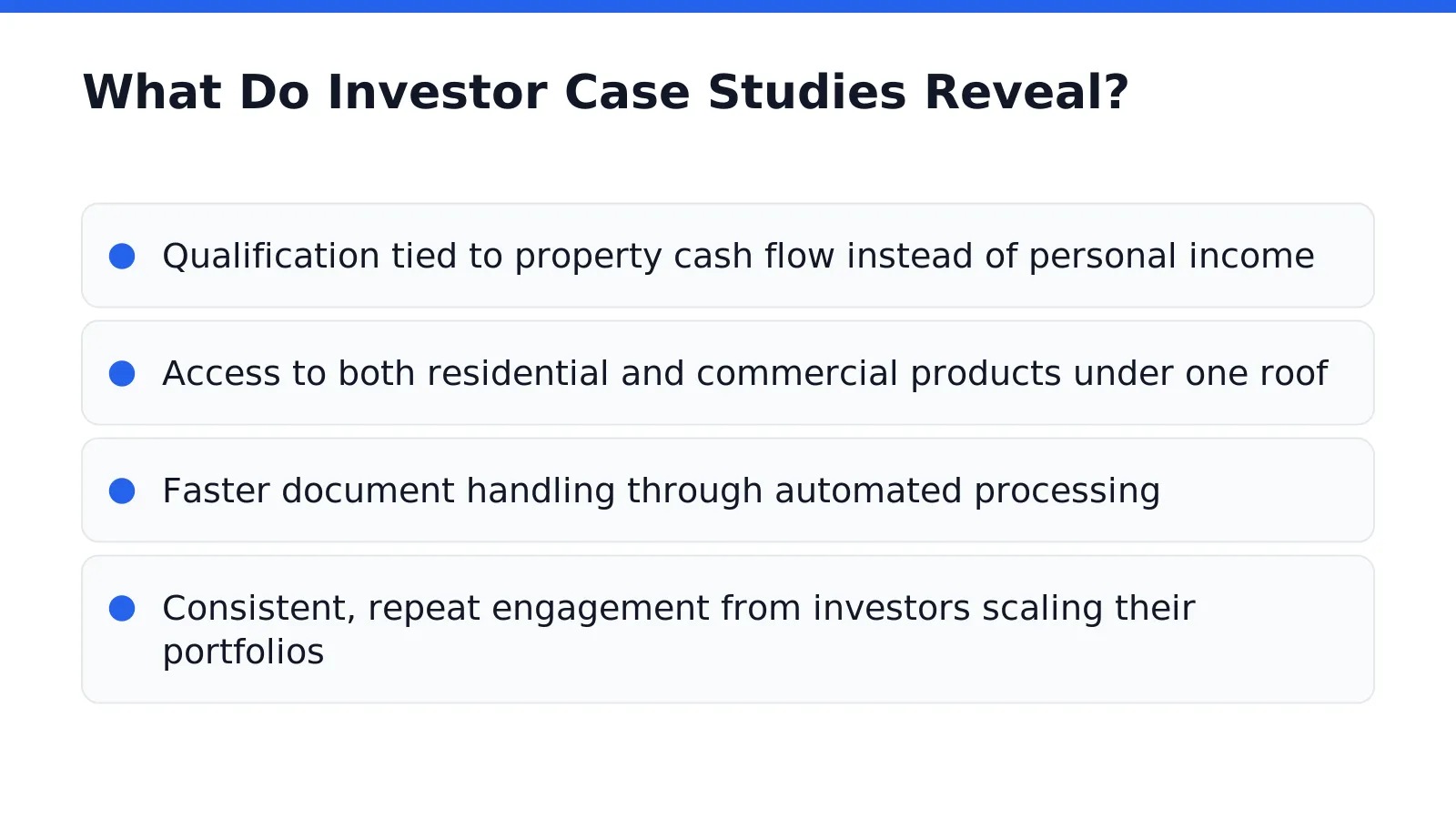
What Do Investor Case Studies Reveal?
Investor case studies reveal that financing built around property performance, not personal income, drives faster approvals and stronger portfolio growth. Client case studies from Munshi Capital Inc. show DSCR and hard money loans qualifying investors based on a property’s cash flow rather than tax returns or pay stubs alone. That shift matters for investors whose income looks complicated on paper but whose properties perform well in the market.
Commercial loan programs extend this flexibility beyond a single purchase. Investors scaling from one rental to a multi-property portfolio find residential. Commercial options sitting side by side, supporting growth without forcing a switch to an unfamiliar lender. Mortgage testimonials collected from borrowers across loan types consistently point to this continuity as a reason for staying with one financing partner through multiple deals.
Why Do Investors Trust Repeat Lenders?
Investors return to lenders who demonstrate integrity across repeated transactions, not just a single closing. A wide product lineup, covering DSCR, hard money, and commercial options, reduces the need to shop multiple lenders for different deal types. That consistency builds the trust reflected in borrower success stories shared by seasoned investors nationwide.
Does Technology Speed Up Investor Closings?
Automated document processing shortens turnaround time on investor files. Mortgage service providers using proprietary indexing tools have reported improved accuracy and reduced staff dependencies during underwriting.
Key patterns across investor files include:
- Qualification tied to property cash flow instead of personal income
- Access to both residential and commercial products under one roof
- Faster document handling through automated processing
- Consistent, repeat engagement from investors scaling their portfolios
These patterns describe a financing approach built for investors who need speed, flexibility, and a dependable process from application through closing.
How Should You Evaluate Mortgage Testimonials?
Strong testimonials reveal integrity and personalized service, not vague compliments. A trustworthy review names specific traits: responsiveness, clear explanations, and attention to a borrower’s unique financial picture. Generic five-star praise with no detail deserves skepticism.
Genuine client case studies go further than star ratings. They trace a borrower’s path from application through closing, showing exactly where guidance mattered. Readers evaluating a lender should look for stories that describe real obstacles, such as self-employment income or a tight closing timeline, and how those obstacles got resolved.
What makes a mortgage testimonial trustworthy?
A trustworthy testimonial reflects clarity, honesty, and a service-driven ethos throughout the lending relationship, not just a happy ending. Borrowers should look for language describing steady communication and transparent explanations of loan terms. Mortgage testimonials that mention a lender returning calls, clarifying documents, or flagging issues early carry more weight than those praising only the final outcome.
Do testimonials prove a lender is fast and transparent?
Speed and transparency are measurable, not just promised. Borrowers should search for mentions of modern technology paired with hands-on loan specialists. That combination points to real visibility into loan status rather than guesswork.
Borrower-success-stories-038, broadly speaking, often carry more credibility when they’re paired with structural evidence. Industry case studies, including one from a mortgage group that modernized customer engagement, show that strong loan officer adoption and scalable automation can translate into measurable loan volume. That pattern matters: it suggests lenders with efficient systems produce borrower outcomes that hold up under scrutiny, not just favorable wording in a review.
Comparing testimonials side by side, across loan type, borrower profile, and process detail, gives a clearer picture than any single glowing quote.
FAQ
Why do borrower success stories matter?
Case studies give prospective clients evidence instead of marketing copy, showing whether a lender actually delivers. They reveal real outcomes across diverse borrower profiles, from first-time buyers to seasoned investors.
What makes a mortgage testimonial trustworthy?
A credible testimonial reflects clear communication about rates, terms, and timelines at every stage, not just a satisfied tone. It mirrors the transparency borrowers experience during their own application process.
What does a first-time buyer’s journey involve?
The path includes program selection, application, underwriting, and closing, with FHA, VA, and USDA options matched to the buyer’s unique financial picture. This tailored matching helps self-employed and irregular-income borrowers who standard criteria often exclude.
Conclusion
In closing, the experiences shared by Munshi Capital Inc. borrowers underscore a fundamental principle: mortgage financing succeeds when built on transparency, personalized guidance, and unwavering commitment to client objectives. Whether navigating first-time homeownership or executing sophisticated investment strategies, borrowers across the nation have secured the right financing through a process designed to eliminate complexity and deliver clarity. This track record reflects our dedication to integrity and dependable service, positioning Munshi Capital Inc. as a trusted partner for those seeking straightforward, borrower-first mortgage solutions.
Leave a Reply