
Bank statement loans verify income through 12-24 months of bank statements, serving self-employed borrowers and 1099 contractors whose tax returns understate earnings. Traditional income loans require tax returns or W-2s, a standard many business owners and investors cannot meet. Munshi Capital Inc. structures bank statement loans for self-employed clients nationwide needing alternative qualification paths beyond conventional documentation standards.
Key Takeaways
- Bank statement loans use 12-24 months of bank statements to verify income instead of tax returns
- Self-employed borrowers and business owners qualify based on actual cash flow deposits into their accounts
- Traditional income loans require W-2s or tax returns, limiting options for non-traditional earners
- Bank statement loans provide flexible financing solutions designed for your unique financial picture and documentation
Why Doesn’t Your Tax Return Tell Your Story?
Tax returns measure deductions, not earning power. Self-employed individuals and business owners reduce taxable income with legitimate write-offs. Those same deductions make a return look weak to a mortgage underwriter. Traditional lenders typically require tax returns or W-2s to verify income, a standard that works fine for salaried employees. Shuts out borrowers whose earnings don’t follow that pattern. For 1099 contractors and real estate investors managing multiple income streams, this creates a documentation gap that has nothing to do with actual financial strength.
Alternative documentation exists specifically to close that gap. A bank statement loan lets qualified borrowers prove income through cash flow rather than tax-reported figures, shifting the underwriting conversation from deductions to deposits. Munshi Capital builds this option into its broader lineup of residential and commercial programs, standing alongside FHA, VA, and USDA loans as part of a full menu of financing paths.
Who Actually Needs Alternative Income Verification?
Self-employed lending solutions matter most for borrowers whose tax documents undersell their real financial position. Business owners, freelancers, and investors with multiple properties often fall into this category.
- Self-employed professionals with significant write-offs
- 1099 contractors without W-2 income history
- Business owners reinvesting profits back into operations
- Real estate investors with income spread across multiple assets
Bank Statement vs W2: What Changes for the Borrower?
The contrast comes down to the evidence each path accepts. A bank statement vs w2 comparison shows one route relying on employer-issued tax forms, the other on actual account activity. Munshi Capital designs its mortgage programs for a wide range of borrowers, from first-time homebuyers to seasoned investors, recognizing that income documentation looks different for every client.
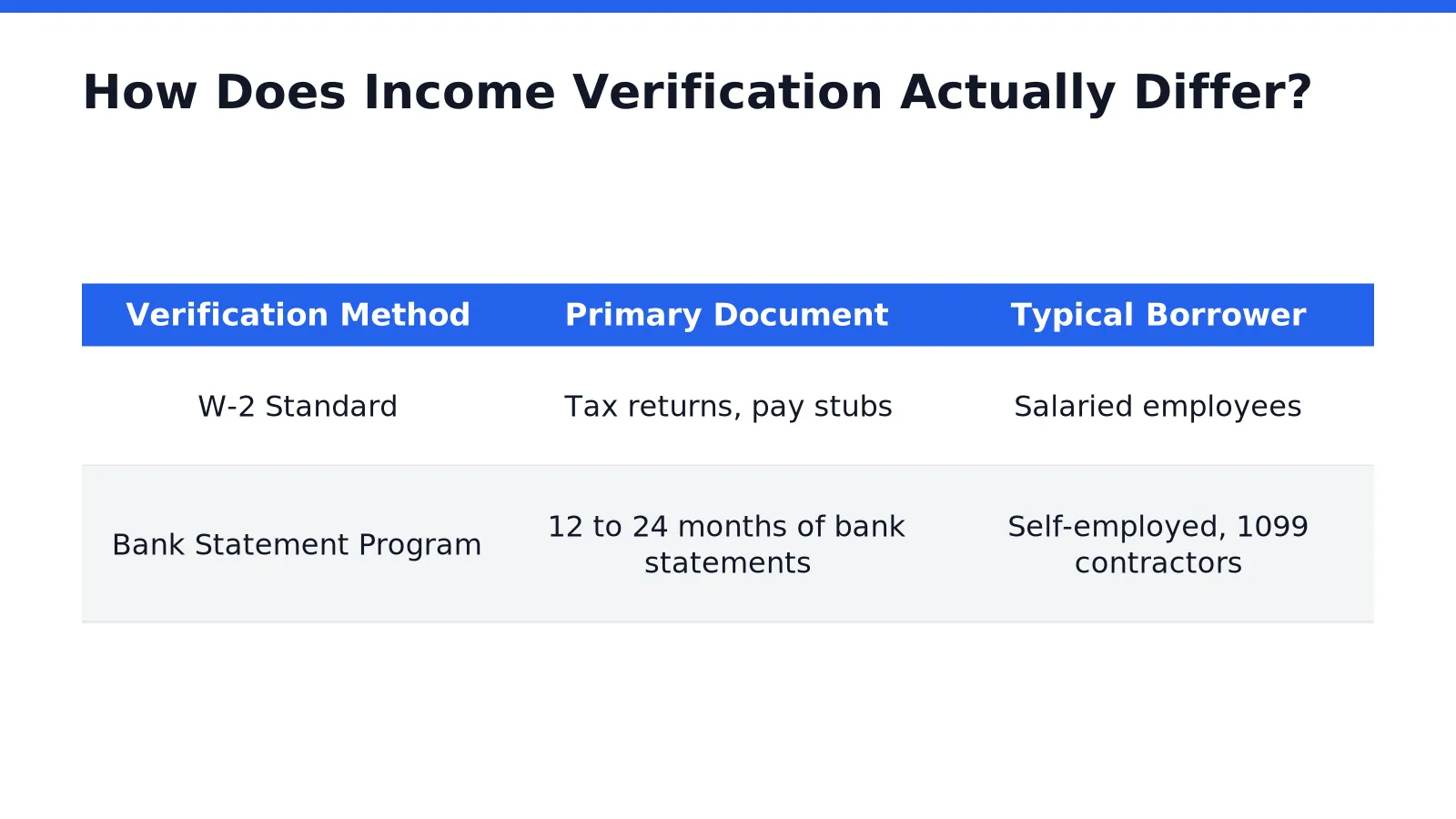
How Does Income Verification Actually Differ?
Lenders measure income two different ways, and the gap between those methods determines who qualifies. The standard W-2 path calculates earnings from tax filings, while an alternative path reads cash flow straight from the bank. For self-employed borrowers, that distinction often decides whether a loan application moves forward or stalls.
Conventional underwriting leans on tax returns to prove income. That approach creates a specific problem for business owners who legitimately deduct expenses to lower their tax burden. Lower taxable income on paper can mean a lower qualifying income in the lender’s eyes, even when actual cash flow tells a stronger story.
Why Does the Bank Statement vs W2 Comparison Matter So Much?
The bank statement vs w2 comparison matters because each method draws from a different financial record entirely. A W-2 reflects withheld wages reported by an employer, straightforward and fixed. Bank statements, by contrast, capture deposits over time, giving a fuller picture of revenue for someone running a business.
This alternative documentation approach does not ignore tax filings entirely. It simply shifts the weight of evidence toward actual deposits, which often run higher than adjusted taxable income.
Munshi Capital Inc. structures financing, including SBA 7(a) and 504 programs, by matching each business owner with the program, term, and rate suited to their specific situation. That same client-first approach extends to self-employed lending, where personalized guidance helps California business owners and investors secure financing with confidence, backed by a team focused squarely on individual goals rather than a one-size-fits-all formula.

What Are The Real Benefits For Self-Employed Borrowers?
Real benefits include qualification based on actual cash flow rather than taxable income, broader eligibility for entrepreneurs and gig workers, and loan structures matched to investment goals. Self-employed applicants, 1099 contractors, and real estate investors in Walnut Creek and across California often show lower taxable income after deductions, even when deposits run strong. Bank statement loans measure the money actually moving through an account, not the number left over after write-offs.
Self-employed lending depends on proving income differently than a salaried borrower can. A direct comparison shows why.
This is the core of the bank statement vs w2 distinction: deposits reflect what a business actually generates. A W-2 reflects only reported wages.
Why does cash flow matter more than tax returns?
Cash flow shows the real earning capacity of a business, not the reduced figure left after deductions. Freelancers and gig workers frequently qualify under this method when conventional underwriting would reject them outright.
What loan options exist beyond bank statement financing?
Investors and business owners also access DSCR. Hard money loans through Munshi Capital Inc., both built for non-traditional income profiles. Commercial loan programs are structured around a property’s income and value, with terms tailored to each investor’s strategy.
Alternative documentation removes the single point of failure that tax returns create for self-employed households, replacing it with a fuller financial picture.

What Are The Trade-offs And Risks To Know?
Alternative-documentation financing carries real regulatory and affordability trade-offs alongside its flexibility. Qualified mortgage status does not apply to bank statement loans, according to the Consumer Financial Protection Bureau. That distinction matters more than most borrowers realize.
Because these loans fall outside qualified mortgage rules, lenders face no requirement to verify repayment ability using the same standards applied to W-2 financing. This gap between bank statement vs w2 underwriting raises the stakes for self-employed applicants and 1099 contractors. Skipping careful review of loan terms can leave a borrower exposed to payments that strain monthly cash flow, especially during slower income months common among business owners and real estate investors.
Does This Mean Alternative Documentation Loans Are Unsafe?
Not inherently. The risk comes from reduced regulatory guardrails, not from the underlying concept of alternative documentation lending. Working with a lender that reviews cash flow carefully, rather than approving based on deposits alone, reduces the chance of an unaffordable loan structure.
How Does Munshi Capital Address These Risks?
Clarity drives the process. Munshi Capital Inc. builds self-employed lending around transparent communication at every underwriting stage, so borrowers see loan terms before committing to them.
Borrowers move through application, underwriting, and closing without hidden terms surfacing late in the process. That structure helps offset the added complexity that comes with non-traditional income documentation.
How Does Munshi Capital Guide You To Closing?
Munshi Capital pairs modern underwriting technology with hands-on loan specialists to move each file toward closing without delay or confusion. For a self-employed borrower in Walnut Creek weighing bank statement vs w2 documentation, that pairing matters. Missing a step in income verification stalls a closing timeline and can cost a deal entirely.
Pre-approval comes quickly once income documents are reviewed. Borrowers track their file at every stage, from application through final signing, with full visibility into where the loan stands. No guesswork, no waiting on hold for an update.
What Happens After Pre-Approval?
A loan specialist reviews alternative documentation, such as bank deposits or profit-and-loss statements, against the chosen loan program. Underwriting then confirms the numbers match the file submitted. Clients receive a clear answer on remaining requirements rather than a vague status update.
Why Does Self-Employed Lending Require A Different Process?
Self-employed lending depends on cash flow patterns instead of a steady paycheck, so the review focuses on deposit history and business activity rather than a W-2 form. Investors and 1099 contractors across California benefit from a process built around that reality, not against it.
Munshi Capital’s guidance through every loan program rests on three pillars:
- Integrity: terms and requirements are disclosed upfront, with no hidden surprises at closing.
- Personalized service: a dedicated specialist answers questions specific to the borrower’s income structure.
- Product range: a wide array of programs allows the file to fit the borrower, not the other way around.
That combination of steady technology and personal attention keeps closing day predictable, even for income profiles traditional mortgages overlook.
FAQ
Who qualifies for a bank statement loan?
Self-employed professionals, 1099 contractors, business owners reinvesting profits, and real estate investors with income spread across multiple assets benefit most from this alternative documentation path.
What is the main difference between bank statement loans and traditional income loans?
Bank statement loans verify income using 12-24 months of bank statements and cash flow deposits. Traditional loans require tax returns or W-2s to calculate earnings.
Why do tax returns sometimes fail to reflect a borrower’s true income?
Legitimate business deductions reduce taxable income on paper, making self-employed borrowers look weaker to underwriters even though their actual cash flow supports the loan.
Conclusion
In closing, the choice between bank statement loans and traditional income loans fundamentally depends on your financial profile and borrowing objectives. Bank statement loans provide flexibility for self-employed borrowers and investors with non-traditional income documentation. Traditional income loans remain the standard pathway for salaried professionals. Munshi Capital Inc. recognizes that no single loan program serves every borrower equally. Our comprehensive suite of residential and commercial financing options ensures you receive personalized guidance to identify the loan structure that aligns with your unique circumstances, delivering transparent service and dependable support throughout your lending journey. To take the next step, request a direct cash offer or request your property assessment and move forward with confidence.
Leave a Reply