
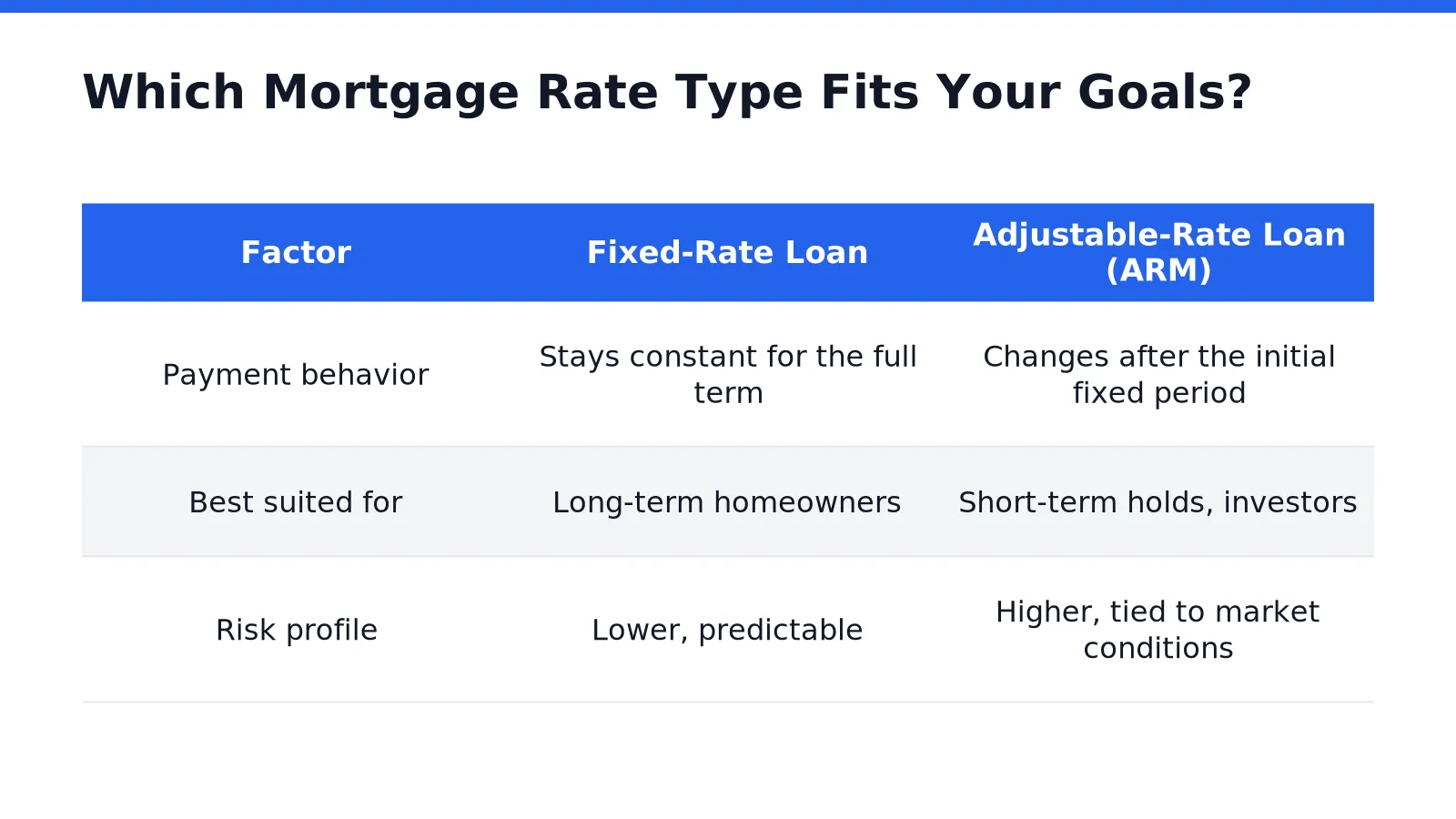
Fixed-rate mortgages lock principal and interest payments for the entire loan term, often 15 or 30 years, giving long-term homeowners predictable budgeting. Adjustable-rate mortgages start with a lower fixed-rate period, then shift based on market conditions, suiting borrowers who plan shorter ownership timelines. Munshi Capital Inc. offers both structures, matching the choice to each borrower’s risk tolerance and financial goals.
Key Takeaways
- Fixed-rate mortgages lock your interest rate and principal payment for the entire loan term, eliminating payment uncertainty.
- Adjustable-rate mortgages feature an initial fixed period, then rates adjust based on market conditions, affecting monthly payments.
- Fixed-rate loans provide payment stability ideal for long-term homeowners planning to keep their mortgage for 7+ years.
- Your choice depends on loan duration, risk tolerance, and interest rate outlook, our specialists help you decide confidently.
What Separates Fixed and Adjustable Rate Loans?
Interest rate behavior marks the core divide between these two mortgage rate types. One holds steady for the life of the loan; the other starts steady, then moves with the broader market.
A fixed vs adjustable comparison starts with payment structure. A fixed-rate mortgage locks the interest rate and the principal-and-interest payment at closing. Both stay constant until the final payment, decades later in many cases. Borrowers know their core housing cost on day one and on the last day of the term. Nothing about the rate shifts, regardless of what the broader economy does.
An adjustable-rate mortgage, often called an ARM vs fixed option in lending conversations, works differently. It opens with an initial fixed-rate period. Once that period ends, the rate adjusts based on market conditions, which can push payments higher or lower over time.
Which Loan Type Fits a Long-Term Buyer?
Borrowers planning to stay in a home for the full loan term generally value payment certainty. A fixed-rate structure removes rate risk entirely, which matters most for buyers on fixed incomes or tight budgets.
Munshi Capital Inc. structures financing for both profiles, serving first-time homebuyers and seasoned investors alike. Residential and commercial programs, including FHA, VA, USDA, and bank statement loans, get tailored to each borrower’s financial picture rather than a one-size approach. Borrowers weighing these structures against their own timeline can request a direct cash offer conversation or request your property assessment to clarify which path fits their goals.

How Does a Fixed-Rate Mortgage Protect Budgets?
A fixed-rate mortgage locks the interest rate in place for as long as the loan remains outstanding. That single feature removes the single largest source of payment uncertainty in mortgage rate types: rate movement. Market swings, inflation reports, and Federal Reserve decisions simply stop mattering once the rate is set.
Budget protection comes from consistency, not from securing the lowest possible starting rate. On a 15-year or 30-year fixed term, the principal-and-interest payment stays identical from the first month to the final one. Property tax and insurance costs may shift, but the core loan payment never does. For a household planning a decade or more in the same home, that predictability turns a mortgage into a fixed line item rather than a moving target.
Why does payment stability matter when weighing fixed vs adjustable options?
Comparing fixed vs adjustable structures comes down to risk tolerance and time horizon. A fixed-rate loan trades the possibility of a lower introductory rate for guaranteed stability across the full term. Borrowers evaluating arm vs fixed scenarios should weigh how long they intend to hold the loan against their ability to absorb a payment increase later.
Munshi Capital Inc. pairs modern underwriting technology with hands-on loan specialists to keep the fixed-rate process efficient and transparent from start to finish. That combination delivers quick pre-approvals and full visibility into loan status at every stage, from application through closing. Borrowers never lose track of where their file stands.
For homeowners ready to lock in payment certainty, the next step is simple:
- Review current fixed-rate program options
- Compare projected payments against an adjustable structure
- Speak with a loan specialist about long-term affordability
Property owners exploring a sale alongside financing decisions can also request a direct cash offer to evaluate every available path forward.

When Does an ARM Make Financial Sense?
An adjustable-rate mortgage makes financial sense when short-term savings outweigh long-term rate risk. The starting rate on an ARM typically sits below the rate on a comparable fixed-rate loan, according to the comparison published by Fixed vs. Adjustable-Rate Mortgage: What’s the Difference?. That gap creates lower monthly payments during the introductory period, which appeals to borrowers who plan to sell, refinance, or pay off the loan before adjustments begin.
The calculation changes once the fixed period ends. At that point, the rate moves up or down alongside broader interest rate trends, rather than staying locked at the original number. Borrowers who hold the loan through multiple adjustment cycles carry real exposure to rising rates and higher payments.
Is an ARM a Good Fit for Real Estate Investors?
Investors often favor an ARM when a property is a short-term hold, such as a fix-and-flip or a bridge position before refinancing. Because many investment strategies depend on speed and flexible capital rather than decades-long stability, these borrowers frequently turn to specialized products like DSCR and hard money loans alongside, or instead of, a traditional ARM.
Who Should Avoid an Adjustable Rate?
Borrowers planning to stay in a home for ten years or more generally carry more risk than reward with an ARM. Long holding periods expose the loan to several adjustment cycles, eroding the early savings.
Choosing between mortgage rate types depends on timeline, risk tolerance, and investment strategy. Munshi Capital’s team offers personalized guidance. Borrowers can match financing structure to their actual goals with confidence, rather than guesswork.
Which Mortgage Rate Type Fits Your Goals?
Loan duration, risk tolerance, and rate expectations determine the better mortgage rate types for a given borrower. No single structure wins for every homebuyer or investor. Long-term stability favors one path; short-term flexibility favors another.
Choosing between a fixed vs adjustable structure starts with an honest look at timeline. A buyer planning to stay in a property for decades gains more from locked-in payments than from an initial discount that eventually expires. An investor flipping a property within a few years often values the lower early-period rate an adjustable loan offers.
How long should a borrower plan to keep the loan?
Shorter holding periods tilt the calculation toward adjustable products. The fixed introductory rate may expire before the loan is sold or refinanced. Longer holding periods reward the certainty of a fixed structure, protecting borrowers from future rate increases.
Does risk tolerance matter more than the rate itself?
Risk tolerance often matters more than the headline number. Borrowers uncomfortable with payment swings do better under a fixed structure, regardless of short-term savings an arm vs fixed comparison might suggest.
Munshi Capital Inc. guides each borrower through this decision with a transparency mission built into every conversation. Clients move through application, underwriting, and closing on a straightforward path designed to avoid hidden surprises. Built on trust, the company delivers borrower-first guidance rooted in clarity and honest communication at every stage.
How Can You Lock in the Right Loan?
Locking in the right loan starts with matching a rate structure to a borrower’s timeline and risk tolerance. A side-by-side review of mortgage rate types clarifies which path serves a homebuyer’s goals, since weighing the advantages and disadvantages of each structure helps a borrower identify the option that best suits their financial situation.
Munshi Capital Inc. built its mortgage financing around the borrower, not the other way around. Guidance runs through every loan program, with clear answers provided at each step rather than left to guesswork. That structure matters most when a borrower is weighing fixed vs adjustable options. Needs a straight comparison rather than a sales pitch.
What should a borrower compare before choosing a rate structure?
A borrower should compare monthly payment stability, total interest cost over the life of the loan, and how long they plan to keep the property. These three factors shape which structure fits best:
- Holding period: Short-term owners often favor lower initial rates; long-term owners favor fixed stability.
- Payment tolerance: Borrowers who need predictable budgeting lean toward fixed terms.
- Rate outlook: Expectations about future market movement influence the ARM vs fixed decision.
Why does personalized guidance matter in this decision?
Because no two financial pictures look alike, a one-size answer fails most borrowers. Munshi Capital Inc.’s approach is rooted in clarity, honesty, and a service-driven ethos that supports borrowers through the full loan journey. That commitment to integrity, personalized service, and a wide range of loan products has made the company a trusted choice for homebuyers and investors nationwide. Borrowers ready to move forward can request a direct cash offer or request your property assessment to get a clear read on their options before committing.
FAQ
What is the main difference between fixed and adjustable rate mortgages?
Fixed-rate mortgages lock the interest rate and principal-and-interest payment for the entire loan term. Adjustable-rate mortgages start with a fixed period, then the rate shifts based on market conditions.
Who benefits most from a fixed-rate mortgage?
Long-term homeowners planning to keep their mortgage for 7+ years benefit most, since fixed-rate loans provide payment stability and eliminate rate risk. This suits buyers on fixed incomes or tight budgets.
How does Munshi Capital Inc. help borrowers choose between these options?
Munshi Capital Inc. matches loan structure to each borrower’s risk tolerance and financial goals, offering FHA, VA, USDA, and bank statement loans. Their specialists provide personalized guidance to help borrowers decide confidently.
Conclusion
In closing, the choice between fixed and adjustable rate mortgages fundamentally depends on your financial circumstances, risk tolerance, and long-term objectives. Fixed rate mortgages provide predictability and protection against market fluctuations. Adjustable rate mortgages offer initial savings for borrowers with shorter time horizons or anticipated income growth. At Munshi Capital Inc., our loan specialists work directly with you to evaluate your unique situation and identify the mortgage structure that aligns with your goals. Through transparent analysis and personalized guidance, we ensure you make an informed decision with full visibility into your loan terms and obligations from application through closing.
Leave a Reply