
Three distinct paths exist: banks lend directly but offer limited products, brokers shop multiple wholesale lenders for a fee, and direct lenders like Munshi Capital Inc. originate loans in-house, offering FHA, VA, USDA
Key Takeaways
- Mortgage brokers submit your application to multiple wholesale lenders, expanding your loan options significantly.
- Direct banks offer single-institution loans, limiting choices but potentially streamlining the approval process.
- Brokers advocate for borrowers’ interests during negotiations, while bank loan officers represent their institution’s priorities.
- Transparent lenders like Munshi Capital provide full visibility into loan status from application through closing.
Why Does Choosing a Lender Type Matter?
Lender type determines who controls the loan file, how many options a borrower sees, and how much guidance arrives along the way. Most homebuyers assume the decision comes down to two choices: a bank or a broker. Three distinct paths exist when evaluating broker-vs-bank-vs-direct-115 financing: a broker, a bank, and a direct lender, with the direct lender option often overlooked.
The distinction matters because a lender and a broker perform fundamentally different roles. A lender is a financial institution that funds loans directly, using its own capital or credit lines. A broker funds nothing. Instead, a broker shops a borrower’s file across multiple wholesale lenders and returns with a set of options to compare.
Does the lender type affect loan options?
Yes, significantly. A bank shows only its own products. A broker surfaces offers from many institutions at once, which is why compare-lenders-mortgage-115 across structures often reveals meaningful differences in terms and flexibility.
Who should weigh these options most carefully?
First-time homebuyers, move-up buyers, self-employed applicants, and investors face the sharpest stakes, since their financial profiles vary widely. Munshi Capital Inc. builds financing for exactly this range of borrowers, from first-time buyers to seasoned investors, with transparency guiding every step of the process.
Skipping this evaluation risks higher costs, slower closings, and missed programs suited to a borrower’s actual situation. Understanding who-to-choose-mortgage-115 before applying protects both budget and timeline:
- Bank: single-institution products, potential relationship perks
- Broker: multi-lender access, added negotiation support
- Direct lender: streamlined in-house process, direct accountability

What Separates a Broker From a Direct Lender?
A broker never funds a loan directly. Instead, a broker shops a borrower’s file across multiple wholesale lenders, searching for competitive terms on behalf of the client. A direct lender, by contrast, originates and funds the loan from its own capital. This structural difference shapes everything downstream, from pricing to accountability.
Repayment structure also diverges sharply between the two models. Borrowers who close with a direct lender repay according to that lender’s own loan terms, with no middleman fee layered in. Borrowers who work through a broker typically pay a loan-specific fee for the matchmaking service. Weighing this distinction is central to any comparing lenders for a mortgage decision. Fee structures affect the total cost of borrowing.
Does a direct lender offer more certainty than a broker?
Certainty often favors the direct lender. The entity taking the application is the same entity funding and servicing the loan. Munshi Capital’s specialists walk borrowers through application, underwriting, and closing personally, removing the guesswork that can accompany a multi-party broker transaction. First-time buyers and self-employed applicants, whose files often carry unique documentation needs, benefit from that single point of accountability.
How does technology factor into the choice?
Speed matters as much as structure. Munshi Capital pairs modern technology with hands-on loan specialist service, giving borrowers full visibility into loan status from submission through closing.
Understanding this broker vs bank vs direct structure is the first step toward choosing the right mortgage path.
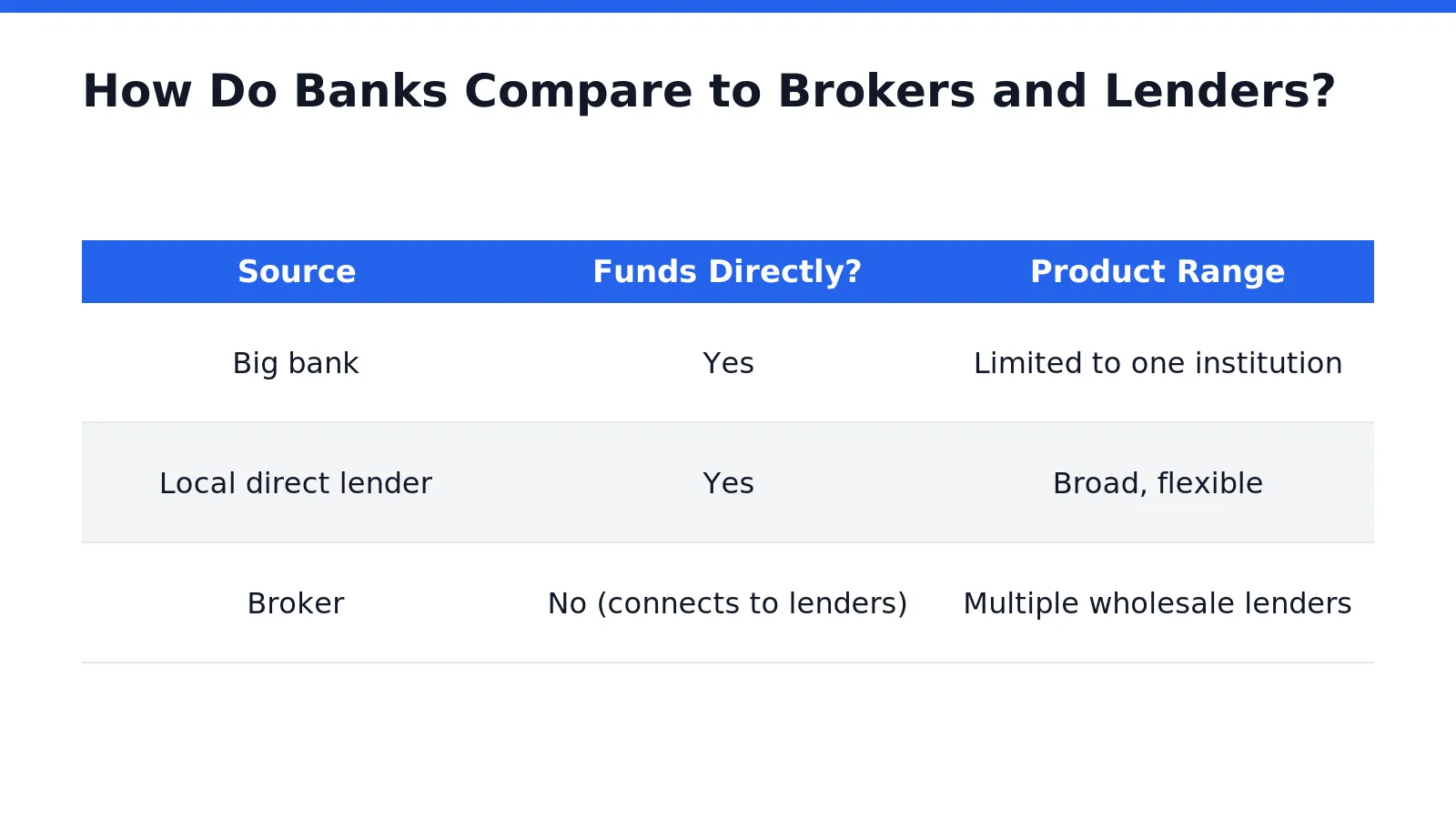
How Do Banks Compare to Brokers and Lenders?
Banks, brokers, and direct lenders each fund mortgages differently, and the gap between them shapes speed, choice, and service. A big bank lends its own money directly to borrowers but restricts clients to that single institution’s product menu. Local direct lenders, by contrast, fund their own loans too, yet often respond faster than a large national bank can manage.
Weighing this broker versus bank versus direct lender tradeoff matters most for buyers juggling tight closing timelines or nonstandard income documentation. A self-employed applicant, for instance, may need a lender willing to look past a single bank’s rigid underwriting box.
Is a Local Direct Lender Better Than a Big Bank?
Often, yes. Local direct lenders combine in-house funding with quicker turnaround, since decisions don’t travel through layers of national bank bureaucracy. A strong preapproval from a lender with local market knowledge can carry real weight during negotiations.
What Should Buyers Look for When Comparing Lenders?
Comparing mortgage lenders means checking product range, responsiveness, and documentation flexibility side by side.
Munshi Capital Inc. operates as a direct lender offering a comprehensive suite of residential and commercial loan programs, including FHA, VA, USDA, and bank statement loans for self-employed borrowers. That breadth, housed under one roof, is part of determining the right mortgage source for first-time buyers, move-up buyers, and investors alike. A wide array of loan products in one place removes the guesswork of bouncing between institutions and gives borrowers nationwide one dependable point of contact from application through closing.

Which Option Fits Self-Employed Buyers and Investors?
Self-employed borrowers and property investors often need financing structures that standard bank underwriting cannot accommodate. Specialized loan products, rather than a single lender type, determine fit for these borrowers. Income documentation varies widely among the self-employed, and investment properties carry risk profiles that traditional mortgages rarely address.
DSCR loans and hard money loans give property investors financing built around rental income and asset value rather than a personal pay stub. Munshi Capital Inc. offers both as part of its investor-focused lineup, alongside bank statement loans suited to business owners with irregular income. Investors evaluating a specific property can request your property assessment to clarify how rental income or asset value may support qualification under these programs. This mix illustrates why the broker-vs-bank-vs-direct-115 decision matters less than matching a borrower’s actual financial picture to the right program.
Do self-employed borrowers need a different loan program?
Yes. Standard W-2 underwriting rarely fits a business owner’s tax filings or seasonal cash flow. Bank statement loans solve this by evaluating deposits instead of traditional pay documentation, giving self-employed applicants a realistic path to approval.
What should investors look for when comparing lenders?
Investors should prioritize loan programs over labels. Compare-lenders-mortgage-115 efforts work best when they examine DSCR qualification thresholds, hard money terms, and underwriting speed rather than focusing only on interest rate.
Munshi Capital Inc. pairs these specialized programs with dependable, personalized guidance from a dedicated team, helping borrowers nationwide move forward with confidence. Mortgage financing built around each borrower includes clear answers through every step of the loan program selection. Quick pre-approvals and transparent visibility into loan status matter especially for investors managing time-sensitive deals.
The who-to-choose-mortgage-115 question resolves differently for every borrower. Self-employed applicants and investors gain the most from working with a lender offering flexible, specialized programs rather than a one-size-fits-all mortgage.
What Steps Lead to a Confident Decision?
A confident mortgage decision rests on structured comparison, not instinct. Borrowers who weigh each path methodically avoid costly surprises later in the loan term.
The broker vs. bank vs. direct lender decision starts with one firm rule: shop around. Regardless of which path a borrower selects, rates, fees, and loan terms vary enough between institutions that skipping comparison almost always costs money. A single quote rarely reflects the best available deal.
Comparing mortgage lenders works best as a deliberate process rather than a single phone call. Consider this sequence:
- Gather at least two to three loan estimates from different sources.
- Confirm whether each institution acts as a lender, a broker, or both.
- Compare interest rates, fees, and closing costs side by side.
- Ask direct questions about who ultimately funds the loan.
Does It Matter Which Type of Lender I Choose?
Yes, because some institutions blur the line between lending and brokering. Certain financial companies operate as both at once, which means borrowers should always confirm which role applies before signing anything. Clarity on this point prevents confusion about who is funding the loan and who is simply shopping it.
What Makes a Lender Trustworthy?
Trust comes from transparency, not promises. Munshi Capital Inc. builds its process on honesty and a service-driven ethos, guiding borrowers from application through closing with clear communication at every stage.
Who to choose for a mortgage ultimately depends on comfort level, financial complexity, and how much hands-on guidance a borrower wants. A borrower-first lender that explains every term earns confidence that a vague quote never will.
FAQ
What is the main difference between a mortgage broker and a direct lender?
A broker shops a borrower’s file across multiple wholesale lenders without funding anything, while a direct lender like Munshi Capital
Conclusion
In closing, the choice between a mortgage broker, bank, or direct lender fundamentally hinges on your specific financial circumstances, timeline, and preference for service delivery. Each channel presents distinct advantages: brokers offer access to multiple lenders, banks provide established institutional stability, and direct lenders deliver streamlined processes with transparent communication. The optimal path forward requires evaluating which structure aligns with your borrowing profile and desired level of personalized guidance throughout the financing journey. Borrowers ready to move forward can request a direct cash offer from Munshi Capital Inc. to begin the process with clarity and confidence.
Leave a Reply