
A complete mortgage document checklist includes photo ID, Social Security proof, income records, and bank statements, applicable across conventional, USDA, VA, investment, and FHA loans. Munshi Capital Inc. provides a free downloadable checklist so borrowers organize paperwork before applying. Submitting complete, accurate files upfront accelerates underwriting and prevents delays that commonly stall closings on investment and owner-occupied properties alike.
Key Takeaways
- Most homebuyers find document requirements confusing, but requirements remain similar across FHA, VA, USDA, and conventional loans.
- Organize financial documents upfront to demonstrate your complete financial picture and qualify for the right loan program.
- Lenders need income verification, asset statements, and credit information to determine your affordable monthly payment and loan amount.
- Prepare documents before meeting with your loan specialist to streamline your application and move toward closing confidently.
What Do You Need Before You Start?
Preparation determines the pace of approval. Before submitting paperwork, borrowers benefit from organizing financial records into one place and confirming which loan program fits their situation, whether FHA, VA, USDA, or bank statement financing for self-employed applicants. A mortgage lender needs detailed information about a borrower’s financial situation to determine affordability. Match the loan program to the borrower’s needs. Skipping this step causes delays later, when missing records stall underwriting and push back closing dates.
Munshi Capital Inc. offers residential and commercial loan programs built for a wide range of borrower profiles, from first-time buyers to experienced real estate investors. That range means the right starting point differs by borrower type. An investor relying on rental income needs different proof than a salaried employee. A self-employed applicant needs different documentation than both.
An application document checklist removes guesswork from this stage. Building one early helps borrowers avoid scrambling for records mid-process, which is often where delays begin.
What Documents Should Be Gathered First?
Start with identification and income verification, since nearly every loan program requires them. Pulling together a mortgage documents needed list upfront, covering identity, income, and assets, prevents repeated requests from underwriting later.
How Does Munshi Capital Guide This Process?
Munshi Capital Inc.’s lending process runs on transparency and honest communication from the first conversation through closing. Borrowers move through a straightforward application, underwriting, and closing sequence designed for clarity, not confusion. There are no hidden surprises buried in fine print.
Knowing what docs to submit before the first meeting with a loan specialist saves time on both sides. To see where your finances stand and what your home could be worth, request your property assessment before moving forward.

Which Income Documents Should You Gather First?
Income verification forms the foundation of every mortgage file. Wage earners and self-employed borrowers follow different paths, but both start with proof that income exists and will continue.
For salaried and hourly employees, two documents matter most. Lenders typically require the last two years of W-2 forms from an employer as proof of steady income. Recent pay stubs covering the last 30 days serve as a secondary income verification document, confirming current earnings match historical records.
What income proof does a self-employed borrower need?
Self-employed borrowers face a different standard. Instead of W-2s, lenders typically ask for mortgage documents needed to show 12 to 24 months of profit and loss statements documenting business income. This range accounts for seasonal fluctuations and year-over-year growth patterns that a single tax return cannot fully capture.
Borrowers assembling their application document checklist should prioritize income proof in this order:
- Gather two years of W-2 forms from each employer.
- Collect the most recent 30 days of pay stubs.
- Pull 12 to 24 months of profit and loss statements, if self-employed.
- Set aside both sets of documents separately if income comes from multiple sources.
Can self-employed borrowers skip traditional income documentation?
Standard tax paperwork does not always reflect a true financial picture, especially for investors with multiple properties or write-offs. Self-employed borrowers and investors who lack conventional documentation may still qualify through bank statement loan programs instead. These programs use deposit history rather than tax returns to establish qualifying income, offering a practical path for borrowers whose paperwork does not match their earning power.
What Asset And Identity Documents Come Next?
Identity verification and asset proof form the next layer of the application document checklist. Lenders confirm who an applicant is, then confirm what financial resources back the loan request. Missing either piece stalls underwriting before it starts.
A government-issued photo ID, such as a driver’s license, satisfies the identity requirement for most loan programs. Proof of Social Security number ranks as another core identity document lenders request during the application phase. Together, these two items establish the borrower’s legal identity on record before any financial review begins.
What asset documents do lenders need?
Asset documentation typically centers on bank statements. Among the mortgage documents needed for underwriting, lenders generally request the last two months of complete checking and savings statements, including every page, even blank ones. Skipping pages creates gaps that trigger follow-up requests and slow the timeline.
How should borrowers organize these files?
Grouping identity and asset paperwork together before submission prevents delays. A simple checklist approach keeps the process orderly:
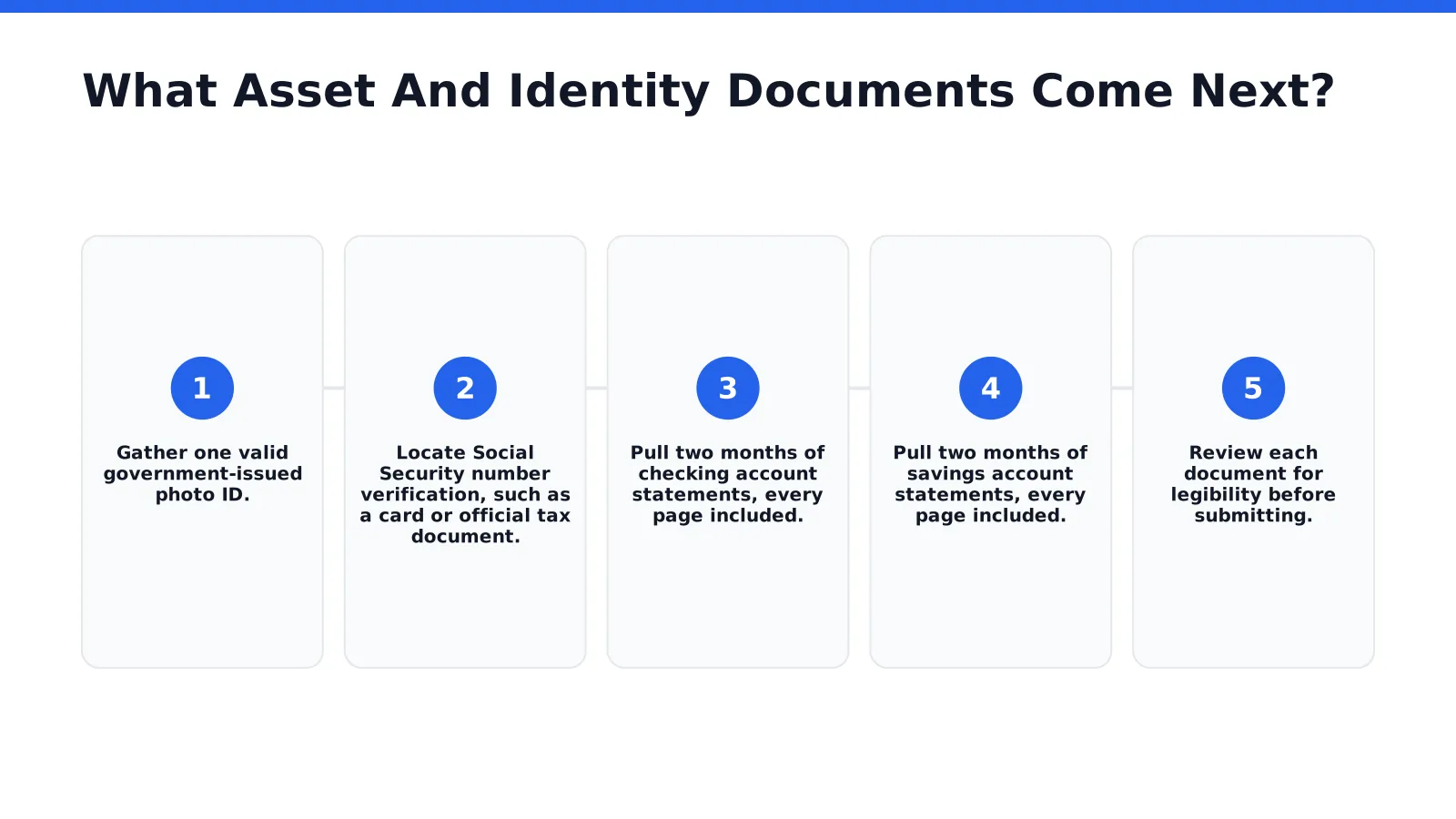
- Gather one valid government-issued photo ID.
- Locate Social Security number verification, such as a card or official tax document.
- Pull two months of checking account statements, every page included.
- Pull two months of savings account statements, every page included.
- Review each document for legibility before submitting.
Self-employed borrowers and investors often juggle multiple accounts, making this step more complex than it looks. Munshi Capital Inc. provides personalized guidance to borrowers nationwide, helping them assemble the correct what docs to submit list and move toward financing with confidence. Borrowers ready to move forward can request a direct cash offer or request your property assessment to clarify next steps before document submission begins.
How Should You Submit Your Documents?
Submission starts with a quick, secure application, not a lengthy paperwork chain. Borrowers who organize files in advance move through underwriting with far less friction. A scattered submission creates delays; a structured one creates momentum.
Munshi Capital’s process follows a clear sequence. Each step builds on the last, so skipping ahead rarely saves time.
- Complete the initial application. Begin with the quick, secure application rather than assembling paperwork first.
- Discuss goals with a loan specialist. Share financial objectives with a Munshi Capital loan specialist and identify whether a residential or commercial program fits the situation.
- Confirm the right loan program. Settling on the correct program before gathering paperwork prevents collecting the wrong documents twice.
- Assemble the application-document-checklist-112. Pull together income records, identification, and asset statements based on the confirmed program.
- Submit files for review. Send the complete set so underwriting can begin without back-and-forth delays.
What happens after documents are submitted?
Once a borrower submits files, the Munshi Capital team guides the file through every step from application to closing. Guidance comes with clarity and speed, without confusing jargon or hidden surprises along the way.
Why does document order matter for approval speed?
Complete, organized submissions tied to mortgage-documents-needed-112 support faster pre-approvals. Borrowers also gain full visibility into loan status from start to finish, reducing uncertainty during underwriting.
Knowing what-docs-to-submit-112 before applying shortens the entire timeline. Preparation, not paperwork volume, determines how smoothly closing arrives.
What Mistakes Commonly Delay Your Approval?
Missing paperwork causes most approval delays. Lenders cannot process a loan file until every required document arrives, correctly dated and fully legible. Borrowers who scramble at the last minute often resubmit the same forms twice, which stretches timelines further.
Gathering a complete application document checklist before submission prevents this cycle entirely. Whether a borrower is purchasing a first home or refinancing an investment property, knowing which documents are needed upfront streamlines the approval process and saves both time and money. Skipping this step is the single most avoidable cause of a stalled closing date.
Why Do Lenders Ask for the Same Documents Twice?
Underwriters often request updated statements because financial records expire quickly during a long approval window. A pay stub from two months ago no longer reflects current income once a closing date slips. Borrowers who understand which mortgage documents are needed at each stage avoid this repeat-request cycle.
What Else Slows Down the Process?
Common missteps include:
- Submitting incomplete bank statements with pages missing
- Failing to explain large, unexplained deposits
- Using outdated tax returns instead of the two most recent years
- Leaving signature fields blank on disclosure forms
Self-employed borrowers face extra scrutiny, since income verification requires more documentation layers. Confusion over what docs to submit at each phase, application, underwriting, or closing, remains a recurring stumbling block.
Munshi Capital Inc. is built on trust and committed to providing transparent, borrower-first mortgage guidance throughout document submission. This approach, rooted in clarity, honesty, and a service-driven ethos, reduces submission errors and keeps files moving. That commitment to integrity and personalized service makes it a trusted choice for homebuyers and investors nationwide.
FAQ
What documents belong on a complete mortgage checklist?
A complete checklist includes photo ID, Social Security proof, income records, and bank statements. These requirements apply across conventional, USDA, VA, investment, and FHA loans.
Why does organizing documents early matter for closing?
Submitting complete, accurate files upfront accelerates underwriting and prevents delays that commonly stall closings. Missing records discovered mid-process push back closing dates on both investment and owner-occupied properties.
How does Munshi Capital support borrowers through document submission?
Munshi Capital Inc. guides borrowers through a straightforward application, underwriting, and closing process built on transparency and honest communication. Loan specialists help organize required paperwork before the first meeting, saving time for everyone involved.
Conclusion
In closing, thorough document preparation and strategic submission establish the foundation for a seamless mortgage approval process. By organizing your financial records, verifying accuracy across all submissions, and maintaining clear communication with your loan specialist, you position yourself for efficient underwriting and faster closing timelines. The mortgage journey demands precision and attention to detail, qualities that, when paired with transparent guidance from experienced lending professionals, transform complexity into confidence and accelerate your path to financing success.
Leave a Reply