
Seasonal mortgage content calendars should spotlight spring homebuying FHA and VA promotions, summer investor-focused DSCR campaigns, fall USDA rural financing pushes, and winter bank statement loan refinancing tips, Munshi Capital Inc. structures these quarterly themes around transparent, borrower-first guidance for first-time buyers and investors alike.
Munshi Capital Inc. builds its FHA, VA, USDA, DSCR, and bank statement loan messaging around these trends, keeping borrowers informed with transparent, timely guidance year-round.
Seasonal mortgage marketing calendars organize content around purchase. Refinance cycles, pairing rate trends with buyer milestones like spring home-shopping season and fall rate lock windows. Munshi Capital Inc. supports loan officers with structured planning covering FHA, VA, USDA, bank statement, DSCR, and hard money loan topics. The planning ensures consistent, locally relevant messaging across the markets Munshi Capital Inc. serves.
Key Takeaways
- Social media calendars drive mortgage lending growth as refinance pipelines decline and purchase activity slows nationwide.
- Seasonal content planning helps loan officers engage borrowers consistently throughout market cycles and economic shifts.
- Ready-made social shareables and post templates accelerate content creation for transparent, borrower-focused messaging strategies.
- Strategic mortgage trending topics position lenders to address client concerns with clear, honest guidance year-round.
What Will You Accomplish With This Calendar?
A structured calendar delivers three outcomes: consistent audience reach, program-specific visibility, and a documented pipeline of content tied to real lending products. Loan officers who skip this planning step scramble for post ideas daily, a habit that produces uneven messaging and missed engagement windows. Mortgage professionals who commit to mortgage trends and seasonal planning instead build a repeatable system, one that matches content to audience need month after month.
Social media marketing has shifted from optional to essential for mortgage lenders as refinance activity cools and purchase volume slows. A calendar built around seasonal mortgage content strategy provides loan officers with a structured approach to maintain engagement during slow periods, offering planned, cohesive posts instead of reactive scrambling. Cohesive messaging also builds trust over time, since prospective borrowers see steady expertise rather than sporadic promotion.
What Topics Should a Mortgage Content Calendar Cover?
Coverage should mirror the full range of clients served, from first-time buyers to experienced real estate investors. Because loan programs span residential and commercial products, including FHA, VA, USDA, and bank statement loans, each month can spotlight a different borrower profile and program. A sample monthly rotation might include:
- First-time buyer basics (FHA, down payment guidance)
- Veteran-focused content (VA loan eligibility)
- Self-employed borrower solutions (bank statement loans)
- Investor strategies (commercial and investment financing)
Planning this way turns a loan officer’s feed into a resource covering trending home finance topics relevant to every stage of the borrowing journey, not just the current news cycle. Each post reinforces expertise without duplicating effort or guessing what to publish next.
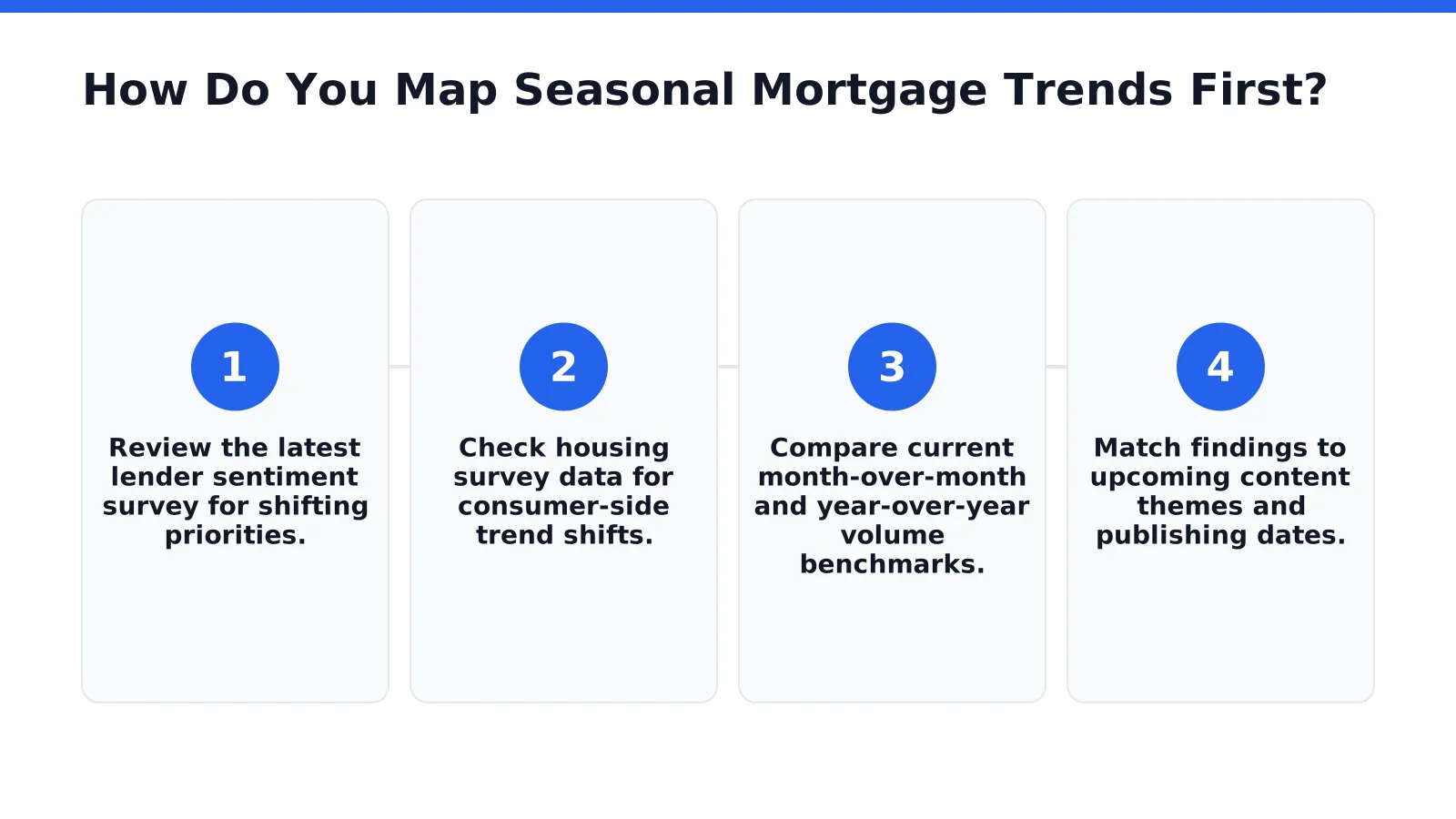
How Do You Map Seasonal Mortgage Trends First?
Mapping seasonal patterns starts with a disciplined review of lender survey data before a single post gets drafted. Industry research series, built from tools like a National Housing Survey and a Mortgage Lender Sentiment Survey, examine data collected across the housing market to surface trends, challenges, and opportunities facing both lenders and consumers throughout the year. These findings form the backbone of mortgage-trends-seasonal-101, giving content teams a factual starting point instead of guesswork.
Survey findings do more than describe the market; they point toward what lenders will prioritize next. Results covering eMortgage technology adoption, for example, reveal shifting business priorities that often shape quarterly content themes for loan officers planning ahead. Pairing those findings with monthly funded-volume benchmarks sharpens the picture further. When funded mortgage volume moves, whether down 2% year over year or down 9% month over month as recent benchmark reporting shows, that shift signals when rate-related content resonates most and when it falls apartment.
What Data Points Belong on a Seasonal Content Calendar?
A working calendar pulls from three data streams: lender sentiment survey results, housing survey findings, and monthly volume benchmarks. Each stream answers a different question, together they define the seasonal-mortgage-content-101 framework.
- Review the latest lender sentiment survey for shifting priorities.
- Check housing survey data for consumer-side trend shifts.
- Compare current month-over-month and year-over-year volume benchmarks.
- Match findings to upcoming content themes and publishing dates.
Where Does Program Messaging Fit Into Trend Mapping?
Program narrative anchors the data. Munshi Capital’s transparent, technology-backed process, supported by loan specialists, gives content creators a dependable story to attach to trending-home-finance-topics-101, whether the season favors purchase activity or refinance interest. Buyers weighing their options can request a direct cash offer. Sellers evaluating timing can request your property assessment before committing to next steps.

Which Trending Home Finance Topics Fill Each Month?
Monthly mortgage content divides into four recurring buckets: residential programs, investor products, local market data, and evergreen education. Building a mortgage trends seasonal calendar around these buckets keeps posting consistent instead of scrambling for ideas every week. Spring and early summer, when first-time buyer season peaks, call for content built on FHA, VA, USDA, and bank statement loan programs. These residential categories give loan officers a reliable topic bucket that matches the seasonal rise in home shopping.
Late summer and fall align with investor activity. DSCR and hard money loan products take center stage during these months, creating investor-focused content opportunities timed to when real estate investors ramp up acquisitions. A trending home finance topics map should rotate this investor education into place before that buying window opens, not after.
Mapping topics to the calendar follows a simple sequence:
- List the residential loan categories (FHA, VA, USDA, bank statement) tied to buyer-season months.
- Schedule DSCR and hard money content ahead of investor buying windows.
- Layer in city-specific posts using local loan programs, rates, and market insights.
- Fill remaining slots with evergreen shareables.
How should loan officers map city-specific content to the calendar?
City-specific mortgage pages supply location-based angles for any given month. Surfacing local loan programs, rates, and market insights gives marketers a ready-made seasonal hook tied to where buyers are actually shopping.
What fills the gaps between trend-driven posts?
Ready-made social shareables, including mortgage myth-busters and credit score basics, cover the gaps between trend-driven posts. These assets build consistent seasonal mortgage content without demanding fresh research every week, keeping the calendar full even in slower news months.
How Do You Build the Monthly Content Calendar?
Building a monthly calendar starts with separating two content types: timely subjects tied to rate movements or seasons, and recurring categories that repeat month after month. Mortgage professionals who skip this split end up publishing scattered, inconsistent posts that confuse their audience rather than build authority. A calendar that blends both layers keeps messaging coherent across weeks while still responding to what borrowers care about right now.
The build process follows a clear sequence:
- List recurring categories first, such as loan program explainers, client success summaries, and process walkthroughs.
- Map mortgage trends seasonal 101 topics onto the calendar, placing rate-sensitive or seasonal posts (spring buying season, year-end refinancing) where they naturally occur.
- Assign one application-to-closing theme per month, since borrowers move through a straightforward application, underwriting, and closing sequence that maps cleanly onto a step-by-step series.
- Rotate loan products weekly rather than repeating one theme, drawing on the full range of residential and commercial programs available to first-time buyers, seasoned investors, and business owners alike.
- Review and adjust the mix monthly based on which categories perform best.
What Makes Seasonal Mortgage Content Different From Evergreen Posts?
Seasonal mortgage content 101 responds to a specific window, like spring purchase season or year-end tax planning, rather than staying relevant indefinitely. Evergreen posts, by contrast, explain lasting concepts such as underwriting steps or loan qualification basics. A strong calendar needs both: seasonal posts drive timely engagement, evergreen posts build long-term search visibility.
Why Track Trending Home Finance Topics Separately?
Tracking trending home finance topics 101 separately prevents a calendar from going stale. Loan officers who monitor rate shifts. Buyer sentiment can slot timely commentary into open calendar slots without disrupting the recurring structure already in place.
What Mistakes Derail a Seasonal Content Plan?
Four errors consistently undermine a mortgage professional’s mortgage trends seasonal strategy. Each one erodes trust or relevance, the two qualities borrowers scan for first.
Dropping borrower-first guidance tops the list. Calendars built without transparent, honest messaging lose the clarity audiences expect from mortgage content, and once trust slips, engagement follows it down. Stale rate references cause similar damage. Ignoring benchmark shifts, like the 30-year conforming retail funded rate moving by basis points month over month per Curinos’s Mortgage Hot Topics report, leaves posts sounding outdated within weeks.
Omitting process transparency ranks third. Skipping mention of quick pre-approvals and full visibility into loan status removes a credibility signal borrowers actively compare across lenders. Generic trend commentary, untethered from real benchmark data, rounds out the list of pitfalls undermining seasonal mortgage content.
Why Does Benchmark Data Matter for Trending Posts?
Figures pulled from a statistically significant lender data set carry weight that generic commentary cannot match. Curinos sources its benchmark figures directly from lenders, which gives loan officers a credible anchor for trending home finance topics discussions. Posts citing verifiable, sourced figures outperform vague trend claims in reader trust.
Avoiding these four mistakes keeps a seasonal calendar accurate, credible, and aligned with what borrowers actually need to hear.
FAQ
What does a seasonal mortgage content calendar accomplish?
It delivers consistent audience reach, program-specific visibility, and a documented content pipeline tied to real lending products like FHA, VA, USDA, and bank statement loans, replacing daily scrambling with a repeatable system.
What topics should the monthly rotation include?
A sample rotation covers first-time buyer basics, VA loan eligibility for veterans, bank statement loans for self-employed borrowers, and investor strategies for commercial and investment financing, matching content to each borrower stage.
Why does seasonal planning matter now for loan officers?
Refinance pipelines decline and purchase activity slows nationwide, making structured, transparent content essential rather than optional for maintaining borrower trust and engagement throughout market cycles.
Conclusion
In closing, understanding mortgage trending topics through a strategic seasonal content calendar empowers borrowers to make informed decisions aligned with their financial objectives. By recognizing how market dynamics, borrower needs, and lending opportunities shift throughout the year, you position yourself to secure financing solutions that match your unique circumstances. Munshi Capital Inc. remains committed to delivering transparent guidance. Dependable service across every season, ensuring you navigate the mortgage landscape with clarity and confidence regardless of when you pursue your financing goals.
Leave a Reply