
Bank statement loans give self-employed entrepreneurs, gig professionals, and investors a path to mortgage approval using 12 to 24 months of bank statements instead of tax returns. Munshi Capital Inc. offers loans up to $4 million for purchase or refinance, covering owner-occupied homes, second homes, and investment properties nationwide, including Anaheim, CA.
Key Takeaways
- Bank statement loans use 12-24 months of financial documentation instead of traditional tax returns for income verification.
- Loans up to $4 million available for purchase, refinance, and investment properties with flexible ownership requirements.
- Self-employed borrowers with non-traditional income sources access transparent underwriting without hidden surprises or complicated processes.
- Personalized guidance from loan specialists ensures self-employed clients secure tailored financing that fits their unique financial picture.
What Is a Bank Statement Loan Exactly?
A bank statement loan verifies income through deposit history rather than tax filings. Self-employed entrepreneurs, freelancers, and gig economy professionals often show reduced taxable income after deductions, even when actual cash flow runs strong. Bank statement loans solve that mismatch by using real deposit activity as proof of earning power.
The mechanics are straightforward. Lenders review 12 to 24 months of personal or business bank statements to document income for a home purchase or refinance. Average monthly deposits, not adjusted gross income, drive the qualifying calculation. This approach gives a more accurate picture of what a business owner actually earns.
Munshi Capital Inc. builds each loan solution around the borrower’s actual financial picture rather than a rigid underwriting formula. Bank statement loans sit alongside FHA, VA, and USDA programs within the company’s residential loan lineup, giving self-employed applicants a real alternative to conventional tax-return underwriting.
Who typically needs a self-employed mortgage like this?
Business owners, 1099 contractors, real estate investors, and gig workers often carry income that looks inconsistent on paper. A self-employed mortgage built on bank statements bridges that gap. Walnut Creek entrepreneurs with seasonal revenue or heavy write-offs frequently fall into this category.
How is alternative income different from standard income verification?
Alternative income relies on cash flow evidence instead of W-2s or federal tax transcripts. Deposits, not deductions, become the measuring stick. This method captures full earning capacity, which traditional underwriting frequently understates for self-employed borrowers.
Entrepreneurs ready to explore financing options can request a direct cash offer or request your property assessment to clarify next steps.
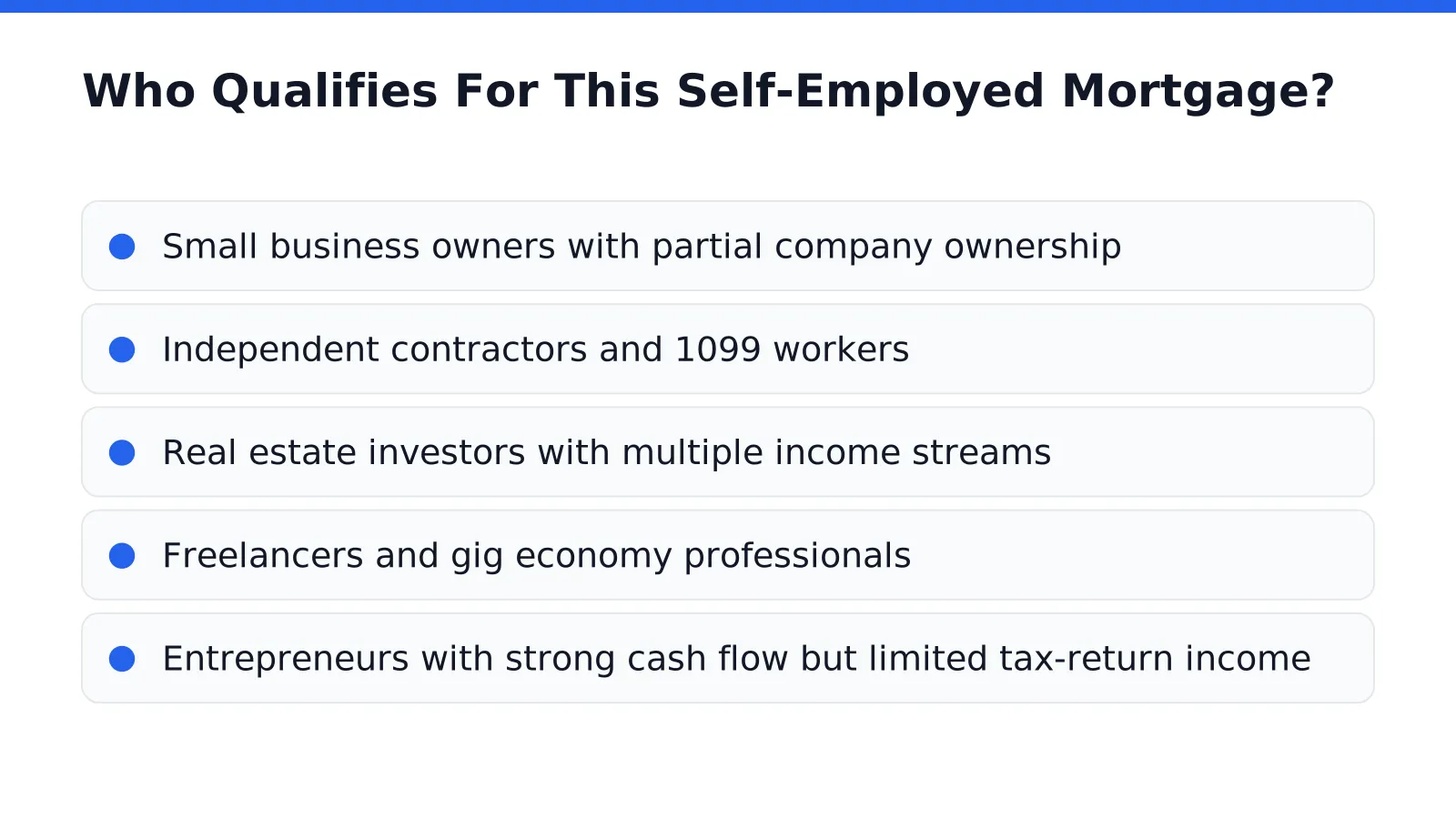
Who Qualifies For This Self-Employed Mortgage?
Self-employed individuals, small business owners, and independent contractors make up the primary candidates for bank statement loans. Traditional lenders often reject these applicants due to tax deductions that minimize paper income, even when actual cash flow is strong. A self-employed mortgage built around real bank activity closes that gap.
Ownership structure rarely disqualifies a borrower. Partial stakeholders in a business remain eligible; full ownership is not a requirement. This flexibility opens the door for partners, co-founders, and investors who hold less than 100% of a company but still generate consistent income from it.
Do Gig Workers And Freelancers Qualify?
Gig economy professionals and freelancers fall squarely within this financing category. Income volatility, inconsistent 1099 forms, and seasonal earnings patterns no longer stand in the way of qualification. Deposits across personal or business accounts serve as the proof lenders need.
What If A Borrower’s Tax Returns Understate Income?
Many self-employed borrowers write off substantial expenses, lowering taxable income on paper. Bank statement programs sidestep that problem by evaluating actual deposits as alternative income, rather than adjusted gross income.
Typical qualifying borrower profiles include:
- Small business owners with partial company ownership
- Independent contractors and 1099 workers
- Real estate investors with multiple income streams
- Freelancers and gig economy professionals
- Entrepreneurs with strong cash flow but limited tax-return income
Munshi Capital Inc. delivers personalized guidance to borrowers nationwide, helping each client match documentation to the right program with confidence. That same commitment to integrity and tailored service has made the company a trusted resource for homebuyers. Investors across the country, including entrepreneurs throughout Walnut Creek and beyond.

How Many Bank Statements Will Lenders Need?
Lenders typically request either 12 or 24 months of business or personal bank statements to document income for bank statement loans. The exact number depends on the loan program and the borrower’s financial profile. Fewer months of history generally means tighter scrutiny on cash flow consistency. A longer statement window often gives underwriters more confidence in income stability.
Self-employed entrepreneurs, gig economy professionals, and small business owners should expect lenders to average deposits across the chosen period rather than relying on a single strong month. This approach reflects the realities of alternative income, which can fluctuate month to month for freelancers and investors alike.
Does the Expense Factor Affect Required Documentation?
Yes. Loans are commonly qualified using a default expense factor of 50 percent, an assumption about business costs relative to revenue. Borrowers whose actual expenses run lower than that default often need a supporting statement from a third-party CPA, tax preparer, or bookkeeping professional. Certain industries with traditionally higher expense ratios may face additional documentation requirements as a result.
What Does the Process Look Like Start to Finish?
Munshi Capital guides borrowers through a straightforward application, underwriting, and closing process built around transparency, with no hidden surprises along the way. Technology paired with hands-on loan specialists supports quick pre-approvals and gives borrowers full visibility into loan status at every stage.
A self-employed mortgage applicant should gather statements early, since missing months can delay underwriting and push back closing timelines.

What Other Alternative Income Documents Count?
Documentation beyond standard bank deposits qualifies many borrowers for alternative income programs. Contract workers paid through 1099 forms represent one accepted category, giving freelancers and gig economy professionals a path that doesn’t depend on W-2 wages. This matters for the growing share of entrepreneurs and investors in Walnut Creek. Nationwide whose earnings don’t fit a traditional pay stub.
Loan size often depends on how income gets documented. Programs built around bank statement loans and 1099 verification can extend financing up to four million dollars. Loan size scales to match each borrower’s investment needs. That range covers everything from a modest starter property to a larger investment acquisition.
Beyond 1099s and bank deposits, several specialized products broaden what counts as qualifying income:
- DSCR loans, which weigh a property’s rental income rather than personal earnings
- Hard money loans, designed for fast-moving investment purchases
- Commercial mortgage programs structured around a property’s income and value rather than a borrower’s tax return
Do self-employed borrowers need a 1099 to qualify?
Not exclusively. A self-employed mortgage applicant without steady 1099 income can still document earnings through bank statements or profit records, since lenders look at the full financial picture rather than one form type.
Can rental income count as alternative documentation?
Yes. Real estate investors often qualify using the property’s own income performance. DSCR-based evaluation shifts the focus away from personal tax filings and toward the asset’s cash flow, which helps investors scale a portfolio without being boxed in by conventional underwriting rules. Business owners weighing these paths can request a direct cash offer or request your property assessment to see which option fits their financial situation.
How Does Munshi Capital Make It Easy?
Munshi Capital simplifies mortgage financing by replacing guesswork with a transparent, step-by-step process built for self-employed income and non-traditional pay structures. Clear communication, not paperwork overload, defines every stage of the loan journey. Self-employed entrepreneurs, gig workers, and real estate investors in Walnut Creek and across the country gain a borrower-first partner rather than a faceless lender.
The foundation rests on honesty. Munshi Capital’s approach is rooted in clarity, straightforward disclosures, and a service-driven ethos that positions the company as a dependable partner throughout the lending relationship. That commitment matters most for borrowers exploring a self-employed mortgage. Income documentation often looks unconventional compared to a standard W-2 file.
What Does the Application Process Actually Look Like?
The process starts with a quick, secure application paired with a dedicated loan specialist. Borrowers share their goals directly with that specialist, who identifies which residential or commercial program fits the situation, whether that means bank statement loans, DSCR financing, or another alternative income path.
Why Does Transparency Matter for Alternative Income Borrowers?
Business owners relying on alternative income, profit and loss statements, or seasonal cash flow often face unclear underwriting elsewhere. Munshi Capital’s mission of transparency removes that uncertainty by explaining each requirement before it becomes a roadblock.
The experience breaks down into three consistent steps:
- Submit a secure application and connect with a loan specialist.
- Review tailored program options based on documented income.
- Move through underwriting with clear, upfront expectations at every stage.
Sellers weighing a property sale alongside financing decisions can request a direct cash offer. Homeowners uncertain of their equity position can request your property assessment before committing to next steps.
FAQ
What documents replace tax returns in a bank statement loan?
Lenders review 12 to 24 months of personal or business bank statements, using average monthly deposits instead of adjusted gross income to verify earning power.
Do self-employed borrowers need full business ownership to qualify?
No, partial stakeholders qualify too. Partners, co-founders, and investors holding less than 100% ownership remain eligible for this self-employed mortgage option.
What property types does Munshi Capital Inc. finance with bank statement loans?
Munshi Capital Inc. finances owner-occupied homes, second homes, and investment properties nationwide, offering loans up to $4 million for purchase or refinance.
Conclusion
In closing, self-employed borrowers navigating the mortgage landscape benefit substantially from bank statement loan programs that recognize income documentation beyond traditional tax returns. Munshi Capital Inc. delivers transparent, personalized guidance through this specialized financing option, ensuring your unique financial profile receives proper evaluation. Our commitment to clarity and dependable service throughout the application and underwriting process removes uncertainty, allowing you to move forward with confidence in securing the right loan solution for your circumstances.
Leave a Reply