
Closing costs typically range between 2% and 5% of the loan amount and cover lender fees, appraisals, title insurance, and prepaid taxes. Freddie Mac reports average closing timelines near 43 days. Munshi Capital Inc. guides first-time buyers and investors through FHA, VA, USDA, and bank statement loan programs, clarifying every fee before closing day arrives.
Key Takeaways
- Closing costs typically range from 2-5% of your total loan amount, payable on closing day.
- The average mortgage closing process takes approximately 43 days from application submission to final closing.
- Closing costs include various fees associated with mortgage origination and finalizing your home purchase transaction.
- Understanding each fee upfront ensures no hidden surprises during your transparent, straightforward closing experience with us.
What Are Closing Costs and Why Do They Exist?
Closing costs are fees borrowers pay to finalize a home loan. These charges exist because a mortgage requires more than a signature; lenders, title companies, appraisers, and insurers each perform work that closes the gap between an accepted offer and a funded loan. Every service tied to verifying a property’s value, clearing its title, and protecting the new owner carries a cost, and those costs land on the borrower at the closing table.
Munshi Capital Inc. guides borrowers through this process with clarity and honest communication, from application through final signature. First-time buyers often expect the purchase price to be the only number that matters. The real total includes a second layer of expenses that catches many borrowers off guard.
What’s typically included in closing costs?
Standard expenses include the appraisal fee, title fees, and the first year of homeowner’s insurance. These mortgage fees cover the administrative and legal work required to transfer ownership safely.
- Appraisal fee: confirms the home’s market value
- Title fees: cover research and insurance tied to escrow closing
- First-year homeowner’s insurance: required before funding
- Loan origination charges: compensate the lender for processing the file
Why can’t these costs be avoided?
Each fee pays for a service that protects either the lender or the borrower. Skipping title work, for example, leaves ownership unverified and exposes a buyer to future claims.
Munshi Capital Inc.’s borrower-first approach, built on clarity and honesty, helps clients face these line items with confidence rather than confusion. Understanding each fee’s purpose turns an unexpected bill into an anticipated, manageable part of closing day.

Which Mortgage Fees Will You Actually Pay?
Borrowers typically pay three categories of charges at closing: appraisal costs, title insurance, and loan origination fees. Each covers a distinct part of finalizing a home loan. Together they make up the bulk of mortgage fees due before keys change hands.
The appraisal fee pays for a licensed professional to confirm the home’s market value. Title insurance protects the lender and the borrower against ownership disputes or liens discovered after purchase. Loan origination charges cover the lender’s cost of processing, underwriting, and funding the mortgage. Beyond these three, borrowers may encounter smaller administrative charges depending on the loan type and property.
Does the loan program change the fees owed?
Yes, fee structures shift depending on the program selected. Munshi Capital Inc. offers residential and commercial loan programs including FHA, VA, USDA, and bank statement loans. Each carries its own underwriting requirements that influence total fees at escrow closing. Government-backed programs like FHA and VA often involve different insurance or guarantee fees than conventional loans, so comparing program types matters before signing.
Real estate investors face a separate set of considerations. Munshi Capital Inc. also provides DSCR and hard money loans built for investor-focused financing, where underwriting relies on property cash flow or asset value rather than traditional income documentation. These programs can carry distinct fee structures tied to the speed and flexibility they offer.
Because fees vary by loan type, credit profile, and property, no single number applies to every borrower. Munshi Capital Inc.’s personalized guidance helps borrowers across the country secure the right financing with confidence, walking through each fee line by line before closing day arrives. Borrowers weighing their options can request your property assessment to see how program choice and property value shape the final fee total.
How Does Escrow Closing Work on Your Loan?
Escrow closing places a neutral third party between borrower, lender, and seller to manage funds and paperwork until every condition of the loan is satisfied. Signing happens only after that neutral party confirms all documents and payments are in order.
On closing day, borrowers sign the final loan paperwork, settle any outstanding closing costs, and receive the keys to the property. These costs cover appraisal, title, and origination charges, collectively known as mortgage fees. The escrow agent collects and distributes to the appropriate parties before the transaction is recorded.
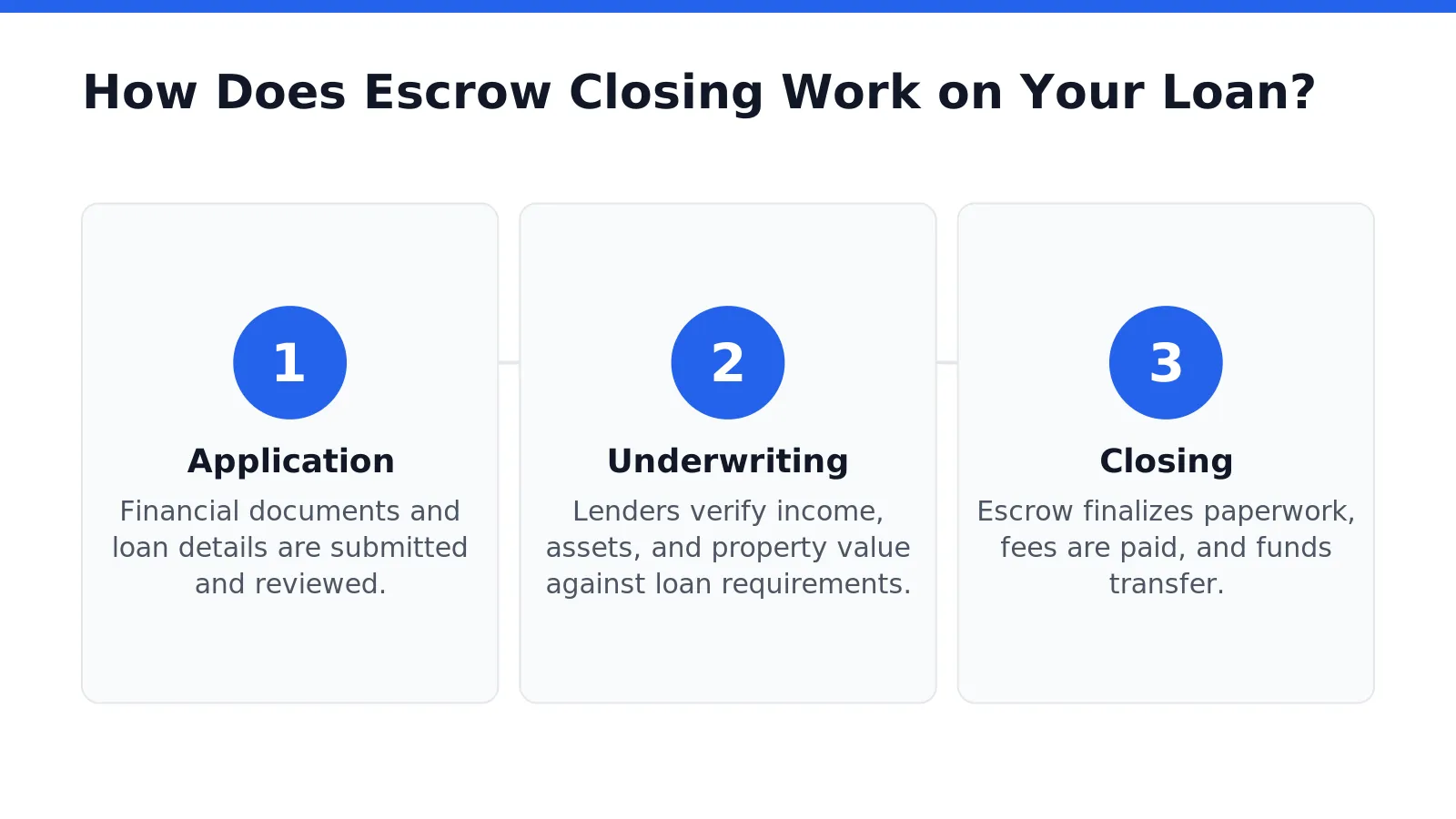
Munshi Capital’s lending process moves borrowers through three stages, each one visible from start to finish:
- Application: Financial documents and loan details are submitted and reviewed.
- Underwriting: Lenders verify income, assets, and property value against loan requirements.
- Closing: Escrow finalizes paperwork, fees are paid, and funds transfer.
No stage hides fees or terms from the borrower. Clarity at each step replaces the guesswork that often derails first-time purchases.
How long does escrow closing take?
Closing takes about 43 days on average from the date a mortgage application is submitted, according to Freddie Mac. Document processing speed, required inspections, and seller timelines all shift that window. Borrowers with organized financial records typically move through underwriting faster, shortening the wait before keys are handed over.
What makes escrow closing feel transparent instead of stressful?
Full visibility into loan status removes the uncertainty that catches many borrowers off guard. When status updates, fee breakdowns, and document requests are shared proactively, surprises at the closing table become rare. Borrowers who want a faster, more predictable path to ownership can request a direct cash offer or request your property assessment to begin the process with clear next steps.

How Much Should You Budget for Closing Costs?
Budgeting for closing costs means planning for 2% to 5% of the total loan amount. On a $350,000 loan, that range translates to roughly $7,000 to $17,500 due at the closing table. Borrowers who skip this planning step often face a scramble for cash in the final weeks before closing, putting the entire purchase at risk.
That range covers a wide mix of expenses. Mortgage fees bundle together charges such as loan origination, appraisal, underwriting, and title work, along with the first year of homeowner’s insurance in many cases. The exact figure depends on loan size, location, and lender.
Why does the closing cost range vary so widely?
A loan near the top of a price bracket often carries proportionally lower fees than a smaller loan. Some charges are apartment rather than percentage-based. Location matters too: state and local fees, recording charges, and insurance requirements shift the total up or down.
Munshi Capital Inc. builds its financing approach around each borrower’s specific numbers rather than a one-size-fits-all estimate. Clear guidance travels through every loan program, from first-time buyer loans to investor-focused products, with answers delivered in plain terms and service borrowers can count on.
Planning for closing costs works best early, not at the finish line. Consider these starting steps:
- Request a loan estimate before shopping for a rate
- Compare fee totals across loan programs, not just interest rates
- Set aside funds separately from the down payment
Borrowers who want precise numbers for their situation can request your property assessment to see how local costs. Loan terms apply to their purchase. Munshi Capital’s commitment to integrity and transparency keeps the budgeting process honest from application through escrow closing.
How Can You Reduce or Prepare for These Costs?
Several strategies exist to ease the burden of upfront fees before closing day arrives. Borrowers who plan ahead can lower out-of-pocket expenses or spread them out, rather than facing one large bill at the finish line.
Down payment assistance programs offer one practical route. Many of these programs extend beyond the down payment itself, permitting funds to cover closing costs as well. First-time buyers in particular should investigate local and state assistance options before assuming savings alone must cover every fee.
Can closing costs be negotiated?
Yes. Buyers facing a motivated seller can request seller concessions, asking the seller to absorb a portion of the fees. Lender credits offer another option, trading a slightly higher interest rate for reduced upfront costs. Some borrowers instead choose to roll certain mortgage fees into the loan balance, lowering cash due at signing while spreading the cost over the loan term.
What makes the closing process easier to manage?
Clarity makes the difference. Munshi Capital guides borrowers through every stage of the loan journey, from application through escrow closing, without confusing jargon or hidden surprises. That transparency extends across the full lending relationship, not just the final signing appointment.
Munshi Capital’s approach rests on a borrower-first philosophy. Honesty and clarity guide every conversation, positioning the company as a dependable partner through the entire loan process. Borrowers weighing their financing options can request a direct cash offer or request your property assessment to better understand costs ahead of closing.
FAQ
How much do closing costs typically cost?
Closing costs typically range between 2% and 5% of the loan amount, covering lender fees, appraisals, title insurance, and prepaid taxes due at closing.
What fees are included in closing costs?
Standard expenses include the appraisal fee, title fees, first-year homeowner’s insurance, and loan origination charges, which together cover administrative and legal work required to transfer ownership.
How long does the mortgage closing process take?
The average mortgage closing process takes approximately 43 days from application submission to final closing, according to Freddie Mac data cited in the article.
Conclusion
In closing, understanding closing costs and fees represents a critical step toward informed mortgage decision-making. Transparency in these expenses eliminates uncertainty and empowers borrowers to evaluate their true financial obligations. At Munshi Capital Inc., we prioritize clarity throughout the lending process, ensuring you comprehend each fee component without hidden surprises. Our commitment to straightforward communication and personalized guidance positions you to move forward confidently, equipped with the knowledge necessary to secure financing aligned with your specific objectives and financial circumstances.
Leave a Reply