
Credit scores directly determine mortgage interest rates, with conventional 30-year loans showing clear tiers: a 620 FICO score carries a 7.61% rate, while a 700 score drops to 7.14%. Borrowers need at least 580 to qualify. 760 or higher secures the best available pricing, significantly lowering lifetime borrowing costs for California homebuyers and investors.
Key Takeaways
- Credit scores of 760 or higher qualify borrowers for the best available mortgage interest rates.
- A 700 credit score currently carries a 7.14% average rate on 30-year fixed mortgages.
- Minimum credit score of 580 required to qualify for mortgage financing across most lenders.
- Lender criteria varies, so personalized guidance helps borrowers understand their unique rate based on credit profile.
Why Does Your Credit Score Move the Rate?
A borrower’s three-digit score tells lenders how much risk they carry, and that risk translates directly into loan pricing. Lower scores signal higher default risk, so lenders charge more to offset potential losses. Higher scores signal reliability and unlock access to lower pricing tiers.
Credit scores generally span a range from 300, the lowest, to 850, the highest. This spread gives mortgage lenders a standardized measure of borrower risk, applied consistently to applications for homes across Walnut Creek and California. A homeowner refinancing with a score in the low 600s sits in a different risk tier than one with a score near 800, even when income and assets look similar.
Why does a small score difference change loan terms so much?
Lenders group scores into risk tiers rather than pricing each point individually. Crossing into a higher tier changes the interest rate offered, the monthly payment, and the total interest paid across the loan term. A modest score gain can shift a borrower into a lower-risk tier and meaningfully reduce long-term borrowing costs.
What should borrowers do before applying for a mortgage?
Prioritizing credit improvement ahead of application season strengthens a borrower’s position before underwriting begins. Paying bills on time, lowering revolving balances, and correcting report errors each raise a score in measurable ways.
Munshi Capital Inc. guides borrowers in Walnut Creek and throughout California through this process with personalized attention, helping first-time buyers, seasoned investors, and current homeowners understand exactly how their score shapes pricing. Operating under a mission of transparency, the company gives every client clear, honest communication about mortgage rates and loan terms, with no hidden surprises at any stage of the lending process. Clients ready to explore options can request a direct cash offer. Those weighing a sale first can request your property assessment to see where they stand.

What Rate Can You Expect at Your Score?
A 700 credit score places a borrower in conventional 30-year fixed-rate territory averaging 7.14% as of September 2026, according to Curinos data cited in reporting on average mortgage rates by credit score. Lenders set pricing tiers around this benchmark, so even small movements in score bring real differences in monthly payment. For California homebuyers in markets like Walnut Creek. Loan amounts run high, that difference compounds fast over a 30-year term.
Credit scores function as the primary lever lenders pull when setting mortgage rates. Qualification for most mortgage products starts at a score of 580. Reaching 760 or higher unlocks the most competitive pricing a lender offers. Between those two thresholds sits a wide range of outcomes, and where a borrower lands determines both approval odds and long-term cost.
Does a Higher Credit Score Always Mean a Lower Rate?
Generally, yes. Lenders treat score tiers as risk indicators. Borrowers closer to 760 typically receive pricing advantages unavailable to those near 580. The relationship is not perfectly linear across every lender. The overall pattern holds: stronger credit reduces the lender’s perceived risk, and reduced risk shows up in the rate sheet.
Score ranges that shape loan pricing generally fall into these bands:
- 580 to 619: Minimum territory for many mortgage programs, often paired with higher rates and added requirements.
- 620 to 699: Broader program access, with pricing still above top-tier offers.
- 700 to 759: Competitive pricing zone, reflected in the 7.14% average noted above.
- 760 and above: Best available rates across most loan types.
Munshi Capital Inc. structures its FHA, VA, USDA, and bank statement loan programs to serve borrowers across this entire range, tailoring each option to the client’s financial picture rather than a single score cutoff. That approach, paired with a commitment to integrity and personalized service, has made the firm a trusted resource for homebuyers and investors nationwide. Homeowners uncertain where their score places them can request a direct cash offer evaluation or pursue credit improvement strategies before locking a rate.
Does a Lower Score Always Mean a Higher Rate?
A lower score does not guarantee a higher rate in every case. Lender criteria differ from institution to institution, so no fixed formula applies across the board. Aggregated data still confirms a measurable pattern: credit scores carry real weight in how mortgage rates get priced, even when individual lenders calculate that weight differently.
Score tiers tell only part of the story for a Walnut Creek homebuyer or California investor. Loan amount and loan-to-value ratio also shape the rate quote, and these factors can widen or narrow the gap between one credit tier and the next. Two borrowers with identical scores but different down payments often land on different offers.
What else affects the rate besides credit score?
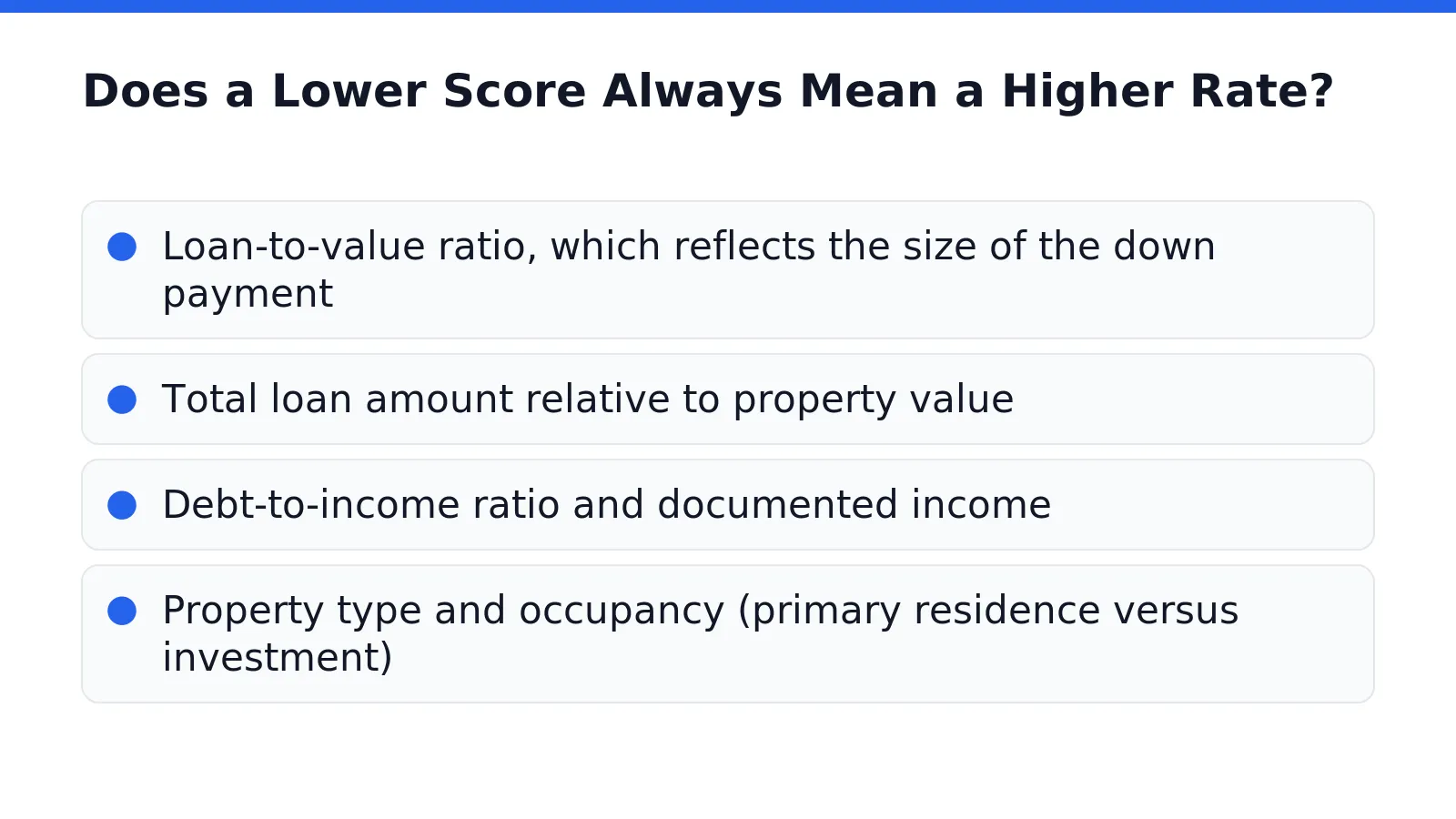
Pricing a mortgage involves more than a single number. Lenders weigh several variables together:
- Loan-to-value ratio, which reflects the size of the down payment
- Total loan amount relative to property value
- Debt-to-income ratio and documented income
- Property type and occupancy (primary residence versus investment)
Can a strong application offset a weaker score?
Sometimes. A larger down payment or lower loan-to-value ratio can narrow the disparity a weaker score would otherwise create. This is where credit improvement efforts pair well with strategic loan structuring rather than acting alone.
Munshi Capital Inc. pairs modern underwriting technology with hands-on loan specialists to sort through these variables for each borrower’s specific picture. That combination delivers fast pre-approvals and full visibility into loan status. Walnut Creek homeowners and investors see exactly where their application stands, not just where their score sits on a chart.

How Can You Raise Your Score Before Applying?
Raising a score before a mortgage application starts with understanding what lenders actually measure. Lenders rely on credit scores as a fast, standardized way to judge how likely a borrower is to repay a loan. Every data point on a credit report carries weight. Improving that number before applying strengthens a borrower’s position at the negotiating table.
What habits actually move a credit score?
Payment history and total debt carried are the two factors lenders weigh most heavily. Borrowers who focus their energy here see the fastest movement in their numbers. Practical steps include:
- Paying every bill on time, without exception, for several consecutive billing cycles
- Reducing balances on revolving credit accounts rather than opening new ones
- Correcting errors on credit reports before a lender pulls them
- Avoiding new credit inquiries in the months leading up to an application
Each of these actions targets the same goal: a cleaner, more predictable repayment record.
Does credit improvement really affect mortgage terms?
Yes. Taking deliberate steps toward credit improvement before applying can help a borrower lock in better mortgage terms than waiting until after submission. A stronger score at the point of application, not after, is what shapes the offer a lender extends.
Timing matters as much as effort. Borrowers gain the most ground when improvement work happens months before shopping for mortgage rates, giving new habits time to register on a credit report. Munshi Capital’s team works directly with clients to understand their financial goals and guide them through next steps with clarity. That guidance carries through a straightforward application, underwriting, and closing process, built so borrowers move forward with confidence and without hidden surprises along the way.
Which Loan Program Fits Your Credit Profile?
Credit profiles vary, and loan programs exist to match that variation rather than force a single standard. Strong credit scores open access to conventional products with the lowest rates. Non-traditional income histories call for a different path entirely. Investors carrying irregular income or unconventional credit files often qualify through DSCR. Hard money loans, financing options built specifically for investor needs rather than W-2 employment records. These programs evaluate property cash flow or asset value instead of relying solely on personal credit history.
Homeowners and buyers across Walnut Creek. The broader California market deserve guidance built around their actual financial picture, not a one-size-fits-all script. Munshi Capital’s mortgage financing centers the borrower, walking clients through every available loan program with clear answers and dependable support at each stage.
Does a lower credit score rule out financing options?
No single score closes every door. Buyers with lower scores still have paths forward through programs designed for diverse financial situations, including investor-focused products that weigh factors beyond a credit report.
Transparency remains the foundation of that guidance. Munshi Capital operates on trust, delivering honest, borrower-first direction so clients understand exactly which program fits before committing to one.
FAQ
What is the minimum credit score needed to qualify for a mortgage?
Most lenders require a minimum credit score of 580 to qualify for mortgage financing. Scores of 760 or higher secure the best available pricing on conventional loans.
How does a credit score affect the interest rate on a mortgage?
Lenders group scores into risk tiers. A 620 FICO score carries a 7.61% rate while a 700 score drops to 7.14% on conventional 30-year loans. Crossing into a higher tier lowers monthly payments and total interest paid over the loan term.
What steps help borrowers improve their credit score before applying for a mortgage?
Munshi Capital Inc. offers personalized guidance to help borrowers understand exactly how their score shapes mortgage pricing before applying.
Conclusion
In closing, your credit score fundamentally shapes the mortgage rate you receive, directly influencing your long-term financial obligations. Understanding this relationship empowers you to make informed decisions about your borrowing strategy and financial readiness. Whether you are a first-time homebuyer or an experienced investor, addressing credit factors before applying positions you for optimal loan terms. Munshi Capital Inc. provides transparent guidance through this process, ensuring you navigate rate structures with clarity and secure financing aligned with your unique circumstances.
Leave a Reply