
Debt-to-income ratio measures total monthly debt payments against gross monthly income, expressed as a percentage. Mortgage lenders, including Munshi Capital Inc., use this figure to determine how much additional debt a borrower manages responsibly. A high DTI limits loan options; paying down balances or raising income lowers the ratio and strengthens mortgage eligibility.
Key Takeaways
- Lenders evaluate your debt-to-income ratio to determine how much additional debt you can responsibly manage.
- Calculate DTI by dividing total monthly debt payments by gross monthly income, then multiply by 100.
- Front-end DTI measures mortgage payment against income; back-end DTI includes all monthly debts against income.
- A high DTI ratio directly impacts your mortgage approval odds and the loan terms you receive.
What Is Your Debt-To-Income Ratio?
A debt-to-income ratio measures total monthly debt payments against gross monthly income. Lenders rely on this figure to judge how much additional debt a borrower can responsibly carry. Missing this calculation before applying leaves borrowers guessing about their own approval odds, often until an application stalls mid-process.
Munshi Capital Inc. serves a wide range of borrowers, from first-time homebuyers purchasing their first property to seasoned investors expanding a portfolio. Every one of these borrowers gets evaluated, in part, on this same debt-to-income profile. The underlying math stays consistent even when loan programs differ.
How Do Lenders Use This Number?
Mortgage lenders use the ratio to gauge risk before extending new credit. A borrower carrying heavy monthly obligations relative to income signals less capacity to absorb a mortgage payment on top of existing debts. This assessment shapes loan terms, approval decisions, and sometimes the size of the loan itself.
What Counts as Monthly Debt?
Monthly debt typically includes recurring obligations such as:
- Auto loan payments
- Credit card minimums
- Student loan installments
- Existing mortgage or rent payments
- Personal loan commitments
Gross monthly income, meanwhile, refers to earnings before taxes and other deductions. Dividing total debt by that income produces the ratio lenders examine during underwriting.
Borrowers who understand this relationship early gain leverage. Self-employed applicants, in particular, benefit from reviewing their obligations against documented income before pursuing financing. Munshi Capital Inc. offers personalized guidance to help borrowers nationwide interpret how this ratio influences their available financing options, giving each client clarity before decisions carry real financial weight.
How Do You Calculate Your DTI?
Two straightforward formulas determine a borrower’s debt-to-income figure, both producing the same ratio lenders use to judge mortgage readiness. The first method adds every monthly debt obligation together, then divides that total by gross monthly income. The second approach reaches the identical answer in percentage form by dividing total monthly debt payments by gross monthly income and multiplying by 100.
What counts as a monthly debt payment?
Monthly debt includes recurring obligations such as auto loans, student loans, credit card minimums, and existing housing payments. Income used in the formula is gross income, meaning earnings before taxes and other deductions are removed. Lenders rely on this combination because it reflects obligations against earning power, not take-home pay.
Why do lenders calculate DTI two different ways?
Both formulas serve the same underwriting purpose; they simply present the result in different formats. One expresses the relationship as a raw ratio. The other converts it into a percentage for easier comparison across loan files. Borrowers can use either version to estimate standing before applying.
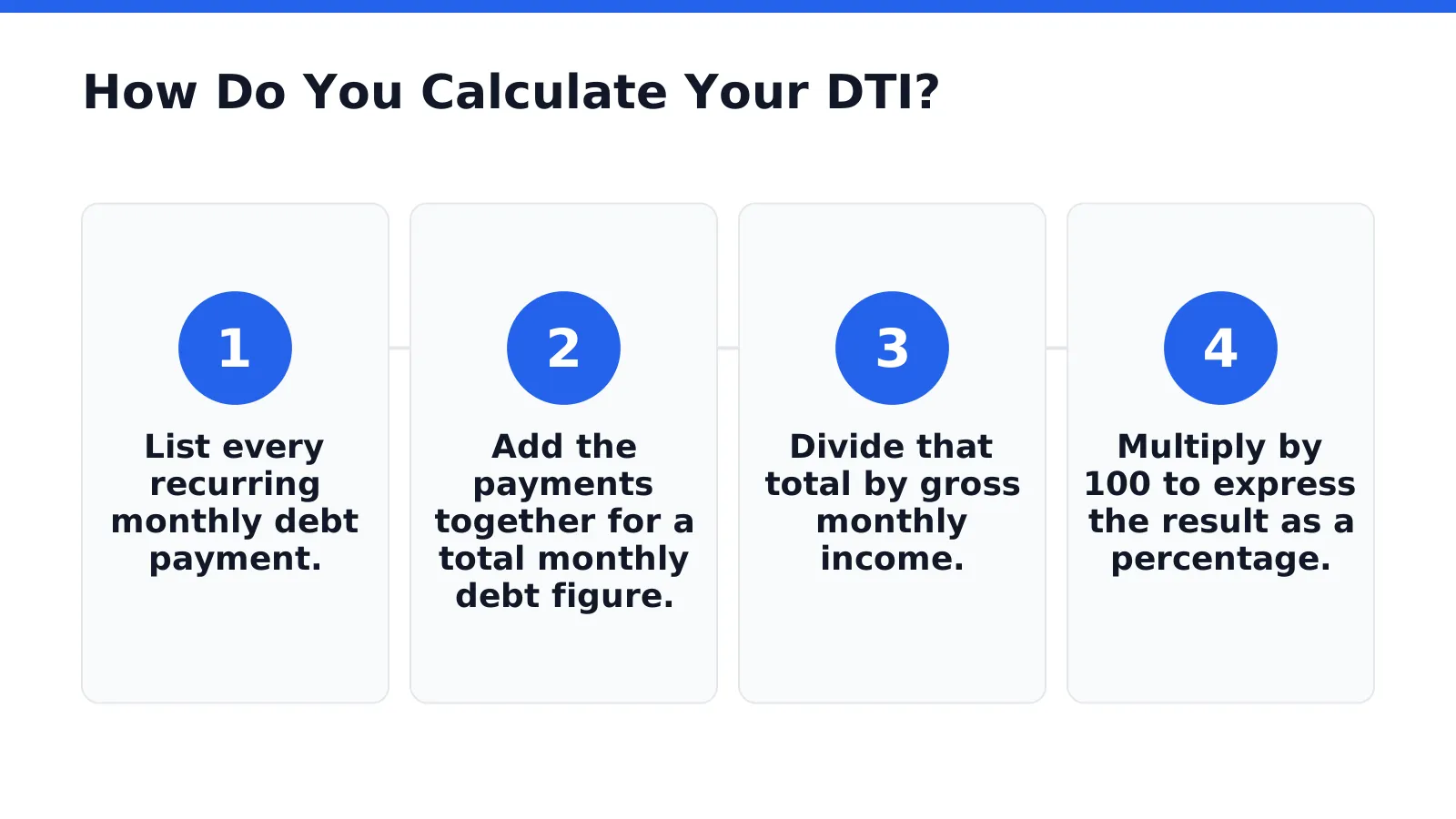
A clear dti calculation typically follows these steps:
- List every recurring monthly debt payment.
- Add the payments together for a total monthly debt figure.
- Divide that total by gross monthly income.
- Multiply by 100 to express the result as a percentage.
Self-employed borrowers and investors often juggle variable income streams, making accurate totals essential before submitting an application. Munshi Capital Inc. guides clients through application and underwriting so each debt figure and income source gets reviewed with clarity from the start. Paired with responsive loan specialists, this process keeps mortgage qualification steps moving without unnecessary delay or confusion.

What DTI Ratio Do Lenders Want?
Lenders generally favor a back-end ratio at or below 36%, with the mortgage portion alone staying under 28%. This guideline, often called the 28/36 rule, gives lenders a quick snapshot of how much financial room a borrower has before monthly debts become risky. Falling outside those numbers does not disqualify a borrower automatically, but it does narrow the field of loan programs available.
Lenders actually look at two separate ratios, not one. Front-end debt-to-income measures the mortgage payment alone against gross monthly income. Back-end debt-to-income widens the lens, adding auto loans, credit cards, student debt, and the home loan together against that same income figure. When a lender mentions “DTI ratio” without specifying which one, the back-end number is almost always what they mean.
Is a lower DTI always better for mortgage approval?
A lower ratio generally strengthens an application, since it signals more breathing room in a borrower’s budget. It can open access to a wider set of loan products and more favorable terms. Borrowers near or above the 36% back-end threshold are not automatically shut out, though their options narrow.
How do the two DTI figures compare?
Because every borrower’s debt picture looks different, a single ceiling rarely tells the full story. Munshi Capital Inc. structures its FHA, VA, USDA, and bank statement loan programs around the realities of each applicant’s financial profile, not a rigid cutoff. That range of products helps match first-time buyers, self-employed borrowers, and investors with mortgage qualification paths suited to their actual DTI standing, rather than forcing every applicant into the same box.

How Can Self-Employed Borrowers Manage DTI?
Self-employed borrowers manage their debt-to-income ratio by combining accurate income documentation with strategic debt reduction. By exploring loan programs that do not weigh personal income as heavily. Munshi Capital Inc. serves first-time homebuyers, investors, and business owners nationwide, offering residential and commercial programs matched to each applicant’s financial picture, including those who work for themselves.
Freelancers, contractors, and small business owners often see fluctuating monthly earnings. That variability complicates standard dti calculation, since lenders typically average income across tax years rather than relying on a single strong month.
What loan options exist if a self-employed borrower has a high DTI?
Borrowers with elevated DTI ratios are not without options. DSCR and hard money loans give real estate investors financing paths based on property cash flow rather than personal debt-to-income alone. This matters for self-employed applicants whose personal tax filings may understate true earning power.
How does transparency in the lending process help self-employed applicants?
Clear, borrower-first guidance helps self-employed applicants document income accurately during underwriting. Munshi Capital Inc.’s approach is rooted in honesty. Step-by-step clarity, reducing the risk of misreported earnings that can derail mortgage qualification.
Beyond choosing the right program, borrowers can take direct action to improve their ratio:
- Increase documented income by consolidating revenue streams or adding a co-borrower.
- Pay down existing debts such as credit cards, auto loans, or business lines of credit.
- Separate personal and business expenses to present cleaner financial statements.
A high DTI ratio can affect available mortgage options, but it is not permanent. Raising income and paying off debt both move the ratio in the right direction, often within a single underwriting cycle.
What Should You Do With Your DTI Result?
A calculated ratio becomes useful only when matched against next steps. Borrowers who know their number should move toward a structured application rather than guessing at eligibility. The first step toward mortgage qualification starts with a quick, secure application that captures financial details, including existing debt obligations. That single step turns a raw percentage into a real conversation about loan options.
First-time homebuyers, real estate investors, and self-employed applicants each bring different income documentation to this stage. A borrower with steady W-2 income faces a different review path than one with variable rental income or business earnings. Sharing goals and financial details with a loan specialist allows the right residential or commercial program to surface, instead of forcing every borrower into one generic box.
Should I wait to apply until my DTI improves?
Waiting is not required before starting the process. An application can begin while a borrower works on debt reduction. Underwriting will account for the actual debt-to-income picture at submission. Delaying only postpones clarity on which programs actually fit.
What happens after I submit my DTI information?
Full visibility into loan status continues from that point forward. Borrowers stay informed as their ratio and qualification details move through underwriting, rather than waiting in silence for updates.
The process from application to closing is built on clarity and speed, without confusing jargon or hidden surprises. Borrowers ready to move forward can request a direct cash offer on their current property. Request your property assessment to understand how existing equity affects the numbers.
FAQ
What is a debt-to-income ratio?
It measures total monthly debt payments against gross monthly income, expressed as a percentage. Lenders, including Munshi Capital Inc., use this figure to determine how much additional debt a borrower manages responsibly.
How do you calculate DTI?
Divide total monthly debt payments by gross monthly income, then multiply by 100. Monthly debt includes auto loans, credit card minimums, student loans, and existing mortgage or rent payments.
What’s the difference between front-end and back-end DTI?
Front-end DTI measures your mortgage payment against income, while back-end DTI includes all monthly debts against income. Both figures shape loan terms and approval decisions during underwriting.
Conclusion
In closing, understanding your debt-to-income ratio represents a critical foundation for securing mortgage financing aligned with your financial circumstances. By comprehending how lenders evaluate this metric, you position yourself to approach the application process with clarity and confidence. Munshi Capital Inc. remains committed to guiding you through this analysis with transparent communication and personalized expertise, ensuring you navigate the lending landscape with full visibility into your options and obligations throughout the entire journey.
Leave a Reply