
Rental property financing often involves DSCR loans or bank statement programs, each serving distinct investor needs, as offered by Munshi Capital Inc., which evaluates property cash flow or alternative income documentation depending on the program, delivering transparent underwriting, fast pre-approvals, and dedicated loan specialists guiding investors nationwide through every step confidently.
Rental property financing starts with options like DSCR, bank statement, and hard money loans, each suited to different investor profiles and cash flow needs. Munshi Capital Inc. guides borrowers through application, underwriting, and closing with full transparency, delivering fast pre-approvals and clear visibility into loan status from start to finish.
Rental property financing hinges on matching loan type to investment strategy, including DSCR loans that qualify borrowers using property cash flow instead of personal income. Munshi Capital Inc. offers DSCR, bank statement, and hard money loan programs for investors nationwide, pairing technology-driven pre-approvals with personalized guidance through application, underwriting, and closing.
Key Takeaways
- Define clear investment goals and assess your financial readiness before identifying rental property opportunities.
- Rental property financing differs significantly from primary residence loans and requires specialized underwriting expertise.
- Strategic financing structures directly improve cash flow potential and maximize your overall return on investment.
- Munshi Capital Inc. offers specialized DSCR and hard money loan programs designed specifically for investors.
Why Is Rental Property Financing So Different?
Qualification standards set rental property loans apart from a standard home mortgage. Lenders evaluate income, assets, credit history, and the property itself through a sharper lens than they apply to an owner-occupied purchase. Buying a property purely for income generation carries risks a primary residence never does. Underwriters price that risk into the loan terms. The result: stricter documentation, closer scrutiny, and less room for error.
Several factors separate a rental purchase from buying a personal home:
- Rental property financing often demands stronger credit profiles and deeper cash reserves.
- Expected rental income factors directly into qualification, not just personal salary.
- Occupancy status changes how a lender classifies and underwrites the loan.
- Property condition and location carry more weight, since the asset itself secures the investment.
Do Self-Employed Borrowers Face Extra Hurdles?
Self-employed applicants often encounter additional documentation requests compared to salaried borrowers. Traditional pay stubs don’t apply, so lenders look for alternative proof of consistent income. This is where investment mortgages built around nontraditional income streams, including options tied to bank statements or projected rental cash flow, matter most.
What Loan Types Fit Investment Properties Best?
No single loan fits every investor. DSCR loans, which qualify borrowers using a property’s rental income rather than personal earnings, suit investors scaling a portfolio quickly. Others benefit from conventional or government-backed structures adapted to investment use.
Munshi Capital Inc. built its lending programs around this complexity. The company offers a comprehensive suite of residential. Commercial loan programs, tailored to each client’s financial picture rather than a one-size-fits-all formula. Transparency drives every step, from initial application through closing, so investors understand exactly what they’re financing and why. Property owners ready to explore selling instead of refinancing can request your property assessment to compare options side by side.

Which Loan Programs Fit Rental Investors Best?
Conventional loans remain the most common path for financing a qualifying one- to four-unit investment property. Property managers and investors expanding a portfolio typically start here before exploring specialized products. Down payment requirements vary by property size: a one-unit purchase may start at 15% down. Multiunit properties generally require a larger contribution. Reserves, credit history, income, debts, and eligible rental income all factor into underwriting decisions.
Government-backed loans work differently for this audience. FHA and VA purchase loans are built for primary residences, not for the direct purchase of a property an investor won’t occupy. Self-employed buyers and seasoned investors looking strictly at rental acquisition will find these programs limited in scope.
What Loan Options Exist Beyond Conventional Financing?
Munshi Capital Inc. offers rental property financing built around the realities of investment ownership rather than owner-occupied underwriting. The lineup includes FHA, VA, USDA, and bank statement loans, each structured to match a borrower’s actual financial picture. Self-employed buyers without traditional pay stubs often find the bank statement option especially relevant.
How Do DSCR and Hard Money Loans Help Investors?
Munshi Capital Inc. also provides dscr loans and hard money loans, two products built specifically for investor needs. DSCR loans evaluate a property’s rental income rather than personal income, a structural advantage for investors scaling multiple properties. Hard money loans serve time-sensitive acquisitions where speed outweighs standard underwriting timelines.
Choosing among investment mortgages depends on occupancy plans, income documentation, and portfolio goals. A residential buyer entering a first rental purchase may lean conventional; an investor scaling multiple units may lean DSCR. Property owners uncertain which structure fits best can request their property assessment before committing to a specific loan path.

How Do DSCR Loans Help Investors Qualify?
DSCR loans qualify investors using property cash flow instead of personal income documentation. Munshi Capital Inc. built this specialized product specifically for investor-focused financing, serving clients who range from first-time buyers to seasoned portfolio owners. For self-employed applicants without traditional pay stubs, this structure removes a major qualification barrier.
Standard underwriting for investment mortgages pulls together several moving parts at once. Lenders weigh credit history, income, assets, debts, down payment size, cash reserves, the property itself, and eligible rental income as a combined picture. None of these factors stands alone; a strong reserve position can offset a thinner credit file, and vice versa.
DSCR loans shift the weighting toward one figure: the debt service coverage ratio, which compares a property’s rental income against its mortgage obligation. A property generating enough rent to cover its debt payments strengthens an application even when personal income documentation is limited or complex.
What Documents Do DSCR Loan Applicants Need?
Applicants typically supply property-level financials, such as lease agreements or market rent estimates, rather than tax returns or W-2s. Credit, assets, and reserves still factor into the underwriting review. The emphasis simply moves away from personal income verification toward the asset’s earning power.
Do All Lenders Offer the Same DSCR Terms?
No. Lender policies can add requirements beyond baseline guidelines, so terms and documentation standards vary by program and by institution. Reserve requirements, minimum coverage ratios, and down payment minimums differ from one lender to the next.
Because requirements shift across lenders, having a knowledgeable guide matters. Munshi Capital Inc. pairs modern technology with hands-on loan specialists, speeding up pre-approvals while keeping every step of rental property financing visible to the borrower. Investors evaluating a specific property can request a direct cash offer comparison alongside financing options. request your property assessment to see how projected rental income measures up under DSCR underwriting before committing to a purchase.
What Financing Strategy Maximizes Rental Returns?
No single loan structure maximizes returns for every rental buyer. The right strategy depends on investment goals, property type, and how much cash flow an investor needs to protect. Strategic financing choices improve cash flow potential. Raise the overall return on an investment property, making the selection process worth careful attention rather than a quick decision.
Multiple financing paths exist, and comparing them before committing often reveals meaningful differences in cost and flexibility. Some buyers prioritize low upfront cash; others prioritize qualifying on rental income rather than personal pay stubs. This is where rental property financing and investment mortgages diverge in purpose and structure.
Which Loan Type Fits a Rental Investor Best?
The answer depends on income documentation and portfolio goals. Self-employed buyers often benefit from loan programs that evaluate property cash flow instead of personal tax returns. First-time investors may lean on conventional terms. DSCR loans serve this exact gap, qualifying borrowers using the rental income a property generates rather than personal earnings.
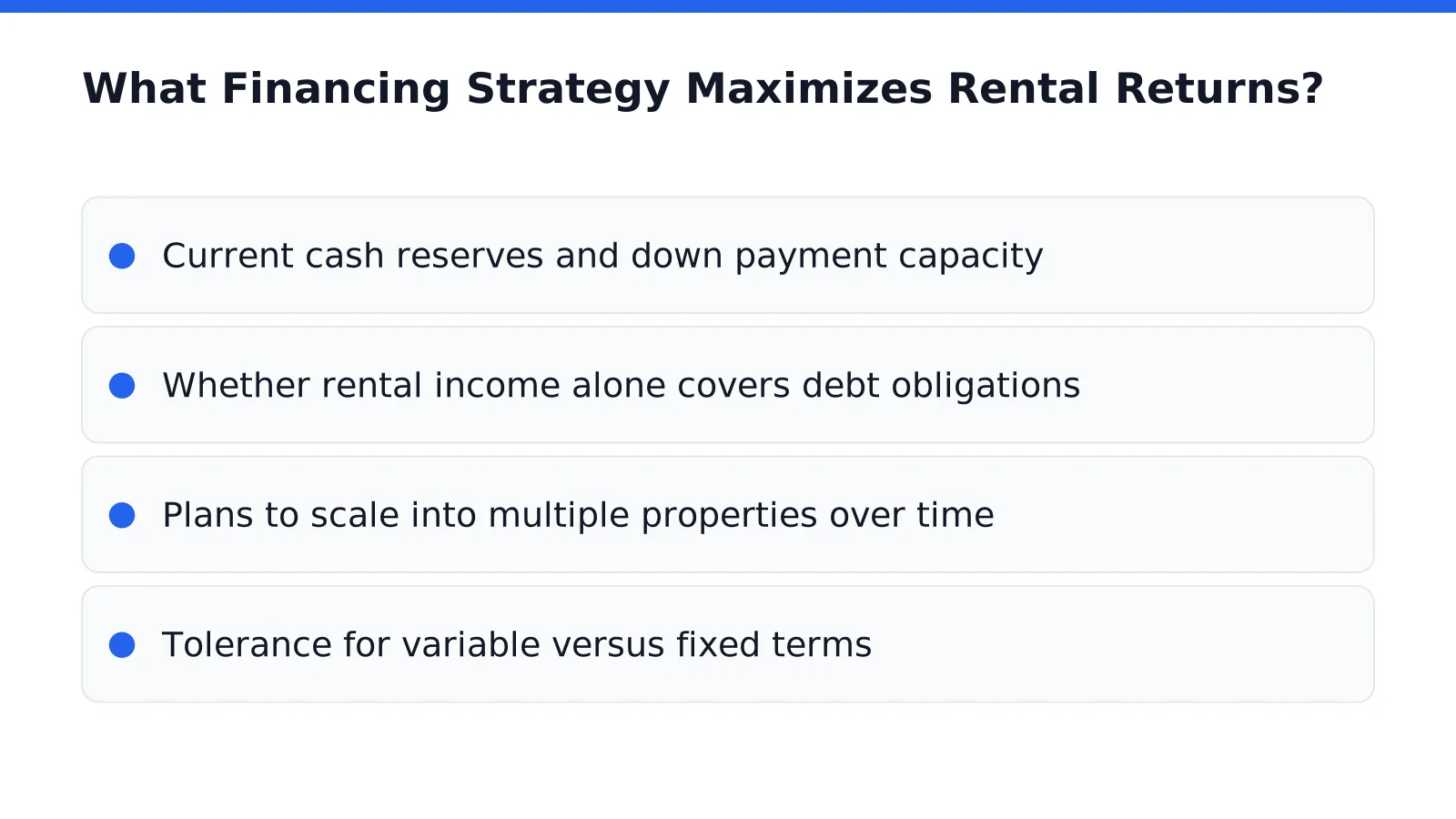
Consider these factors before choosing a financing route:
- Current cash reserves and down payment capacity
- Whether rental income alone covers debt obligations
- Plans to scale into multiple properties over time
- Tolerance for variable versus fixed terms
Munshi Capital specializes in mortgage financing for a diverse range of borrowers, from first-time homebuyers to seasoned investors. Guidance is personalized, helping clients nationwide secure financing with confidence rather than guesswork.
Built on trust, the lending approach stays transparent and borrower-first throughout. Property owners weighing their next move can request a direct cash offer or request your property assessment to clarify where financing fits into their broader investment strategy.
How Does Munshi Capital Simplify Closing?
Munshi Capital removes guesswork from closing through a structured application, underwriting, and closing sequence built on clear communication at every stage. Investors move from submission to funding without hidden fees or last-minute surprises buried in fine print. Clarity replaces confusion, and confusion is where most closing delays originate.
Speed matters as much as transparency. Pre-approvals move quickly, and borrowers retain full visibility into loan status from the first document upload through final signing. For investors financing rental units through rental property financing programs or dscr loans, that visibility prevents the scheduling conflicts that derail time-sensitive purchase contracts.
What Happens First in the Closing Process?
Closing starts with a short, secure application. Investors outline their goals to a Munshi Capital loan specialist and identify which residential or commercial program matches their strategy. That early conversation shapes every step that follows, from document requests to underwriting timelines.
Why Does Loan Variety Affect Closing Speed?
A single lender offering multiple loan types avoids the delays that come with bouncing between institutions. Munshi Capital’s broad suite of investment mortgages, paired with specialized products, lets investors match financing to the deal rather than restructure the deal around financing. That alignment, built on a standing commitment to integrity, is why investors nationwide return for repeat transactions:
- Streamlined application built for speed and accuracy
- Transparent underwriting with no concealed conditions
- Ongoing loan-status updates through closing
- Access to varied programs under one lender relationship
FAQ
What makes rental property financing different from a home mortgage?
Lenders apply stricter documentation and closer scrutiny because rental properties carry income-generation risk a primary residence doesn’t. Qualification depends on credit profile, cash reserves, expected rental income, and the property itself, not just personal salary.
Which loan programs does Munshi Capital Inc. offer for investors?
Munshi Capital Inc. provides DSCR, bank statement, and hard money loan programs, along with conventional and government-backed structures adapted for investment use. These options are tailored to each borrower’s financial picture rather than a one-size-fits-all formula.
How do DSCR loans help rental property investors?
DSCR loans qualify borrowers using the property’s rental income instead of personal earnings, making them well-suited for investors looking to scale a portfolio quickly. Munshi Capital Inc. guides borrowers through this process with transparency from application to closing.
Conclusion
In closing, financing a rental property requires a strategic approach grounded in thorough financial analysis, appropriate loan selection, and partnership with a lender committed to transparency. Munshi Capital Inc. delivers the specialized expertise and comprehensive loan programs necessary to navigate this complex landscape with confidence. Our dedication to clear communication, personalized guidance, and dependable service ensures that investors secure financing aligned with their specific objectives and financial circumstances. The path to successful rental property investment begins with informed decisions. Reliable support, both of which form the foundation of our client relationships.
Leave a Reply