
Mortgage refinancing makes financial sense when a lower interest rate, shorter loan term, or equity access produces savings that exceed closing costs. Homeowners benefit most with many years remaining on their loan and long-term plans to stay. Munshi Capital Inc. offers tailored loan programs, including FHA, VA, USDA, DSCR, and bank statement options, guiding borrowers through transparent underwriting and closing.
Key Takeaways
- Refinancing saves money when new loan terms offset closing costs over your remaining mortgage timeline.
- Borrowers with 15+ years remaining on mortgages typically realize the greatest refinancing savings potential.
- Lower interest rates, shorter loan terms, and accessing home equity represent the three primary refinancing goals.
- Our loan specialists provide transparent guidance to determine if refinancing aligns with your specific financial situation.
What Should You Know Before Refinancing?
Preparation determines whether a refinance saves money or adds unnecessary cost. Replacing an existing mortgage with a new loan forms the core of refinance basics. The goal typically centers on securing a lower interest rate or more favorable repayment terms. A new loan does not automatically improve a homeowner’s financial position; it requires careful comparison against the original mortgage.
Homeowners should understand the two primary paths before applying:
- A rate-and-term refinance adjusts the interest rate, loan duration, or both, without changing the loan balance significantly.
- A cash-out refinance replaces the mortgage with a larger loan, allowing homeowners to convert built-up home equity into usable cash.
Each path serves a different financial goal. Clarity on the objective, lower payments, a shorter term, or access to equity, should come before comparing lenders.
What documents does a homeowner need before applying?
Lenders generally request income verification, credit history, and current mortgage statements to assess eligibility. Property value documentation also factors into the review, since the new loan amount depends on current home equity. Gathering these materials early shortens the underwriting timeline.
Does refinancing suit every homeowner?
Not every borrower benefits equally from refinancing, which is why individualized guidance matters. Munshi Capital Inc. designs mortgage financing for a wide range of borrowers, from first-time homebuyers to seasoned investors, recognizing that no two financial pictures are identical. Built on a trust-based, borrower-first approach, the company guides homeowners through the decision with transparency rather than generic assumptions.
Homeowners ready to explore equity options can request a direct cash offer evaluation. Those still weighing their current home’s standing can request your property assessment before committing to a new loan structure.

When Does Refinancing Actually Make Sense?
Savings determine the answer, not timing alone. A refinance earns its keep when the money saved over the life of the new loan exceeds the closing costs charged to originate it. Homeowners weighing refinance basics should treat this comparison, savings versus upfront cost, as the starting test for any decision.
Rate improvement matters too. A new rate that beats the current one by roughly 0.75 to 1.0 percentage points generally signals a worthwhile move. Smaller gaps often leave too little room for the savings to outpace closing costs. Homeowners should calculate the actual dollar difference before applying.
How much rate reduction is needed to refinance?
A drop of at least 0.75 to 1.0 percentage points is the general benchmark worth considering. Below that range, closing costs frequently erase much of the benefit, leaving little financial upside for the effort involved.
Who benefits most from refinancing?
Homeowners with many years remaining on their mortgage. Who intend to stay in the home long-term, tend to see the largest savings. Time allows the lower monthly payment to accumulate into meaningful totals, offsetting the upfront cost of the new loan.
Two paths dominate this decision:
- Rate-and-term refinance: replaces the existing loan with one carrying a lower rate, a shorter term, or both, without pulling cash out.
- Cash-out refinance: replaces the loan with a larger one, converting built-up home equity into usable funds.
Munshi Capital Inc. structures its lending process around clear, honest communication, giving borrowers the clarity needed to judge timing with confidence. Homeowners uncertain about their equity position can request your property assessment before deciding which refinance path fits their goals.
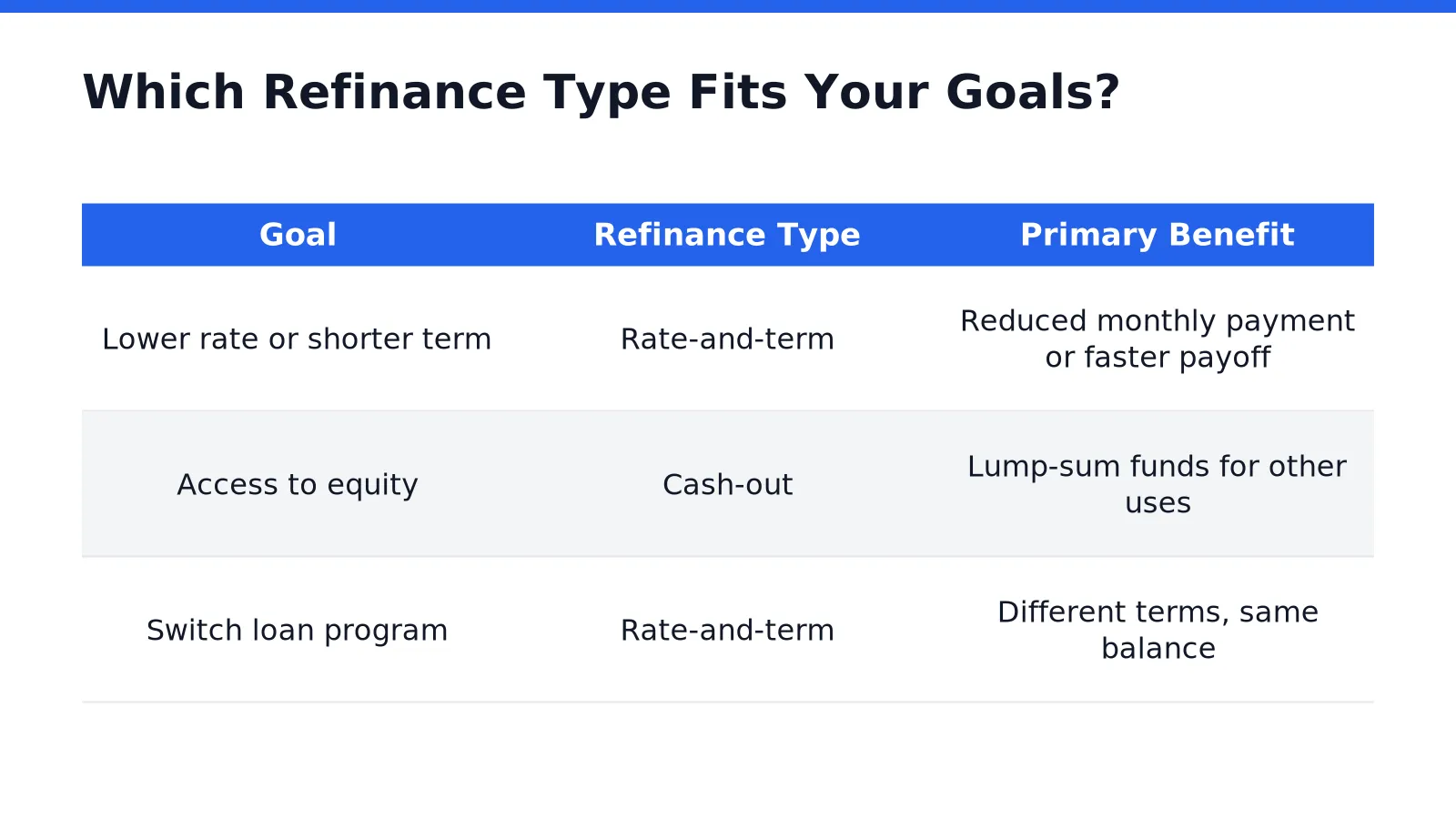
Which Refinance Type Fits Your Goals?
Four distinct motivations drive most refinance decisions: a lower rate, a shorter term, a different loan type, or access to home equity. Understanding refinance basics means matching the loan structure to the underlying financial goal rather than chasing a headline rate. Each path carries its own underwriting path and documentation requirements.
What is a rate-and-term refinance?
A rate-and-term refinance replaces an existing mortgage with a new one carrying a different interest rate, a different repayment length, or both, without increasing the loan balance for cash. This structure suits homeowners focused purely on reducing monthly payments or paying off the home faster. Munshi Capital Inc. supports these goals through a full residential and commercial lineup, including FHA, VA, USDA, and bank statement loans, giving borrowers with varied income documentation a path to qualify.
What is a cash-out refinance?
A cash-out refinance replaces the current mortgage with a larger loan and distributes the difference to the homeowner in cash. Equity becomes liquid funds that can cover renovations, debt consolidation, or investment purchases. Munshi Capital Inc. serves equity-focused borrowers through specialized products such as DSCR loans, which evaluate qualifying income against property cash flow, and hard money loans for time-sensitive transactions.
The table below summarizes the core distinction:
Homeowners uncertain which structure fits their situation can request your property assessment to evaluate current equity before deciding. For those ready to explore equity options directly, the next step is to request a direct cash offer and compare it against refinance proceeds.
What Are the Steps to Refinance?
Refinancing follows a defined sequence: application, underwriting, and closing. Munshi Capital Inc. built this sequence to remove hidden surprises. Give homeowners a clear path from the first document submitted to the day a new loan replaces the old one.
Before starting, homeowners should understand the refinance basics: refinancing swaps an existing mortgage for a new one, ideally with better terms. From there, the loan choice splits into two paths. A rate-and-term refinance changes the interest rate, the loan length, or both, without pulling cash from the home. A cash-out refinance converts built-up equity into funds a homeowner can use for other goals.
The process itself breaks into clear steps:
- Confirm the goal: lower payment, shorter term, dropped mortgage insurance, or equity access.
- Select a loan type: rate-and-term or cash-out.
- Submit the application with income, asset, and property documentation.
- Complete underwriting, where a loan specialist verifies financial details and property value.
- Close the loan by signing final documents and covering closing costs.
Modern technology drives much of the speed behind this sequence. Munshi Capital Inc. pairs that technology with hands-on loan specialist support, so each step keeps moving without stalling in a queue. The result: homeowners receive fast pre-approvals and maintain full visibility into loan status from the first submission through closing day.
How Fast Can a Refinance Close?
Closing speed depends on loan complexity and how quickly documents arrive. Combining digital tools with direct specialist communication shortens the typical wait for pre-approval and keeps underwriting moving. Homeowners who prefer a different route, such as selling outright, can request a direct cash offer or request your property assessment before committing to any refinance path.
What Mistakes Should You Avoid When Refinancing?
Skipping a break-even calculation ranks among the costliest refinancing errors. Many homeowners sign new loan paperwork without checking whether the savings actually outweigh the fees.
Before committing to a new loan, divide total closing costs by the expected monthly savings to find the break-even point, the number of months needed to recover upfront expenses. This single calculation separates a sound financial move from a premature one. Homeowners who skip it risk locking into a loan that costs more than it saves over the time they plan to stay in the home.
How can homeowners avoid common refinancing errors?
Following a disciplined sequence reduces the chance of a costly misstep:
- Gather current loan statements and closing cost estimates.
- Calculate the break-even point before applying.
- Confirm the refinancing goal, whether lowering payments, shortening the term, or tapping equity.
- Review terms with a loan specialist before signing.
Munshi Capital Inc. built its lending process around integrity and personalized service specifically to help borrowers sidestep these missteps. The team works with clients ranging from first-time homebuyers to experienced investors, tailoring guidance to each financial picture rather than offering generic advice.
Why does personalized guidance matter before signing?
A dedicated loan specialist confirms that the refinance actually matches the borrower’s stated goal before any paperwork closes. This review step catches mismatched terms, overlooked fees, or timelines that don’t align with how long the homeowner plans to stay. Skipping that conversation leaves borrowers exposed to errors a second set of eyes would have caught.
FAQ
When does refinancing make financial sense?
Refinancing makes sense when a lower rate, shorter term, or equity access produces savings that exceed closing costs. A rate improvement of roughly 0.75 to 1.0 percentage points generally signals a worthwhile move.
What are the two main types of refinancing?
A rate-and-term refinance adjusts the interest rate or loan duration without changing the balance significantly. A cash-out refinance replaces the mortgage with a larger loan, converting home equity into usable cash.
Lenders request income verification, credit history, current mortgage statements, and property value documentation. Gathering these materials early shortens the underwriting timeline with Munshi Capital’s transparent process.
Conclusion
In closing, refinancing represents a strategic financial decision that demands careful evaluation of your current circumstances, market conditions, and long-term objectives. By understanding when refinancing aligns with your goals. How to navigate the process methodically, you position yourself to optimize your mortgage structure and achieve measurable financial benefits. Munshi Capital Inc. stands ready to guide you through this evaluation with transparent analysis and personalized expertise, ensuring you make informed decisions grounded in clarity rather than uncertainty.
Leave a Reply