
Self-employed professionals in Walnut Creek, CA qualify for mortgages through programs like bank statement loans and DSCR financing, which replace traditional W-2 verification with business documentation, P&L reports, and licensing records. Munshi Capital Inc. evaluates personal and business income separately, giving freelancers and independent contractors a documented path toward pre-approval without relying on standard tax-return underwriting alone.
Key Takeaways
- Self-employed borrowers need comprehensive business documentation, including tax returns and licensing, to qualify for mortgages.
- Bank statement loans provide an alternative for self-employed applicants who don’t meet traditional income verification requirements.
- Credit scores of 800+ alone don’t guarantee mortgage approval; lenders evaluate complete financial profiles for self-employed applicants.
- Transparent underwriting processes help self-employed borrowers understand exactly which documents and factors determine their loan eligibility.
Why Is a Self-Employed Mortgage Harder to Get?
A self-employed mortgage carries extra scrutiny because lenders cannot verify income with a simple pay stub. Business owners, freelancers, and independent contractors in Walnut Creek often submit more paperwork than salaried applicants, and underwriters examine that paperwork line by line. Many self-employed workers struggle with mortgage approval for one core reason: income without a traditional salary takes more work to prove.
Difficulty, though, is not the same as impossibility. Paul Buege, an operations executive cited by Rocket Mortgage, calls the belief that self-employed borrowers face a harder approval path a common misconception rather than an industry rule. Qualification remains achievable; the process simply demands sharper preparation.
What makes income documentation so complicated for business owners?
Income documentation complicates approval because self-employed earnings fluctuate and mix personal with business finances. Lenders need multiple years of tax returns, profit-and-loss statements, and sometimes bank statement loans paperwork to establish a reliable income pattern. Freelancers and contractors with variable monthly revenue face closer review than someone with a fixed annual salary.
Does working with a specialized lender change the outcome?
Choosing a lender built around flexible underwriting changes the experience considerably. Munshi Capital Inc. structures mortgage financing around each borrower’s actual financial picture, guiding clients through every loan program with clear answers rather than generic checklists.
Borrowers gain:
- Direct access to loan specialists familiar with self-employment income patterns
- Guidance tailored to individual business structures, not one-size-fits-all criteria
- A process built on dependable, consistent communication from application to closing
Munshi Capital Inc.’s personalized approach helps business owners nationwide pursue financing with confidence, backed by a team focused squarely on each client’s goals.

What Income Documentation Will Lenders Require?
Lenders require proof that income is real, recurring, and sufficient to cover a mortgage payment. For a self-employed mortgage, that proof looks different than a standard employee’s paperwork. Business owners, freelancers, and independent contractors in Walnut Creek must show both personal and business financial records to satisfy underwriting standards.
Salaried workers prove earnings with a single document: the IRS Form W-2. Self-employed applicants have no employer issuing that form, so they substitute a broader paper trail. This typically includes:
- Business licensing records
- Insurance documentation tied to the business
- Profit-and-loss (P&L) statements covering recent operating periods
- Personal tax returns and supporting schedules
What If a Business Owner Doesn’t Have Traditional Tax Returns?
Some business owners structure their finances in ways that make tax returns an incomplete picture of cash flow. In these cases, bank statement loans offer an alternative path, using deposit history rather than tax filings to establish qualifying income. This option fits consultants, contractors, and small business owners whose write-offs shrink their reported taxable income without reflecting actual cash flow.
Why Does Income Documentation Matter So Much for the Self-Employed?
Income documentation matters because underwriters need consistency, not just a snapshot. A single strong month means little without a pattern behind it. Munshi Capital Inc. reviews this documentation within a transparent underwriting process, built to carry self-employed borrowers from application to closing without hidden surprises.
Munshi Capital Inc. offers FHA, VA, USDA, and bank statement loan programs, each structured around a different financial profile. Business owners in Walnut Creek with variable income benefit most from loan programs designed specifically for non-traditional earners.

Could Bank Statement Loans Fit Your Business?
Business owners with strong revenue but thin personal tax returns often qualify for more financing than a standard application shows. Self-employed borrowers can and do qualify for common mortgage types. Many achieve better terms through a non-qualified mortgage option, such as a bank statement loan. This path matters for Walnut Creek entrepreneurs whose write-offs shrink taxable income on paper while cash flow stays healthy.
A self-employed mortgage built around bank statements shifts the conversation away from tax returns and toward actual deposits. Instead of W-2s, lenders review months of business or personal statements to establish real earning power. Munshi Capital Inc. structures this review around clarity, not guesswork, so freelancers and contractors see exactly how their income translates into loan eligibility.
What Documents Does a Bank Statement Loan Require?
Income documentation for this program typically centers on consistent account activity rather than a single tax form. Munshi Capital Inc. pairs modern underwriting technology with hands-on loan specialist support, keeping the process transparent and fast from application through closing.
Who Else Benefits Beyond Bank Statement Borrowers?
Investors expanding a rental portfolio often need financing that evaluates the property, not personal payroll. Munshi Capital Inc. offers DSCR loans and hard money financing for exactly that purpose, giving investor-focused clients a path that runs parallel to traditional self-employed lending.
The common thread across every program: trust. Munshi Capital Inc. is built on a borrower-first philosophy, rooted in honest communication and a service-driven process. For a Walnut Creek business owner weighing refinance or purchase timing, understanding which documentation path fits is the first step toward a confident decision, not a rejected application.
What Underwriting Factors Determine Your Approval?
Underwriters weigh business structure, income stability, and documentation quality when reviewing a self-employed mortgage application. Approval odds rise or fall based on how clearly earnings can be verified across multiple sources.
Business income from a partnership or S corporation receives particular scrutiny. Underwriters trace this income differently than wages reported on a personal return. Partnership and S-corp earnings pass through individual tax filings but originate from the business entity itself. Lenders examine both the personal return and the underlying business financials to confirm the income belongs to the borrower and reflects consistent, repeatable cash flow.
Tax strategy carries real weight too. Self-employed borrowers who write off fewer business expenses for at least two years before applying typically show stronger qualifying income. Heavy deductions shrink the net figure underwriters can count. Business owners should plan for this tradeoff well ahead of a purchase.
Does bank statement income count toward approval?
Yes. Many self-employed applicants document earnings through bank statement loans rather than tax returns alone, using average monthly deposits to establish cash flow. This path benefits borrowers whose tax filings understate true earning power.
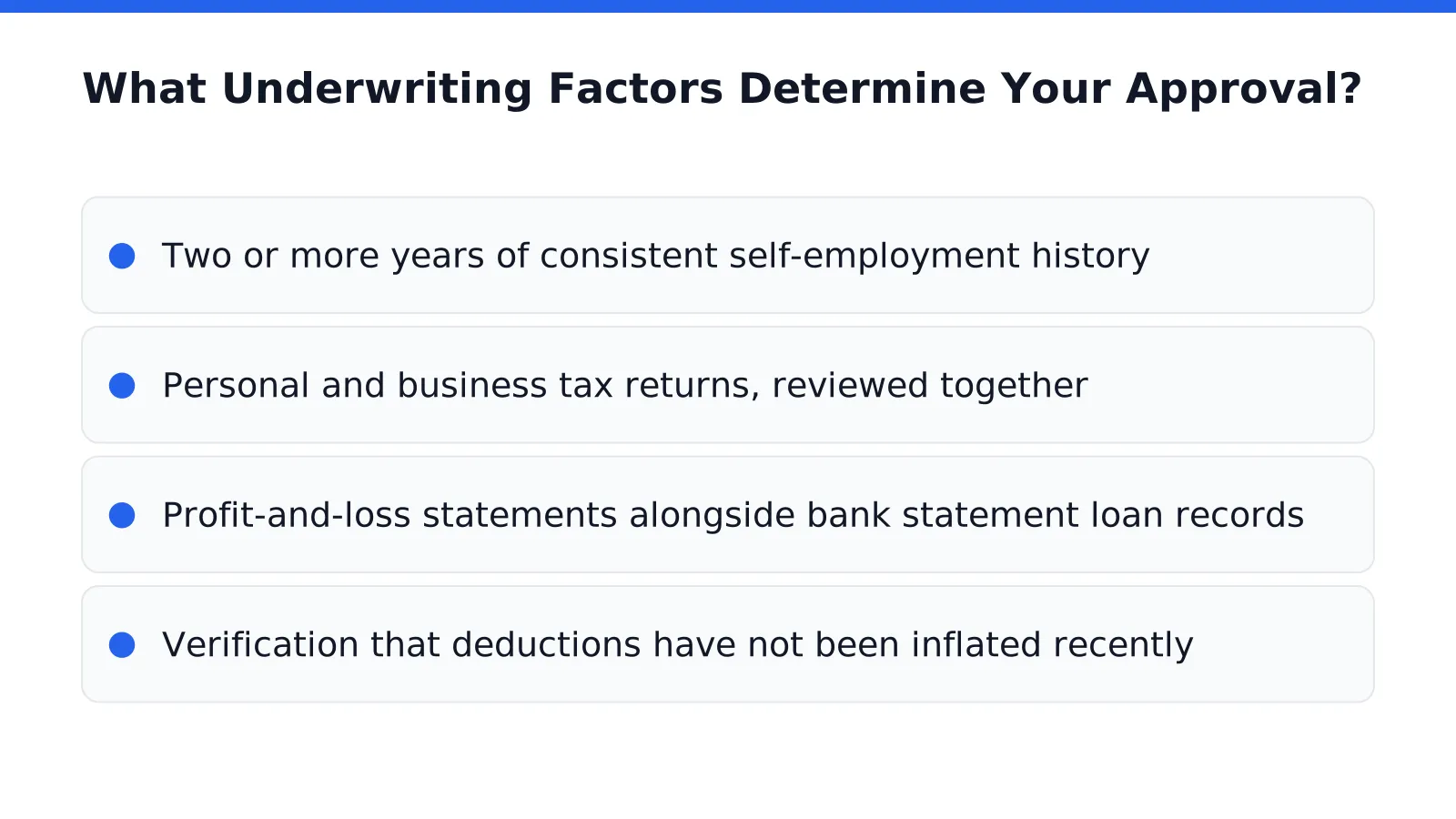
Common underwriting checkpoints include:
- Two or more years of consistent self-employment history
- Personal and business tax returns, reviewed together
- Profit-and-loss statements alongside bank statement loan records
- Verification that deductions have not been inflated recently
Munshi Capital Inc. built its underwriting process around transparency, giving Walnut Creek business owners clear visibility into loan status at every stage rather than vague updates. That clarity, paired with thorough income documentation review, keeps surprises out of the closing process and strengthens the path to approval.
How Does Munshi Capital Simplify Your Approval?
Munshi Capital Inc. simplifies approval through integrity, personalized service, and a wide range of loan products built for business owners and self-employed professionals. Walnut Creek entrepreneurs often carry irregular cash flow, so the underwriting process accounts for that reality instead of penalizing it.
A self-employed mortgage application looks different from a standard payroll-based one. Lenders want consistent income flow because it signals the ability to repay a loan reliably, a principle that shapes every review at Munshi Capital Inc. Rather than forcing freelancers and contractors into a rigid template, the company’s loan specialists evaluate the full financial picture, from business revenue patterns to personal credit history.
What documents does a self-employed borrower need?
Business owners typically submit income documentation such as profit-and-loss statements, bank deposits, and tax records to verify earnings. For borrowers whose tax returns understate true cash flow, bank statement loans offer an alternative path that weighs deposits over deductions.
Why choose a lender built for independent earners?
Munshi Capital Inc. specializes in mortgage financing designed to serve a diverse range of borrowers, from first-time homebuyers to seasoned investors. That range matters for contractors and freelancers near Walnut Creek who need flexibility, not a one-size-fits-all checklist.
The process stays grounded in clarity and honesty from application through closing. Borrowers see:
- Transparent communication at each underwriting stage
- Loan specialists who explain requirements in plain terms
- Product options matched to irregular income patterns
Homeowners weighing a sale instead of a refinance can request a direct cash offer to compare paths quickly. Property owners unsure of current value can request your property assessment before deciding which financing route fits their goals.
FAQ
What documents do self-employed borrowers need for a mortgage?
Lenders require tax returns, profit-and-loss statements, and bank statement loans paperwork to establish a reliable income pattern. Personal and business financial records both factor into underwriting decisions for business owners and independent contractors.
Why does a self-employed mortgage face extra scrutiny?
Lenders cannot verify income with a simple pay stub, so business owners and freelancers submit more paperwork than salaried applicants. Underwriters examine that documentation line by line before approving financing.
How does Munshi Capital Inc. support self-employed borrowers?
Munshi Capital Inc. structures financing around each borrower’s actual financial picture, offering direct access to loan specialists familiar with self-employment income patterns. Clear communication guides clients from application through closing.
Conclusion
In closing, self-employed borrowers navigating the mortgage landscape benefit from working with lenders who understand the complexities of non-traditional income documentation. By selecting a financing partner committed to transparency and personalized guidance, you gain access to specialized loan programs designed to accommodate your unique financial profile. The right lender removes friction from the application and underwriting process, providing clear answers and dependable service throughout your journey toward homeownership or investment property acquisition.
Leave a Reply