
Mortgage underwriting at Munshi Capital Inc. moves through four stages: application submission, document processing, underwriter review, and final approval. Underwriters evaluate credit history, income, assets, and a home appraisal before issuing a decision. The full process typically takes between 40 and 50 days, ending with loan approval and a scheduled closing date.
Key Takeaways
- Underwriting determines loan approval by reviewing your credit history, financial profile, and property details thoroughly.
- The underwriting process typically takes 40 to 50 days from application submission to completion.
- A loan processor organizes and verifies all necessary documents after you submit your initial application.
- Our loan specialists provide transparent communication and full visibility into your loan status throughout underwriting.
What Should You Prepare Before Underwriting Starts?
Preparation determines how smoothly a loan file moves through review. Borrowers who organize their financial records early avoid the delays that stall closings and frustrate home purchase timelines. Munshi Capital structures this groundwork into clear, sequential steps so clients know exactly what comes next.
- Complete a quick, secure application. Borrowers begin by sharing their goals with a loan specialist and identifying which residential or commercial program fits their situation.
- Confirm personal and financial information. Lenders verify identity details and income data, then pull a credit report as part of this early check.
- Gather supporting financial documents. Borrowers should have pay stubs, tax returns, and bank statements ready, since these feed directly into the document review stage.
- Stay available for follow-up requests. Loan specialists often need clarification on specific entries, and quick responses keep the file moving.
Once these steps are complete, the file transitions into formal mortgage underwriting. A dedicated underwriter examines the full financial picture before issuing a decision.
How long does preparation take before underwriting begins?
Timelines vary by borrower, depending on how quickly documents are gathered and verified. Munshi Capital’s team guides clients through every step from application to closing, emphasizing clarity and speed rather than guesswork or hidden surprises.
What happens if documents are incomplete?
Missing paperwork slows the path toward loan approval and may require additional back-and-forth with the underwriter. Submitting a complete, organized file from the start reduces this risk significantly. Borrowers ready to move forward can request a direct cash offer or request your property assessment to begin the process with confidence.

How Does Document Review Support Loan Approval?
Document review supports loan approval by giving underwriters verified, organized financial records before any final decision gets made. Organized paperwork removes the guesswork that stalls applications and triggers repeated requests for the same information. Borrowers who submit incomplete files risk delays that push closing dates further out. Add stress to an already demanding process.
Once an application is submitted, a loan processor steps in to gather and organize the required paperwork for the underwriter. This step keeps mortgage underwriting moving instead of stalling at the first hurdle. Munshi Capital Inc. structures this review around a straightforward application, underwriting, and closing sequence, built to leave no hidden surprises during the document review stage.
The process typically unfolds in four stages:
- Submit income, asset, and identification records requested by the loan processor.
- Allow the processor to organize the file and forward it to underwriting.
- Respond promptly to any underwriter follow-up requests for clarification.
- Receive a final decision once the file satisfies all program requirements.
Munshi Capital Inc. pairs modern technology with hands-on loan specialists, giving borrowers continuous visibility into where their file stands at each stage of review. That transparency reduces the anxiety that often comes with waiting on a lender’s internal process.
What documents slow down underwriting the most?
Missing bank statements, unexplained deposits, and inconsistent income records cause the most delays. Borrowers who prepare these items early move through review with fewer interruptions and fewer surprises near closing.
Can a loan be denied after document review begins?
Yes. An underwriter can deny a file if documentation contradicts earlier statements or fails to meet program guidelines, regardless of how far along the review has progressed.
What Do Underwriters Evaluate During Review?
Three core factors drive every underwriting decision: credit, capacity, and collateral. Lenders frame these as the “three C’s” of underwriting. Each one answers a distinct question about a borrower’s readiness for a home loan. Skipping preparation on any single factor slows the file and risks a denial letter instead of a closing date.
Mortgage underwriting examines credit history first, looking at payment patterns, outstanding debt, and overall creditworthiness. Capacity measures income and employment stability against monthly obligations, confirming a borrower can sustain payments over the life of the loan. Collateral evaluates the property itself, since the home secures the debt if payments stop.
How does loan type affect what underwriters check?
Loan type shapes which documents and ratios carry the most weight. Munshi Capital Inc. offers FHA, VA, USDA, and bank statement loans across residential and commercial programs, giving each client’s financial picture a matching product. A self-employed investor relying on bank statements faces different scrutiny than a salaried first-time buyer using an FHA loan. Both paths run through the same three-factor framework.
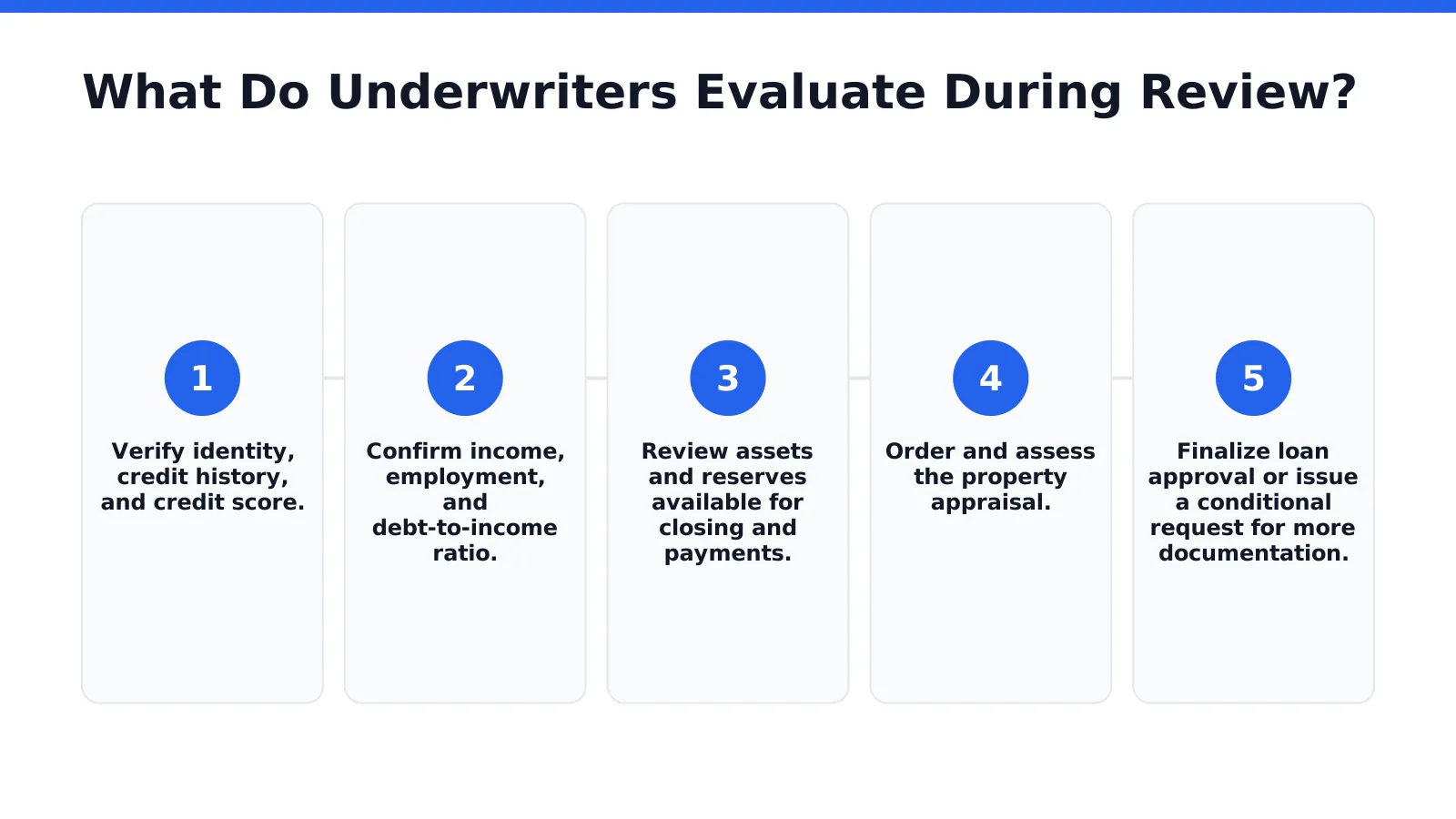
Borrowers can expect underwriters to move through review in a consistent order:
- Verify identity, credit history, and credit score.
- Confirm income, employment, and debt-to-income ratio.
- Review assets and reserves available for closing and payments.
- Order and assess the property appraisal.
- Finalize loan approval or issue a conditional request for more documentation.
Does underwriting treat every borrower the same way?
No single borrower profile dictates the outcome. Munshi Capital Inc. serves first-time homebuyers and seasoned investors alike, and each application receives individual assessment rather than a one-size-fits-all checklist. Thorough document review early in the process, with pay stubs, bank statements, and tax records organized in advance, keeps the three-C evaluation moving without unnecessary delay.
How Long Does Mortgage Underwriting Typically Take?
Mortgage underwriting generally takes between 40 and 50 days to complete from start to finish, according to Rocket Mortgage’s report on the mortgage underwriting process. This timeline covers the full review cycle, not just a single approval decision. Borrowers who understand this window plan their closing dates realistically and avoid unnecessary stress.
Delays often stem from missing paperwork or slow responses, not from the lender’s internal process. Munshi Capital Inc. pairs modern underwriting technology with hands-on loan specialists to keep files moving on schedule rather than stalling in a queue. That combination shortens the gap between application and loan approval, since specialists flag issues before they become bottlenecks.
What speeds up the underwriting timeline?
Fast, thorough document review moves a file through underwriting faster than almost any other factor. Borrowers who submit complete pay stubs, tax returns, and bank statements upfront remove a common source of delay. A dedicated team member reviewing each submission catches gaps early, before they stall the file.
Does every loan take the same amount of time?
No. Timelines shift based on loan type, documentation complexity, and appraisal scheduling. Investors with multiple properties or self-employed borrowers with variable income often need extra verification steps.
Borrowers can expect the process to generally follow this pattern:
- Initial file review and document collection
- Credit, income, and asset verification
- Property appraisal and title review
- Underwriter decision or request for clarification
- Final approval and clear-to-close
Munshi Capital Inc.’s personalized guidance keeps borrowers nationwide informed at each stage, so no step feels like a mystery.
What Mistakes Delay Final Loan Approval?
Slow responses to underwriter requests cause the most common delays in mortgage underwriting. Additional documents or explanations often get requested mid-review, and borrowers who hesitate to reply stall their own file. Underwriters build timelines around borrower cooperation, not around guesswork.
Incomplete document review ranks as a close second cause of delay. Missing pay stubs, unexplained bank deposits, or outdated tax records force underwriters to pause a file and wait. Each pause resets momentum and pushes the closing date further out.
Why Do Underwriters Ask for More Documents Mid-Review?
Underwriters ask for more paperwork when the original file leaves questions unanswered. A large deposit without a paper trail, a new job without an offer letter, or a credit inquiry without context all trigger follow-up requests. Responding within a day or two, rather than a week, keeps the file moving toward loan approval.
Common mistakes that slow approval include:
- Ignoring or delaying underwriter document requests
- Submitting incomplete bank statements or tax returns
- Opening new credit accounts during the review period
- Changing jobs or income structure mid-process
- Failing to explain unusual deposits or withdrawals
Munshi Capital Inc. built its lending approach on clarity, honesty, and a service-driven ethos designed to keep borrowers informed at every stage. That transparency reduces the confusion that typically slows approval timelines. Backed by a commitment to integrity and personalized service, Munshi Capital Inc. stands as a trusted partner for borrowers nationwide working to avoid costly, time-consuming setbacks on the path to closing.
FAQ
What are the four stages of mortgage underwriting?
The underwriting workflow at Munshi Capital Inc. follows four sequential stages, application submission, document processing, underwriter review, and final approval, with each stage building on verified credit, income, asset, and appraisal data before a decision is issued.
How long does the underwriting process take?
Processing windows generally span 40 to 50 days from the point a complete application is submitted to the issuance of a final decision and closing date. Individual timelines shift based on how quickly a borrower supplies requested documentation.
What happens if I submit incomplete documents?
An incomplete file typically triggers additional underwriter requests and extends the review timeline; providing a complete document set upfront reduces the likelihood of these delays.
Conclusion
In closing, understanding the mortgage underwriting process empowers you to navigate each stage with confidence and clarity. The systematic evaluation of your financial profile, property details, and creditworthiness ensures that your loan decision rests on solid ground. By partnering with a lender committed to transparency and personalized guidance, you gain visibility into every step of the journey, eliminating uncertainty and positioning yourself for a successful closing. Your path to financing is straightforward when built on honest communication and dependable expertise.
Leave a Reply