
VA home loan approval moves through five stages: prequalification, Certificate of Eligibility, lender application, underwriting, and closing. Veterans, active-duty service members, and eligible surviving spouses apply through a private lender, such as a bank or mortgage company. The VA guarantees a portion of the loan, enabling benefits like zero down payment.
Key Takeaways
- VA loans close in 30 to 45 days through a straightforward five-step process designed for Veterans.
- The VA guarantees part of your loan, enabling lenders to offer better terms and rates.
- Our loan specialists guide you through preapproval, house hunting, contract, underwriting, and closing with full transparency.
- VA-backed purchase loans require working with a private lender committed to clear communication throughout.
What Makes VA Loans Different From Other Mortgages?
VA loans carry a federal guarantee that conventional mortgages simply do not offer. The Department of Veterans Affairs backs a portion of each loan against loss, a structure that lets private lenders extend terms unavailable elsewhere, including the option to skip a down payment entirely.
That guarantee exists for a specific purpose. The program helps veterans, active-duty servicemembers, National Guard and Reserve personnel, and eligible surviving spouses move into homeownership, rather than functioning as a generic lending product open to anyone. A veteran mortgage built on this guarantee shifts risk away from the borrower and onto the federal backing itself.
That shift produces tangible savings. Because the VA stands behind the loan, borrowers often see more competitive rates, no down payment requirement, and no private mortgage insurance, three costs that routinely burden conventional borrowers for years.
Who Can Actually Use a VA Loan?
Access depends on service history, not credit profile alone. Confirming va eligibility is the first real step. The guarantee only extends to those who meet the VA’s service requirements.
How Do VA Loan Costs Compare to Conventional Loans?
- No down payment requirement in most cases
- No private mortgage insurance
- Rates that frequently beat conventional benchmarks
- Federal guarantee reduces lender risk, not borrower documentation burden
Munshi Capital Inc. positions VA loans as one part of a broader suite of residential loan programs, matched to each client’s financial picture rather than a single rigid template. That range matters, because no two service members arrive with identical income, credit, or property goals.

How Do You Prove Your VA Eligibility?
Proof starts with one document: the Certificate of Eligibility, or COE. This certificate confirms qualification for the home loan benefit. Must reach the lender before a VA-backed purchase loan moves forward. Without it, underwriting stalls. Lenders cannot verify entitlement on their own; the paperwork has to come first.
What Does a Lender Need to See?
Lenders require the COE as direct proof of VA eligibility. Active duty service members face one additional step: a statement of service, signed by a personnel officer or unit commander. This statement confirms current duty status and service dates, filling gaps the COE alone does not cover.
The documentation differs slightly depending on service category:
- Veterans and separated service members: COE only, generally sufficient on its own.
- Active duty personnel: COE plus a signed statement of service from a personnel officer or unit commander.
- National Guard and Reserve members: COE paired with service records confirming qualifying duty.
Why Does This Documentation Matter So Much?
A private lender, not a government office, issues the actual loan. Banks and mortgage companies underwrite these loans using the COE as their starting point for eligibility confirmation. Skipping or delaying this step slows closing timelines and jeopardizes purchase contracts with tight deadlines.
Munshi Capital Inc. works alongside veterans, active-duty members, and surviving spouses to confirm documentation early and avoid costly delays. Personalized guidance from Munshi Capital Inc. helps borrowers nationwide secure the right veteran mortgage financing with confidence, rather than guesswork. Sellers weighing a property sale alongside a home purchase can request a direct cash offer to simplify the transition. Homeowners uncertain of their property’s value can request your property assessment before listing.
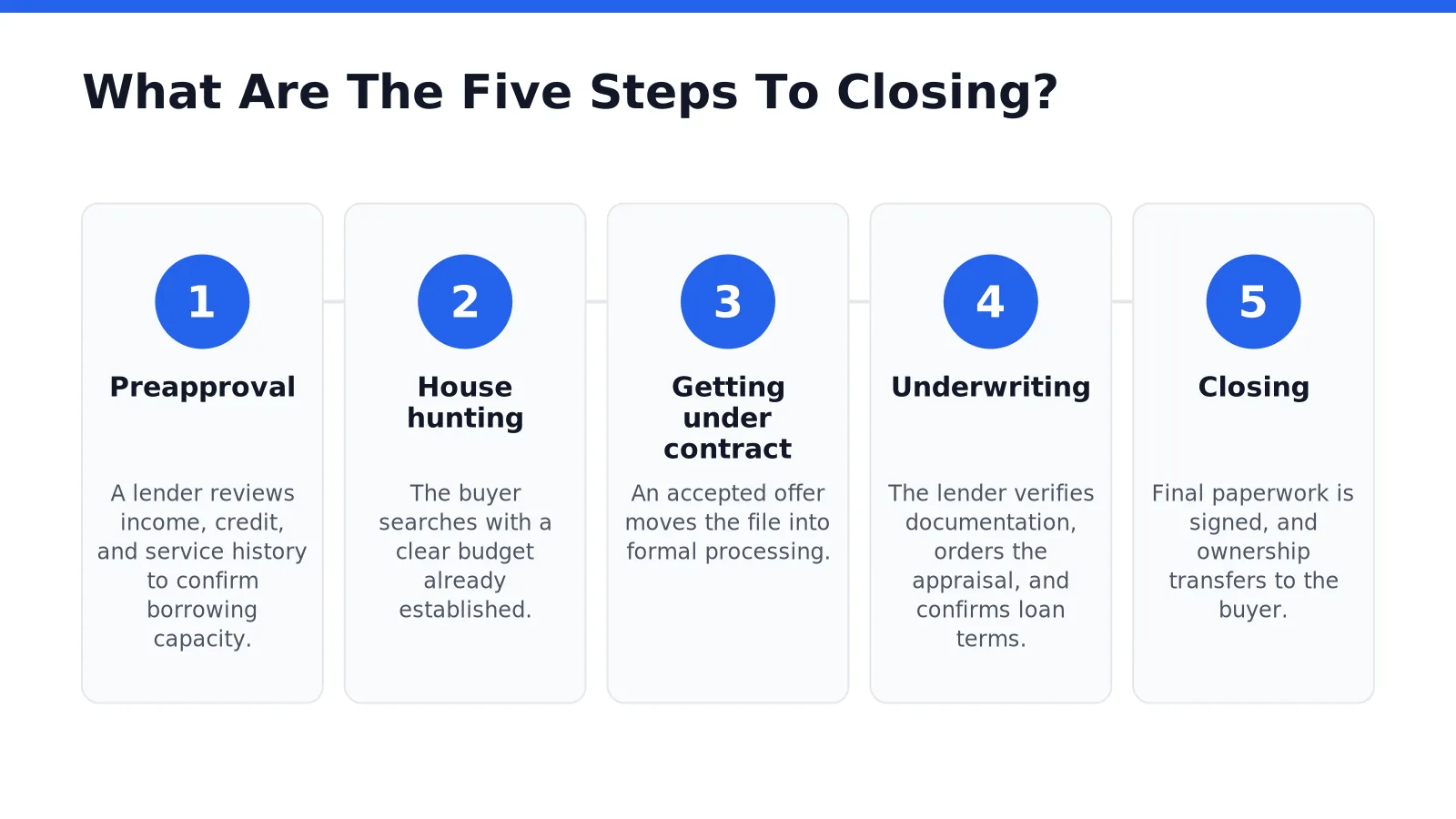
What Are The Five Steps To Closing?
Closing on VA loans follows five defined stages: preapproval, house hunting, getting under contract, underwriting, and closing. Each stage builds on the one before it, and skipping ahead rarely works. Veterans who understand this sequence avoid delays that can push a closing date past a lease deadline or a moving truck reservation.
The process mirrors a conventional mortgage in most respects. Obtaining a veteran mortgage is not significantly different from securing any other type of home loan. The paperwork, credit review, and appraisal steps follow a similar rhythm. What changes is the guaranty backing the loan and the eligibility documentation required upfront.
- Preapproval – A lender reviews income, credit, and service history to confirm borrowing capacity.
- House hunting – The buyer searches with a clear budget already established.
- Getting under contract – An accepted offer moves the file into formal processing.
- Underwriting – The lender verifies documentation, orders the appraisal, and confirms loan terms.
- Closing – Final paperwork is signed, and ownership transfers to the buyer.
How Long Does Closing Take?
Closings on VA-backed loans typically take between 30 and 45 days, though individual timelines vary by file complexity. A borrower with clean documentation and quick responses to lender requests tends to land on the shorter end of that range. Delays usually stem from slow paperwork turnaround, not the loan type itself.
What Role Does VA Eligibility Play?
Confirming VA eligibility happens early, often during preapproval, and it determines the guaranty terms attached to the loan. Without this confirmation, underwriting cannot proceed. Munshi Capital Inc. pairs modern technology with hands-on loan specialist guidance, giving borrowers quick preapprovals and full visibility into status at every stage, from the first document request through the final signature.

Why Does Working With The Right Lender Matter?
The right lender determines whether a veteran mortgage closes on schedule or stalls in confusion. Lender choice shapes every stage of the borrowing timeline, from the first document request to the final signature. Veterans who choose an experienced, VA-savvy lender and real estate agent keep their file moving and avoid delays that derail closings.
Quick responses matter just as much as lender expertise. Borrowers who answer lender requests promptly, paired with an agent who understands VA loans, keep the process smooth and on track. A lender unfamiliar with VA guidelines slows underwriting, misses eligibility nuances, or misreads property requirements tied to these loans.
Munshi Capital Inc. builds its lending process around that standard. The company guides borrowers through a straightforward application, underwriting, and closing sequence designed for ease and understanding, without hidden surprises. That structure rests on a mission of transparency: clear, honest communication at every stage of the loan, not only at closing.
What makes a lender trustworthy for VA borrowers?
Trustworthiness shows up in consistency, not promises. Munshi Capital Inc.’s approach stays rooted in clarity, honesty, and a service-driven ethos, positioning the company as a reliable partner throughout the loan journey. That consistency protects borrowers from surprise conditions, re-disclosures, or last-minute requirements that threaten closing dates.
What should veterans look for before choosing a lender?
Veterans should confirm a lender’s familiarity with VA eligibility rules and documentation standards before signing on. A mismatch here causes slowdowns that ripple through the entire closing timeline.
Key factors worth comparing:
- Direct experience underwriting VA-backed loans
- Clear, responsive communication during underwriting
- A documented, predictable closing process
- A track record built on transparency rather than sales pressure
A lender who delivers on all four points shortens the distance between preapproval and keys in hand.
What Should You Do Next?
Three clear paths exist for veterans, active-duty members, and eligible surviving spouses weighing a home purchase or refinance. The strongest next step depends on where each borrower stands today: gathering documents, comparing lenders, or ready to make an offer. Delaying action carries a real cost, since rate environments shift and preferred properties sell quickly.
Borrowers early in the process should confirm their VA eligibility status before anything else. This single step shapes every decision that follows, from loan amount to timeline.
How does Munshi Capital support veteran borrowers?
Munshi Capital Inc. builds mortgage financing around the borrower, not a generic checklist. Guidance extends through every loan program, paired with clear answers and dependable service at each stage. That structure reflects a broader commitment to integrity, personalized service, and a wide array of loan products, which has made the company a trusted choice for homebuyers nationwide.
Is a VA loan still the right fit?
VA loans remain a strong option for anyone currently on active duty or who has served as a veteran. Terms often include affordability advantages tied to VA backing, such as better rates and no down payment requirement.
For those ready to move forward, three actions matter most:
- Request a personalized consultation to review loan program options.
- Request a direct cash offer if selling a current property to fund the next purchase.
- Request your property assessment to understand current market value before listing or refinancing.
Each step builds toward a mortgage decision made with full visibility, not guesswork.
FAQ
What are the five stages of the VA loan process?
The VA loan process moves through prequalification, Certificate of Eligibility, lender application, underwriting, and closing. Munshi Capital Inc.’s loan specialists guide borrowers through each stage with full transparency.
What financial advantages do VA loans offer over conventional mortgages?
VA loans typically require no down payment and no private mortgage insurance, while offering rates that frequently beat conventional benchmarks. The VA’s federal guarantee reduces lender risk, enabling these borrower-friendly terms.
What document proves VA loan eligibility?
The Certificate of Eligibility (COE) proves qualification for the VA home loan benefit. Must reach the lender before underwriting begins. Active duty personnel also need a signed statement of service confirming their current duty status.
Conclusion
In closing, understanding the VA loan process positions eligible borrowers to leverage a powerful financing tool designed specifically for their service. The pathway from application through closing requires clarity at each stage, a principle that defines our commitment to transparency and dependable guidance. By working with specialists who prioritize honest communication. Personalized support, veterans and active-duty service members gain the confidence to navigate their financing journey with full visibility and integrity, ensuring their homeownership goals are achieved without unnecessary complexity or surprise.
Leave a Reply