
Commercial real estate financing structures loan terms around a property’s income and value rather than the borrower’s personal finances alone. Munshi Capital Inc. offers commercial mortgage programs for office buildings, retail, and multifamily properties, serving investors and business owners nationwide. Options include purchase, refinance, and expansion financing, each designed for the property’s cash flow and the client’s investment strategy.
Essential Insights for Commercial Real Estate Investors
- Commercial real estate loans serve as critical financial instruments for property investors and business expansion strategies nationwide.
- Munshi Capital Inc. offers specialized DSCR and hard money loan products designed specifically for investor-focused financing needs.
- Transparent underwriting processes with quick pre-approvals provide borrowers full visibility into loan status from application through closing.
- Personalized guidance from loan specialists ensures each borrower receives tailored solutions matching their unique financial picture and goals.
What Is Commercial Real Estate Financing?
Commercial real estate financing funds the purchase, development, or refinancing of income-producing property rather than a primary residence. Loans in this category cover land, office buildings, retail centers, and other physical assets used for business or investment purposes. Traditional lenders, including banks, extend this type of financing to business owners and investors who need capital to acquire or improve commercial sites.
A commercial mortgage overview starts with one core distinction: these loans are not built the same way as a home mortgage. Residential loans rely heavily on personal income and credit history. Commercial financing, by contrast, centers on the property itself, specifically its income potential and current market value. Munshi Capital Inc. provides commercial mortgage financing for business owners. Real estate investors across the USA, structuring programs around the income and value of the property being financed rather than a one-size-fits-all formula.
How Does Commercial Financing Differ From a Home Loan?
A commercial real estate loan serves income-producing property, while a home loan serves an owner-occupied residence. Lenders evaluating commercial deals weigh the property’s cash flow and valuation first. This shift in focus explains why terms, documentation, and underwriting differ sharply between the two loan types.
This commercial-financing-guide approach gives buyers and investors flexibility across several property types and transaction goals, including:
- Purchasing new office, retail, or industrial space
- Refinancing existing commercial debt
- Expanding or developing an owner-occupied facility
- Acquiring income-producing investment property
Understanding these commercial loan basics helps investors. Business owners enter negotiations prepared, with realistic expectations about how a lender will size up both the deal and the property behind it.

Which Loan Programs Fit Your Property?
Property type determines loan structure more than almost any other factor. A warehouse, an apartment building, and a mixed-use retail space each carry different risk profiles, cash flow patterns, and lender expectations. Matching the right program to the right asset class shortens underwriting and may improve the likelihood of approval.
Munshi Capital Inc. structures its commercial mortgage overview around property type first, then borrower profile second. Office buildings and mixed-use properties qualify for standard commercial mortgage financing, provided the income generated supports the requested loan amount. Multifamily and apartment complexes with five or more units fall into a separate category. Lenders evaluate rental income and occupancy history rather than a single tenant’s lease. Industrial, warehouse, and self-storage facilities round out the core property types eligible for financing, reflecting steady demand from logistics and storage operators nationwide.
Investors with less conventional deals often need more than a standard mortgage. This is where a solid commercial financing guide separates straightforward purchases from specialized situations. DSCR loans and hard money products exist specifically for investors who need speed or whose personal income doesn’t match the deal size. These tools give real estate investors financing paths that a traditional mortgage underwriter would never approve on income alone.
Does property type change the loan terms?
Yes. Lenders price risk differently for office space, multifamily housing, and industrial facilities, since each carries distinct vacancy and income patterns. A clear grasp of commercial loan basics helps buyers anticipate which documentation and terms apply before they submit an application.
What if a property doesn’t fit a standard category?
Mixed-use buildings, self-storage facilities, and owner-occupied commercial space often require a blended underwriting approach. Commercial lending carries complexities that residential financing simply doesn’t, so matching the loan program to the exact asset class matters from day one.
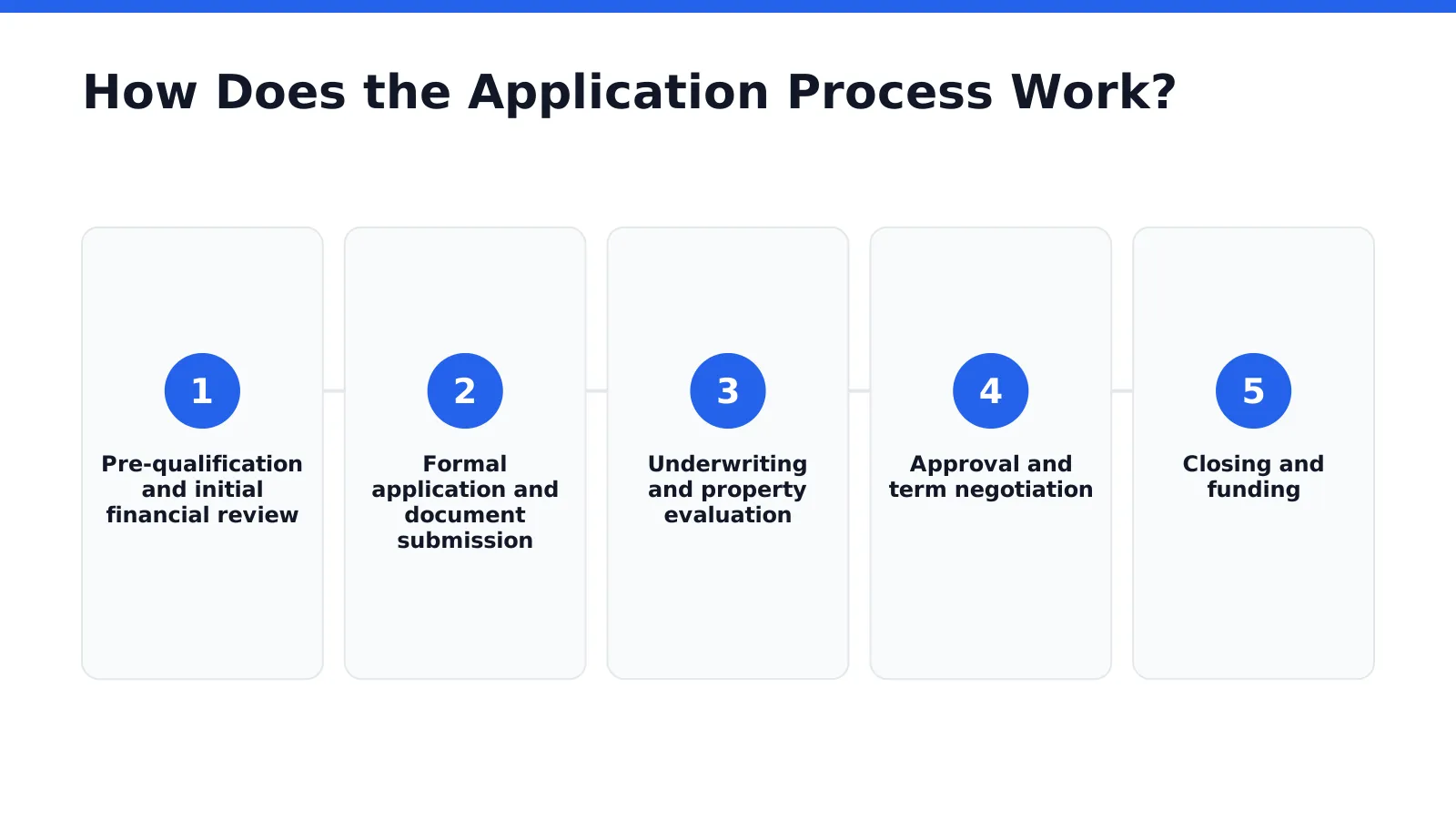
How Does the Application Process Work?
Commercial borrowers move through a defined sequence: pre-qualification, document submission, underwriting, and closing. Munshi Capital Inc. structures this path so applicants face no hidden surprises at any stage. Clarity replaces guesswork from the first phone call to the signing table.
Technology drives much of the speed behind this process, but it does not replace human judgment. Loan specialists review each file personally, pairing automated tracking tools with direct borrower communication. That combination produces quick pre-approvals and gives applicants full visibility into loan status, from initial submission through final funding.
A dependable commercial financing guide treats document preparation as the single biggest lever for speed. Careful, early gathering of required paperwork, tax returns, financial statements, rent rolls, and entity documents shortens underwriting timelines considerably. Missing or disorganized records remain the most common cause of delay in commercial transactions.
What Documents Does a Commercial Loan Application Require?
Lenders typically request business financial statements, property-level income data, and borrower credit history. Organizing these materials before submission prevents back-and-forth delays during underwriting. Applicants who prepare early move through review faster than those who scramble mid-process.
How Many Steps Are Involved in Closing a Commercial Loan?
The process generally includes several distinct phases:
- Pre-qualification and initial financial review
- Formal application and document submission
- Underwriting and property evaluation
- Approval and term negotiation
- Closing and funding
Understanding these commercial loan basics helps investors anticipate each milestone rather than react to it. A solid commercial mortgage overview at the outset, covering property type, income documentation, and repayment structure, keeps the entire transaction moving on schedule and avoids costly missteps late in underwriting.

What Loan Terms Should You Expect?
Commercial loan terms vary by property type, borrower strength, and lender structure. Commercial financing guide-012 programs set loan amounts based on each property’s value and income. This flexibility lets business owners and investors scale from a single retail unit to a multi-property portfolio. Falling outside that range does not disqualify a borrower; it simply shapes which program fits best.
A lower LTV means a larger down payment. It also signals reduced lender risk and often results in more favorable pricing. Term length matters just as much as the rate itself. Borrowers typically choose among:
- 5-year terms, suited to short-hold investment strategies
- 7-year terms, balancing flexibility and stability
- 10-year terms, common for stabilized income properties
- 25-year terms, which spread payments for long-term holds
How do lenders decide how much to approve?
Underwriting for commercial properties relies on commercial loan basics-012, specifically cash flow performance and the asset value of the property itself. Rather than focusing solely on personal income, lenders evaluate whether the property generates enough revenue to support the debt.
What should buyers review before signing?
Two figures drive nearly every approval decision: Loan-to-Value and Debt Service Coverage Ratio, or DSCR. DSCR measures the property’s income against its debt obligations, and lenders use it alongside LTV to judge repayment capacity. Grasping this commercial mortgage overview-012 before applying prevents delays and mismatched expectations during underwriting. Borrowers seeking clarity on property value can request your property assessment before moving forward with an application.
How Do You Choose the Right Lender?
Repayment capacity determines loan approval more than any other factor. Commercial lenders evaluate a business’s ability to repay the loan, not just the personal finances of the borrower. That distinction shapes which lender fits best. Income-producing property deals hinge on business performance, not a personal credit profile alone.
Investors comparing lenders benefit from reading this commercial-financing-guide-012 as a baseline before requesting quotes. A solid guide clarifies what documentation, revenue history, and property income projections a lender will request. Borrowers who understand these fundamentals negotiate from a stronger position.
What makes a lender trustworthy for commercial deals?
Trustworthy lenders combine integrity, personalized service, and a broad range of loan products into one dependable relationship. That combination, rather than a single low rate, builds a lender into a trusted nationwide choice for investors and business owners. Borrowers should look for guidance that stays consistent from application through closing, not just at the point of sale.
Does personalized guidance matter more for commercial loans?
Yes. Commercial deals vary widely in structure, property type, and borrower profile, so personalized guidance helps borrowers across the country secure the right financing confidently. A lender built on trust delivers transparent, borrower-first mortgage guidance throughout the loan journey, rooted in clarity and honesty rather than generic underwriting templates.
When screening lenders, investors should weigh:
- Transparency around rates, terms, and closing timelines
- A track record of serving diverse borrower types
- Clear communication from application through funding
- A commercial-loan-basics-012 explanation offered upfront, before documents are signed
A strong commercial-mortgage-overview-012 conversation early in the process reveals whether a lender prioritizes clarity or simply closes volume.
FAQ
How does commercial real estate financing differ from a home loan?
Commercial loans focus on the property’s income potential and market value. Home loans rely heavily on personal income and credit history, creating different terms, documentation, and underwriting standards.
What property types does Munshi Capital Inc. finance?
Munshi Capital Inc. offers commercial mortgage programs for office buildings, retail centers, and multifamily properties, serving investors and business owners nationwide with purchase, refinance, and expansion options.
What loan products does Munshi Capital Inc. offer investors?
Munshi Capital Inc. provides specialized DSCR and hard money loans designed for investor-focused financing, alongside FHA, VA, USDA, and bank statement loan programs tailored to each client’s financial picture.
Conclusion
In closing, commercial real estate financing requires a strategic approach grounded in clarity, accurate financial assessment, and alignment with your specific investment objectives. The lending landscape offers diverse programs tailored to varied borrower profiles and property types. Success depends on transparent communication with your financing partner and a thorough understanding of terms, obligations, and timeline expectations. By prioritizing honest dialog and selecting a lender committed to personalized guidance throughout the application and closing process, you position yourself to secure financing that genuinely supports your commercial real estate goals with confidence and dependable service. Property owners ready to move forward can request a direct cash offer to begin the process with clarity.
Leave a Reply