
Multifamily mortgage financing covers loan programs for properties with five or more units, including Fannie Mae DUS loans, DSCR loans, and bank statement loans. Fannie Mae’s DUS lenders underwrite and close loans, sharing risk with Fannie Mae to ensure sound financing.
Key Takeaways
- FHA multifamily loans require minimum down payments as low as 3.5% for borrowers with credit scores of 580 or higher.
- Fannie Mae DUS loans align lender, borrower, and investor interests through a trusted multifamily financing structure nationwide.
- Multifamily financing options scale across diverse investment sizes, from small residential properties to large development projects.
- Transparent underwriting, closing, and loan delivery processes ensure borrowers understand every step of multifamily mortgage financing.
What Makes Multifamily Mortgage Financing Different?
Multifamily mortgage financing serves income-producing buildings, not single-family homes, and the underwriting reflects that difference. Lenders weigh rental income, occupancy, and property class alongside a borrower’s personal financial profile. Apartment investing stands apart from residential purchasing precisely because the property itself generates revenue that lenders factor into approval decisions.
Munshi Capital Inc. structures its multifamily mortgage information and loan programs for a wide range of borrowers, from first-time homebuyers testing their first duplex to seasoned investors scaling a portfolio. That range matters. A two-unit buyer and a sixty-unit operator face very different capital needs. Both require financing designed for their specific situation rather than a generic residential template.
How does multifamily financing differ from a standard home loan?
Multifamily lending treats the property as a business asset. Underwriters review projected rental income, unit mix, and operating expenses, not just the borrower’s paycheck. This shifts the qualifying math toward the deal itself.
What should investors expect from a multifamily financing guide?
A solid multifamily financing guide should map out the full range of loan types available, since options vary widely regardless of project size or scope. Clarity here prevents costly missteps before closing.
Grounding every step in transparent, honest communication, Munshi Capital Inc. walks borrowers through apartment loan basics before underwriting begins, so no surprise terms surface at the closing table.
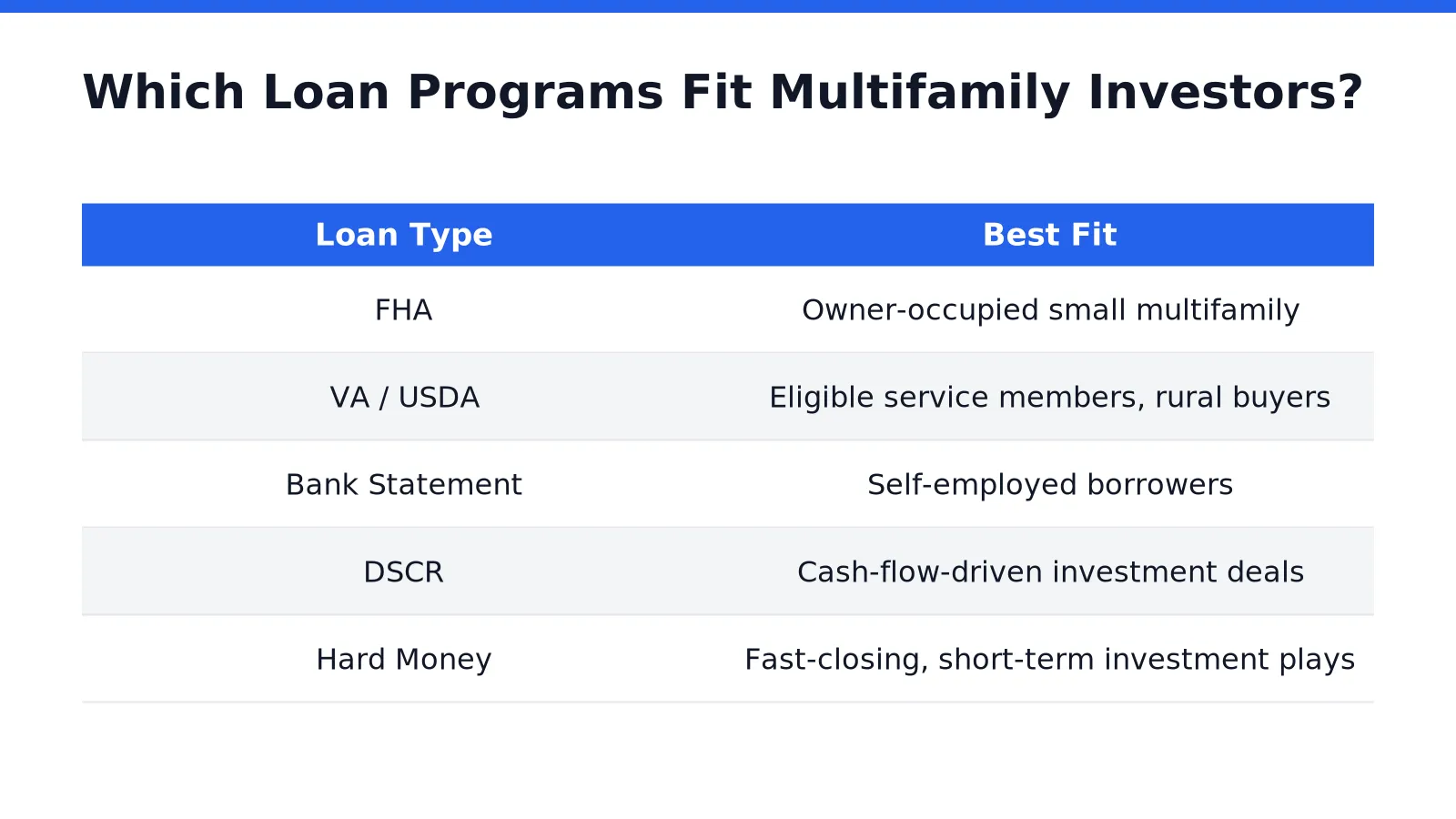
Which Loan Programs Fit Multifamily Investors?
Multifamily investors need financing matched to property type, borrower profile, and exit strategy. Munshi Capital Inc. offers a comprehensive suite of residential and commercial loan programs, including FHA, VA, USDA, and bank statement loans, built for borrowers ranging from first-time buyers to seasoned investors. This breadth matters for anyone building a multifamily financing guide before approaching a lender.
Government-backed options serve a specific purpose. FHA products work well for owner-occupants purchasing small multi-unit buildings. VA and USDA loans fit borrowers who meet service or location requirements. Bank statement loans give self-employed investors a path forward when traditional income documentation falls short.
What loans work best for investor-owned apartment buildings?
Investor-focused deals call for different underwriting logic than owner-occupied purchases. Munshi Capital Inc.’s specialized products, including DSCR (debt service coverage ratio) and hard money loans, address exactly this gap. These programs evaluate property cash flow and deal speed rather than personal income alone, making them central to practical apartment loan basics for scaling investors.
Does credit score affect multifamily loan terms?
Yes, credit score plays a direct role in FHA multifamily financing. FHA multifamily loan down payment minimums tie to credit score, meaning stronger credit profiles typically unlock lower upfront cash requirements. Investors building a credit strategy around a multi-unit purchase should treat this as foundational multifamily mortgage info.
Choosing between these programs depends on documentation, timeline, and long-term holding plans. Munshi Capital Inc.’s commitment to integrity. A wide array of loan products positions the firm as a dependable resource for investors nationwide navigating these decisions.

How Does FHA Multifamily Financing Work?
FHA multifamily financing ties loan terms directly to credit score, property location, and documented income. Borrowers with a credit score of 580 or higher qualify for a down payment as low as 3.5% of the property’s value. That single threshold separates affordable entry from a steeper cash requirement.
Credit scores between 500 and 579 shift the math considerably. These borrowers face a financing cap of 90% of value, meaning a 10% down payment, and only when a lender chooses to allow it. The gap between these two tiers makes credit repair a worthwhile step before applying.
What Credit Score Is Needed for an FHA Multifamily Loan?
Lenders draw a hard line at 580. Above that score, a borrower unlocks the 3.5% down payment tier. Below 580 but above 500, financing still works. Only at a 90% cap and solely at a given lender’s discretion.
Does FHA Require a Minimum Income to Qualify?
FHA sets no fixed income floor for applicants. Documentation still matters, though. Borrowers must show repayment ability through W-2 wages, self-employment earnings, or other stable, verifiable income sources.
Location affects borrowing power too. Most counties sit at the FHA loan limit floor. Higher-cost counties scale upward toward the ceiling, based on local median home prices.
This layered structure rewards strong credit and stable income without shutting out borrowers who fall short of perfect numbers. Munshi Capital Inc. guides clients through this multifamily financing guide to credit tiers, documentation, and county limits, moving applicants through underwriting and closing without hidden surprises.

What Role Do Fannie Mae And Freddie Mac Play?
Fannie Mae stands as the largest guarantor of mortgages in the United States, making it the dominant force behind multifamily housing finance nationwide. Freddie Mac operates under a comparable charter. Fannie Mae’s structure offers the clearest window into how government-sponsored financing actually works for apartment buyers. Together, these entities set the tone for pricing, underwriting standards, and liquidity across the multifamily lending market.
Fannie Mae’s signature program carries an unusual nickname: “The Loan We All Own.” The name reflects a structure built to align the interests of lenders, borrowers, and investors rather than pit them against each other. That alignment matters for any investor building a multifamily-financing-guide-014 before approaching a lender. It explains why underwriting standards stay consistent across markets.
How does risk-sharing work under this model?
Approved lenders, known as DUS lenders, underwrite, close, and deliver loans on Fannie Mae’s behalf. Critically, these lenders typically retain roughly one-third of the risk themselves. This arrangement does two things for borrowers:
- It keeps lenders financially invested in sound underwriting, not just loan volume.
- It gives borrowers access to standardized terms backed by a government-sponsored guarantor.
Understanding this backbone is part of solid apartment-loan-basics-014 for anyone comparing financing sources before a purchase.
Why does this matter for an individual borrower?
A borrower working through multifamily-mortgage-info-014 benefits indirectly from this risk-sharing model. It shapes the rates and terms available at the lender level. Munshi Capital Inc. translates these structures into guidance tailored to each client’s goals, helping borrowers across the country secure financing with confidence rather than guesswork.
How Does Munshi Capital Guide Your Closing?
Closing on a multifamily property demands coordination between underwriting, documentation, and funding, and Munshi Capital Inc. manages each stage with modern technology paired with hands-on loan specialists. That combination keeps pre-approvals fast and gives borrowers full visibility into loan status at every step, from initial application to the final signature. No guesswork, no black box: borrowers see exactly where their file stands. Property owners weighing their options before applying can request your property assessment to better understand how their asset fits into a financing strategy.
For residential owners scaling into multi-unit buildings, this clarity matters most. A delayed closing can mean a lost purchase contract or a missed rate lock. Munshi Capital Inc. builds its mortgage financing around the borrower, not the paperwork, offering guidance through every loan program with direct answers and dependable service rather than generic scripts.
What Happens Between Application and Closing?
Borrowers move through application, underwriting, and closing as a structured sequence, not a maze. Each stage is designed to prioritize ease and understanding, with no hidden surprises buried in fine print. Investors evaluating a multifamily financing guide for a new acquisition get a clear roadmap before signing anything.
Why Does Transparency Matter for Investors and Commercial Borrowers?
Trust determines whether a borrower returns for the next deal. Munshi Capital Inc. is built on that principle, committing to transparent, borrower-first mortgage guidance rooted in clarity, honesty, and a service-driven ethos.
Commercial borrowers and seasoned investors researching multifamily mortgage info benefit from this consistency across every loan program offered. The same standard applies whether the deal is a first duplex purchase or a complex apartment portfolio. For anyone mastering the apartment loan basics, that reliability turns a stressful closing into a predictable one.
FAQ
How does multifamily financing differ from a standard home loan?
Multifamily lending treats the property as a business asset. Underwriters review projected rental income, unit mix, and operating expenses rather than just the borrower’s paycheck. ### A solid guide maps out the full range of loan types available, since options vary widely regardless of project size or scope. Munshi Capital Inc. walks borrowers through apartment loan basics before underwriting begins, preventing surprise terms at closing.
What loan programs fit multifamily investors?
Munshi Capital Inc. offers FHA, VA, USDA, and bank statement loans for a range of borrowers, plus specialized DSCR and hard money loans for investor-owned deals. This breadth matches financing to property type, borrower profile, and exit strategy.
Conclusion
In closing, multifamily mortgage financing requires a strategic approach grounded in understanding your specific investment objectives and financial profile. The right lender partners with you through transparent communication, comprehensive loan options, and personalized guidance to ensure your multifamily acquisition aligns with your long-term goals. By prioritizing clarity throughout the application and underwriting process, you gain the confidence and visibility necessary to make informed decisions and move forward with conviction in your real estate investment strategy. Property owners ready to explore their options can request a direct cash offer. Begin a transparent conversation about financing their next multifamily acquisition.
Leave a Reply