
SBA loan programs, including 7(a), 504, and microloan options, give small business owners and commercial real estate investors competitive rates, low down payments, and flexible overhead requirements, with some loans requiring no collateral. Munshi Capital Inc. structures commercial financing around property income and value, pairing SBA-backed
Key Takeaways
- SBA 7(a), 504, and microloan programs offer competitive rates comparable to non-guaranteed commercial loans for small businesses.
- Government-backed SBA loans require lower down payments and flexible overhead requirements, reducing upfront capital barriers for borrowers.
- SBA-guaranteed financing eliminates collateral requirements, enabling small business owners to access capital without risking personal assets.
- Munshi Capital Inc. has guided thousands of small businesses through transparent SBA loan processes with personalized specialist support.
What Is an SBA Loan and How Does It Work?
An SBA loan is a small business financing product in which the Small Business Administration guarantees a portion of the debt issued by a private lender. The Small Business Administration functions as the primary source for government-backed small business financing, setting the framework that lenders nationwide follow. This structure shifts risk away from the lender, which opens the door to terms that a conventional bank loan rarely offers.
Because the government guarantees part of the loan, business owners gain capital with less equity upfront than conventional financing demands. Standard commercial loans often require substantial down payments and strong collateral positions. The guarantee changes that equation, letting qualified borrowers access funding without exhausting cash reserves meant for payroll, inventory, or expansion.
How does the guarantee affect loan terms?
The partial government guarantee reduces lender exposure, which translates into lower down payment requirements and more flexible repayment structures. Borrowers typically see this reflected in longer amortization schedules and competitive rates compared to unsecured business debt.
Who can benefit from this type of financing?
Mortgage lenders like Munshi Capital Inc. apply this framework across a broad range of clients. The company specializes in financing designed for first-time homebuyers, seasoned investors, and established business owners alike. For commercial borrowers specifically, loan programs get structured around the income and value of the underlying property rather than rigid one-size-fits-all criteria, with terms tailored to each investment strategy.
This approach matters most for owners who lack the deep equity reserves large institutions often require. A comprehensive guide to SBA lending shows how guarantee-backed capital bridges that gap. Those exploring detailed information on SBA financing options will find that eligibility hinges less on perfect credit. More on business viability and repayment capacity, a distinction that opens financing to entrepreneurs otherwise locked out of conventional markets.
How Does the SBA 7(a) Loan Help You?
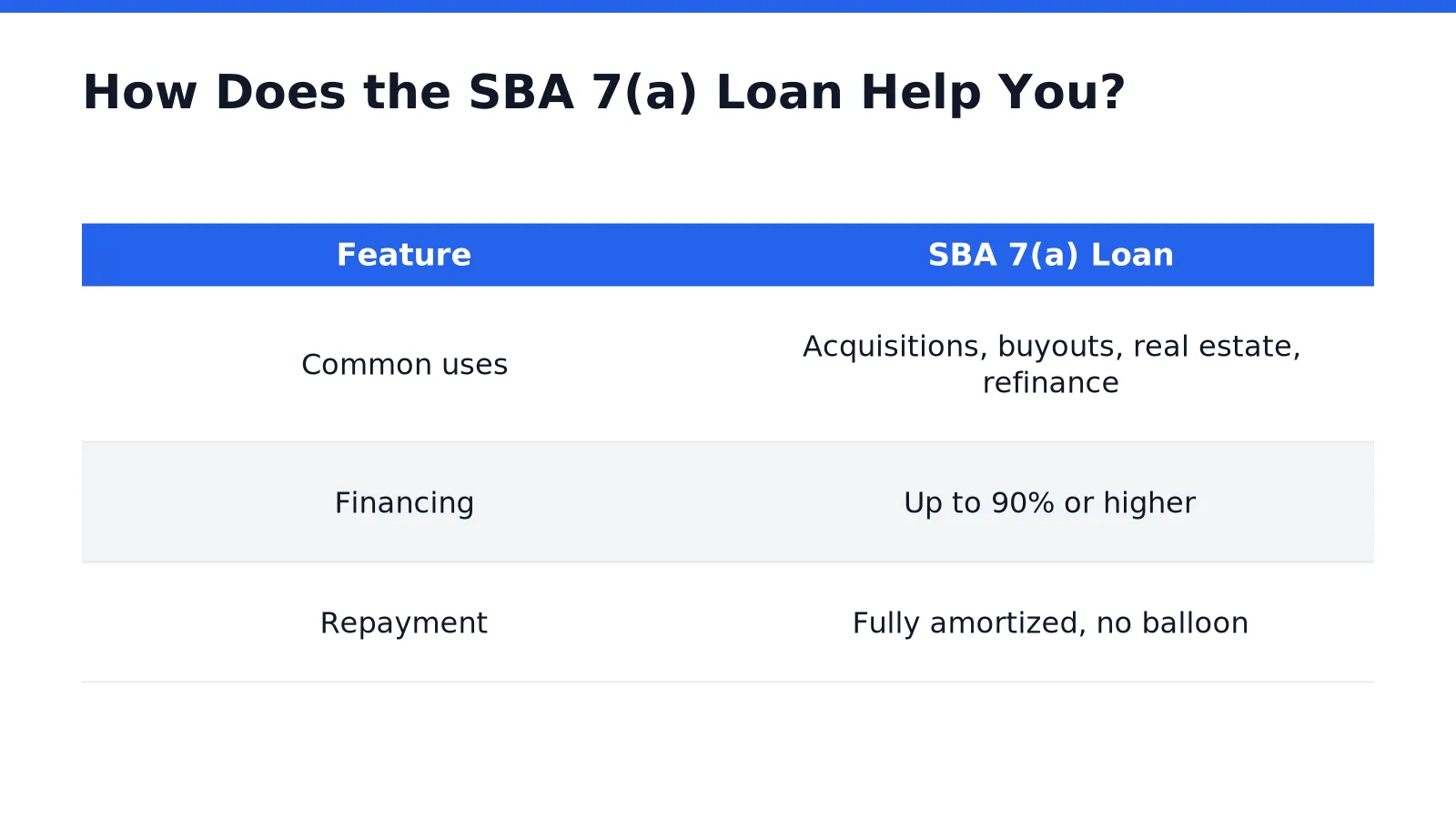
The SBA 7(a) loan stands as the most widely used government-backed financing option for small business owners. Acquisitions, partner buyouts, real estate purchases, and refinancing all fit naturally within its structure. This flexibility makes the program a practical starting point for any business owner researching an SBA loan guide before approaching a lender.
Financing terms separate the 7(a) program from conventional commercial loans. Buyers can access up to 90% bank financing or higher, which lowers the equity required at closing. Capital that would otherwise sit tied up in a down payment stays available for inventory, staffing, or working capital instead.
Repayment structure matters just as much as financing amount. SBA 7(a) loans amortize fully, with no balloon payments lurking at the end of the term. Monthly payments stay predictable from closing through payoff, removing the refinancing scramble that balloon structures often force.
What Can the SBA 7(a) Loan Be Used For?
Beyond acquisitions and buyouts, the 7(a) program finances owner-occupied commercial real estate, from office space to industrial facilities. Refinancing existing commercial debt also qualifies, giving business owners a path to better terms without starting from scratch. Munshi Capital Inc. structures these loans around the borrower’s operating income and long-term investment strategy.
For owners comparing financing paths, pairing SBA lending info with a review of commercial mortgage structures clarifies which program fits best:
A thorough SBA 7(a) 504 guide review before applying helps business owners match loan structure to long-term goals.

What Does the SBA 504 Loan Cover?
SBA 504 financing funds three categories: commercial real estate purchases, improvements to that real estate, and large equipment acquisitions. Business owners use this structure to expand facilities, modernize operations, or secure heavy machinery without draining working capital. Skipping this financing path often means delaying growth or paying cash for assets that could instead build long-term equity.
Munshi Capital Inc. structures commercial loan programs that align with this framework, covering projects large and small. That range accommodates everything from a single-location equipment upgrade to a multi-building acquisition. A lower required contribution frees up cash for operations, inventory, or reserves.
Term length matters just as much as loan size. Munshi Capital Inc. offers flexible term lengths. Borrowers match repayment schedules to their actual investment horizon instead of forcing a short-term loan onto a long-term asset.
How Is Eligibility Determined for These Loans?
Underwriting centers on cash flow and asset value, not personal income alone. This cash flow and asset-based approach means a property or piece of equipment generating steady income can qualify even when a borrower’s personal financial picture looks unconventional.
What Size Project Qualifies?
Projects ranging from pricing varies million or more fit within Munshi Capital Inc.’s commercial programs. The structure below summarizes the core terms:
Owners evaluating this comprehensive sba loan guide should weigh term length against projected income before committing.

Who Qualifies for SBA Loan Programs?
Qualification hinges on three factors: how a business earns its income, the character of its ownership, and the location where it operates. These criteria form the foundation of this sba-loan-guide-013. They determine whether a business owner moves forward in the application process or needs to restructure first.
Beyond those basics, lenders look for proof that a business can handle debt responsibly. Size standards set by the SBA must be met. Demonstrated ability to repay matters just as much. A sound business purpose behind the loan request rounds out the core requirements.
Does Bad Credit Disqualify a Business Owner?
Not necessarily. Owners with imperfect credit histories still qualify for startup funding under certain programs. Approval weighs the full financial picture rather than a single score. Repayment capacity and business viability often carry more weight than past credit missteps.
What Does Qualification Review Typically Cover?
Lenders evaluating a loan application generally check the following:
- Income source and stability of the business
- Ownership structure and background
- Operating location and compliance with SBA size standards
- Repayment capacity based on cash flow
- A clearly defined, sound business purpose for the funds
This sba-lending-info-013 review process protects both the borrower and the lender from taking on unsustainable debt.
Munshi Capital Inc. guides business owners and real estate investors through this qualification process with transparency at every step. Built on trust, the company applies a borrower-first approach rooted in clarity and honesty. That commitment, paired with a broad sba-7a-504-guide-013 product lineup, makes Munshi Capital Inc. a dependable partner for business owners evaluating SBA financing.
How Does Munshi Capital Simplify SBA Financing?
Munshi Capital removes the guesswork from SBA financing by guiding borrowers through a clear, three-stage path: application, underwriting, and closing. No hidden surprises interrupt the process. Each stage builds on a sba-loan-guide-013 approach designed for business owners who need predictable timelines, not endless paperwork.
Speed matters as much as clarity. Modern technology handles document collection and status tracking, while dedicated loan specialists manage the details that software cannot. This blend of automation and hands-on service forms the backbone of reliable sba-lending-info-013, giving small business owners a pre-approval process that moves quickly without sacrificing accuracy.
What makes the process transparent from start to finish?
Full visibility sets this process apart. Borrowers see exactly where their loan stands at every stage, from initial submission through final closing. Quick pre-approvals mean less waiting and more certainty for owners planning time-sensitive purchases or expansions.
Why do SBA borrowers need a structured 7(a) and 504 approach?
Commercial real estate investors and entrepreneurs often juggle multiple financing variables at once: property value, business income, and growth timelines. A disciplined sba-7a-504-guide-013 framework organizes these variables into one coherent plan rather than a scattered checklist.
This consistency reflects a broader philosophy. The approach stays rooted in clarity, honesty, and service, values that shape every borrower conversation. Business owners considering a property sale as part of their financing strategy can request a direct cash offer. Those evaluating current property value can request your property assessment to inform next steps.
Essential Benefits of Government-Backed SBA Financing
What makes SBA loans different from conventional commercial loans?
The SBA guarantees a portion of the loan, shifting risk away from the lender. This guarantee enables lower down payments, flexible overhead requirements, and competitive rates, with some loans requiring no collateral.
Who qualifies for SBA-backed financing?
Eligibility depends more on business viability and repayment capacity than perfect credit. Munshi Capital Inc. serves first-time homebuyers, seasoned investors, and established business owners, structuring commercial financing around property income and value.
What can an SBA 7(a) loan be used for?
The SBA 7(a) loan covers acquisitions, partner buyouts, real estate purchases, and refinancing. Its flexibility makes it a practical option for small business owners researching commercial financing solutions.
Conclusion
In closing, SBA loan programs represent a critical financing avenue for small business owners seeking capital to launch, expand, or stabilize operations. The landscape of available options, from traditional SBA 7(a) loans to specialized ROBS. Microloan programs, demands careful evaluation aligned with your specific business objectives and financial circumstances. Securing the right SBA financing requires partnering with lenders who prioritize transparency, personalized guidance, and a thorough understanding of your enterprise. By working with experienced loan specialists committed to clear communication. Dependable service throughout the application and underwriting process, business owners gain the confidence and clarity necessary to make informed financing decisions that support sustainable growth.
Leave a Reply