
Real investor DSCR loan case studies document actual closings, such as a San Antonio, Texas purchase at 80% LTV with a 1.23 DSCR and zero income verification. Munshi Capital Inc. structures similar cash-flow-based financing for rental property buyers nationwide, qualifying borrowers on property income rather than personal tax returns, with loan details anonymized for client privacy.
Key Takeaways
- DSCR loans qualify investors on property income, not personal tax returns, enabling faster approvals for rental acquisitions.
- First-time investors secure 80% LTV financing with DSCR ratios as low as 1.23 without income verification requirements.
- Real estate investors structure purchases, refinances, and fix-and-flip exits using transparent DSCR loan programs nationwide.
- Munshi Capital’s specialized investor financing removes documentation barriers, delivering clear guidance through every deal stage.
What Makes DSCR Case Studies Worth Studying?
Real examples reveal underwriting patterns that marketing pages never show. DSCR case studies document how actual loans came together: the property type, the rental income used, the final structure. Each one gives investors a reference point for their own deal before they apply.
Patterns matter most when no two deals look alike. DSCR loan examples show different outcomes because lenders and wholesale investors apply different underwriting rules to credit, down payment, and property type. Studying several examples, rather than one, exposes that variation instead of hiding it.
Why do DSCR loan outcomes vary so much between lenders?
Underwriting rules are not standardized across the DSCR market. Credit score minimums, down payment expectations, and reserve requirements shift from one lender to the next. A deal that qualifies easily with one capital source may face stricter terms elsewhere, which is exactly why comparing case studies matters before locking into a lender.
Munshi Capital Inc. built its lending approach around that variability. The company offers DSCR loans alongside hard money loans as investor-focused options, a product set that goes beyond standard residential programs built for owner-occupants. That range serves first-time homebuyers and seasoned investors alike, each evaluated against financing suited to their actual financial picture.
Transparency ties every case study together. Munshi Capital Inc. operates on a mission of clarity and honest communication through each stage of the lending process. The terms behind a closed deal match what the investor expected going in.
An investment case study DSCR review, then, is not a sales tool. It’s a diagnostic. Investors who study multiple examples spot which lender terms fit their property, and which ones would cost them later.

How Did A San Antonio Investor Qualify Fast?
A first-time real estate investor in San Antonio, Texas closed a purchase loan with financing options available through Munshi Capital Inc. The file serves as one of several dscr-case-studies-016 demonstrating how speed and property economics work together in practice. No tax returns. No employment letters. The property’s own numbers carried the file from application to closing.
What made the rental income enough to qualify?
Qualification rested on the property’s projected rental income rather than the borrower’s personal earnings or job history. A dscr-loan-examples-016 review like this one shows underwriters comparing expected rent against the proposed mortgage payment, not pay stubs against debt. If the rent covers the obligation at an acceptable ratio, the deal moves forward. Personal financial history stays out of the equation entirely.
Why does this matter for investors weighing their options?
Speed and clarity separate confident investors from stalled ones. Munshi Capital Inc. pairs modern underwriting technology with hands-on loan specialist support, which shortens the distance between application and pre-approval. That combination produced the kind of quick turnaround this San Antonio buyer needed to compete for the property.
This transaction stands as a useful investment-case-study-dscr-016 for out-of-state buyers eyeing unfamiliar markets. The structure worked because:
- The property cash-flowed enough to meet the 1.23 ratio threshold
- No income documentation was required from the borrower
- Loan-to-value held at 80%, a standard investor benchmark
Guidance remained personalized throughout, with a team focused on the investor’s specific goals rather than a generic approval checklist. Investors evaluating a similar purchase can request a direct cash offer or request your property assessment to explore financing options with Munshi Capital Inc. before submitting a formal application.
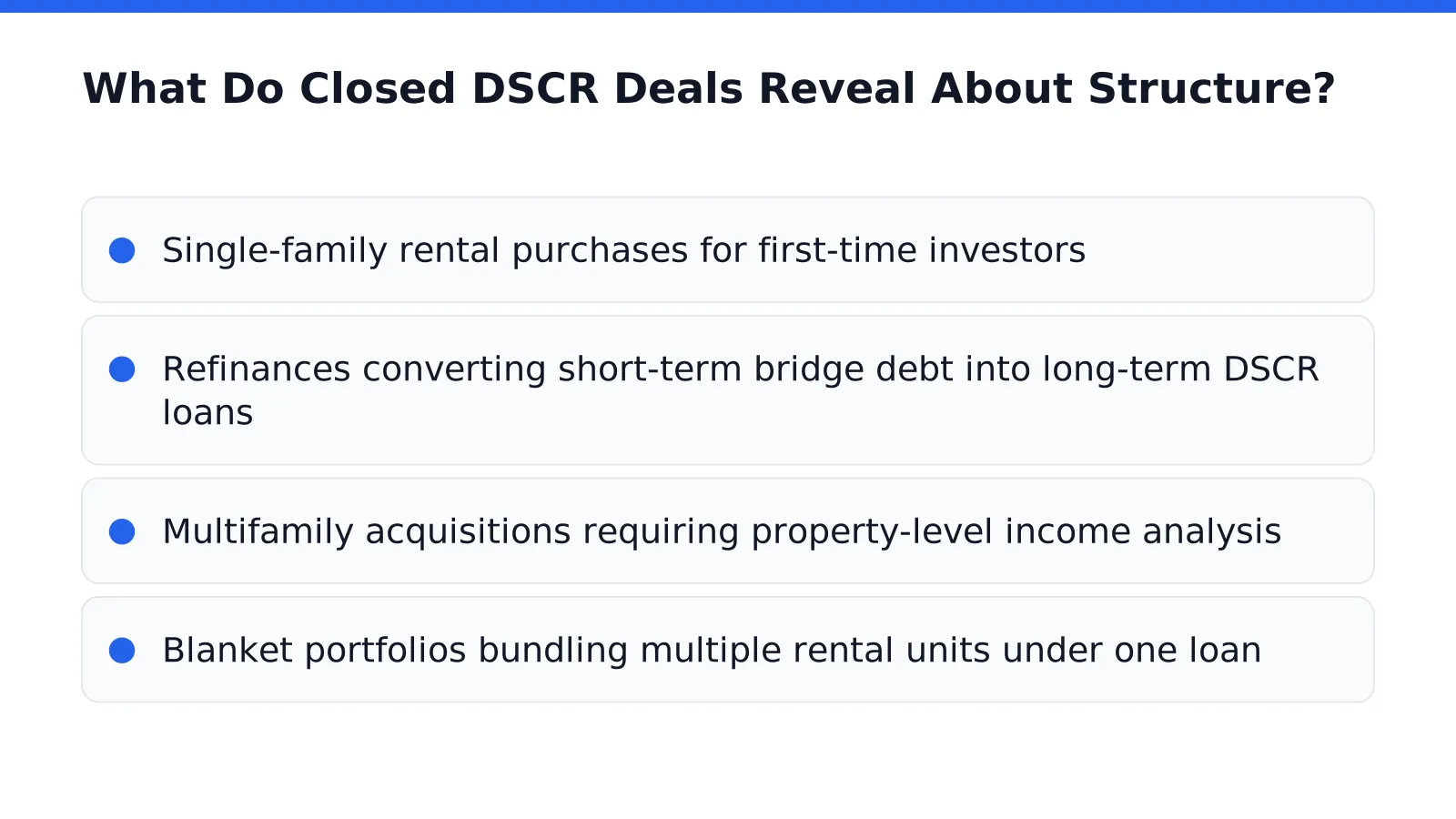
What Do Closed DSCR Deals Reveal About Structure?
Closed DSCR deals reveal a financing structure built on property income, not personal tax returns. Industry-wide closed-deal records show DSCR financing structured across deals nationwide, covering rentals, refinances, and multifamily acquisitions. Skipping cash-flow underwriting means missing a financing path already proven at that scale.
Reviewing DSCR case studies across markets uncovers a consistent pattern. Deal sizes range widely, from single-family purchases to blanket portfolios covering 55 properties. That spread shows cash-flow-based underwriting scales from a first rental to a sprawling multi-property holding.
What types of properties close under DSCR financing?
DSCR structures close across several property categories, each carrying a distinct cash-flow profile:
- Single-family rental purchases for first-time investors
- Refinances converting short-term bridge debt into long-term DSCR loans
- Multifamily acquisitions requiring property-level income analysis
- Blanket portfolios bundling multiple rental units under one loan
Comparing DSCR loan examples side by side shows underwriting centers on the property’s income, never the borrower’s W-2 or tax filings.
How does loan structure stay consistent across deal sizes?
Munshi Capital Inc. gives borrowers full visibility into loan status from start to finish, paired with quick pre-approval timelines. That transparency matters most when a deal involves multiple properties or a tight closing window. A wide product lineup, built on a commitment to integrity, keeps investors returning for every later acquisition.
Any investment case study on DSCR financing reads as a structural blueprint, not a one-off story. Income coverage ratio, property type, and loan sizing repeat across markets and portfolio sizes alike.

Why Are DSCR Loans Key For New Investors?
Rental income, not personal pay stubs, decides approval under a debt-service coverage ratio (DSCR) loan. New investors gain access to financing without submitting tax returns or W-2s. Qualification rests on what the property earns rather than what the borrower earns personally. That shift removes a barrier that keeps many aspiring landlords stuck renting instead of owning.
Self-employed buyers face this barrier most often. Business owners with variable income, freelancers, and investors expanding a portfolio all run into traditional underwriting walls built around steady paychecks. A DSCR structure sidesteps that wall entirely, evaluating the deal on the rental math instead of the borrower’s W-2 history.
What Do DSCR Case Studies Reveal About First-Time Investor Outcomes?
Reviewing DSCR case studies shows a consistent pattern: properties with rent that covers the mortgage payment get approved, regardless of the owner’s personal income documentation. First-time buyers purchasing a single rental unit follow a similar underwriting path to seasoned investors managing several properties.
How Do DSCR Loan Examples Help Explain the Qualification Process?
Looking at real DSCR loan examples clarifies how lenders weigh rental projections against the proposed mortgage payment. Each scenario centers on one question: does the property’s income support the debt?
Munshi Capital Inc. structures this process around clarity at every stage:
- Application built around property cash flow, not personal tax filings
- Underwriting focused on rental income documentation
- Closing guided step-by-step with no hidden conditions
An investment case study on DSCR financing typically highlights this same framework. New investors move from application to closing without the paperwork burden tied to conventional personal-income loans, while Munshi Capital Inc. guides first-time buyers through financing designed for their exact situation.
What Should You Verify Before Choosing A Lender?
Credit score minimums, down payment limits, and reserve requirements separate one lender’s program from the next. Investors reviewing DSCR loan examples quickly discover that no two offers look alike. Skipping this comparison costs real money: a borrower who accepts the first term sheet may overpay on rate or get stuck with a reserve requirement that drains available capital.
Lenders and wholesale investors set their own rules, and the gaps between them matter. Before signing anything, property owners and portfolio builders should confirm the following:
- Credit score minimums, which vary widely by lender and loan type
- Down payment and LTV limits, since some programs demand significantly more equity upfront
- DSCR ratio thresholds, the specific coverage number a property must hit to qualify
- Reserve requirements, meaning how many months of payments must sit in the bank at closing
Why Does Loan Transparency Matter For DSCR Borrowers?
Clarity protects investors from surprises at the closing table. Munshi Capital Inc. builds its approach on trust, honesty, and a service-driven ethos, positioning the company as a dependable partner through every stage of the loan journey. That borrower-first guidance matters most when reviewing an investment case study for DSCR financing. Qualification depends entirely on the property’s income rather than personal tax returns.
What Should An Investor Ask Before Signing?
Ask how the DSCR ratio gets calculated, and ask what reserves are required at closing. Request the credit score floor in writing, not verbally.
Munshi Capital Inc. structures mortgage financing around the borrower, not the paperwork. Guidance runs through every loan program with clear answers and dependable service. Investors examining DSCR case studies can compare terms with full visibility rather than guesswork.
Essential Takeaways for DSCR Loan Success
Why do DSCR loans skip personal income verification?
Qualification rests on the property’s projected rental income rather than the borrower’s tax returns or employment history. Underwriters compare expected rent against debt obligations to determine the DSCR ratio for approval.
What loan products does Munshi Capital Inc. offer investors?
Munshi Capital Inc. provides DSCR and hard money loans as investor-focused options, alongside FHA, VA, USDA, and bank statement programs. This range serves both first-time homebuyers and seasoned investors with tailored financing.
Why should investors compare multiple DSCR case studies before applying?
Underwriting rules vary between lenders on credit minimums, down payments, and reserves. A deal qualifying easily with one source may face stricter terms elsewhere. Reviewing several case studies reveals that variation before locking into a lender.
Conclusion
In closing, the case studies presented demonstrate that successful real estate investment financing requires more than capital availability, it demands a lending partner committed to understanding your specific investment objectives and financial circumstances. Munshi Capital Inc. delivers precisely this through transparent processes, specialized DSCR loan solutions, and personalized guidance that removes complexity from acquisition and refinancing decisions. Investors nationwide rely on this combination of expertise, integrity, and dependable service to execute their strategies with confidence and clarity.
Leave a Reply