
Residential mortgage options from Munshi Capital Inc. include FHA, VA, USDA, and bank statement loans, covering first-time homebuyers to investors. DSCR and hard money loans serve specialized needs. Transparent underwriting and fast pre-approvals guide borrowers nationwide through every step confidently.
Residential mortgage loans encompass FHA, VA, USDA, and bank statement programs, each suited to different borrower profiles from first-time buyers to investors. Munshi Capital Inc. guides clients through application, underwriting, and closing with full transparency, offering DSCR and hard money loans alongside quick pre-approvals and complete visibility into loan status.
Residential mortgage loans fall into three core categories: conventional, government-backed (FHA, VA, USDA), and specialty programs like bank statement or DSCR loans for self-employed borrowers and investors. Munshi Capital Inc. structures each option around loan type, term, and interest rate, matching California homebuyers and nationwide investors with transparent, income-based financing solutions.
Key Takeaways
- Residential mortgages consist of three core elements: loan type, loan term, and interest rate structure.
- Munshi Capital Inc. offers FHA, VA, USDA, conventional, and bank statement loans for diverse borrower profiles.
- First-time homebuyers and seasoned investors access tailored financing solutions through our comprehensive residential loan programs.
- Transparent underwriting and fast pre-approvals ensure borrowers maintain full visibility throughout the entire lending process.
What Makes Choosing a Mortgage So Confusing?
Dozens of loan programs compete for attention, each with different down payment rules, income documentation requirements, and property eligibility standards. A home purchase ranks among the largest financial commitments a person makes. A mortgage uses the home itself as collateral. That means the lender holds rights to the property if payments stop, raising the stakes for picking the wrong fit.
First-time buyers face a maze of government-backed options. Self-employed applicants run into income documentation hurdles traditional lenders rarely explain clearly. Investors juggle property-based qualification standards that differ entirely from owner-occupied rules. Each of these groups needs a different starting point, yet most lenders present the same generic menu to everyone.
Why does mortgage shopping feel overwhelming for new buyers?
New buyers often don’t know which category of loan applies to their situation before they even start comparing rates. A solid residential mortgage guide (residential-mortgage-guide-002) breaks financing into three core decisions: loan type, loan term, and interest rate structure. Without that framework, buyers compare rates on loans that don’t even match their qualifications.
What causes confusion for self-employed and investor borrowers?
Self-employed borrowers and real estate investors typically fall outside standard documentation boxes. Munshi Capital Inc. addresses this by offering mortgage financing for borrowers ranging from first-time homebuyers to seasoned investors, with a full suite of residential and commercial programs built for different financial pictures.
Residential loan basics (residential-loan-basics-002) matter here: understanding what counts as qualifying income, acceptable property types, and down payment minimums prevents wasted applications. Munshi Capital structures guidance around the borrower, not a fixed script, offering clear answers through every program step. That borrower-first approach removes much of the guesswork that makes how to get a home loan (how-to-get-a-home-loan-002) feel like an uphill climb for most applicants.
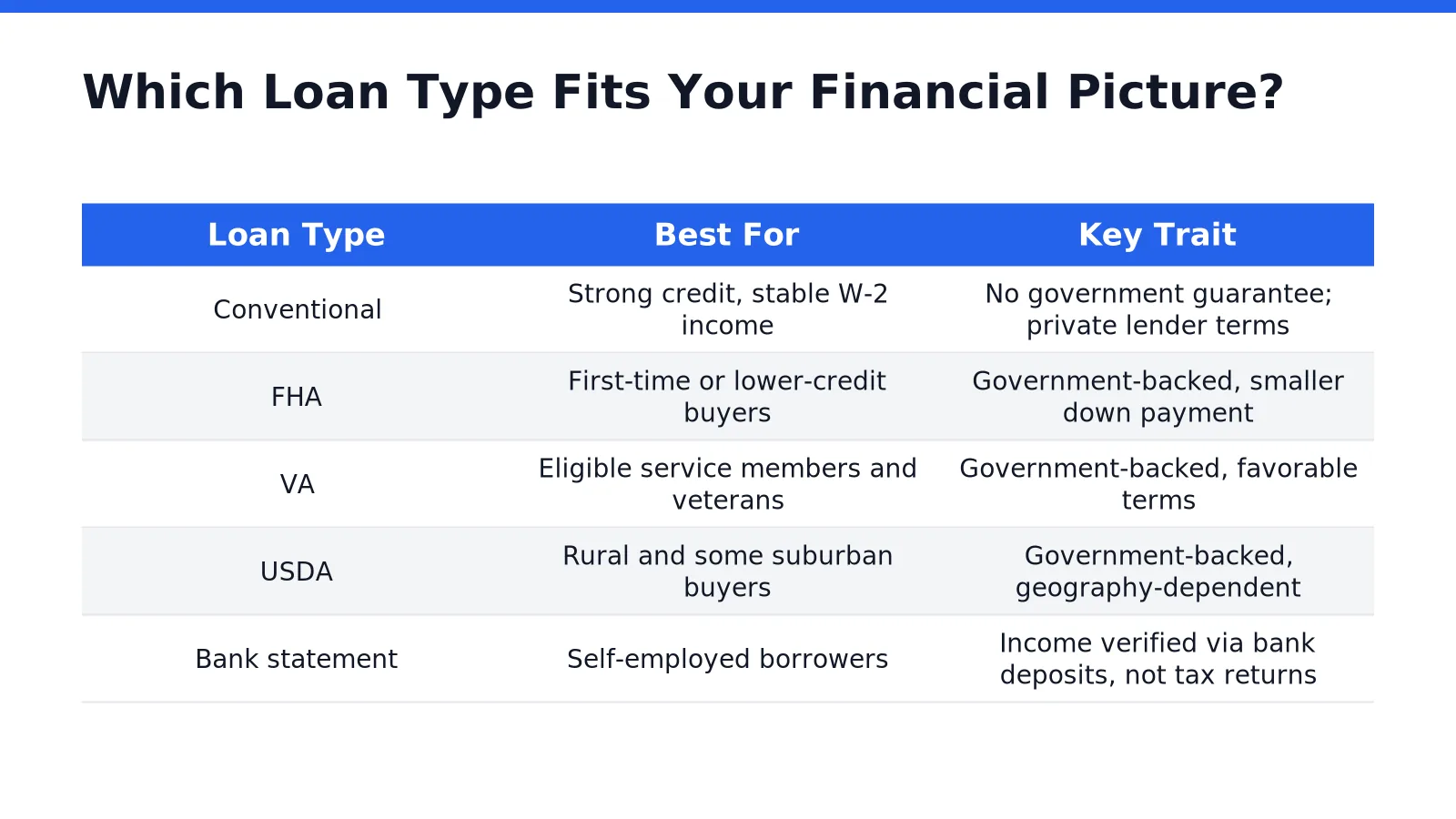
Which Loan Type Fits Your Financial Picture?
Financial circumstances, not preference alone, determine the right mortgage product. A self-employed investor with variable income needs a different structure than a first-time buyer with a steady paycheck. Skipping this step costs borrowers money: the wrong loan type means higher mortgage insurance, a larger down payment, or a rejected application after weeks of waiting.
This kind of residential loan basics assessment starts with a simple question: is the loan backed by a government program, or is it conventional? Conventional loans are not insured or guaranteed by the federal government; they come from private lenders such as banks. Credit unions, and they typically carry stricter credit and income requirements. Government-backed programs, by contrast, exist to widen access for buyers who might not otherwise qualify.
Munshi Capital Inc. structures its residential mortgage guide around that distinction, offering FHA, VA, USDA, and bank statement loans built around each client’s actual financial picture rather than a one-size-fits-all formula.
How does someone figure out how to get a home loan that matches their income type?
The process starts with an honest look at income documentation, credit profile, and the size of loan needed. A W-2 employee with consistent pay stubs fits neatly into conventional or FHA underwriting. A self-employed borrower, whose tax returns rarely reflect true cash flow, often fits better with a bank statement loan that verifies income through deposits instead.
Munshi Capital Inc.’s wide array of loan products, paired with personalized guidance, gives homebuyers and investors nationwide a path suited to their actual numbers, not a generic template.

How Do Fixed Rates and Loan Terms Work?
Fixed rates and loan terms determine how much a monthly mortgage payment costs. How long that cost stays the same. Every loan carries three core elements worth evaluating before signing anything: the residential loan basics of loan type, loan term, and interest rate type. Borrowers who understand these pieces walk into underwriting with far more confidence than those who don’t.
Fixed-rate mortgages remain the most popular choice among homeowners, and the reason is simple: predictability. A fixed-rate loan locks in the interest rate for the entire life of the loan, which stabilizes payments for long-term budgeting. Monthly principal and interest stay constant whether the loan runs 15, 20, or 30 years.
Why does loan term length matter so much?
Loan term length sets the pace of repayment and the total interest paid over time. A shorter term, such as 15 years, builds equity faster but raises the monthly payment. A longer term, such as 30 years, lowers monthly costs but stretches out interest expense.
Is a fixed rate always better than an adjustable one?
Not necessarily, but fixed rates offer certainty that adjustable products cannot match. The right fit depends on income stability, how long someone plans to stay in the home, and risk tolerance.
Munshi Capital’s loan specialists offer personalized guidance, part of a broader guide to residential mortgages, helping borrowers nationwide choose a term and rate structure matched to their goals. That guidance covers how to secure a home loan from first application through closing, with clarity at every step.

What Options Exist for Investors and Self-Employed Buyers?
Investors and self-employed buyers qualify for mortgage programs built around property income. Bank statements rather than a standard pay stub. Conventional underwriting denies many financially strong borrowers simply because tax returns show lower adjusted income than actual cash flow. Munshi Capital Inc. structures financing around the real numbers behind a business or a rental portfolio, not a W-2 assumption.
Munshi Capital Inc. includes specialized products like DSCR loans and hard money loans, both built for investor-focused financing. DSCR loans qualify an investor using the property’s rental income instead of personal tax filings. Hard money loans fund time-sensitive purchases and renovation projects that conventional closing timelines cannot support.
What Is a DSCR Loan?
A debt-service coverage ratio (DSCR) loan evaluates a rental property’s income against its mortgage obligation, not the borrower’s personal earnings. Self-employed investors with inconsistent W-2 income often qualify faster this way. Property cash flow, not a pay stub, carries the application.
Self-employed applicants face a related hurdle: tax write-offs that shrink paper income well below actual earnings. Munshi Capital Inc. emphasizes clarity and honest communication throughout underwriting, walking bank statement loan applicants through exactly which documents count as proof of income. Learning how to get a home loan without traditional pay stubs starts with that documentation review, not guesswork.
A solid residential mortgage guide for investors begins with matching loan structure to strategy, whether that means a rental purchase, a renovation flip, or a refinance. Mastering residential loan basics matters most for borrowers whose income doesn’t fit a standard mold. California investors and owners nationwide can search their city for local programs, rates, and market insights. Those weighing a sale instead of financing can request a direct cash offer. Owners confirming current value first should request your property assessment.
How Does the Application and Closing Process Work?
Borrowers move through three clear stages: application, underwriting, and closing. Each stage follows a structured path built for clarity, not confusion. No hidden fees surface late, and no surprise conditions appear at the closing table.
The process starts simply. A borrower completes a quick, secure application and shares financial goals with a loan specialist. That conversation determines which residential or commercial program fits the borrower’s situation, whether a first home purchase, a move-up property, or an investment acquisition. This initial exchange sets the foundation for everything that follows, functioning as the entry point into a complete residential mortgage guide that carries borrowers from inquiry to funded loan.
From there, underwriting begins. Loan specialists combine modern technology with hands-on review to move files forward quickly while keeping borrowers informed at every step.
What Happens During Underwriting?
Underwriting verifies income, assets, and property details against the chosen loan program’s requirements. Borrowers receive full visibility into loan status throughout, rather than waiting weeks for an update. This transparency reflects core residential loan basics that every applicant should expect from a lender.
How Fast Can Pre-Approval Happen?
Pre-approvals move quickly once documentation is submitted. Speed does not replace accuracy, however; files still receive full review before conditions clear.
Closing follows underwriting approval. The borrower reviews final terms, signs documents, and funds the loan. For anyone researching how to get a home loan without unnecessary delay, this three-stage structure, application, underwriting, closing, offers a predictable, repeatable path from first contact to keys in hand.
Understanding Core Residential Mortgage Fundamentals
What types of residential mortgage loans does Munshi Capital offer?
Munshi Capital Inc. provides conventional, government-backed options like FHA, VA, and USDA, plus specialty programs including bank statement, DSCR, and hard money loans for diverse borrower profiles.
How does Munshi Capital help self-employed borrowers qualify?
Munshi Capital structures guidance around the borrower’s actual financial picture, offering bank statement loans and clear answers on qualifying income, removing documentation hurdles traditional lenders rarely explain clearly.
What makes the Munshi Capital loan process transparent?
Borrowers move through application, underwriting, and closing with full visibility into loan status, backed by modern technology and hands-on loan specialists delivering quick pre-approvals.
Conclusion
In closing, navigating the residential mortgage landscape requires both comprehensive knowledge of available loan programs and access to transparent, dependable guidance. The diversity of financing options, from conventional and government-backed loans to specialized investor products, ensures that borrowers with varying financial profiles. Objectives identify solutions aligned with their specific circumstances. Success in securing appropriate residential financing depends on partnering with lenders who prioritize clarity throughout the application, underwriting, and closing process, eliminating uncertainty and building confidence in your borrowing decision.
Leave a Reply