
DSCR loans qualify real estate investors using a property’s rental income instead of personal income or tax returns. Munshi Capital Inc. calculates debt service coverage ratio by dividing net operating income by debt obligations, including principal and interest, serving self-employed landlords, LLC borrowers, and portfolio builders nationwide seeking non-QM financing without employment verification.
Key Takeaways
- DSCR loans qualify borrowers based on rental property cash flow, eliminating personal income documentation requirements entirely.
- Real estate investors bypass traditional employment verification by using the property’s debt service coverage ratio for approval.
- Self-employed investors and LLC owners access financing designed specifically for investment properties without standard income restrictions.
- DSCR loans serve both short-term and long-term rental properties, providing flexible solutions for diverse investment strategies.
What Exactly Is a DSCR Loan?
A DSCR loan is a mortgage product designed specifically for purchasing short-term or long-term rental investment properties. Unlike a conventional mortgage, this financing structure evaluates the property itself rather than the borrower’s personal finances. That distinction changes everything for landlords juggling multiple properties or irregular income streams.
Qualification hinges on projected rental income instead of pay stubs or tax returns. Lenders review the property’s expected cash flow to determine whether it can cover its own debt obligations. No personal income or employment verification enters the equation at all.
This approach removes a major obstacle for self-employed investors and portfolio builders. Traditional underwriting often penalizes landlords who write off expenses aggressively or hold income across multiple entities. A rental-income-based model sidesteps that friction entirely, judging the asset instead of the applicant’s tax strategy.
How does a DSCR loan differ from a traditional mortgage?
Traditional mortgages weigh personal income, employment history, and debt-to-income ratios. A DSCR loan ignores those factors and instead measures the subject property’s ability to generate enough rental income to service its own debt. Investors scaling a portfolio benefit because each new loan stands on its own property performance, not on an ever-thinning personal income statement.
Munshi Capital Inc. positions DSCR investor finance alongside hard money lending as part of a broader suite built for serious property investors. These programs sit within a comprehensive catalog of residential. Commercial loan options serving borrowers nationwide, from first-time buyers to seasoned landlords.
For investors evaluating whether an investment mortgage DSCR structure fits a current acquisition, reviewing the property’s rental performance is the logical starting point. Owners sitting on underperforming or hard-to-finance properties can also request a direct cash offer to compare against refinancing or holding strategies.

How Does DSCR Qualification Work for Investors?
Property income, not personal income, drives approval under a DSCR loan guide framework. Rental cash flow replaces tax returns. W-2s as the qualifying measure, a structure that removes the single biggest obstacle self-employed landlords face with conventional lenders. Standard mortgages scrutinize personal earnings, write-offs, and employment history; DSCR underwriting looks at what the property itself generates.
This distinction matters most for investors whose tax returns show heavy deductions. A portfolio builder who legally minimizes taxable income often looks “unqualified” on paper to a conventional underwriter, even while owning properties with strong cash flow. DSCR investor finance solves that mismatch by letting the asset speak for itself.
Munshi Capital Inc. structures its investment mortgage DSCR programs around each borrower’s specific goals, not a generic checklist. Guidance runs through every loan program, with clear answers replacing the guesswork that slows down traditional underwriting. The firm’s menu extends beyond DSCR into FHA, VA, USDA, and bank statement financing, giving investors multiple paths depending on how their portfolio and finances are structured.
What Information Replaces Income Documents in DSCR Underwriting?
Lenders substitute personal income verification with a property-level cash flow review. Rental income gets measured against the property’s debt obligations, producing a ratio that determines eligibility. No pay stubs, no tax transcripts, no employment letters required.
Who Benefits Most From This Qualification Method?
Self-employed landlords, LLC-structured investors, and portfolio builders scaling past a handful of properties gain the most. Traditional debt-to-income limits stop mattering once rental performance becomes the qualifying factor. Before selecting a program, investors evaluating a purchase or refinance can request your property assessment to confirm projected rental income supports the target loan amount. Munshi Capital’s team reviews those numbers and maps out financing options aligned with each investor’s long-term acquisition strategy.

What Credit and Down Payment Do You Need?
Qualification for a DSCR loan guide‘s typical approval range hinges on two numbers: credit score and down payment. Lenders generally set a minimum credit score of 680 before extending a debt service coverage ratio loan, according to industry requirement data from What are the requirements for a DSCR loan?. That threshold separates most investors from eligibility at a glance.
Credit score is not a pass-fail test, though. A higher score unlocks a better interest rate. More favorable loan terms, giving investors more room to negotiate repayment structure and fees. Portfolio builders with scores well above the 680 floor typically see pricing advantages that compound across multiple properties over time.
Down payment requirements follow a similarly firm pattern. Most lenders require 20 to 25 percent of the purchase price upfront for DSCR investor finance, a higher bar than many owner-occupied loan programs. That range reflects the added risk lenders absorb when underwriting is based on rental income rather than a borrower’s personal earnings.
How does credit score affect DSCR loan approval?
Credit score determines both eligibility and pricing. Scores at or above 680 typically clear the baseline approval threshold, while stronger scores translate directly into lower rates and more flexible terms on an investment mortgage DSCR product.
Is 20 percent down enough for a DSCR loan?
Twenty percent sits at the low end of the standard range for most lenders, with 25 percent common for certain property types or borrower profiles. Investors should prepare for either figure depending on the deal.
Munshi Capital guides borrowers through every step of application, underwriting, and closing, translating credit and down payment requirements into a clear picture of what an offer looks like. Investors ready to move forward can request a direct cash offer or request your property assessment to see where their numbers stand today.
How Do You Calculate the DSCR Ratio?
Dividing a property’s net operating income by its total debt obligations, including the mortgage payment, produces the DSCR figure. The resulting number tells lenders whether rental income alone can carry the loan. No tax returns or pay stubs enter the equation.
This calculation sits at the center of the DSCR loan guide that investors need before approaching a non-QM lender. Net operating income covers rent collected minus operating expenses like taxes, insurance, and maintenance. Debt obligations include principal, interest, taxes, and insurance, often bundled as the PITI payment.
What Does the DSCR Number Actually Mean?
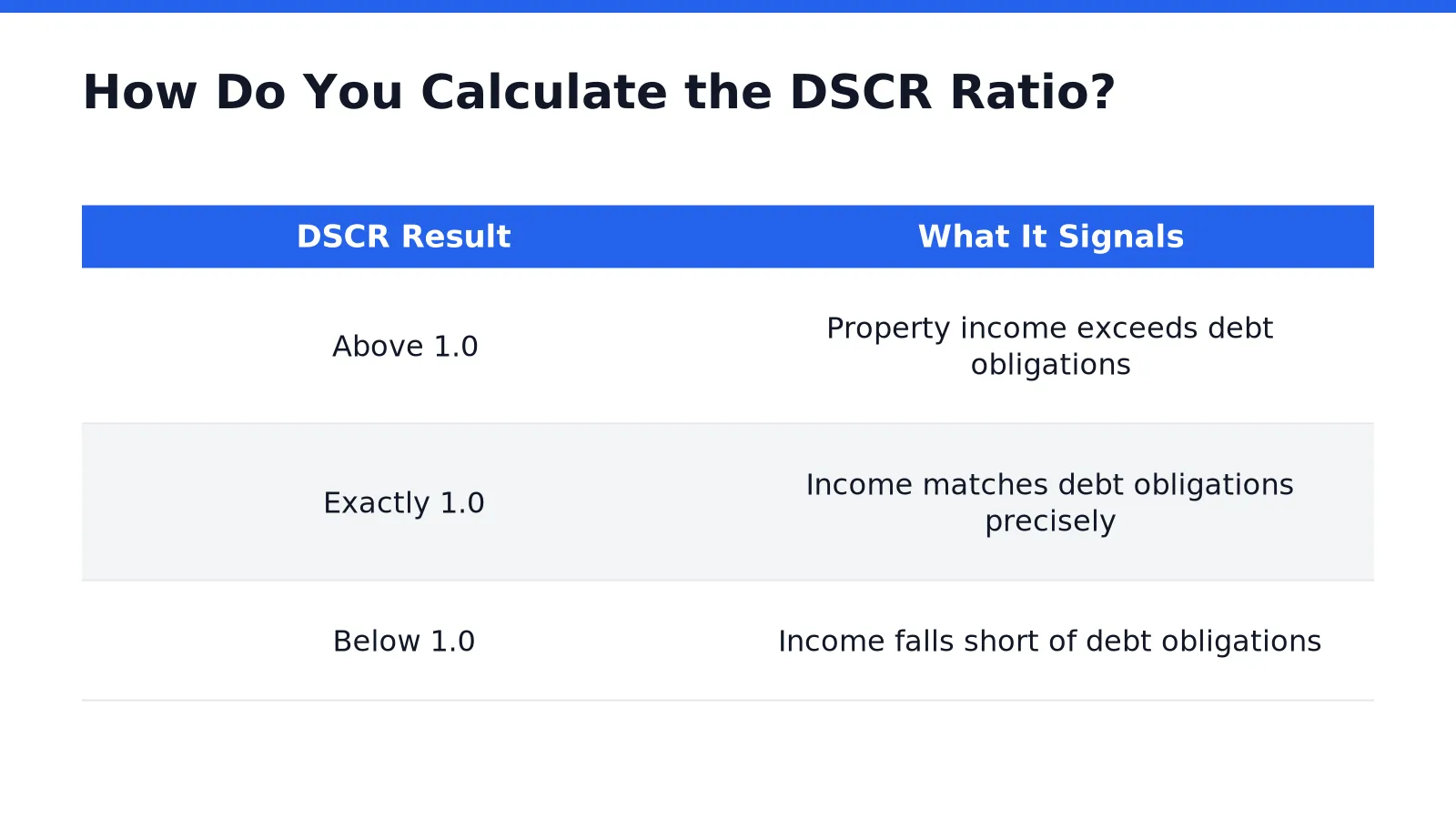
A ratio above 1.0 means the property generates more income than its debt requires. A ratio below 1.0 means the rental income falls short of covering the mortgage payment. Lenders use this single figure to judge whether a property can service its own debt without relying on an owner’s outside salary.
Precision matters here. A miscalculated net operating income figure skews the entire investor finance decision, leading to an inaccurate loan offer or an unnecessary denial.
Munshi Capital Inc. pairs modern underwriting technology with hands-on loan specialists who verify these numbers manually. That combination speeds up pre-approval review without sacrificing accuracy. Investors also receive full visibility into loan status, from the initial application through closing. No step in the investment mortgage process happens behind closed doors. For portfolio builders juggling multiple properties, that transparency removes guesswork from every calculation and every closing date.
What Rates and Terms Should You Expect?
Rate expectations for cash-flow-based financing sit higher than conventional mortgages, with current pricing in the mid-6% to 7% range according to a 2025 industry analysis from DSCR Loans: Requirements, Rates, And How To Qualify. The same analysis reports down payments of 20-25% and minimum credit scores near 660-700 as the standard benchmark for approval. Property investors researching this DSCR loan guide will notice a clear tradeoff built into the structure.
Rates run higher, and prepayment penalties often apply during the early years of the loan term. In exchange, borrowers gain faster approvals and the ability to close title under an LLC rather than a personal name, a feature few conventional lenders permit.
Why Do DSCR Loans Cost More Than Conventional Mortgages?
Lenders price these loans against the property’s cash flow risk, not personal income documentation. The rate reflects the asset’s performance. Speed and ownership flexibility carry a cost that shows up directly on the rate sheet.
Typical terms line up this way:
Munshi Capital Inc. builds its DSCR investor financing process around clarity about these figures from the first conversation. Clients review the rate structure, penalty schedule, and down payment requirement before submitting an application. That transparency matters most for portfolio builders comparing multiple investment mortgage DSCR offers across different property types. A half-point rate difference compounds significantly over a multi-unit hold period. Loan specialists walk investors nationwide through each term so no surprise appears at the closing table.
Which Properties and Investors Qualify Best?
Stabilized rental properties with one to four units qualify best for DSCR financing, not primary residences. Munshi Capital Inc. structures its investment mortgage DSCR programs around properties already generating consistent rental income. The loan hinges on cash flow rather than a borrower’s paycheck.
Owner-occupied homes fall outside this category entirely. Long-term rental performance matters more than purchase price or buyer income history.
What type of borrower benefits most from a DSCR loan?
Investors new to real estate often qualify more easily through this path than through conventional underwriting. Borrowers carrying existing debt obligations, ones that would otherwise disqualify them from a traditional mortgage, find DSCR structuring removes that obstacle. Self-employed landlords and portfolio builders without traditional pay stubs gain the same advantage.
Which properties typically fail to qualify?
Short-term flips, vacant units, and non-stabilized properties rarely meet lender expectations. Underwriters want proven rental history, not projected income on a property still under renovation.
Qualification generally favors:
- Long-term rental properties with one to four units
- Properties with documented, stabilized rental income
- Borrowers prioritizing property cash flow over personal income verification
- Investors managing multiple debt obligations who need flexible underwriting
Qualification generally excludes:
- Primary residences and owner-occupied homes
- Properties lacking rental history or stable tenancy
- Short-term fix-and-flip projects without rental documentation
A property’s earning power carries more weight here than a borrower’s W-2. This is the foundation of a complete DSCR loan guide: match the right asset type to the right financing model. Munshi Capital Inc. built its DSCR investor finance offerings around that principle, pairing a wide array of loan products with guidance rooted in clarity and honesty, qualities that make the company a dependable resource for investors evaluating which properties actually qualify.
How Does Munshi Capital Guide DSCR Borrowers?
Munshi Capital guides DSCR borrowers through a structured path built on clarity rather than guesswork. Every stage, from first inquiry to final closing, rests on honest communication about property cash flow, loan terms, and timelines. Self-employed landlords and portfolio builders often arrive frustrated by opaque lenders. This approach replaces that frustration with a plan they can actually follow.
The application process itself stays simple by design. Borrowers move through underwriting and closing without hidden fees or surprise conditions buried in fine print. This dscr-loan-guide-009 approach means investors know what documentation matters, what the property’s debt service coverage ratio needs to show, and what to expect at each checkpoint.
What makes DSCR pre-approval faster at Munshi Capital?
Speed comes from pairing technology with real loan specialists who understand investment property financing. Automated systems handle the routine calculations, while experienced staff review the details that matter for a given rental portfolio. That combination shortens pre-approval timelines without sacrificing accuracy on the numbers.
Can investors track their loan status during the process?
Full visibility into loan status remains available from application through closing. Investors managing multiple properties do not have to chase updates or wonder where a file stands. This matters most for dscr-investor-finance-009 clients juggling several deals simultaneously. Delays on one property can stall plans for the next acquisition.
Munshi Capital’s foundation rests on trust and a service-driven commitment to borrower-first guidance. Clarity, honesty, and consistent communication define the relationship from day one. For investors ready to move forward with an investment-mortgage-dscr-009 strategy, the next step is simple:
- Review current rental property details and projected cash flow
- Connect with a loan specialist to discuss DSCR qualification
- Request your property assessment to confirm financing options before submitting a formal application
Portfolio builders exploring a property sale alongside new acquisitions can also request a direct cash offer to compare paths and move forward with confidence.
What’s the Next Step for Your Portfolio?
Growth requires a financing partner that treats each investor as a distinct case, not a checklist. Munshi Capital builds mortgage financing around the individual investor, offering guidance through every loan program with clear answers and dependable service. Skipping that kind of partnership often means missed acquisitions, slower closings, and costly guesswork on cash flow numbers.
Portfolio builders exploring a dscr-loan-guide-009 face a choice: patch together generic advice or work with a lender structured for rental-income qualification. Munshi Capital stands on trust, committed to transparent, borrower-first guidance for the next DSCR purchase or refinance. That approach rests on clarity and honesty rather than sales pressure, which matters most when timelines are tight and competing offers are on the table.
Why does loan program variety matter for investors?
Variety protects against being boxed into one structure that fits only certain properties. A trusted dscr-investor-finance-009 strategy draws on a wide range of loan products, backed by a consistent commitment to integrity that has made the firm a dependable choice for investors nationwide.
How does loan visibility help with planning future deals?
Full visibility into loan status, from application through closing, lets investors plan their next acquisition with confidence instead of waiting on unclear updates. That transparency supports faster decisions on timing a refinance or lining up the next investment-mortgage-dscr-009 purchase.
Investors ready to move forward have two clear paths:
- Sellers holding an investment property can request a direct cash offer to evaluate a fast, straightforward exit.
- Owners weighing current equity or next steps can request your property assessment before committing to a purchase, refinance, or sale decision.
Essential Principles of DSCR Loan Qualification
What is a DSCR loan?
A DSCR loan is a mortgage product for purchasing short-term or long-term rental investment properties, evaluating the property’s rental income rather than the borrower’s personal finances or employment history for approval.
How does DSCR qualification differ from a traditional mortgage?
Traditional mortgages weigh personal income, employment history, and debt-to-income ratios. DSCR underwriting measures the property’s own rental cash flow against its debt obligations, including principal and interest.
Who benefits most from DSCR financing?
Self-employed landlords, LLC borrowers, and portfolio builders benefit. DSCR loans eliminate personal income documentation and employment verification, judging the asset instead of the applicant’s tax strategy.
Conclusion
In closing, DSCR loans represent a strategic financing mechanism for real estate investors seeking to leverage property income as the primary qualification metric. By prioritizing cash flow over personal income documentation, this loan product addresses the distinct financial profiles of investment portfolios. Munshi Capital Inc. delivers transparent guidance through the DSCR application process, ensuring investors understand their options and secure financing aligned with their portfolio objectives. Our commitment to clarity and dependable service positions borrowers to make informed decisions and advance their investment strategies with confidence.
Leave a Reply