
USDA loans deliver 0% down payment financing for eligible rural. Select suburban properties, with eligibility based on household income guidelines and location. Munshi Capital Inc. guides borrowers through USDA eligibility maps. Requirements, offering transparent, step-by-step support from application through closing to secure dependable, tailored financing nationwide.
USDA-eligible areas across the United States include designated rural and suburban zones identified through the USDA Property Eligibility Map, which determines zero-down financing qualification. Munshi Capital Inc. guides first-time buyers and investors nationwide through USDA loan programs, checking property eligibility, income limits, and underwriting requirements with transparent, step-by-step support from application through closing.
Key Takeaways
- USDA loans require household income to meet specific guidelines and properties must be located in USDA-eligible rural areas.
- The Single Family Housing Guaranteed Loan Program provides transparent eligibility evaluation through USDA’s Income and Property Eligibility Site.
- Property location in designated rural zones determines USDA loan qualification alongside documented household income verification requirements.
- Our loan specialists guide you through USDA eligibility assessment with clear answers about income thresholds and property requirements.
What Will This USDA Guide Help You Accomplish?
This guide equips suburban and rural home buyers across the United States with a clear path to zero-down financing. USDA-backed mortgages carry a 0% down payment option, lower interest rates, and reduced upfront and annual fees compared with the mortgage insurance required on conventional loans. Without this knowledge, buyers risk overlooking a financing route that could save thousands over the life of a loan. The guide walks readers through four core outcomes.
- Confirm location eligibility. Learn how to check whether a target property sits inside USDA-approved boundaries using the usda-eligible-areas-guide-100 before making an offer.
- Understand income limits. Review how household earnings factor into qualification, since the USDA restricts both property location and income levels to keep benefits reaching low- and moderate-income households.
- Assess property qualification. Apply the usda-property-eligibility-100 standards to narrow a search to homes that meet USDA structural and location rules.
- Explore available loan structures. Compare rural-mortgage-programs-100 options suited to first-time buyers, suburban movers, and real estate investors seeking low-cost entry into homeownership.
What Does the USDA Eligibility Site Actually Check?
The eligibility site exists to estimate the likelihood that an applicant qualifies for program assistance before a formal application begins. It screens household income against program guidelines and flags whether a property’s location meets rural designation. Running this check early prevents wasted time pursuing a home that will not clear underwriting.
Munshi Capital Inc. pairs this federal framework with personalized guidance from a dedicated loan team, helping borrowers nationwide move from eligibility questions to confident closings. Property sellers and buyers ready to move forward can request a direct cash offer or request your property assessment to begin the process.
How Do You Check USDA Property Eligibility?
Buyers confirm property eligibility by using an interactive eligibility map before writing an offer on a home anywhere in the United States. This single step prevents wasted earnest money and avoids a financing denial late in escrow. Skipping it risks falling in love with a property that a lender cannot finance under the program.
The map codes ineligible regions in red. A red zone signals that a USDA-backed loan will not work for that specific parcel, even if a neighboring block qualifies. Buyers searching suburban edges of growing metro areas should expect boundary lines that shift block by block. USDA rural designations follow population thresholds rather than county lines.
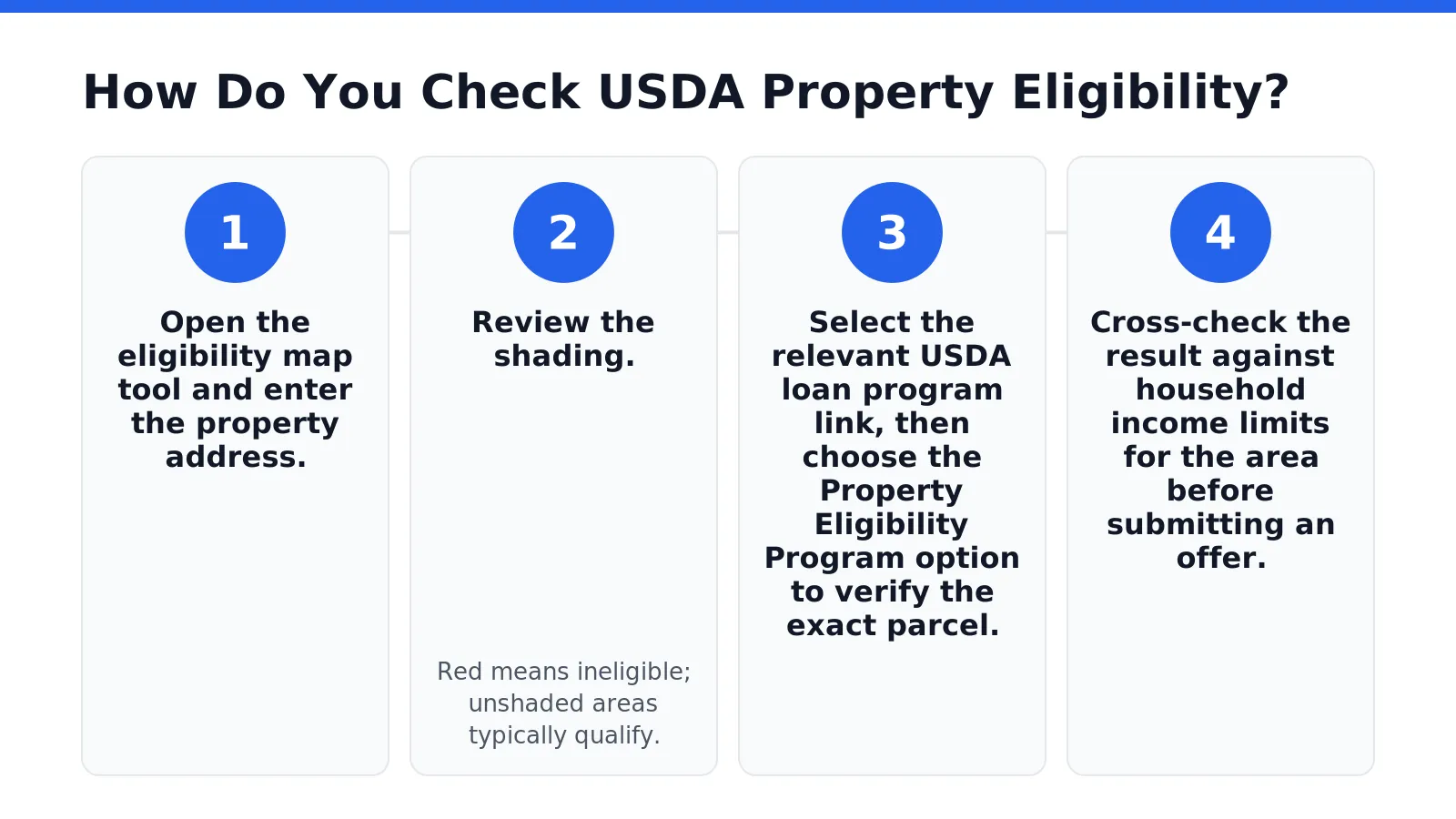
Confirming a specific address takes a short sequence of steps:
- Open the eligibility map tool and enter the property address.
- Review the shading. Red means ineligible; unshaded areas typically qualify.
- Select the relevant USDA loan program link, then choose the Property Eligibility Program option to verify the exact parcel.
- Cross-check the result against household income limits for the area before submitting an offer.
Is USDA Financing Only for Farmland?
No. USDA loans extend homeownership access to rural communities and many suburban areas, not just remote agricultural land. The program targets population density and infrastructure, so buyers often find eligible homes closer to city edges than expected.
What Happens If a Property Falls in a Red Zone?
A red zone means that address does not currently qualify for USDA-backed financing. Buyers should check immediately surrounding streets. Eligibility boundaries change block by block rather than following a strict radius from a city center.
Munshi Capital Inc. guides borrowers nationwide through this usda-property-eligibility-100 check as part of a broader review of rural-mortgage-programs-100. The full usda-eligible-areas-guide-100 process, ensuring every address gets verified before an application moves forward.

How Do You Confirm Household Income Eligibility?
Household income eligibility depends on total earnings across every household member, measured against limits set for the specific county and household size. These limits change based on location and family composition. A figure that qualifies one applicant in one state may exceed the cap for another household elsewhere. Missing this detail early costs borrowers weeks of wasted paperwork and delayed closings.
For 2026, the thresholds are straightforward. A household of one to four people must earn less than the county-specific limit set for that size. A household of five to eight people must earn at or below the limit set for that larger size. Falling above these figures disqualifies an applicant from this particular path, regardless of credit history or down payment readiness.
Income alone does not decide eligibility. The property itself must sit inside an area the USDA formally classifies as rural, part of the broader usda-eligible-areas-guide-100 that defines where this financing applies. A buyer who meets every income requirement still cannot close if the home falls outside that mapped boundary.
Confirming eligibility follows a logical sequence:
- Calculate total household income from all occupants, not just borrowers on the loan.
- Compare that figure against the applicable 2026 limit for household size.
- Verify the property address falls within an eligible rural zone under current usda-property-eligibility-100 standards.
- Select a USDA loan program and review its Loan Program Basics for specific underwriting requirements.
Does household size change the income limit?
Yes. Larger households receive a higher ceiling because the USDA recognizes greater living costs per family. A household of five to eight faces a limit that exceeds the limit applied to smaller households of one to four, with exact figures varying by county.
What if income falls just above the limit?
Borrowers near the threshold should explore alternative rural-mortgage-programs-100 or FHA and conventional options before assuming disqualification. Documentation methods vary by lender and loan type.
Which Rural Mortgage Programs Fit Your Goals?
Rural mortgage programs serve distinct borrower goals, from zero-down purchases to investment financing in eligible small towns and outlying suburbs across the United States. Matching the right program to the right goal prevents wasted applications and missed savings. Munshi Capital Inc. offers a comprehensive suite of residential loan programs, including rural mortgage programs such as FHA, VA, USDA, and bank statement loans, built to match each borrower’s financial picture.
USDA loans, also known as Rural Development loans, stand out for pairing low interest rates with a zero-down payment structure for eligible homebuyers. That combination matters most for buyers with limited cash reserves who still want predictable monthly costs. VA and FHA programs serve different needs, often fitting veterans or buyers with lower credit scores. Bank statement loans suit self-employed borrowers and investors with nontraditional income documentation.
How does a buyer choose between USDA, FHA, and VA financing?
The choice depends on eligibility factors rather than preference alone. USDA financing applies to properties in designated rural and some suburban zones. FHA and VA programs follow different location-independent qualification rules tied to credit history or military service.
Borrowers evaluating options should follow these steps:
- Confirm the target property sits within a qualifying rural or suburban boundary.
- Review income limits against household size and county guidelines.
- Compare USDA’s zero-down structure against FHA’s low down payment and VA’s service-based benefits.
- Consult the dedicated guaranteed housing webpage for full detail on the Single Family Housing Guaranteed Loan Program.
Questions that remain unanswered online do not require guesswork. Buyers can reach out to any of the program’s approved lenders for direct, personalized assistance. Those weighing a purchase against current market value should request your property assessment before comparing financing paths.
What Mistakes Delay USDA Loan Approval?
Missing documentation and unclear communication cause most delays in USDA loan approval. Buyers across suburban and rural areas of the United States lose weeks of processing time to errors that careful preparation avoids. Munshi Capital Inc. pairs modern technology with hands-on loan specialists to catch these issues early, keeping files moving instead of stalling in underwriting.
Four mistakes account for the bulk of avoidable delays:
- Submitting incomplete income or asset documentation, which forces underwriters to pause and request resubmission.
- Skipping pre-approval before house hunting, leading to confusion about affordability and eligibility late in the process.
- Misunderstanding property requirements under the usda-eligible-areas-guide-100, resulting in offers on homes outside qualifying zones.
- Failing to ask questions when loan status is unclear, allowing small issues to compound into closing delays.
Why does loan status visibility matter so much?
Borrowers who track their file from start to finish catch errors before they become closing-day emergencies. Full visibility into loan status, paired with quick pre-approval, prevents the last-minute surprises that most often stall a closing date.
Who can help when the eligibility website leaves questions unanswered?
Approved lenders participating in the guaranteed loan program serve as a direct resource for buyers navigating the usda-property-eligibility-100 rules. A transparent, borrower-first approach rooted in clarity and honest communication closes the gap that miscommunication typically creates in rural-mortgage-programs-100 applications.
FAQ
What determines USDA loan eligibility?
USDA loan eligibility depends on two factors: property location within USDA-designated rural or suburban zones and household income meeting program guidelines. Munshi Capital Inc. checks both factors using the USDA Property Eligibility Map and Income and Property Eligibility Site.
How do I check if a property qualifies for USDA financing?
Buyers use the interactive USDA eligibility map to confirm a target property sits inside approved boundaries before making an offer. Munshi Capital Inc. guides borrowers through this property eligibility check with transparent, step-by-step support.
What financial benefits do USDA loans offer compared to conventional loans?
USDA-backed mortgages offer a 0% down payment option, lower interest rates, and reduced upfront and annual fees compared with the mortgage insurance required on conventional loans. This structure helps first-time buyers and investors save money.
Conclusion
In closing, understanding USDA-eligible areas and programs represents a critical step toward homeownership in rural and transitional communities. Munshi Capital Inc. recognizes that navigating these opportunities requires clarity and expert guidance tailored to your specific financial circumstances. Our comprehensive USDA loan expertise, combined with transparent processes and dedicated loan specialists, ensures you move forward with confidence. Whether you are a first-time homebuyer or experienced investor, we remain committed to delivering the straightforward answers and dependable service necessary to secure financing that aligns with your goals and circumstances.
Leave a Reply