
Conversion improves when borrower-first guidance replaces generic ad funnels: Munshi Capital Inc. pairs fast, transparent pre-approvals with personalized loan-specialist support across FHA, VA, USDA, bank statement, DSCR, and hard money programs, giving every borrower full visibility into loan status from application through closing, no hidden surprises.
Mortgage lead generation success in 2026 depends on system-building rather than list-buying, according to analysis of 3.2 million leads. Loan officers at Munshi Capital Inc. convert prospects through local city-page targeting, FHA, VA, USDA, and bank statement loan programs, plus transparent follow-up
Key Takeaways
- Qualified leads drive higher conversion rates and stronger client relationships than purchased list rentals.
- Transparent communication throughout application, underwriting, and closing builds borrower trust and repeat business.
- Personalized guidance aligned with borrower goals converts prospects into long-term clients across all loan programs.
- Fast pre-approvals with full loan status visibility demonstrate commitment to borrower-first service and reliability.
What Makes a Mortgage Lead Funnel Convert?
Conversion rates separate a working funnel from a wasteful one. A strong mortgage-lead-gen-106 strategy nurtures prospects over time rather than chasing cold names off a purchased list. Nurtured, warm prospects convert at dramatically higher rates than cold-called strangers. That gap explains why loan officers investing in trust-building outperform those relying on volume alone.
Quality matters more than quantity at every stage. High-quality leads strengthen client relationships and significantly improve conversion rates, driving measurable business growth rather than short-lived spikes in form fills. Branch managers tracking lead-generation-benchmarks-106 should weigh lead quality alongside raw counts. A smaller pool of well-matched borrowers often outproduces a large batch of unqualified contacts.
What stages make up a high-converting mortgage funnel?
A funnel built for conversion generally includes these components:
- Awareness content that builds familiarity before any form is submitted
- A simple intake process reflecting strong mortgage-form-conversion-106 design
- Prompt, personalized follow-up from a loan officer or specialist
- Transparent status updates through underwriting and closing
Each stage reduces drop-off and keeps prospects engaged.
Why does personalized guidance improve funnel outcomes?
Personalized guidance helps borrowers nationwide secure financing with confidence, which keeps them engaged through longer underwriting timelines. Munshi Capital Inc.’s team focuses on understanding each client’s goals rather than pushing a generic product. That approach, paired with modern technology and hands-on loan specialist service, keeps the process fast and transparent from application through closing. Loan officers modeling their own funnels on this balance of technology. Personal attention typically see fewer stalled applications and stronger completion rates overall.

Why Do Purchased Lead Lists Underperform?
Purchased lead lists underperform because brokers never gain ownership of the pipeline they fund. The arrangement resembles renting an apartment: monthly payments flow out, yet no equity accumulates. Loan officers restart the search every month, chasing fresh names while the asset they built stays with the vendor.
Recycled data compounds the problem. The same contact list often reaches dozens of competing loan officers at once. Prospects grow numb to outreach before a broker even calls. Effective mortgage lead gen depends on reaching borrowers who have not already heard five identical pitches that week.
Why does buying leads cost more over time?
Repeated purchases drain budget without building a durable asset. Each new batch requires the same spend, the same vetting, and the same conversion effort, with no cumulative advantage carried forward. Brokers who instead capture high-intent prospects, people actively searching for financing, stop competing for that recycled data and start owning their market presence.
What should replace a purchased list strategy?
Shifting toward owned channels changes the economics of the pipeline entirely. Consider the contrast:
- Purchased lists: recurring cost, shared data, no lasting equity
- Owned pipeline: one-time build, exclusive relationships, compounding value
Munshi Capital Inc. built its model around that distinction. The company offers a comprehensive suite of residential and commercial loan programs, including FHA, VA, USDA, and bank statement loans, matched to each borrower’s financial picture. That range, paired with a steady commitment to integrity, gives referral partners and loan officers a dependable product set to pair with any lead strategy that favors ownership over rental.
What Benchmarks Define Qualified Mortgage Leads?
Financial stability and readiness separate a qualified lead from a name on a list. A borrower who shows verifiable income, manageable debt, and a clear timeline to purchase meets the first benchmark loan officers should measure against. These traits let lenders tailor outreach instead of running the same script on every contact.
How does lead source affect qualification rates?
Source quality shapes conversion before a single phone call happens. Leads generated through mortgage lead generation channels built on social platforms and locally optimized landing pages tend to arrive warmer. The content already filtered for relevant financial profiles and local buying intent. Generic purchased lists skip that filtering step entirely.
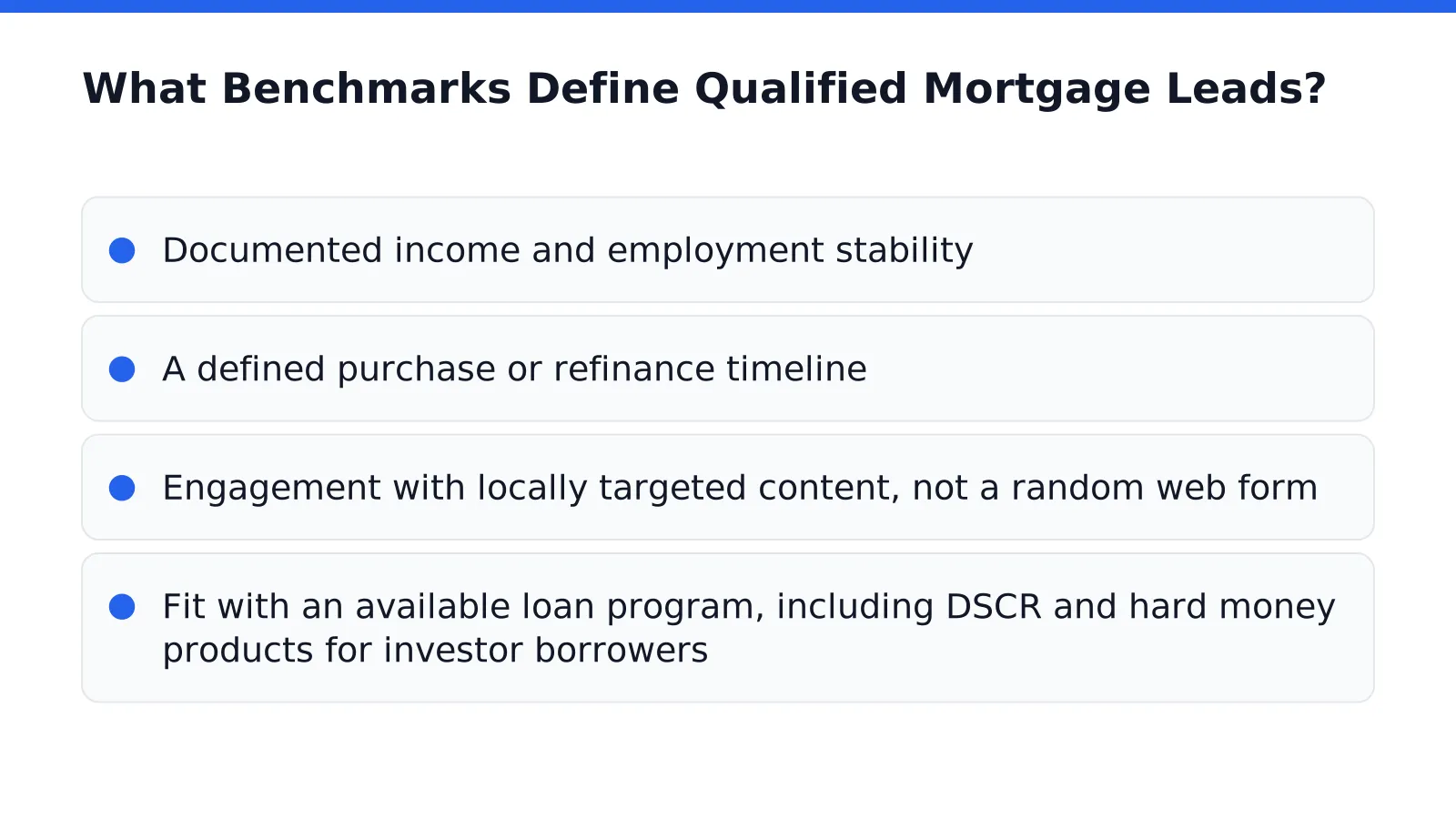
Branch managers tracking lead generation benchmarks should weigh more than volume. The following factors separate a qualified lead from a cold contact:
- Documented income and employment stability
- A defined purchase or refinance timeline
- Engagement with locally targeted content, not a random web form
- Fit with an available loan program, including DSCR and hard money products for investor borrowers
That last point matters for branches serving a mixed client base. A benchmark built only around traditional W-2 buyers misses seasoned investors who qualify through specialized financing instead.
What role does technology play in qualifying leads?
Technology-backed processing sets a service benchmark borrowers now expect as standard, not a bonus. A system that delivers quick pre-approval. Full visibility into loan status, from application through closing, keeps qualified leads engaged rather than shopping elsewhere. Munshi Capital Inc. builds this visibility into every file it opens.
Loan officers measuring their own pipeline should ask one question: does the current process confirm readiness fast enough to beat a borrower’s shrinking attention span? If the answer is no, the benchmark needs resetting before conversion rates improve.

How Can You Raise Mortgage Form Conversion?
Friction kills mortgage form conversion. Applicants abandon forms the moment confusion or hesitation sets in, so every field, question, and transition must earn its place. A straightforward application, underwriting, and closing process, free of hidden surprises, keeps borrowers moving instead of backing out midway.
Clarity does the heavy lifting here. Guiding applicants from the first click to closing day with speed. Plain language, rather than dense jargon, prevents the drop-off that stalls so many funnels. Loan officers who strip confusing terminology from their forms see fewer stalled sessions and more completed submissions.
What makes a mortgage application form convert better?
Speed and security matter most. A quick, secure application that asks borrowers to share their goals and select a loan program alongside a specialist shortens the time it takes to submit, which directly reduces abandonment. Borrowers who can state their purpose upfront, whether buying a first home or financing an investment property, move through underwriting with fewer stalls.
Trust also plays a measurable role in completion rates. Honest, transparent communication at every step gives applicants confidence to finish every field rather than quit partway through.
Loan officers chasing stronger lead generation benchmarks should audit their forms against these principles:
- Remove unnecessary fields that add friction without adding value.
- Replace industry jargon with plain-language prompts.
- Let borrowers specify loan goals early, before dense underwriting questions appear.
- Pair every form with a visible, responsive specialist contact point.
Does a fast process really change conversion rates?
Yes. A rushed, confusing process breeds doubt, and doubt drives exits. Pairing speed with clarity, not speed alone, keeps borrowers confident enough to complete the entire application rather than closing the browser tab. For brokers building a sustainable mortgage lead gen strategy, prospects who want a fast path to an offer can request a direct cash offer. Those still weighing options can request your property assessment before committing further.
How Do You Keep Lead Generation Compliant?
Compliance starts with documented consent. Effective mortgage-lead-gen-106 programs collect verifiable consumer permission before any outreach begins, pairing that consent with sourcing records that hold up under scrutiny. Loan officers who skip this step expose themselves. Their branches to real regulatory exposure under the Telephone Consumer Protection Act (TCPA).
Documentation matters more than intent. A lead purchased without a clear consent trail carries risk regardless of how the outreach is worded. Branch managers reviewing vendor relationships should ask a direct question: can this source produce a timestamped consent record on demand? If not, the lead is a liability, not an asset.
What Makes a Mortgage Lead Source Compliant?
A compliant source maintains verifiable records showing when and how a consumer agreed to be contacted. Outreach practices built on top of that consent must stay consistent with what the consumer actually agreed to receive. Lenders who track these details reduce exposure before a single call gets dialed.
Munshi Capital Inc. operates from this same foundation. Trust forms the base of every borrower relationship, and transparent, borrower-first guidance shapes each stage of the loan journey. Clarity and honesty drive the approach, positioning the firm as a dependable partner rather than a transactional lender.
For teams building out lead-generation-benchmarks-106 tracking, compliance metrics belong alongside conversion data:
- Consent documentation rate per lead source
- Time between consent capture and first contact
- Vendor audit frequency
Reliable compliance practices protect the pipeline and the borrower relationship alike.
FAQ
Why do nurtured leads convert better than purchased lists?
Nurtured leads build trust over time, while purchased lists leave brokers renting a pipeline they never own. Munshi Capital Inc. pairs transparent follow-up with FHA, VA, USDA, and bank statement programs to keep prospects engaged.
What stages should a mortgage funnel include?
A high-converting funnel includes awareness content, simple intake forms, prompt personalized follow-up, and transparent status updates through underwriting and closing. Each stage reduces drop-off and keeps borrowers engaged.
How does personalized guidance improve conversion outcomes?
Personalized guidance keeps borrowers confident and engaged through longer underwriting timelines by focusing on individual goals rather than generic products. Munshi Capital Inc. combines this approach with modern technology and loan specialist support for fewer stalled applications.
Conclusion
In closing, effective mortgage lead generation and conversion optimization demand a commitment to transparency, personalized service, and streamlined processes that prioritize borrower understanding. By combining data-driven targeting strategies with genuine expertise. Clear communication, lenders establish the trust necessary to guide diverse borrowers, from first-time homebuyers to seasoned investors, toward confident financing decisions. The most successful approach integrates modern technology with dedicated specialist guidance, ensuring every prospect receives dependable support aligned with their unique financial objectives throughout the entire lending journey.
Leave a Reply