
Effective mortgage calculator use requires accurate inputs: home price, down payment percentage, credit score range, zip code, and loan term. Going below a 20% down payment typically adds PMI to monthly costs. Munshi Capital Inc. notes calculators offer estimates only; a licensed loan specialist confirms actual financing terms and approval eligibility before closing.
Key Takeaways
- Enter accurate home price, down payment, credit score range, and zip code for reliable estimates.
- Select your loan term and interest rate, use national average or input your own figure.
- Monthly payment updates automatically as you adjust inputs, showing real-time calculation changes.
- Calculator results provide estimates only; they don’t indicate approval or guarantee financing eligibility.
Why Do Mortgage Calculator Estimates Fall Short?
Standard online tools generate only a ballpark monthly payment, not a full accounting of homeownership costs. A mortgage calculator guide published by Fannie Mae notes that calculator results in no way indicate loan approval or actual financing terms. Borrowers who treat the output as final often miss costs that surface only after closing.
Property taxes, homeowners insurance, HOA dues, and private mortgage insurance rarely appear in a default calculation. Without manual adjustments to these line items, buyers face a gap between the estimate and the real bill each month. That gap can strain a household budget that was built around an incomplete number.
Why do calculator estimates miss total loan costs?
Most tools focus narrowly on principal and interest, leaving out the long-term cost of borrowing. An amortization guide fills this gap by showing how much of each payment goes toward interest versus principal over the life of the loan. Reviewing the full schedule reveals the true total cost of financing, not just the monthly figure.
Can a calculator replace professional loan guidance?
No. A calculator estimates numbers; it cannot evaluate credit profile, income documentation, or program eligibility. Munshi Capital Inc. guides borrowers through a straightforward application, underwriting, and closing process with no hidden surprises, replacing guesswork with personalized direction. That guidance, rooted in clarity and honesty, turns a rough estimate into a dependable financing plan.
Homeowners weighing a sale instead of a refinance can skip the estimating entirely. Request a direct cash offer for a clear, document-backed number. Those still deciding which path fits their situation can request your property assessment to compare options before committing to a loan structure.
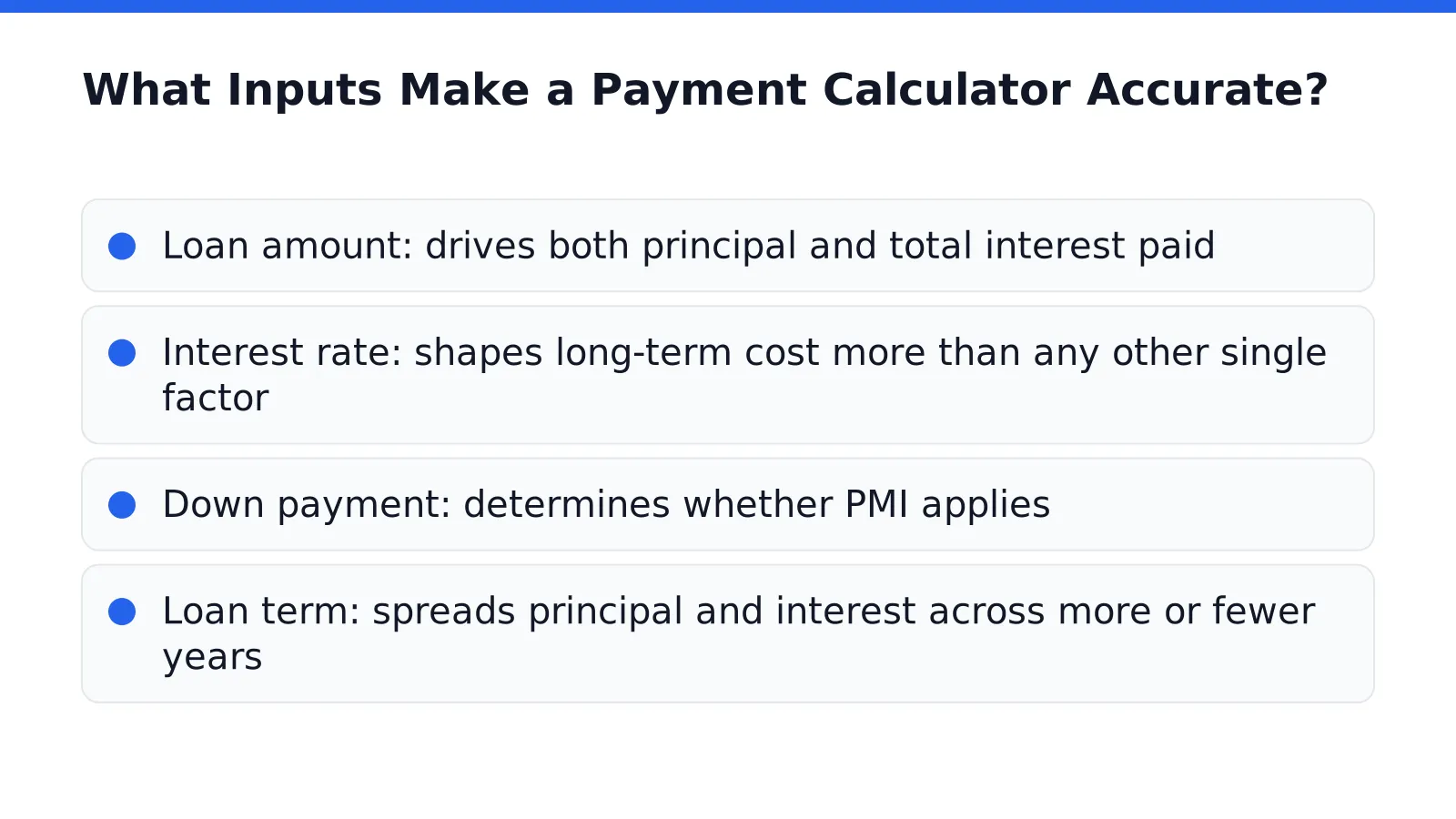
What Inputs Make a Payment Calculator Accurate?
Accuracy depends on five core inputs: loan amount, interest rate, loan term, down payment, and insurance costs. Missing any single figure skews the final estimate and sets up a false sense of affordability. A trustworthy payment calculator treats these inputs as interconnected, not isolated boxes to fill.
Principal sits at the foundation of every calculation. Principal represents the amount borrowed from a lender to purchase a home, measured before any interest gets added. Every other figure in a mortgage calculation builds on top of this base number, so an inaccurate principal throws off the entire estimate.
Down payment size changes the math in ways many homebuyers overlook.
Does a Smaller Down Payment Raise the Monthly Cost?
Yes. Putting down less than 20 percent typically adds private mortgage insurance to the monthly payment shown on a calculator. This insurance protects the lender, not the borrower, yet it still raises the total due each month. Factoring in PMI early prevents an unpleasant surprise once closing documents arrive.
Borrowers get the clearest results when they treat a calculator as a starting framework rather than a fixed quote. Loan programs vary by borrower profile. Financing is structured around each applicant’s financial picture rather than a single generic estimate. A first-time buyer, a seasoned investor, and a homeowner refinancing an existing loan will each see different numbers depending on credit profile, loan structure, and program type.
For a complete picture, consider how these inputs interact:
- Loan amount: drives both principal and total interest paid
- Interest rate: shapes long-term cost more than any other single factor
- Down payment: determines whether PMI applies
- Loan term: spreads principal and interest across more or fewer years
Treating a calculator result as a flexible estimate, not a guarantee, keeps expectations grounded throughout the homebuying process.
How Does Amortization Shape Your Total Cost?
Amortization determines how much a borrower pays in total interest versus principal across the life of a loan. Two variables drive this outcome: the interest rate and the loan term. Together, these figures separate a manageable mortgage from one that quietly drains a household budget over decades.
The interest rate entered into any payment calculator directly determines the long-term cost of the loan over its full term. Interest represents the price of borrowing money from a lender. That price moves with market-based rates rather than staying fixed across all borrowers. A half-point difference in rate, compounded over 15 or 30 years, reshapes total repayment by a significant margin.
Does Loan Term Length Matter for Amortization?
Yes. Standard mortgage lengths of 15 or 30 years set the repayment timeline and shift how interest accumulates. A shorter term concentrates payments into fewer years but lowers total interest paid. A longer term spreads cost out, easing monthly cash flow while raising the lifetime interest bill.
Running these numbers through an amortization guide before signing prevents budget surprises later. Munshi Capital Inc. supports that process with quick pre-approvals and full visibility into loan status. Borrowers can track amortization progress from application through closing. That transparency, built on clarity and honest communication, makes Munshi Capital Inc. a reliable partner for the full term of the loan, not just the closing table.
Which Loan Programs Does Munshi Capital Offer?
Munshi Capital provides a full suite of residential. Commercial loan programs built for borrowers at every stage, from first-time buyers to seasoned investors. FHA, VA, USDA, and bank statement loans each solve a distinct financing gap that a generic payment calculator cannot capture on its own.
Standard home-purchase programs fit different financial pictures:
- FHA loans: lower down payment thresholds for first-time or credit-building buyers
- VA loans: financing designed for eligible veterans and service members
- USDA loans: options for buyers in eligible rural and suburban areas
- Bank statement loans: income verification built for self-employed borrowers whose tax returns don’t reflect true cash flow
What Loan Program Fits First-Time Homebuyers?
First-time buyers typically start with FHA or VA programs, since both reduce upfront cash requirements. A mortgage calculator guide gives a rough monthly payment, but program eligibility and rate structure determine the real number.
How Do Investor Loan Programs Differ From Standard Mortgages?
Real estate investors rarely qualify through conventional income documentation alone. Munshi Capital’s DSCR (debt-service coverage ratio) loans. Hard money loans evaluate rental income or asset value instead of a personal pay stub. These products exist precisely because standard calculator assumptions, built around salaried W-2 income, misrepresent what an investment property can actually support.
Transparency governs every program on this list. Munshi Capital’s mission keeps underwriting criteria, rate structure, and closing timelines clear from application through funding, with no hidden conditions introduced late in the process.
Technology speeds up pre-approval, but loan specialists do the refining work. Where a basic amortization guide shows only principal. Interest declining over time, a specialist recalculates the figure against the chosen program’s actual terms, taxes. Insurance, so the estimate matches the loan being underwritten rather than a generic default.
How Do You Get Personalized Mortgage Guidance Now?
Personalized mortgage guidance starts with a direct conversation, not another spreadsheet. A mortgage calculator guide or amortization guide builds useful context. Neither replaces a lender who reviews a borrower’s full financial picture. Numbers on a screen cannot account for credit nuances, local market conditions, or loan program eligibility.
Munshi Capital Inc. builds mortgage financing around each borrower. Guidance extends through every loan program, residential or commercial, with clear answers instead of vague disclaimers. First-time buyers get the same direct attention as seasoned investors managing multiple properties. That consistency, paired with a broad range of loan products, is why borrowers nationwide treat Munshi Capital as a trusted resource rather than a one-time transaction.
Why doesn’t a calculator result count as loan approval?
A payment calculator estimates monthly costs using the inputs entered, nothing more. It cannot verify income, assess credit history, or confirm underwriting conditions. Results provide a planning tool only; they never indicate approval or financing of a mortgage loan. Borrowers who need an accurate answer should contact a mortgage lender directly to understand personalized financing options.
What should homeowners do after running the numbers?
Treat calculator output as a starting point, not a final figure. Refinancing homeowners and investors alike benefit from pairing online estimates with lender review before making decisions.
Two paths move things forward from there:
- Request a direct cash offer for property-related transactions requiring speed and certainty.
- Request your property assessment to get a clearer, personalized financial picture before committing to a loan program.
FAQ
What inputs do mortgage calculators need for reliable estimates?
Accurate results require home price, down payment percentage, credit score range, zip code, and loan term. Omitting any of these core inputs skews the estimate and creates a false sense of affordability.
Why do mortgage calculator results fall short of actual costs?
Standard calculators generate only a ballpark monthly payment, often leaving out property taxes, homeowners insurance, HOA dues, and PMI. These missing line items create a gap between the estimate and the real monthly bill after closing.
Can a mortgage calculator replace professional loan guidance?
No, a calculator only estimates numbers and cannot evaluate credit profile, income documentation, or program eligibility. Munshi Capital Inc. guides borrowers through application, underwriting, and closing with personalized direction rooted in clarity and honesty.
Conclusion
In closing, effective mortgage calculator usage establishes the foundation for informed financial decision-making throughout your lending journey. By systematically evaluating multiple scenarios and understanding the variables that influence your monthly obligations, you position yourself to engage with lenders from a position of clarity and confidence. This disciplined approach to pre-qualification analysis aligns with the transparent, borrower-first principles that guide responsible mortgage financing, ensuring your path to homeownership or investment success remains grounded in realistic expectations and verifiable data.
Leave a Reply